
What Turnitin Similarity Score Is Allowed for Indian Theses (2026)
UGC rules allow up to 10% similarity in your main chapters, 0% in the abstract and exclude bibliographies. Here is what each Turnitin colour zone actually means for your degree.
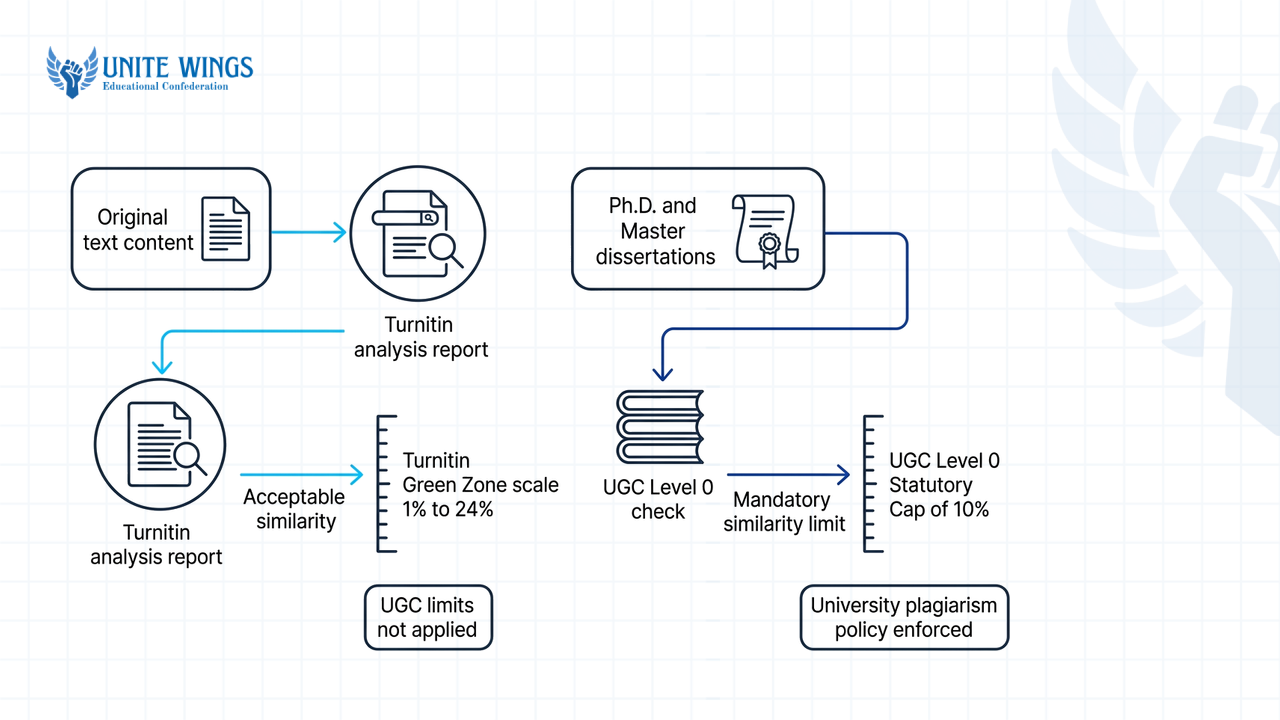
For a Master's dissertation or PhD thesis in India, a good Turnitin similarity score is 10% or below, which falls under the UGC's Level 0 zero-penalty slab, according to Jirmi. Under some institutional guidelines in India, departments may permit a similarity score of up to 15% or 20% within Turnitin's green zone, provided core sections like your abstract, results, and conclusions remain completely original. Turnitin's raw score includes your bibliography by default, so your initial report's percentage often drops significantly the moment your university librarian turns on the reference exclusion filter.
In short
- The 10% UGC cap: The UGC (Promotion of Academic Integrity and Prevention of Plagiarism in Higher Educational Institutions) Regulations set Level 0 (up to 10% similarity) as the safe limit with zero penalty for Master's and PhD theses.
- Zero-tolerance sections: Under UGC rules, your abstract, hypothesis, observations, results, conclusions, and recommendations must have 0% similarity, even if your overall thesis is under 10%.
- The reference list trap: Unfiltered bibliographies add 15% to 20% to your raw score; ask your library cell whether their official check toggles the "Exclude Bibliography" setting before you rewrite anything.
- Draft check rule: Never upload a pre-check draft to a random online seller or a standard college portal unless the repository setting is switched to "Do not store submitted papers," or your final upload will show 100% self-plagiarism.
What are the 5 Turnitin similarity colour codes and what do they mean?
Turnitin's Feedback Studio assigns one of five colour codes to your submission based on the total percentage of text matching its database: Blue (0%), Green (1%–24%), Yellow (25%–49%), Orange (50%–74%), and Red (75%–100%), as documented by EssaysUniverse and Purply. These colours measure raw text overlap against Turnitin's index of 1.9 billion student papers and 47,000+ journals, not academic misconduct.
What most students get wrong is assuming a Green badge guarantees university clearance. In Indian universities, Turnitin's built-in 24% Green ceiling collides with the UGC's 10% statutory cap. A thesis with 18% similarity displays a comforting Green bar on your screen, yet fails the PhD pre-submission check at the university library because it crosses the 10% UGC Level 0 boundary.
| Turnitin Colour | Similarity Range | What Turnitin's Software Signals | How Indian University Placement & Thesis Cells Treat It |
|---|---|---|---|
| Blue | 0% | No matching text found in the database. | Suspicious or Safe: Accepted, though experienced guides verify you did not use hidden character tricks or image-based PDFs to bypass scanning. |
| Green | 1% to 24% | Low similarity band in standard institutional views. | Split Zone: 1%–10% passes UGC Level 0 for all degrees. 11%–24% is often cleared for BTech/MBA projects, but fails UGC Level 0 for MTech, MPhil, and PhD theses. |
| Yellow | 25% to 49% | Medium similarity requiring instructor inspection. | UGC Level 1 Trigger: Rejected at library check. You get up to 6 months to rewrite and resubmit your thesis script. |
| Orange | 50% to 74% | High similarity with substantial text overlap. | UGC Level 2 / 3 Trigger: At 41%–60%, you face a 1-year debarment from submitting. Above 60%, your degree registration faces permanent cancellation. |
| Red | 75% to 100% | Very high matching across most of the document. | UGC Level 3 / Self-Plagiarism: Either copied wholesale or your previous draft was accidentally saved to the Turnitin repository during a trial run. |
Inside the enhanced report, Purply notes that Turnitin also groups overlaps into "Match Groups" and "Sources" using distinct visual cues to separate properly quoted and cited lines from uncited blocks. When your guide opens your file on Moodle, Canvas, or a standalone ShodhShuddhi portal, they will evaluate reports source-by-source using the match overview. While matches scattered across standard terminology are often cleared, a single dominant source matching your text may be flagged for manual investigation.
What is the maximum Turnitin percentage allowed by UGC in India?
Under the UGC (Promotion of Academic Integrity and Prevention of Plagiarism in Higher Educational Institutions) Regulations, 2018, the maximum allowed similarity without penalty is 10% (Level 0) for Master's dissertations and PhD theses, according to ResearchGuru and ResearchExperts. Scores above 10% trigger graded penalties ranging from a mandatory rewrite within six months to permanent cancellation of your registration.
If you are researching what is a good turnitin similarity score for thesis in india, you must look at two rules inside the UGC policy that most blog posts leave out. First, the 10% cap applies to non-core chapters like your introduction and literature review after statutory exclusions are removed. Second, DoMyWork and ResearchExperts confirm that the UGC enforces a strict zero-tolerance rule (0% similarity) on core work: your abstract, summary, hypothesis, observations, results, conclusions, and recommendations must be 100% original.
| UGC Plagiarism Tier | Similarity Score Slab | Corresponding Turnitin Colour | Official UGC Penalty for Students | What Happens at Your University |
|---|---|---|---|---|
| Level 0 | Up to 10% | Blue (0%) or lower Green (1%–10%) | No penalty (Minor similarities). | Library issues the anti-plagiarism clearance certificate; you proceed to viva or final binding. |
| Level 1 | Above 10% to 40% | Upper Green (11%–24%) to Yellow (25%–40%) | Revised script required within a maximum of 6 months. | Thesis rejected at pre-submission. Missing the 6-month revision window forces a complete withdrawal and restart. |
| Level 2 | Above 40% to 60% | Upper Yellow (41%–49%) to lower Orange (50%–60%) | Debarred for 1 year from submitting a revised script. | You lose an academic year and face a DAIP hearing. |
| Level 3 | Above 60% | Upper Orange (61%–74%) to Red (75%–100%) | Registration cancelled permanently for that programme. | Expulsion from the degree program following an Institutional Academic Integrity Panel (IAIP) verdict. |
Individual Indian universities enforce their own ordinances on top of the UGC baseline. According to a policy analysis by DoMyWork, institutions like IIT Kanpur and the University of Hyderabad enforce a strict tolerance limit of 10% or less for theses and research manuscripts. State technical universities and central universities (and central or state universities) publish their own circular updates through their research cells or central libraries, and many switched between Turnitin and DrillBit-Extreme under the national ShodhShuddhi initiative. Because a university syndicate can change whether the 10% cap includes or excludes self-published papers from one semester to the next, check the latest circular on your university's Controller of Examinations or Central Library webpage before binding your hard copy.
When a dispute happens over a high similarity score, you do not fail automatically. Your case is referred to the Departmental Academic Integrity Panel (DAIP), and if escalated, the Institutional Academic Integrity Panel (IAIP), where you can defend your overlap reports before any penalties are executed.
Does Turnitin count references and bibliography in the similarity score?
Yes, Turnitin counts references, bibliographies, and direct quotations in its raw similarity score by default unless the instructor or librarian turns on specific exclusion filters, as confirmed by IJCRT and Turnitin0. According to ResearchExperts, a properly cited thesis can gain 15% to 20% similarity strictly from its reference list when bibliography exclusions are turned off.
Why does a standard APA or IEEE reference list spike your score so badly? Every paper you cite has already been cited in thousands of previous papers stored inside Turnitin's 1.9-billion-paper index. If your reference list is unchecked, exact paper titles and journal names in your bibliography will match word-for-word against the database.
Here is how to make sure Turnitin's automated filter actually recognizes and drops your bibliography when your library runs the scan:
- Use a standard, standalone section heading: Place your citations under an exact heading on a new page:
References,Bibliography, orWorks Cited. Do not use creative headings likeSources I Consulted for Chapter 4orLiterature List, because Turnitin's parser looks for standard keyword triggers to stop counting. - Do not place appendices after the references: Once Turnitin detects the word
References, its exclusion algorithm attempts to ignore text until the end of the document. If you put 15 pages of survey tables or code appendices after your bibliography, either the filter will break and count your references, or your library will refuse to turn the filter on. Put appendices before theReferencesheading. - Ask your library if you should strip the bibliography from the test PDF: Some Indian university libraries ban staff from toggling the "Exclude Bibliography" checkbox inside the software, requiring strict unedited raw reports. Check your university's submission checklist: typically, you must submit a single searchable PDF containing the abstract and all chapters, accompanied by a signed affidavit of originality and your supervisor's certificate.
- Format direct quotes with actual quotation marks or indentation: ResearchProspect points out that Turnitin's "Exclude Quoted Material" filter only recognises text wrapped in standard double quotes (`
If your literature review is still triggering high matches because you copy-pasted sentences while taking notes, the Research with AI: Perplexity and NotebookLM shows you how to synthesise 30+ PDFs in your own phrasing while keeping every inline citation accurate.
Can you fail a college project with a 15% Turnitin score?
No, a 15% score cannot automatically fail you because Turnitin has no internal pass-or-fail threshold, and ProofreaderPro alongside PlagiarismCheck confirm that 15% is generally accepted as low similarity for standard undergraduate and college research projects. However, whether 15% passes in India depends on your degree level and where that 15% is located inside your file.
Use this three-part decision rule to evaluate a 15% report:
- If you are submitting a BTech final-year project, BBA/MBA capstone, or semester seminar paper: A 15% score sits comfortably inside Turnitin's Green band (1%–24%) and clears the standard 15%–20% departmental cutoff used by most engineering and management colleges.
- If you are submitting a Master's thesis (MTech, MSc, MA) or PhD thesis under strict UGC 2018 rules: A 15% score after exclusions puts you in UGC Level 1 (11%–40%), which means the library will reject the soft copy and ask you to drop it to 10% or below before issuing your certificate.
- If that 15% comes from a single source or sits in your Conclusion: Even if your college allows 20% overall, a 15% match concentrated in two copied pages of your Results or Abstract violates the UGC zero-tolerance rule on core sections and will get flagged by your internal examiner.
There is a second metric on your 2026 report that catches students off guard: Turnitin's AI writing indicator. As Turnitin0 highlights, the AI writing detection percentage is completely independent of the similarity score. You can score 4% on Turnitin similarity (Green) and 65% on the AI writing report because you asked a chatbot to rewrite your introduction. Many Indian universities and UGC-CARE journals now reject manuscripts with high AI scores even when the similarity percentage is below 10%.
Why is my Turnitin score 20% even when I wrote everything myself?
A 20% similarity score on a 100% self-written thesis usually comes from four non-plagiarism sources: an unexcluded reference list, standard methodology phrasing, mandatory institutional templates, or your own previously stored draft, according to CustomUniversityPapers and TurnitinPlagiarismCheck. With over 1.9 billion student papers and trillion-scale phrase fingerprints in Turnitin's database (ResearchExperts), five-to-eight-word technical strings will highlight even if you never opened the matched source.
Before you panic and start using sketchy "synonym spinner" websites—which ruin your technical grammar and trigger AI/manipulation flags—diagnose which of these five traps caused your 20% score:
- You or a vendor ran a "pre-check" with repository storage turned ON: This is the most destructive mistake Indian students make. You pay ₹300 at a cybercafe outside campus or on a Telegram channel to check your draft before submitting to your HOD. The vendor runs your file through a compromised foreign student account configured to "Standard Paper Repository." Your thesis is now saved inside Turnitin's global database. Three days later, when your university library scans your official PDF, Turnitin matches your thesis against the vendor's upload and returns 98%–100% Red similarity. It also violates safe handling of your unpublished intellectual property under India's Digital Personal Data Protection (DPDP) Act 2023 when third-party pre-check services store or process your draft manuscript. Only test drafts when the instructor setting is explicitly set to "Do not store the submitted papers."
- Your own published IEEE or Scopus paper is in the database: If you have already published papers based on your research prior to submitting your thesis, When you paste that published paper into Chapter 4 of your thesis, Turnitin matches your thesis against your own published work. Fix: Submit reprints of your published papers alongside your thesis to the library cell so they can legally exclude self-citations, or verify whether your university ordinance requires you to paraphrase your own published paper.
- College cover pages, bonafide certificates, and declaration templates: Shared institutional templates can easily trigger similarity matches against previous student cohorts. Fix: Strip the cover page, declaration, certificate, and table of contents from the PDF you send for the similarity scan, following standard Indian university library guidelines.
- Standard experimental procedures and mathematical definitions: If you write "The samples were annealed at 500°C for 2 hours in a muffle furnace and cooled to room temperature" or "Cronbach's alpha was calculated using SPSS version 26 to test internal consistency," hundreds of researchers have written that exact sentence. Fix: Turn on the "Exclude small matches" filter (which filters out very short matching phrases) or restructure the sentence around your specific table data: "Using a muffle furnace (2 hours at 500°C, followed by ambient cooling), we prepared Sample Set B (Table 3.1)."
- Real-time database inflation between two checks: ResearchExperts notes that identical files checked two weeks apart can increase by 1% to 3% simply because Turnitin indexes thousands of new journals and theses every day. Always keep a 2%–3% buffer below your university's cutoff (aim for 7%–8% if the cap is 10%).
How to lower your Turnitin score below 10% before final submission
To bring a 15%–25% similarity score down to the UGC Level 0 limit (under 10%) without losing technical accuracy, stop editing single words and instead restructure the high-density match blocks listed in your Match Overview panel. Follow these five steps in order:
- Clean the PDF structure before touching a single sentence: Prepare a copy of your document draft. Delete the title page, supervisor certificate, declaration, acknowledgements, list of figures/tables, and the bibliography (if your library permits excluding references via document preparation). Export this clean version as a searchable PDF—never a scanned image PDF, which libraries reject immediately.
- Audit your zero-tolerance sections first: Open your previous similarity report and check the Abstract, Results, and Conclusion chapters. Even a 2% match here breaks UGC core-work rules. Rewrite any highlighted line in these three sections from scratch by closing the source paper and explaining your numeric finding directly (for example, replace generic literature callbacks with your exact metric: "Our CNN model reduced false positives by 14.2% on the chest X-ray test split compared to the ResNet-50 baseline in Table 4.2").
- Attack the Top 5 sources in the Match Overview panel: Do not waste two nights fixing 0.5% matches at the bottom of the report. Click the red number icon on the right sidebar of Turnitin Feedback Studio to open the Match Overview. If Source #1 accounts for 4% of your thesis, click it to jump to every paragraph matching that single paper. Convert passive literature summaries into comparative synthesis: instead of writing three separate paragraphs summarising Paper A, Paper B, and Paper C (which mimics their abstracts), write one paragraph comparing how all three handled the same variable—or put their parameters into a comparison table.
- Replace block quotes with data-driven citations: In engineering, science, and management theses, direct quotes are rarely necessary outside legal definitions or interview transcripts. If you quoted a 40-word definition from a textbook, rewrite the mechanism in the context of your project variables and keep the inline citation at the end of the sentence.
- Prepare your official submission folder: Once your official university scan clears the 10% threshold (on Turnitin or ShodhShuddhi's DrillBit-Extreme), collect the four mandatory items required by Indian university research cells: the soft copy of the thesis on a digital medium or portal, the software-generated anti-plagiarism report showing the final percentage, your signed Student Affidavit of Originality, and the Plagiarism Verification Certificate signed by your research supervisor.
Your action plan for this week
- Today: Download your university's latest plagiarism circular from the Central Library or university research portal to confirm whether your exact cutoff is 10% or 15%, and whether references and self-published papers are excluded via software filters or stripped from the PDF.
- Next steps: Strip your cover certificates, declarations, and appendices from a test copy of your manuscript, and audit your Abstract, Results, and Conclusion chapters to ensure they contain zero copied phrases.
- Before your final library upload: Open your Match Overview panel, rewrite any paragraph where more than two consecutive lines are highlighted from a single external source, and get your supervisor to sign the originality certificate alongside the official report.
Write your literature review and thesis faster without similarity flags
In the Research with AI: Perplexity and NotebookLM masterclass, you will set up a two-tool workflow that pulls verified academic sources, cross-checks your uploaded PDFs, and helps you draft properly cited literature reviews in your own words—so you walk away with a clean research pipeline that stays safely below the 10% UGC cap.
Frequently asked questions
What is the maximum acceptable Turnitin similarity percentage for a PhD thesis in India?
Under the UGC Regulations 2018, the maximum acceptable similarity score for an Indian PhD thesis or Master's dissertation is 10% (Level 0), which carries zero penalty. Individual institutes like IIT Kanpur and the University of Hyderabad also strictly enforce this 10% cap, while requiring 0% similarity in core chapters like your abstract, results, and conclusion.
Does the UGC allow up to 10% or 15% similarity for doctorates?
The UGC allows up to 10% similarity for doctorates under Level 0. A score between 11% and 40% falls into UGC Level 1, which is not permitted for final clearance and requires you to revise and resubmit your thesis script within a maximum period of six months.
How do I exclude references and bibliography from my Turnitin score?
Only an instructor or university librarian can toggle the "Exclude Bibliography" and "Exclude Quotes" checkboxes inside Turnitin's filter settings. On your end, place your citations at the very end of the file under a standard heading (References or Bibliography) with no appendices after it so the software's parser detects the section automatically.
Does Turnitin count direct quotes and self-citations as plagiarism?
Turnitin counts both direct quotes and your own previously published papers in its raw similarity percentage unless exclusion filters are applied. Wrap direct quotes in standard double quotation marks so the quote filter recognises them, and declare your own published conference or journal papers to your university library so they can apply institutional self-citation exemptions.
What are the UGC 2018 penalties if my thesis crosses 40% similarity?
If your thesis similarity is above 40% and up to 60% (Level 2), you are debarred from submitting a revised script for one full year. If your similarity exceeds 60% (Level 3), your registration for that degree programme is permanently cancelled following a review by the Institutional Academic Integrity Panel (IAIP).
Is Turnitin's AI score included in the 10% similarity percentage?
No, Turnitin's AI writing detection percentage is completely separate from the text-matching similarity score. A thesis can have 5% text similarity and still show a 70% AI writing score on the instructor's dashboard, which many Indian universities now penalise independently during pre-submission checks.
Newsletter
Stay updated with our latest news and insights.