
How to Reduce Turnitin Similarity Under 10% Without Paraphrasers
A step-by-step fix for a high similarity report: how to exclude bibliography matches, synthesis-rewrite lit reviews and clear repetitive methodology blocks in an hour.
To get your Turnitin similarity score under 10% before a midnight deadline without triggering the AI detector, stop replacing individual words and start merging consecutive single-source summaries into multi-source synthesis paragraphs. Under the UGC Anti-Plagiarism Regulations 2018, Indian universities treat up to 10% similarity as Level 0 with zero penalty, whereas 10% to 40% falls into Level 1 and forces you to submit a revised thesis script within six months. You can drop a 32% draft to 7% in one evening by fixing your bibliography heading so the auto-filter catches it, repairing broken quotation marks, and applying the read-close-write method to your longest highlighted literature review blocks.
In short
- Target the 10% UGC cap: Premier institutes like IIT Kanpur and the University of Hyderabad enforce a strict 10% ceiling; attack your top 3 longest colour-coded matches first rather than hunting down 1% fragments.
- Never use QuillBot or spinners: Turnitin's December 2023 and August 2025 updates detect AI paraphrasers and humanizers, flagging them under a unified blue highlight as of August 2026.
- Use the read-close-write method: Read the flagged paragraph, minimize your PDF, and rewrite the core idea from memory by combining 2 to 3 authors who share a finding into a single sentence.
- Fix formatting traps: Change creative reference headings to "References" so Turnitin's automatic filter drops them, and convert 40-word APA block quotes into shorter inline quotes with standard double quotation marks (
""). - Verify repository settings before re-uploading: If your faculty portal saves drafts to the standard student repository, a second upload will trigger a 100% self-match that only your instructor can delete.
Why does Turnitin highlight common phrases and standard methodology terms?
Turnitin flags common phrases and standard methodology terms because its engine checks for consecutive matching word strings across 45 billion web pages, 1.9 billion student papers, and 130 million academic publications, rather than judging whether an idea is stolen. According to AI Plag Guides, the software chops your document into strings and flags any consecutive sequence of 8 or more words that matches its database. If you write "Data was collected using a five-point Likert scale questionnaire distributed to 200 engineering undergraduates," at least a thousand previous BTech and MBA dissertations in the global repository contain that exact string.
Understanding how to reduce Turnitin similarity score quickly starts with knowing what to ignore on your PDF report. Under the UGC 2018 guidelines, the similarity check excludes all generic terms, laws, standard symbols, and standard equations. Do not try to invent synonyms for technical terms like "Convolutional Neural Network," "Scanning Electron Microscopy," or "ordinary least squares regression." Changing "mean squared error" to "average squared mistake" to beat the algorithm will get your report rejected by your internal project viva panel for technical inaccuracy.
| UGC Similarity Tier | Similarity Percentage | Penalty for Indian University Dissertations and Theses |
|---|---|---|
| Level 0 | Up to 10% | Minor similarities; zero penalty. |
| Level 1 | 10% to 40% | Student must submit a revised script within a maximum of 6 months. |
| Level 2 | 40% to 60% | Student is debarred from submitting a revised script for 1 year. |
| Level 3 | Above 60% | Immediate cancellation of the student's program registration. |
While Reading University's standard academic guidelines colour-code scores between 1% and 24% as green (low concern), Indian engineering and postgraduate departments rarely accept a 22% green score. As documented by ResearchExperts, institutes like IIT Kanpur and the University of Hyderabad enforce the 10% Level 0 ceiling strictly, while select departments at state and private universities allow up to 15%. Leave your standard methodology nouns alone and recover your percentage points from the literature review and introduction chapters instead.
How do I rewrite a flagged literature review paragraph so it passes?
You rewrite a flagged literature review paragraph by combining the read-close-write method with multi-source synthesis, which replaces sequential single-paper summaries with one paragraph comparing multiple authors. As noted by ThesisLikho and Anushram, literature reviews generate the highest similarity scores because students summarize papers one by one while looking at the original abstract, unintentionally copying the author's clause order and verb choices.
What most students get wrong is trying to edit a highlighted sentence while staring directly at the red text on their screen. When you edit with the source open, you keep the skeleton of the sentence—such as Author (Year) investigated X using Y and found Z—and only swap the adjectives, which Turnitin still connects across broken strings.
Follow this exact 4-step mechanical workflow to clear a heavily highlighted literature review page:
- Sort your Turnitin PDF by highest match: Look at the numerical match breakdown at the end of your report. Ignore the 1% matches at the bottom and locate the top 3 to 5 sources that account for the bulk of your red, pink, or purple highlights.
- Apply the read-close-write rule: Read a flagged 150-word paragraph in your draft to understand the technical takeaway. Minimize the PDF and your Word document, open a blank Notepad window, and type out what those papers proved as if you were explaining it to your project partner before a viva.
- Shift from chronological listing to synthesis: Instead of writing three consecutive sentences that start with an author's name, group the studies by their finding, limitation, or dataset. Put all the citations at the end of the combined thought.
- Flip the grammatical anchor: If the original sentence starts with the tool ("Using a Random Forest classifier, Sharma (2023) achieved..."), start your sentence with the data problem or the performance gap ("Class imbalance in credit card datasets limits tree-based models, even when tuned for precision (Sharma, 2023; Verma & Rao, 2024).").
Here is a real side-by-side example from a final-year BTech computer science project on crop disease detection that dropped from 32% to 7% similarity in one evening.
| Draft Stage | Text in Document (Bold indicates Turnitin string matches) | Paragraph Similarity | Why It Failed or Passed |
|---|---|---|---|
| Before (Patchwriting & Sequential Summary) | Kumar et al. (2022) proposed a deep learning model based on Convolutional Neural Networks for the automated detection of rice leaf diseases. The authors collected a dataset of 5,000 images from agricultural fields in Punjab and achieved a classification accuracy of 94.5% using the ResNet-50 architecture. Similarly, Patel and Shah (2023) implemented a transfer learning approach using VGG-16 to classify tomato leaf blight, reporting that data augmentation techniques significantly improved model generalization on unseen test data. | 32% match | Uses standard abstract boilerplate ("proposed a deep learning model based on...", "achieved a classification accuracy of..."). Summarizes one paper after another using the exact syntax of the source papers. |
| After (Read-Close-Write & Synthesis) | Pre-trained architectures like ResNet-50 and VGG-16 consistently exceed 90% accuracy on regional crop datasets, including rice in Punjab and tomato blight samples, provided the training pipeline includes image augmentation to prevent overfitting on unseen field photos (Kumar et al., 2022; Patel & Shah, 2023). | 7% match | Merges two separate summaries into one analytical point. Eliminates all 8-word narrative strings while keeping the exact technical terms (ResNet-50, VGG-16, overfitting). |
If you are organizing dozens of IEEE or Springer PDFs and struggling to spot shared patterns across them, the Research with AI: Perplexity and NotebookLM shows you how to map multiple papers by methodology and limitations before you start typing your draft.
Why does fixing Turnitin similarity with QuillBot trigger the AI detector?
Fixing Turnitin similarity with QuillBot triggers the AI detector because Turnitin's algorithm measures statistical perplexity and sentence length uniformity rather than just looking up words, and it explicitly flags automated text spinners. According to Turnitin's release notes, the company integrated dedicated AI paraphrasing detection in December 2023, added detection for AI "bypasser" and humanizer tools in August 2025, and consolidated all likely AI-generated and AI-modified content into a single unified blue highlight in August 2026.
When you paste a human-written paragraph into QuillBot or a "make this pass Turnitin" prompt, the tool swaps synonyms and reorders clauses according to predictable probability weights. As explained by Detector.io and SupWriter, this lowers your red similarity score because the exact 8-word strings are broken, but it flattens the perplexity (word choice unpredictability) and burstiness (variation in sentence length) of your prose. You trade a 28% similarity score for a 65% blue AI writing score.
Keep these operational facts in mind before running any English dissertation chapter through an automated rewriter:
- External AI checkers cannot predict your Turnitin score: A single-source analysis by Deceptioner (2026) found that while QuillBot's internal AI detector and Turnitin's detector have moderate statistical correlation across massive datasets, their scores on individual student papers diverge widely because their weighting parameters differ. Passing a free online AI checker does not mean your file will pass your university's Turnitin portal.
- The 20% threshold rule: According to a 2026 Turnitin AI Detection Limits FAQ, Turnitin maintains its false-positive rate below 1% specifically for documents that contain more than 20% likely AI writing. If you run two full chapters through a spinner to save time tonight, you cross that 20% volume threshold and trigger an official review by your department's academic integrity committee.
- Language scope: Turnitin's AI writing evaluation supports English, Spanish, and Japanese, with specific AI paraphrasing detection restricted to English texts. Since virtually all Indian engineering, science, and management theses are submitted in English, every paragraph you spin is subject to paraphrase tracking.
If you want to use an LLM during your thesis workflow without handing over your sentence structure to a spinner, use it to question your notes rather than rewrite your prose. In our Claude Masterclass, we teach students how to upload their rough research notes into Claude Projects to identify contradictions across papers, leaving the actual sentence drafting in your own natural voice.
How do I fix broken quotation marks that Turnitin counts as plagiarism?
You fix broken quotation marks by replacing single quotes or unformatted block quotes with standard straight or smart double quotation marks ("") and placing the inline citation immediately before or after the closing punctuation. As detailed by PlagiarismCheck.io and Turnitin's exclusion guide, Turnitin's "Exclude Quoted Material" filter relies entirely on machine-readable punctuation boundaries to recognize that a passage is a direct quote.
Three specific formatting errors cause Turnitin to treat properly cited quotes and reference lists as plagiarized student writing:
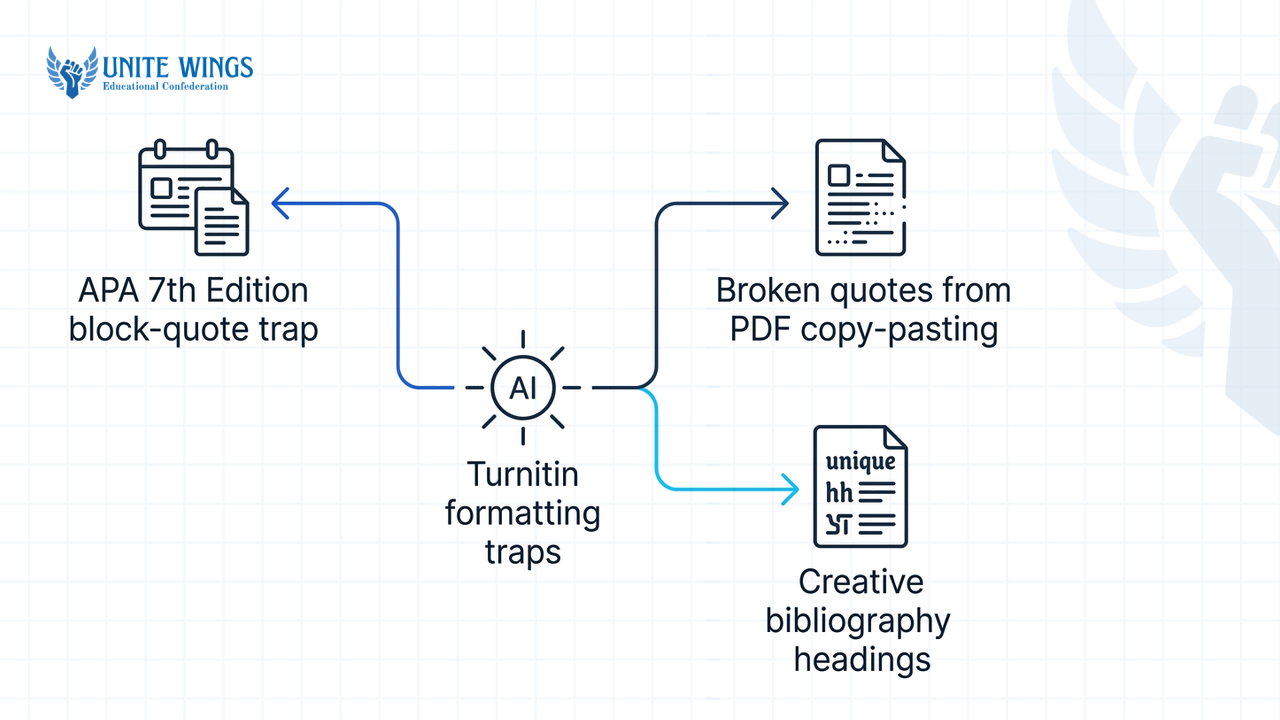
- The APA 7th Edition block-quote trap: Official APA 7th edition rules state that any direct quote of 40 words or more must be formatted as an indented block quote without quotation marks. Because there are no quotation marks, Turnitin's quote filter fails to recognize the block and highlights the entire 50-word passage in red. The fix: If your department relies on automated Turnitin score cutoffs without manual line-by-line inspection, cut the quote down to 35 words, pull it back into your main paragraph, and wrap it in standard double quotation marks (
""). - Broken quotes from PDF copy-pasting: When you copy a definition from a two-column IEEE PDF, hidden line breaks or single quotation marks (
'') often replace standard double quotes, or you accidentally close the quote after the first sentence of a two-sentence excerpt. The fix: PressCtrl + Fin Word, search for", and verify that every opening mark has a matching closing mark in the exact same paragraph. Never wrap an entire multi-paragraph section in quotation marks to game the filter; as ResearchExperts notes, evaluators check the raw text and reject papers that abuse quote tags. - Creative bibliography headings: Turnitin's automatic bibliography filter looks for standard section headers and fallback boundary phrases to stop scanning at the end of your paper. If you title your final section Sources Consulted for This Study or Literature Cited in Chapter 1 to 5, the parser keeps reading and flags every single journal title and DOI in your list, often adding 8% to 12% to your total score. The fix: Rename your heading to a single, standalone line reading References or Bibliography in standard heading text, with no colons, numbers, or extra words attached.
Should I delete small matches under 1% or ask my guide to exclude them?
You should ask your faculty guide to exclude small matches using Turnitin's 8-to-10 word filter rather than deleting or rewriting them yourself, unless your university syndicate explicitly requires an unfiltered raw score. According to Turnitin's official filter documentation, the software's default minimum threshold for a small-match exclusion filter is 8 words, and any changes you make to filters inside a student preview account are temporary and do not alter the official report seen by your instructor.
When you open the Turnitin feedback studio and click the red funnel icon (Filter and Settings) to exclude matches under 1% or under 10 words, your score on the screen might drop from 18% to 9%. The moment you close that browser tab, your score reverts to 18% on your professor's dashboard. Do not assume that toggling a switch on your end fixes your submission.
Use these decision rules to handle small matches tonight:
- If your score is 14% and made of twelve <1% matches: Do not rewrite them. Check if those highlights are institutional affiliations ("Department of Computer Science and Engineering, Anna University"), standard table headers, or funding acknowledgements. Take a screenshot of the match breakdown and email your project guide asking them to enable the "Exclude small matches by word count (8–10 words)" setting in the official assignment inbox.
- If your college examination cell mandates an unfiltered score: Some Indian state universities and NITs require the central library to sign off on the raw, unfiltered similarity percentage (or only permit bibliography exclusions) to stop students from hiding patchwriting inside 9-word chunks. If your library certificate requires a raw score under 10%, you must manually clear enough 1% matches to cross the line. Focus on the 1% matches located in your Introduction and Conclusion chapters, where you can easily combine two short sentences into one, and leave the technical methodology matches untouched.
- The 100% resubmission panic: If you fixed your draft, uploaded it a second time to your college LMS or a third-party checking portal, and suddenly got a 100% similarity score, stop editing your text. As documented by NaturalWrite (2025), this happens when the instructor leaves the assignment setting on "Standard paper repository" instead of "No repository." Your second upload just matched against the draft you uploaded three hours ago. You cannot rewrite your way out of a 100% self-match; you must contact your faculty coordinator or library administrator with the Paper ID of your first draft and ask them to request a permanent repository deletion through the institutional Turnitin admin console.
Your action plan before tonight's deadline
If your submission portal closes tonight and your report is sitting above 10%, execute these steps in exact order to get maximum percentage reduction per minute spent:
- Step 1 (Formatting sweep): Open your Word file. Change your reference list heading to the exact word
References. Search for block quotes over 40 words, trim them below 35 words, and wrap them in standard double quotation marks (""). If your library hadn't enabled the bibliography filter, this step alone can drop your score by 5% to 10%. - Step 2 (Attack the top 3 sources): Open your Turnitin PDF and scroll to the final summary page. Identify Sources #1, #2, and #3. Go to the paragraphs highlighted in those three colours, which are almost always in your Literature Review or Introduction. Read each flagged paragraph, minimize your PDF, and rewrite it from memory by synthesizing two or three cited papers into one combined comparison sentence.
- Step 3 (Clear the 1% narrative matches): Ignore all highlighted methodology nouns, equations, and college names. Find the 8-to-12 word highlights inside your general discussion paragraphs and restructure the clauses by swapping the subject and the object of the sentence.
- Step 4 (Safe verification): Before uploading your revised file to your college portal, verify with a classmate or your guide whether the portal is set to "No repository" for draft checks, so you do not trigger a 100% self-match right before the deadline.
Build a clean research and drafting workflow with Claude
If you have more papers, minor projects, or journal submissions coming up this semester, stop waiting until the night of the deadline to fix patchwritten drafts. Join the Claude Masterclass to learn how to set up Claude Projects and Artifacts that organize your literature review notes, extract methodology comparisons across PDFs, and help you structure original academic arguments from day one.
Frequently asked questions
Why is my Turnitin similarity score high even though I wrote every word myself?
Your score is high because Turnitin detects matching consecutive word strings of 8 or more words across 45 billion web pages and 1.9 billion student papers, regardless of whether you copied intentionally. Summarizing papers sequentially using standard academic phrases or leaving your bibliography under a non-standard heading will inflate your score even in 100% original work.
Does citing a source remove it from Turnitin similarity?
No, adding an in-text citation like "(Sharma, 2024)" does not stop Turnitin from highlighting the sentence if your wording stays too close to the original paper. Turnitin only ignores cited text when it is wrapped in standard double quotation marks ("") and your instructor has turned on the "Exclude Quoted Material" filter.
What is the difference between Turnitin's similarity score and its AI writing detector?
The similarity score measures exact word-string overlap against an external database of websites, journals, and past student papers. In contrast, the AI writing detector does not search a database; it measures statistical perplexity and sentence structure uniformity within your text to flag content generated by LLMs or modified by AI paraphrasing tools.
Can I reduce my Turnitin score to 0% safely?
You do not need a 0% score, and trying to force a technical thesis down to 0% often ruins your methodology section by replacing standard domain terms with awkward synonyms. Under UGC 2018 regulations, any score up to 10% falls into Level 0 and carries zero academic penalty across Indian universities.
How do I fix a 100% similarity match caused by resubmitting my own draft?
Do not rewrite your paper; a 100% match means your first draft was saved into Turnitin's standard student paper repository. Write down the numerical Paper ID from your first submission receipt and ask your project guide or college Turnitin administrator to delete that initial file from the institutional repository before you upload again.
Newsletter
Stay updated with our latest news and insights.