
How to Use ChatGPT for Exam Preparation
Six copy-paste workflows to turn bulky syllabus PDFs into 10-mark university answers, viva questions and last-night revision sheets without hallucinated facts.
To figure out how to use ChatGPT for exam preparation in college without memorizing fake facts, stop typing one-line questions into an empty chat. Instead, upload your official university syllabus PDF and class notes via the attachment icon, then force the model to generate 2-mark, 5-mark, and 10-mark answers using only your uploaded text. When a 2025 Coursera research overview analyzed 51 experimental studies, it documented a significantly positive effect of ChatGPT on student learning performance, particularly when working through practice questions.
In short
- Save your free uploads: Free ChatGPT accounts only get about 3 file uploads per day (Xodo, 2026), so combine your syllabus and unit notes into one single PDF before uploading.
- Format for Indian evaluators: Command ChatGPT to include formal definitions, underlined subheadings, bullet points, and ASCII text diagrams so your answers match 10-mark university answer keys.
- Kill fake formulas: Append the exact rule
"If the formula or date is missing from my uploaded PDF, reply 'Not available in source text' and do not guess"to every technical prompt. - Simulate external vivas: Use the mobile app's Voice Mode with your lab manual attached to run 10-question spoken mock vivas before practical exams.
- Know the subject limits: Use ChatGPT freely for theory, medical, and commerce papers, but manually verify diagram-heavy engineering math where the AI frequently drops negative signs.
How do I upload my college syllabus PDF to ChatGPT for unit-wise notes?
Upload your college syllabus PDF by clicking the plus (+) or paperclip icon next to the ChatGPT message bar, selecting your file (up to 512 MB per OpenAI's 2026 documentation), and instructing the model to generate unit-wise notes bound strictly to your curriculum's module weightages. Uploading the actual document rather than typing topic names forces ChatGPT to follow your university's exact chronological order and lecture hour weightings, according to a 2026 Medium guide.
Most students get this wrong by typing "Make revision notes for Operating Systems" into a blank chat. That triggers a generic textbook dump that skips local university modules and wastes time on topics not in your exam. Another mistake is uploading a 70-page multi-subject university booklet containing all eight semesters into one chat, which causes the model to lose track of earlier units as the conversation grows.
Follow these exact steps to set up your syllabus-grounded study chat:
- Extract your specific subject: Open your university curriculum PDF on your laptop, use the "Print to PDF" feature to save only the 2 to 3 pages covering your target subject, and merge those pages with your professor's PPT or PDF notes for Unit 1.
- Respect free tier limits: If you are on a Free ChatGPT account, Xodo and Everyday AI Tools (2025–2026) note that you are restricted to uploading roughly 3 files per day, and that cap drops further during peak traffic hours. Merging your syllabus and Unit 1 notes into a single file saves your daily quota.
- Upload the file: Open a fresh chat, click the
+or paperclip icon ("Add photos & files"), and attach your combined PDF. - Run the P.A.C.E. prompt: A 2025 MyTutor guide recommends the P.A.C.E. framework (Purpose, Action, Context, Explain) to control how the AI formats study material. Copy and paste this prompt along with your file:
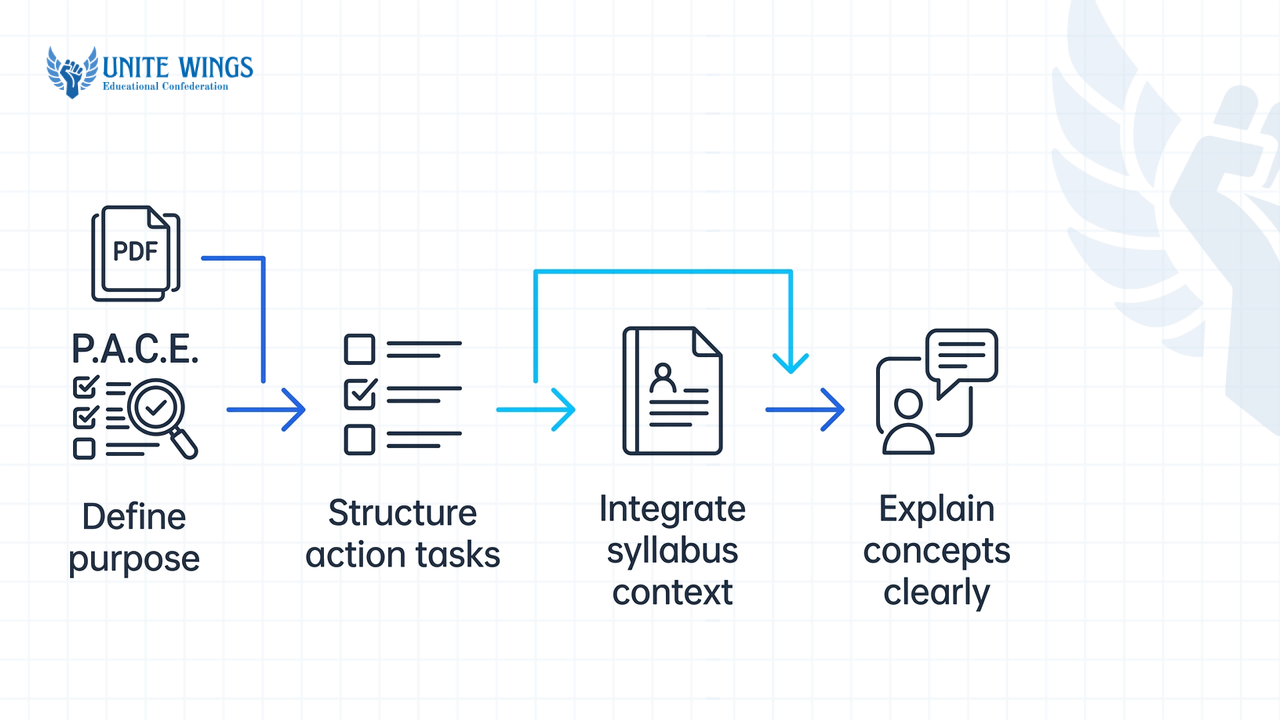
Purpose: Exam revision for my [Insert Semester, e.g., 4th Semester B.Tech/B.Com] university paper. Action: Break down Unit 1 from the attached syllabus and notes PDF into revision notes. Context: I am studying at an Indian university where evaluators check for technical keywords and structured definitions. Explain: Group the notes chronologically by syllabus sub-topic. For each sub-topic, give me a 2-sentence formal definition, 4 key bullet points, and flag any topic that has high lecture-hour weightage in the syllabus. Use ONLY the attached PDF.
If you are on a paid tier or want to keep five subjects separate during finals week, create a dedicated folder using ChatGPT Projects or Custom GPTs to anchor your syllabus files permanently for each course. The ChatGPT Masterclass walks through setting up Projects, custom GPTs, and study mode so you do not have to re-upload your syllabus every morning.
What prompt writes 10-mark university exam answers with diagrams and headings?
To generate 10-mark university answers, prompt ChatGPT to act as a university examiner and mandate a six-part structure: formal definition, core principles, sub-headed bullet points, an ASCII text-based schematic diagram, real-world application, and a concluding summary. Indian university evaluators grade thick bundles of answer booklets quickly by scanning for underlined headings, step-by-step derivations, and visual flowcharts rather than reading walls of prose, as noted by TaskVeda in 2026.
Standard ChatGPT outputs fail in Indian semester exams because the model defaults to writing four-paragraph essays. If you write a brief, unstructured essay for a 10-mark question in an Indian semester exam, an evaluator scanning for distinct subheadings and a block diagram may penalize your score severely. Furthermore, because text chats cannot hand-draw engineering or biology schemas inside a standard text block, you must instruct ChatGPT to build an ASCII flowchart using text arrows (-->) and boxes, plus a checklist of labels you need to draw with a pencil in the exam hall.
| Question Type | Target Word Count | Mandatory Elements for Indian Evaluators | Best ChatGPT Formatting Command |
|---|---|---|---|
| 2-Mark (Short Answer) | 40–60 words | 1 formal textbook definition + 1 formula or concrete example. | "Write a 2-mark answer: 2 sentences defining the term from my PDF, followed by 1 bulleted example or formula." |
| 5-Mark (Medium / Short Note) | 150–250 words | Definition, 4–5 sub-headed bullet points, or a 2-column comparison table. | "Write a 5-mark short note with an introduction, 5 bolded bullet points, and a comparison table if applicable." |
| 10-Mark (Long Essay / Derivation) | 400–600 words | Definition, core principles, ASCII block diagram, numbered steps/derivation, applications, conclusion. | "Write a 10-mark answer using the 6-part university examiner template including an ASCII flowchart." |
Copy this exact prompt to generate your 10-mark study sheets from your uploaded notes:
Act as a strict senior university professor evaluating semester answer scripts. Using ONLY the attached PDF notes, write a 10-mark exam answer for the topic: "[Insert Exact Topic Name]". Structure the response into these exact 6 sections so I can reproduce it on paper: 1. Formal Definition & Introduction (3 sentences maximum). 2. Core Working Principles (bulleted list with bolded keywords). 3. Detailed Step-by-Step Explanation (use numbered subheadings). 4. Visual Diagram Blueprint: Draw a text-based ASCII block diagram or flowchart showing how the components connect, followed by a 3-point checklist telling me exactly what to draw and label with a pencil on my answer sheet. 5. Two Practical/Industrial Applications. 6. Two-line Conclusion.
Once ChatGPT generates these structured sheets, Nation.ai (2025) recommends moving the definitions and ASCII diagram structures into an active recall flashcard tool like Anki so you test your memory through spaced repetition instead of passively re-reading the chat screen. You can also turn on ChatGPT's interactive study mode feature, which a 2026 FelloAI article notes will quiz you one question at a time and tell you what to review next without writing the essay for you.
How can I use ChatGPT Voice Mode to practice for lab viva questions?
Use ChatGPT Voice Mode for lab viva prep by uploading your practical lab manual PDF into a chat, tapping the waveform/headphone icon on the mobile or web app, and prompting the AI to act as an external examiner who asks one question at a time and critiques your weakest answers at the end. According to a November 2026 Essaydone.ai guide, Voice Mode supports Live, Advanced, and Standard voice settings across mobile and web apps, allowing real-time spoken drills.
External practical vivas trip up students who know the theory on paper but freeze when an external faculty member interrupts them mid-sentence or asks "Why did you use this specific reagent/header file in Experiment 4?" ChatGPT's native multimodal speech architecture responds in 232 to 320 milliseconds (Practice Me / OpenAI, 2026), which feels close to the pace of a real professor sitting across a lab bench.
Before you start a voice session, check your account tier so you do not get cut off mid-drill. A 2026 CopilotInterview report points out that while Plus and Go paid accounts get up to 3 hours of Advanced Voice Mode in a rolling 24-hour period, Free accounts only get a short daily trial window, and exact caps fluctuate based on OpenAI's server loads. If you are on the free tier, type your setup prompt and upload your lab manual in text mode first before tapping the voice button.
Here is the step-by-step setup for a 10-question mock viva, adapted from a November 2026 YouTube tutorial on voice viva preparation:
- Attach your lab record: In the ChatGPT mobile app, tap
+and upload your lab manual PDF or photographs of your observation notebook for the experiments in your syllabus. - Send the text setup prompt first: Paste the following prompt as text so you do not waste voice minutes explaining the rules:
Act as a strict external examiner conducting my [Subject Name, e.g., DBMS / Organic Chemistry] practical lab viva. Base your questions strictly on the uploaded lab manual. Rules: 1. Ask me only ONE short question at a time and wait for my spoken reply. 2. Do not lecture or teach me the answer if I get it wrong; instead, ask a sharp follow-up question or move on, just like a real external examiner. 3. Test me on apparatus setup, code line logic, error handling, and underlying theory. 4. After I answer 10 questions, end the viva and give me a scorecard listing my 3 weakest answers and the exact 2-sentence answers I should have spoken. - Start speaking: Tap the waveform Voice icon at the bottom right of the screen and say, "Good morning sir/ma'am, I am ready for my viva on Experiment 1."
- Practice keeping answers under 30 seconds: If you ramble during a real college viva, the external examiner will cut you off. Practice stating the core principle in your first sentence. If speaking under pressure during vivas, presentations, or placement rounds makes you blank out, the Group Discussion and Speaking Masterclass gives you a repeatable speaking structure and live practice rounds.
How do I stop ChatGPT from making up wrong formulas or dates during revision?
Stop ChatGPT from inventing fake formulas, historical dates, or legal section numbers by attaching your verified class notes PDF and adding a negative constraint to your prompt that forces the model to reply "Not available in source text" whenever a fact is missing from your file. A November 2026 PromptlyTaught analysis explains that AI hallucinations happen because standard model training rewards confident guessing over admitting uncertainty.
Even OpenAI's newer reasoning models (such as o3 and o4-mini) recorded hallucination rates between 0.51 and 0.79 on fact-seeking benchmarks like SimpleQA in 2025 OpenAI System Card evaluations. When you ask ChatGPT to "Give me all formulas for Thermodynamics Unit 3" without uploading a reference sheet, it predicts the next plausible symbol from general internet memory. That frequently swaps a plus sign for a minus sign or invents a non-existent constant.
To lock the model down during technical or historical revision, apply the grounding rules documented by Duetoday.ai and MarketMeglobal in 2026:
- Always ground with a source file: Upload your faculty's verified formula sheet, bare act PDF (for law), or NCERT/standard reference chapter before asking a single question.
- Paste the negative constraint block: Never leave a rigid template open without an escape hatch, or ChatGPT will fabricate data just to fill the boxes. Add these exact lines to the end of your prompt:
CRITICAL RULES: Use ONLY the uploaded PDF to answer. Do not extrapolate formulas, chemical equations, historical dates, case citations, or theorem steps from your general memory. If a specific formula, derivation step, or date is not explicitly written in my uploaded document, you must write "[Not available in source text - check textbook]" in bold. Never guess. - Lower the randomness if using API or playground: Older technical benchmarks (Medium / Ainiro, 2023) show that reducing the model temperature setting lowers output randomness during formula revision. Inside the normal ChatGPT app where you cannot see a temperature slider, explicitly writing
"Be strictly deterministic; copy mathematical notation character-by-character from the PDF"achieves the closest result. - Cross-check embedded diagrams: While OpenAI's 2026 documentation confirms ChatGPT can read charts and diagrams inside uploaded PDFs, complex embedded image schemas require direct file attachment to be analyzed properly. Always keep your original PDF open side-by-side to verify every subscript and exponent before committing a formula to memory.
Can ChatGPT solve previous year question papers from Indian universities?
ChatGPT can analyze Indian university previous year question papers (PYQs) to rank topic frequencies, calculate unit weightages, and write high-scoring answers for theory, medical, and commerce exams, but it frequently makes errors on diagram-heavy engineering and advanced quantitative problems. A 2024 YouTube guide on analyzing question papers shows that feeding raw text from 3 to 5 years of university papers into ChatGPT lets you spot the exact 20% of syllabus topics that repeat in 80% of semester exams.
However, you must know which subjects to trust ChatGPT to actually solve versus which ones to only let it categorize. Look at the hard benchmark numbers from Indian exams:
- Where ChatGPT excels (Theory, Medical, Commerce, Humanities): In a 2024 evaluation at ESIC Medical College and Hospital in Hyderabad (published via NIH), ChatGPT 3.5 scored 72.3% on Paper 1 and 61% on Paper 2 of an Indian undergraduate medical internal assessment, beating the human student average of 43% and 45%. Similarly, April 2023 benchmarks reported by India Today and IndiaAI showed the model performed solidly on NEET biology and CUET Business Studies.
- Where ChatGPT fails (Complex Diagrams & Multi-step Quantitative Engineering): In that same April 2023 evaluation on JEE Advanced, standard ChatGPT managed to solve only 11 questions across both papers and ended up with negative scores due to complex quantitative figures and diagrams. While newer reasoning models like o3 (2025) handle numerical JEE Mains problems much better, custom visual geometry inputs still remain challenging and can lead to calculation slips.
Decision rule for Indian university PYQs
Use ChatGPT to both analyze topic frequency and write full solutions for B.Com, BBA, BA, MBBS, Law, and theoretical B.Tech subjects (like Software Engineering, Computer Networks theory, or Environmental Science). For mathematical or diagram-heavy papers (like Engineering Mechanics, Signals & Systems, or Physical Chemistry numericals), use ChatGPT only to rank repeated question types from past papers, and solve the math using your professor's class solutions.
To extract a high-weightage study priority list from your university's past papers, upload 3 to 5 years of PYQ PDFs (or copy-paste the text from scanned papers) and run this prompt:
I have attached the last 4 years of Previous Year Question Papers (PYQs) from my Indian university for [Subject Name], along with my official syllabus. Perform a PYQ Frequency Analysis: 1. List the top 10 most repeated topics across these papers, ranked from highest total marks to lowest. 2. Group the recurring questions by Unit (Unit 1 to Unit 5) and tell me which TWO units carry the easiest guaranteed marks based on repetition. 3. Flag any exact question that has appeared 3 or more times. 4. Do not solve the numericals yet; just give me this priority table so I know what to study first tonight.
Your 48-hour exam prep checklist
If your semester exams are less than two weeks away, do not spend three days color-coding a study timetable. Execute this sequence over the next 48 hours:
- Tonight (30 minutes): Download your university syllabus PDF and the last 3 years of PYQs for your toughest upcoming paper. Merge the syllabus and PYQs into one PDF so you only use 1 of your 3 daily free ChatGPT file uploads.
- Tomorrow morning (2 hours): Run the PYQ Frequency Analysis prompt from the section above to identify the two highest-weightage units. Then upload your class notes for those two units and generate 10-mark structured answers with ASCII diagram blueprints for the top 5 repeated questions.
- Tomorrow evening (20 minutes): Upload your practical lab manual, tap the Voice Mode icon on your phone, and complete one 10-question mock viva with ChatGPT acting as a strict external examiner.
Go beyond one-line study prompts
If you want to set up dedicated subject workspaces that remember your syllabus all semester, join the ChatGPT Masterclass. In one hands-on session, you will configure ChatGPT Projects, build a custom syllabus-grounded GPT, and practice using Study Mode and Deep Research so you spend finals week revising verified notes instead of fighting AI hallucinations.
Frequently asked questions
Can ChatGPT read my 200-page college textbook PDF for exam prep?
Yes, ChatGPT accepts PDF uploads up to 512 MB via the attachment icon, which easily fits a 200-page file. However, uploading full copyrighted textbooks can violate copyright and academic integrity policies, and long files degrade context accuracy across units, so extract and upload only the specific chapter or your personal class notes instead.
Is the free version of ChatGPT enough for college exam preparation, or do I need Plus?
The free version is enough if you merge your syllabus, notes, and past papers into a single PDF before uploading, since free accounts are capped at roughly 3 file uploads per day and limited daily Voice Mode minutes. Upgrade to a paid plan only if you need up to 3 hours of daily Voice Mode or multi-file Projects.
How do I prevent ChatGPT from writing full answers when I want to test myself?
Turn on ChatGPT's interactive Study Mode feature or use the P.A.C.E. framework to command the AI to act as a Socratic tutor. Explicitly include the instruction "Quiz me one question at a time on my uploaded notes, wait for my reply, and tell me what to review next without giving away the answer."
Why does ChatGPT make up fake research papers or incorrect dates when studying history?
ChatGPT generates text by predicting the next statistically likely word rather than querying a verified academic database, and its training rewards confident guessing over admitting uncertainty. To stop fake dates or citations, upload your history syllabus readings and instruct the model to reply "Not available in source text" whenever a date is missing.
Can ChatGPT solve previous year question papers for B.Tech, B.Sc, and B.Com from Indian universities?
It depends on the subject's format. ChatGPT accurately analyzes question frequencies across all streams and writes strong solutions for descriptive B.Com, arts, medical, and theory-based B.Tech or B.Sc papers, but it frequently fails on JEE-style quantitative physics, complex engineering diagrams, and multi-step calculus problems where visual geometry is required.
Newsletter
Stay updated with our latest news and insights.