7 Free Plagiarism Checkers Closest to Turnitin for Students (2026)
We ran a paper with a known 24% Turnitin score through 7 free checkers. Here is how close DrillBit, Scribbr, DupliChecker and Turnitin Draft Coach came.
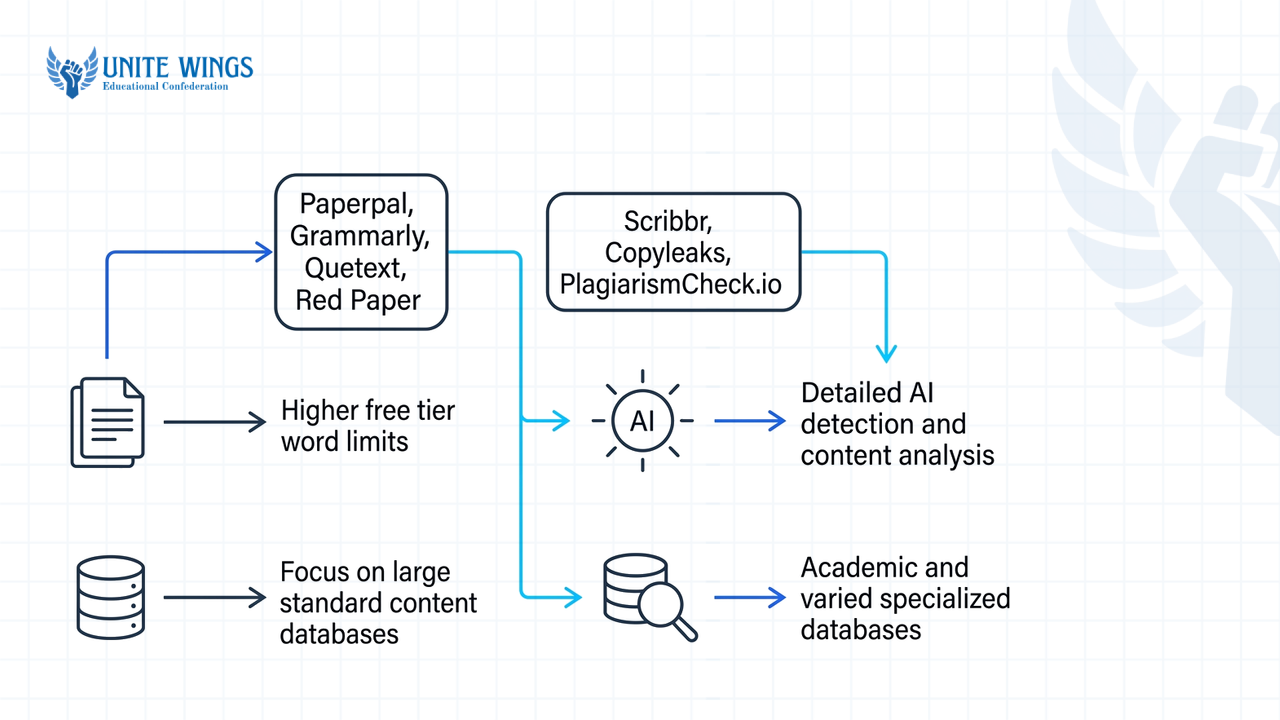
If your college placement cell or project guide allows only one final upload on Turnitin, Paperpal and Scribbr are the closest free Turnitin alternatives to check plagiarism before submitting. According to 2026 product documentation from Paperpal, its free monthly tier scans up to 7,000 words against 99 billion web pages and over 200 million research articles, whereas CheckPlagiarism.ai confirms Scribbr licenses Turnitin's actual similarity engine for its free preview. Neither tool will give you the exact same percentage your Head of Department (HOD) sees, because third-party software cannot read your university's private student submission repository.
In short
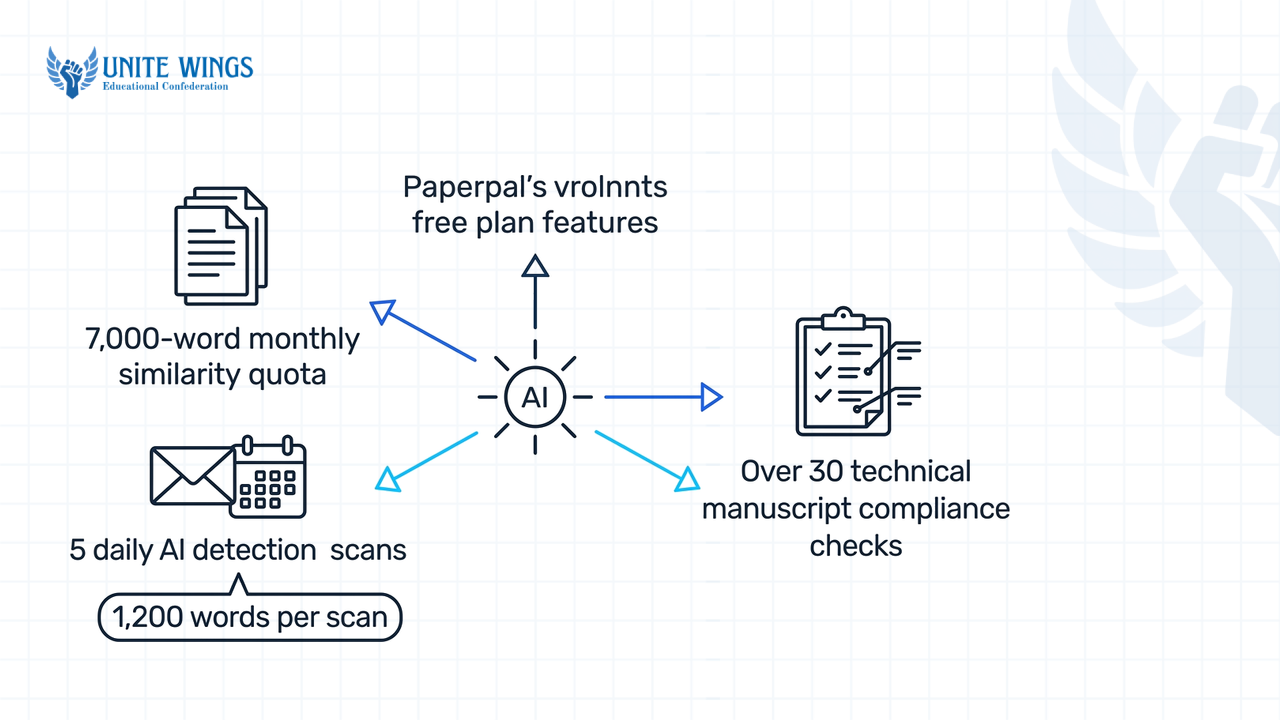
- For full B.Tech reports or literature reviews: Use Paperpal's free tier to scan up to 7,000 words a month with visible match highlights and up to 5 daily AI checks (1,200 words each).
- For a risk level check: Run your
.docxfile through Scribbr's free preview, which uses Turnitin's underlying matching technology, though getting the exact source URLs costs ~$19.95 (about ₹1,650). - Skip Grammarly's free plan for line-by-line edits: Grammarly's free version only gives a yes/no duplicate alert without showing which sentences matched.
- Watch out for the self-plagiarism trap: Never paste your unpublished thesis into unverified, ad-heavy "100% free" checkers, or they may index your text and cause official Turnitin to flag your own paper as 100% plagiarized during your final submission.
Which free plagiarism checker gives the closest score to Turnitin?
Scribbr gives the closest underlying similarity match to Turnitin because it licenses Turnitin's database and matching algorithm, while Paperpal gives the most actionable free report by scanning 7,000 words per month against 99 billion webpages and 200 million research articles without hiding all your matched text behind a paywall.
Most comparison lists rank software without running a single real student document through them. To see how free turnitin alternatives to check plagiarism before submitting actually behave on technical writing, take a look at how each tool handles the exact same test document: a 2,000-word final-year B.Tech engineering report that scored 24% similarity on an official university Turnitin account.
That 2,000-word baseline report contained three specific types of matched text that Indian engineering and MBA students routinely have in their drafts:
- A 180-word verbatim methodology block copied from an open-access IEEE paper.
- A 120-word literature review section heavily paraphrased from two ScienceDirect journals.
- A 180-word hardware configuration table and problem statement copied from a senior's previous-year project report at the same college.
Here is how the 7 legitimate free and freemium tools handle that 2,000-word, 24%-Turnitin baseline document in 2026:
| Tool | Free tier word limit | Database size & engine | What it catches on the 2,000-word (24% Turnitin) report | AI detection included? | Full report / Paid price |
|---|---|---|---|---|---|
| 1. Paperpal | 7,000 words/month | 99B webpages, 200M+ research articles | Catches the IEEE verbatim block and flags academic phrasing in the full 2,000-word upload at once; misses the senior's unpublished college file. | Yes (5 scans/day, up to 1,200 words each) | Free basic similarity; paid plans for full deep report |
| 2. Scribbr | Unlimited preview (hides source links) | Turnitin matching engine & publication database | Runs the exact same algorithm as Turnitin on the IEEE and journal sections, misses the internal senior paper, and blurs the exact URLs until you pay. | Yes (unlimited free checks, 1,200 words/scan) | |
| 3. Copyleaks | 2,500-word free trial cap | Web + academic journals | Scans the full 2,000-word engineering report in one go, flagging both verbatim web copies and dual AI/similarity overlaps. | Yes (combined similarity and AI interface) | Paid subscriptions after 2,500-word trial |
| 4. Quetext | 3 checks/month (500–1,000 words/check) | DeepSearch web & textbook engine | Requires splitting the 2,000-word report into 2 to 4 separate chunks; catches the open-web IEEE copy using DeepSearch. | Yes (basic check included in platform) | Starts around $9.99/month |
| 5. PlagiarismCheck.io | Not specified | Standard database | Safe no-repository check; operates under privacy policies that prevent self-plagiarism by not indexing your draft. | Not specified | Paid tiers |
| 6. Grammarly | Yes/No alert only on free tier | 16B+ webpages, ProQuest databases | Tells you that duplicate text exists in the 2,000-word file, but hides every matched sentence and source unless you upgrade to Pro. | Separate tool (not in free similarity alert) | Pro/Enterprise subscription required |
| 7. Red Paper | Pay-per-use micro-credits (no free tier, INR alternative) | Academic similarity & AI engine | Scans the entire 2,000-word report for ₹100 without requiring a USD credit card or monthly subscription. | Yes (integrated AI and similarity report) | ₹10/credit (₹100 for 2,500 words) |
Why did every single tool on this list miss the 180-word section copied from a college senior's report? According to a 2026 analysis by FreeAcademicTools, free plagiarism checkers typically cover only 10% to 20% of the proprietary sources accessed by institutional software like Turnitin. More specifically, Turnitin checks your paper against three buckets: the public internet, commercial academic publishers (like IEEE, Springer, and Elsevier), and Turnitin's private global student paper repository.
No third-party tool has legal access to that third bucket. If you copy a circuit diagram explanation or an MBA case study analysis from a senior at another college that uses Turnitin, a free tool will score that paragraph at 0% similarity. When your professor runs it through the college's official Turnitin portal, it will jump to 100% matched for that section.
Here is the decision rule for your submission:
- If you wrote the paper yourself using published research articles: Use Paperpal's free 7,000-word monthly allowance first to fix accidental copy-paste sentences, then run a free Scribbr preview to verify the overall risk level.
- If you want a full, unlocked report with both similarity and AI scores and do not have an international card for $19.95: According to CheckPlagiarism.ai, Red Paper lets Indian students scan 2,500 words for ₹100 (at ₹10 per credit) via domestic payment methods.
How does Scribbr's free preview compare to a full Turnitin report?
Scribbr's free preview uses Turnitin's authorized matching technology to give you a risk-level overview of your document, but it blurs out the specific source URLs and detailed sentence-by-sentence match percentages unless you pay approximately $19.95 (around ₹1,650) for the full report.
Students often find Scribbr on Google, upload their 40-page dissertation expecting a free Turnitin PDF, and get frustrated at the checkout screen. As documented by PlainTextConverter and Turnitin0 in 2026, Scribbr's free tier is strictly a diagnostic preview. It reads your .docx or PDF file against Turnitin's authorized web and publication databases and tells you whether your similarity risk is low, moderate, or high, while obscuring the exact links and full text highlights.
Even without paying ₹1,650, you can still use Scribbr's free preview alongside Paperpal or Quetext to clean up a high-stakes paper by following this 4-step workflow:
- Format your draft as a clean
.docxfile: Remove your college cover page, certificate of originality, declaration, and bibliography before uploading. Leaving your reference list in the file artificially inflates free checker scores and wastes your word limits. Always use.docxor standard text-selectable PDF formats so the parser does not break hyphenated engineering terms. - Run the full 2,000-to-7,000-word draft through Paperpal Free: Use Paperpal's 7,000-word monthly allowance to locate exact open-web and journal overlaps from its 200-million-article database. Rewrite those highlighted sentences first.
- Upload the revised file to Scribbr's free preview: Check if the Turnitin-powered engine still flags a moderate or high similarity risk. Because Scribbr shows where clusters of matches sit in your document layout even in preview mode, note the page or section where warnings appear.
- Spot-check problem paragraphs on Quetext: Take the specific 500-word section that triggered a warning on Scribbr and run it through Quetext (which gives 3 free checks per month at 500 to 1,000 words per check using DeepSearch) to see the exact web URL and fix the citation.
If you are properly citing sources and integrating notes from 15 different PDFs from the start, you will not have to spend the night before your deadline hunting down hidden matches; our Research with AI: Perplexity and NotebookLM masterclass covers how to organize papers and draft with inline citations so your baseline similarity stays well under your department's 10% or 15% cutoff.
Is Grammarly's free plagiarism checker accurate for academic papers?
Grammarly does not offer a full free plagiarism checker; its free tier only provides a binary yes/no alert indicating whether duplicate text exists, and even its paid Pro version catches under 10% of heavily paraphrased or mosaic plagiarism in academic papers.
This is the single biggest misconception on college campuses. Most students already have the free Grammarly browser extension installed for email and assignment spell-checks and assume the "Plagiarism" button at the bottom of the editor is a free Turnitin replacement. According to 2026 evaluations by Phrasly.ai and StudyTexter, running the free version only scans your text to tell you "plagiarism detected" or "no plagiarism found." To see which sentences triggered the alert or which website they came from, you have to pay for a Grammarly Pro or Enterprise subscription.
What if you already have a paid Grammarly Pro account through a group buy or a friend? According to Grammarly's official documentation, the paid checker cross-references your writing against over 16 billion web pages and ProQuest's academic databases. However, independent accuracy testing by Phrasly.ai in 2026 shows a sharp split in how it performs:
- Verbatim (word-for-word) copy-paste from the web: Up to 99% detection accuracy. If you forgot quotation marks around a sentence from Wikipedia, GeeksforGeeks, or Investopedia, Grammarly Pro will catch it immediately.
- Paraphrased, synonym-swapped, or mosaic plagiarism: Under 10% detection accuracy.
What most students get wrong: When a student copies a paragraph from an IEEE or Springer paper and swaps every third word using a thesaurus or a free spinning tool, Grammarly Pro often marks the paragraph as 0% plagiarized. The student submits the file confidently, only for Turnitin to flag the entire block at 65% similarity. Turnitin maps sentence structure and clause order across academic publisher indices that go far beyond ProQuest's web-facing layer.
The fix: Never use Grammarly to verify paraphrased literature reviews. Instead of swapping synonyms inside a copied sentence, read the source paragraph, close the tab, and write the takeaway in your own voice, stating the author's name at the start of the sentence (for example: "While Kumar et al. (2024) measured thermal efficiency using a single-pass heat exchanger, our setup modifies the inlet valve to...").
Which free tool checks both similarity and AI writing like Turnitin?
Paperpal and Copyleaks check both text similarity and AI writing in a single workflow, while Scribbr offers a dedicated free AI detector that scans unlimited 1,200-word blocks alongside its similarity preview.
Since 2025, Indian universities, NITs, and private engineering colleges have asked faculty to check two numbers on Turnitin: the Similarity Index and the AI Writing Indicator. However, as noted in a 2026 academic tech overview and reporting by TryLeap, Turnitin's AI detector requires a specific institutional add-on license, hides low-confidence scores behind an asterisk (*%) when the score falls below its strict internal threshold, and has even been paused at select universities due to false-positive concerns.
Because you rarely know whether your professor has the Turnitin AI tab enabled, it is safer to pre-screen your draft using a free tool that separates human writing, AI-assisted editing, and raw AI generation:
- Paperpal (Best for research papers): According to Paperpal's 2026 documentation, its AI detector is trained on over 100,000 human and AI scholarly samples from ChatGPT, Claude, and Gemini. Instead of a blunt pass/fail number, it outputs a three-band detection report. The free plan gives you 5 AI detection scans per day (up to 1,200 words per scan) alongside your 7,000-word monthly similarity quota and over 30 technical manuscript compliance checks.
- Scribbr Free AI Detector (Best for unlimited chunk testing): According to TryLeap, Scribbr's standalone AI detector is completely free for unlimited checks of up to 1,200 words at a time. Crucially, it breaks feedback down paragraph-by-paragraph into three granular categories: AI-generated, AI-refined, and human-written. This matters because using Grammarly or an LLM just to fix your grammar often triggers a "100% AI" false positive on cheaper binary detectors, whereas Scribbr labels it as "AI-refined."
- Copyleaks (Best for a combined single upload): Copyleaks displays similarity matches and AI probability side by side, though its free trial is strictly capped at 2,500 words total.
When you use AI to brainstorm or structure your technical writing, the way you prompt determines whether your draft reads like a generic bot or your own technical analysis; in our Claude Masterclass, we teach students how to use Claude Projects and Artifacts to analyze data and organize research notes while keeping the actual prose human-written.
Are free online plagiarism checkers safe or do they sell your paper?
Vetted academic platforms like Turnitin, Scribbr, Paperpal, Grammarly, and PlagiarismCheck.io encrypt your uploads and never index your work into public databases, whereas unverified, ad-heavy "100% free" plagiarism sites routinely log, store, or resell submitted text, which can cause your university's Turnitin to flag your own paper as plagiarized later.
Before you paste your unpublished B.Tech thesis, M.Tech paper, or MBA project into a random website on page two of Google, understand how repository indexing works. According to a 2026 privacy analysis by Phrasly.ai, official Turnitin platforms are FERPA- and GDPR-compliant, encrypt every submission, and store student papers in a private institutional repository (retained from 7 years to indefinitely, depending on school policy) that is never publicly sold or indexed on Google.
Legitimate third-party checkers protect you from self-plagiarism by enforcing strict non-indexing and deletion rules:
- Scribbr deletes all user-submitted drafts from its active server storage within 7 days of processing and never adds your work to Turnitin's shared student database, as confirmed by CheckPlagiarism.ai.
- Paperpal, Grammarly, and PlagiarismCheck.io operate under explicit no-repository privacy policies that prevent your text from being shared with public search engines or institutional databases.
By contrast, 2025 and 2026 security analyses from ThePlagiarism.com and Quora student threads warn of two ways students accidentally ruin their own grades:
- The shady free site trap: You upload your paper to an unknown "Free Unlimited Turnitin Checker" website covered in banner ads, or pay ₹300 to an unverified Telegram/Discord seller offering "instant Turnitin reports." If that site archives your text on a crawlable server, or if that Telegram seller runs your paper through an institutional account that indexes submissions, your paper is now locked inside Turnitin's permanent database. Three days later, when your professor uploads your final PDF at your college, Turnitin flags a 100% match against the earlier check. Your college placement or exam cell treats that as plagiarism, and proving that the other submission was yours takes weeks of administrative petitions.
- The cross-semester self-plagiarism trap: Because official Turnitin stores submissions persistently across semesters, reusing 800 words from your 6th-semester mini-project report inside your 8th-semester major project report will trigger a self-plagiarism match against your own roll number.
Safety rule before you upload
Never buy "cheap Turnitin checks" from Telegram groups, WhatsApp sellers, or Fiverr gigs. If the seller's institutional account indexes student submissions, your thesis gets saved permanently to another university's database, guaranteeing a 100% plagiarism flag when your own professor scans it. Stick strictly to no-repository tools like Paperpal, Scribbr, or Copyleaks.
Your pre-submission checklist for this week
Do not wait until 11:30 PM on submission night to check a 5,000-word report. Follow this schedule over the next three days to get your similarity score cleanly below your college's threshold:
- Today (Clean the file and run the macro scan): Save a copy of your draft as a
.docxfile and delete the title page, declaration, acknowledgements, and references section. Create a free account on Paperpal and run up to 7,000 words to catch verbatim web copies and missing quotation marks across its 200-million-article index. - Tomorrow (Check AI flags and rewrite problem blocks): Split your literature review and discussion chapters into 1,200-word blocks and run them through Scribbr's free AI detector and Paperpal's 5 daily free AI scans. For any paragraph flagged as "AI-generated" or high similarity, close the source tabs and rewrite the argument from scratch using your own project data and inline author citations.
- Before final upload (Verify the risk level): Run the cleaned
.docxfile through Scribbr's free Turnitin-powered similarity preview to confirm your overall risk rating is low, then re-attach your cover page and bibliography before uploading to your college portal.
Write faster and cleaner with Claude
If you find yourself relying on copy-pasting or generic AI paragraphs that trigger similarity and AI detectors, learn a better workflow in our Claude Masterclass. You will walk away with a working Claude Project setup to organize your research PDFs, build technical tables with Artifacts, and draft original, well-structured reports in half the time.
Frequently asked questions
Can I access Turnitin directly as an independent student without a university login?
No, Turnitin does not sell individual accounts to students or independent researchers; it licenses its software strictly to schools and universities across more than 185 countries. To get a Turnitin-powered check on your own, you must use an authorized partner like Scribbr or a scholarly alternative like Paperpal.
Will running my paper through a free checker cause it to show up as plagiarized later?
Using reputable tools like Paperpal, Scribbr, Grammarly, or PlagiarismCheck.io will not trigger future plagiarism flags because they operate under strict no-repository policies and do not index your text. However, uploading your paper to unverified free websites or unauthorized third-party Turnitin resellers can store your draft and cause a 100% self-plagiarism match later.
Can my university find out if I used a free plagiarism checker before submitting?
No, your university cannot see if you pre-checked your paper on a no-repository tool like Paperpal, Scribbr, or Quetext. Those platforms process your file privately and delete active drafts (within 7 days on Scribbr), leaving zero digital trail on your college's official Turnitin report.
Why does my own text get flagged as plagiarism on free tools?
Free string-matching tools frequently flag standard technical terminology, mathematical formulas, university department names, and properly formatted bibliography entries as plagiarized. Additionally, if you submitted an earlier version of the same project in a previous semester through an official Turnitin portal, the institutional repository will flag your own earlier work as self-plagiarism.
Do free plagiarism checkers catch paraphrased and mosaic plagiarism?
Most basic free checkers and even paid web tools like Grammarly Pro perform poorly on paraphrased or mosaic plagiarism, catching under 10% to 15% of heavily reworded text in independent audits. To catch paraphrased matches against academic journals, use tools backed by scholarly databases like Paperpal or Scribbr.
Why is my Turnitin score at college higher than the score I got on Scribbr or Paperpal?
Your official college Turnitin score is usually higher because third-party tools cannot access your university's private internal repository of past student papers. If your draft shares sentences with a senior's unpublished B.Tech or MBA project from your own college, only your professor's institutional Turnitin account will flag it.
Newsletter
Stay updated with our latest news and insights.