How to Write a Professional Resume for Your First Job in India
Use 15 copy-paste bullet examples and the action-verb formula to build a one-page PDF resume that passes ATS filters and survives a 6 to 8-second recruiter scan.
To figure out how to write a professional resume for first job in India, stick to one page, use a single-column layout, and replace generic career objectives with measurable academic projects and internship outputs. According to ResumeVera, over 8 million graduates enter the Indian job market annually, meaning your file must pass automated Applicant Tracking Systems (ATS) before a human recruiter spends 6 to 8 seconds scanning the top third of your page.
By the end of this guide, you will have a complete, one-page PDF resume built from your college classes, short internships, and fest committees, using 15 copy-paste bullet examples.
Key takeaways
- Keep your resume strictly to one page, formatted in a single column with standard 10 to 12 pt fonts (Calibri, Arial, or Georgia) so ATS software can read every word.
- Drop outdated personal details: remove your photograph, date of birth, father's name, full street address, marital status, and the bottom "Declaration" paragraph.
- Follow the "Action Verb + Task + Tool/Method + Result" formula to turn 2-month internships and college fest duties into corporate-ready proof points.
- Maintain two versions if needed: one rigid template required by your college Training and Placement Office (TPO) and one clean, single-column PDF for off-campus drives on LinkedIn and Naukri.
What is the right order of sections in a fresher professional resume?
The standard section order for a fresher professional resume in India is Contact Header, Targeted Summary or Objective, Education, Skills, Internships or Projects, Certifications, and Achievements. For tech or off-campus product roles, you can move Projects and Skills directly above Education to show practical proof within the first 6 seconds of a recruiter's scan.
According to ResumeVera, recruiters expect a reverse-chronological layout where your latest degree and most recent work sit at the top. Because Indian recruiters and ATS filters scan resumes in roughly 6 to 8 seconds, FundoCareer notes that the top third of your page ("above the fold") decides whether you get shortlisted.
Here is the step-by-step setup to build your base document today:
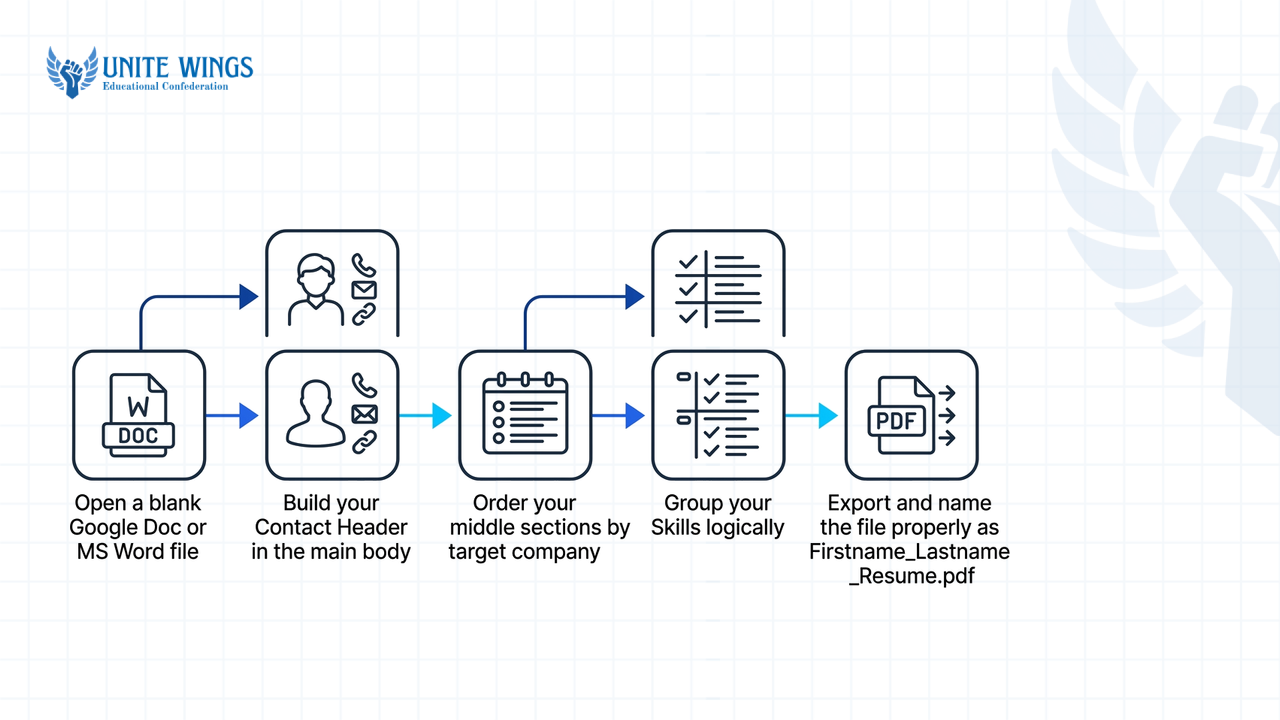
- Open a blank Google Doc or MS Word file: Set your margins between 0.5 and 1.0 inches with single-line spacing. Pick one font—Calibri, Arial, Georgia, or Times New Roman—sized at 10 to 12 pt for body text.
- Build your Contact Header in the main body: Do not put your contact info inside the Word "Header" box, as many ATS parsers skip it. Write your full name at the top, followed by one line containing your phone number, city, a clean Gmail address (
firstname.lastname@gmail.com), your LinkedIn URL, and your GitHub or portfolio link. Never use your college.eduor.ac.inemail, which expires after graduation. - Order your middle sections by target company: Use standard, ATS-recognized headings like "Education", "Skills", "Projects", and "Internships" rather than creative labels like "My Journey".
- Group your Skills logically: Instead of a long bulleted list or soft-skill adjectives like "hardworking," ResumeGenerator.in recommends grouping 6 to 10 specific technologies under clear labels (for example: Languages: Python, SQL, Java | Tools: Git, PowerBI, Excel).
- Export and name the file properly: Save your final document as a text-selectable PDF named
Firstname_Lastname_Resume.pdf(such asRahul_Sharma_Resume.pdf).
| Section Priority | Campus Mass Hiring & Core Roles (TCS, Infosys, L&T) | Off-Campus Startups, Product & AI/Data Roles |
|---|---|---|
| 1. Top Header | Name, Phone, Gmail, City, LinkedIn | Name, Phone, Gmail, City, LinkedIn, GitHub / Live Portfolio Link |
| 2. Opening | 30–50 word Hybrid Objective/Summary | 30–50 word Hybrid Summary with core tech stack |
| 3. Primary Block | Education (Degree, 12th, 10th marks in single lines) | Technical Skills (grouped by Languages, Frameworks, Tools) |
| 4. Core Proof | Technical Skills & Academic Projects | Projects (with live links) & Short Internships |
| 5. Secondary Proof | Internships & Certifications | Education (Degree first; drop 10th/12th if space is tight) |
| 6. Bottom Block | Positions of Responsibility & Achievements | Certifications, Hackathons & Positions of Responsibility |
What most Indian students get wrong about formatting
The biggest mistake final-year students make is downloading a two-column, graphic-heavy template with profile photos and skill progress bars (like "Python: 80%"). According to Jobsify.ai, multi-column layouts, icons, and visual bars break Applicant Tracking Systems, causing automated rejections before a human ever sees your name.
Similarly, TalentTapped confirms that modern private-sector employers in India want you to omit your photograph, date of birth, father's name, marital status, and the old-school bottom "Declaration" ("I hereby declare that the above information is true...").
Keep one caveat in mind: Indian college Training and Placement Offices (TPOs) often force students to use a rigid institutional template that demands a photo and a multi-row table for semester marks. Do not fight your TPO. Keep that exact file exclusively for your college portal, and build a separate, single-column ATS resume for every off-campus application.
Should a fresher use a resume summary or a career objective in 2026?
Freshers in 2026 should skip generic career objectives and use a 30-to-50-word targeted hybrid opening instead. This 2-to-3-sentence block combines your degree, core technical skills, one quantified proof point from a project or internship, and the exact job title you are applying for.
According to CampusFirstIndia, vague lines like "Seeking a challenging position in a reputed organization to utilize my skills" are obsolete. While Western resume guides tell you to drop objectives entirely, CV Prime's 2026 analysis notes that Indian recruiters still look for a brief opening statement to quickly route entry-level applicants into the right hiring track.
Your opening 40 words must name your degree, top three tools, one concrete project metric, and the target role. Here is how you can write yours for different tracks:
- For IT Services & Software Engineering: "Final-year B.Tech Computer Science student proficient in Java, SQL, and React. Built an automated inventory web app that reduced stock entry errors by 15% for a local vendor, and solved 250+ problems on LeetCode. Seeking a Software Development Engineer (SDE-1) role to build scalable backend systems."
- For Data & Business Analytics: "B.Com (Hons) graduate skilled in Python, SQL, Advanced Excel, and PowerBI. Completed a 2-month finance internship analyzing 10,000+ sales rows to identify a 12% seasonal revenue drop. Targeting a Junior Data Analyst role to turn raw business data into visual dashboards."
- For Marketing, Operations & Non-Tech Roles: "Final-year BBA student experienced in Meta Ads, Google Analytics, and B2B lead generation. Led a 10-member college fest sponsorship team to raise ₹1.2L from 8 local brands. Applying for a Growth Marketing Associate role to drive measurable customer acquisition."
Should I include my 10th and 12th marks on a professional resume in India?
Include your Class 10 and Class 12 marks as compact single-line entries under Education if you are applying through campus placements, targeting mass IT recruiters, or holding strong scores. If you are applying off-campus to startups or product firms and need space for projects, you can drop school marks.
According to TalentTapped, campus placement cells and legacy Indian recruiters still treat board marks as a baseline filter to check academic consistency. ResumeVera notes that major IT services firms like Infosys and Wipro frequently set minimum screening cut-offs at 6.5 CGPA (or 65% aggregate), while TCS sets a baseline filter at 6.0 CGPA.
What if your college CGPA is below 6.5? Career advisors disagree here. ResumeVera recommends including your CGPA if it is 6.5 to 7.0+ and omitting it if it is lower, since recruiters will check transcripts during background verification anyway. However, campus TPO portals will reject forms with missing academic numbers.
Follow this rule: include all three scores on your campus resume, and drop low school or college numbers on your off-campus resume. Do not use a bulky 5-column table that eats up four inches of vertical space. Format your entire education history in three clean text lines:
- B.Tech in Information Technology — ABC Institute of Technology, Pune (2022–2026) | CGPA: 7.8/10
- Class XII (CBSE) — Delhi Public School, Nagpur (2022) | 86.4%
- Class X (CBSE) — Delhi Public School, Nagpur (2020) | 89.0%
How do I write strong bullet points for a 2-month college internship?
Write bullet points for a 2-month internship the exact same way you would for a full-time job, using the "Action Verb + Task + Tool/Method + Result" formula. Instead of listing daily duties like "learned Python," state what you built, which tools you used, and a countable output.
Why does this level of detail matter so much right now? According to the India Skills Report 2026 (published by ETS, CII, AICTE, and Taggd) cited by GetWork, national fresher employability sits at 56.35%, yet only about 42.6% of candidates pass employer screening criteria because of skill mismatches. At the same time, NASSCOM's Strategic Review 2026 estimated India's tech industry revenue at $315 billion in FY26 with roughly 135,000 net job additions, while Hyring and Build Fast with AI report that general IT services pay freshers 3.5 to 4.5 LPA compared to 8 to 15+ LPA for AI/ML, data science, and specialized product roles (salary ranges shift by city and company tier, so check Glassdoor or AmbitionBox before applying).
To compete for those higher-paying roles, LinkedInRank points out that your academic projects and short internships must act as your primary work experience. If you don't have a strong project to list yet, the AI Portfolio Sprint helps you pick a real problem, build a working project with AI tools, and publish it so you have concrete proof under your name.
When writing your bullets, FundoCareer advises quantifying team size, time saved, or reports generated. Never start a bullet point with "Worked on," "Helped with," or "Responsible for."
Here are 10 copy-paste bullet examples (5 for short internships and 5 for academic projects) that turn basic college tasks into business impact:
5 copy-paste bullets for a 2-month summer internship
- Software / Web Dev Intern: Weak: Worked on frontend pages using React. -> Strong: Built 6 responsive product pages using React.js and Tailwind CSS for a 5-member startup team, reducing page load time by 1.2 seconds on mobile devices.
- Data Analytics Intern: Weak: Analyzed sales data in Excel and made charts. -> Strong: Cleaned and analyzed 15,000+ rows of regional sales data using Python (Pandas) and Excel pivot tables, building 4 weekly PowerBI dashboards for the sales manager.
- Digital Marketing Intern: Weak: Handled social media accounts and wrote blog posts. -> Strong: Drafted and scheduled 24 SEO-optimized blog posts and LinkedIn carousels using Canva and Semrush, increasing organic page impressions by 18% over 8 weeks.
- Core Engineering / Manufacturing Intern: Weak: Observed assembly line operations during summer training. -> Strong: Mapped shop-floor cycle times across 3 assembly stations using AutoCAD and time-motion logs, proposing a tool-rack layout that cut worker retrieval time by 10%.
- Finance / Accounting Intern: Weak: Helped the CA with client tax filings and GST. -> Strong: Reconciled monthly GST invoices and bank statements for 12 SME clients using Tally Prime, flagging and resolving 30+ billing discrepancies ahead of audit deadlines.
5 copy-paste bullets for final-year academic projects
- Full-Stack E-Commerce / Inventory App: Developed a full-stack inventory tracking system using Node.js, Express, and MongoDB that automated low-stock email alerts and reduced manual counting errors by 15% during testing with a local store.
- AI / Machine Learning Project: Trained a customer churn prediction model in Python using Scikit-Learn on a 7,000-row telecom dataset, achieving 84% accuracy and deploying a live interactive demo via Streamlit.
- IoT / Electronics Capstone: Designed an Arduino and ESP8266-based smart irrigation prototype connected to soil moisture sensors, cutting water usage by 22% across a 2-week greenhouse trial.
- Financial Valuation / Commerce Project: Conducted a Discounted Cash Flow (DCF) and peer-multiple valuation of 4 listed Indian FMCG companies in MS Excel, producing a 15-page equity research report with buy/sell models.
- AI Workflow / Prompt Engineering Project: Built an automated resume-to-job-description matcher using the OpenAI API and Google Sheets, cutting manual keyword screening time from 15 minutes to 30 seconds per application.
(Note: For any software or data project, ResumeVera recommends adding a plain-text GitHub link or live project URL right next to the project title so recruiters can verify your code.)
How can I make college fest organizing sound professional on a resume?
Place college fest roles under a section titled "Positions of Responsibility" and translate student activities into corporate terms like vendor negotiation, sponsorship outreach, and logistics coordination. Back every bullet with hard numbers: budget managed (such as ₹80,000 to ₹1.5L), team size, or attendee footfall.
According to BestJobTool and AI Resume Studio's 2026 guide, recruiters do not care that your fest was fun; they care that you can manage money, deadlines, and people without dropping the ball. Treat your college club or fest committee like a mini-company where you managed a budget, a team, and a deadline.
Here are the final 5 copy-paste bullets to complete your set of 15, showing how to turn campus extracurriculars into corporate language:
- Fest Sponsorship Head: Spearheaded B2B sponsorship outreach across 45 local businesses, pitching custom branding tiers and securing ₹1.2L in cash and in-kind partnerships for a 3-day annual tech fest.
- Cultural / Event Logistics Coordinator: Coordinated end-to-end stage, sound, and vendor logistics across 12 campus venues with a 15-member volunteer team, delivering 20+ events on schedule for 2,500+ attendees.
- Coding Club / Technical Chapter Lead: Organized a 24-hour inter-college hackathon for 300+ student developers, managing a ₹85,000 budget, 6 industry judges, and GitHub submission workflows.
- Placement Cell (TPO) Student Coordinator: Managed interview scheduling and recruiter communication for 18 visiting companies during the 2025–26 placement season, coordinating assessments for 400+ final-year students.
- College Magazine / PR Lead: Led a 6-member editorial and design team to publish a 40-page annual college newsletter and run Instagram PR campaigns, driving 1,200+ event registrations in 3 weeks.
If you have the raw points written down but want a structured way to tighten your wording and pass automated filters, the Resume Masterclass walks you through rebuilding your layout so a recruiter gets your value in ten seconds.
Your 3-step checklist before you apply today
Do not close this tab and go back to scrolling job boards with your old file. Take 30 minutes right now to finish these three actions:
- Run the Ctrl+A plain-text test: Export your resume as a PDF, open it, press
Ctrl+A(Select All), copy the text, and paste it into Notepad. If the text pastes in a jumbled order or skips your contact info, your layout will fail an ATS scan. Rebuild it in a single-column Google Doc. - Rewrite your top 6 bullets with numbers: Pick your best internship, your top two academic projects, and one college leadership role. Rewrite every bullet using the Action Verb + Task + Tool + Result formula so every line contains at least one number (rows, rupees, percentages, or users).
- Rename and split your files: Save your clean, single-column version as
Firstname_Lastname_Resume.pdffor LinkedIn and Naukri, and keep your college's mandatory table format in a separate folder strictly for your TPO portal.
Rebuild your resume in one sitting
If you want guided help turning your rough college projects and internships into a crisp, ATS-ready one-pager, join the Resume Masterclass. You will learn how to use AI to sharpen your bullets while staying in full control of your facts, walking away with a finished, recruiter-ready resume that passes the 10-second scan.
Frequently asked questions
Is a one-page resume mandatory for freshers in India?
Yes, a fresher resume in India must be strictly one page. According to FundoCareer, recruiters scan resumes in roughly 6 to 8 seconds, making a single-page limit essential under high-volume screening. If you have zero to two years of experience, trim wide margins and extra lines so everything fits on a single page.
Should I include a photograph and date of birth on my Indian resume?
No, you should leave out your photograph, date of birth, father's name, marital status, and the bottom declaration section on standard corporate applications. FundoCareer and TalentTapped confirm that modern companies in India omit these details to prevent bias and save space. Only include a photo if your college placement cell explicitly mandates an institutional template.
Which file format is best for submitting resumes to Indian job portals?
Always upload a text-selectable PDF exported directly from Google Docs or Microsoft Word, named Firstname_Lastname_Resume.pdf. According to ResumeGenerator.in and Jobsify.ai, image-based PDF scans or heavy graphic templates cannot be read by Applicant Tracking Systems (ATS), which causes your application to appear blank to the screening software.
How many projects should a fresher include on a resume?
A fresher should feature 2 to 3 strong academic or personal projects on their resume. LinkedInRank notes that for students without full-time work history, projects serve as primary work experience. List the project title, a live GitHub or demo link, the exact tech stack or tools used, and 2 quantified bullet points per project.
What should I do if my college CGPA is below 6.5?
If your CGPA is below 6.5, ResumeVera advises omitting the number from your off-campus resume so you are not immediately filtered out, as recruiters will check your transcripts during verification anyway. However, for on-campus drives where TPO portals mandate every score, enter your exact marks and apply to companies without strict cut-offs.
Can I use my college email ID on my resume?
No, you should never use your college email ID on your resume. According to Jobsify.ai, college email accounts are often deactivated shortly after graduation, meaning you could miss interview invites or offer letters. Use a clean, permanent personal Gmail address formatted as firstname.lastname@gmail.com instead.
Newsletter
Stay updated with our latest news and insights.