
How to Tailor Your ATS Resume to Any Job Description in 10 Minutes
Copy four AI prompts to target 12 to 15 core skills and get a 70% to 80% keyword match, saving your resume from the filters that reject 75% of Naukri and LinkedIn applications.
To tailor an ATS resume in 10 minutes, use a 4-step AI prompt sequence to extract 12 to 15 core skills from the job description, map them to your real project evidence, and rewrite only your summary, skills section, and top experience bullets. This method targets a 70% to 80% keyword match without triggering AI spam filters or inventing fake metrics that fail background checks.
By the end of this guide, you will have four copy-paste prompts ready to customize your resume for the job tab you have open right now.
Key takeaways
- 75% of Indian portal applications on Naukri and LinkedIn get filtered out by ATS software before a human recruiter ever sees them, according to 2026 data from CVefy and CV-Prime.
- Target 12 to 15 core hard-skill keywords per application, aiming for a 70% to 80% match rate across your Skills section and work experience bullets.
- Customize only three sections for every job: your Professional Summary, Skills list, and Work Experience or project achievement bullets.
- Run a 4-step sequential prompt (Extract, Map, Rewrite, Audit) rather than a one-click rewrite so ChatGPT or Claude does not hallucinate tools you cannot defend in a technical round.
Why your static resume gets rejected on Indian job portals
Sending the exact same resume file to every job posting yields a baseline keyword match score between 40% and 60% on platforms like Workday and Greenhouse, according to a 2026 analysis by Jobloo. In India, where popular IT, finance, and marketing roles attract 500 to 1,000 applicants per posting, a generic file will almost never reach the shortlist.
According to 2026 reports from CVefy and CV-Prime, 75% of all applications submitted on Indian portals like Naukri and LinkedIn are filtered out by Applicant Tracking Systems before a human recruiter opens them. Over 95% of major Indian companies—from mass recruiters like TCS and Infosys to domestic banks and startups—use automated screening software, notes NextCV.
Missing keywords account for roughly 55% of total ATS rejections, based on Jobscan data cited by CV-Prime. When you figure out how to tailor ats resume to job description using ai properly, your odds shift immediately. Customizing your resume with role-specific keywords yields a 2x to 4x increase in interview callback rates compared to sending a generic template, according to LinkedIn India and CV-Prime data. One 2026 study by Jobloo even found that per-job LLM-adapted resumes achieve a 12.7% interview callback rate, compared to the 2% to 3% industry baseline for static auto-apply resumes.
| ATS Platform | Common Users in India | How the Screening Engine Works |
|---|---|---|
| Workday | Enterprise MNCs and large organizations | Uses a semantic similarity model and machine learning relevance scoring to process candidate pools. |
| Zoho Recruit & Keka Hire | Indian corporate employers and startups | Evaluates contextual sentence structures and candidate data during screening. |
| Naukri Resdex | Almost all Indian corporate HR teams and agencies | Searches both your uploaded resume file and your portal profile summary/skill tags independently. |
| Ashby & Greenhouse | Series A to C tech startups, product companies | Applies strict boolean and keyword filtering; Ashby is noted by Jobloo as one of the strictest filters for small hiring pools. |
| SAP SuccessFactors & Taleo | Legacy enterprises and large corporate organizations | Dominant corporate platforms where standard layouts are essential to prevent keyword drop-off. |
What is the exact AI prompt to match my resume bullets to a job description?
The safest way to tailor your resume is a 4-step sequential prompt workflow: extract requirements, map your real evidence, rewrite supported bullets using action-scope-tool-result phrasing, and run a fact-check audit. As confirmed by Jobbie in 2026, splitting this into four steps stops AI from hallucinating unverified credentials or inventing fake numbers.
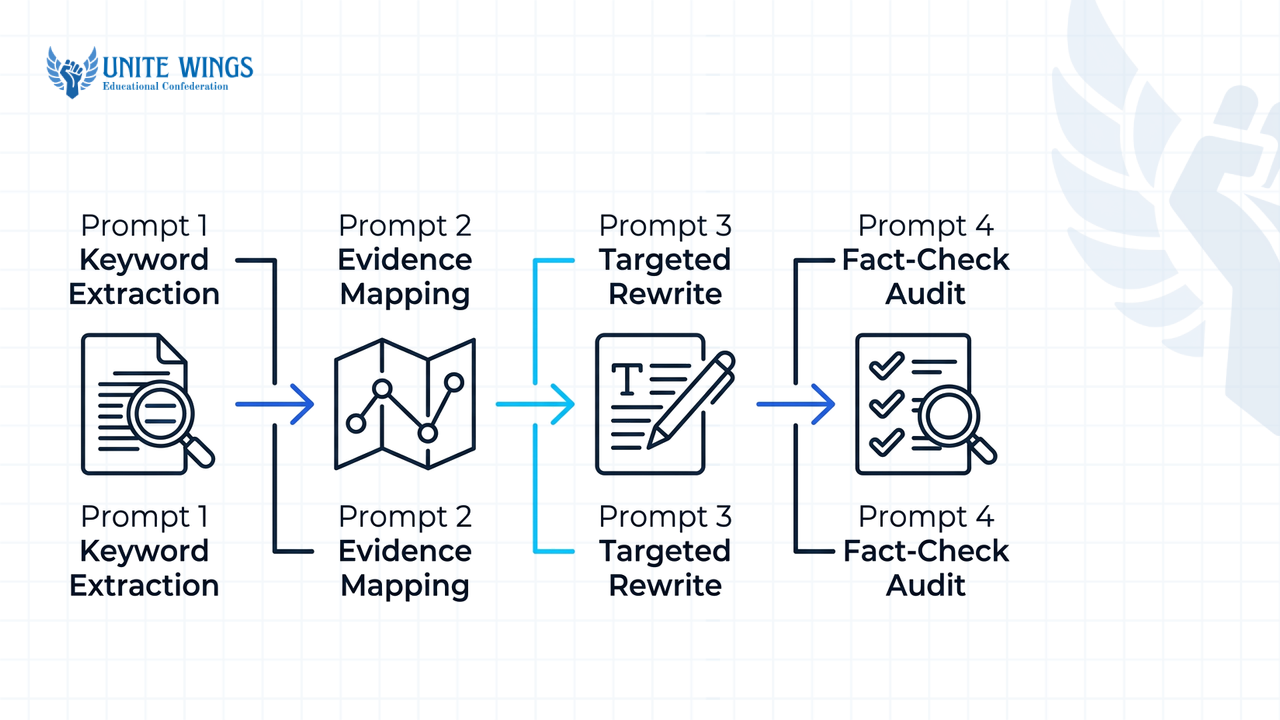
If you paste your resume and a job description into an AI tool with a lazy prompt like "Rewrite my resume for this job," the model will lie for you. It will claim you managed a team when you were an intern, or slip "AWS" into your project bullets just because the job listing asked for it.
Never use a one-click rewrite prompt, because Indian companies run strict background verification (via firms like AuthBridge or First Advantage) and technical grilling that will expose fabricated skills immediately. Instead, open Claude or ChatGPT and run this 10-minute workflow. (Note: A single 2026 source, Apply4Me, clocks this 4-phase workflow at 15 minutes, though once you have your master resume saved in a chat, you can execute it in 10 minutes flat.)
Step 1: Extract the top 12 to 15 keywords (2 minutes)
Copy the entire target job description and run this first prompt in your AI chat:
Prompt 1 (Keyword Extraction): "Act as an Indian tech recruiter using an ATS like Workday or Zoho Recruit. Analyze the following job description and extract:
- The top 12 to 15 core hard-skill keywords (tools, languages, frameworks, methodologies).
- The top 3 action/outcome requirements (what this person must actually build, analyze, or fix). List the exact spelling and acronyms used in the text. Do not rewrite anything yet. Here is the JD: [Paste Job Description]"
Step 2: Map your master resume evidence (3 minutes)
Now paste your existing base resume. According to 2026 guidance from ApplyBuddy, a job description requirement is not proof of qualification; your AI workflow must evaluate your master resume strictly before writing.
Prompt 2 (Evidence Mapping): "Here is my current master resume: [Paste Master Resume]. Build a 3-column table mapping the 12-15 extracted keywords from Step 1 against my resume. Column 1: JD Keyword/Requirement. Column 2: Exact proof/project from my resume (Full Match, Partial/Transferable Match, or Missing). Column 3: How we can phrase the Full or Partial matches honestly without inventing tools I have never used."
Step 3: Rewrite your summary, skills, and top bullets (3 minutes)
Once you review the table and confirm the matches are honest, run the rewrite prompt.
Prompt 3 (Targeted Rewrite): "Using ONLY the Full Matches and approved Partial Matches from our table, rewrite the following three sections of my resume to align with the job description:
- A 3-line Professional Summary that mirrors the JD's core role title and top 4 hard skills.
- A clean, plain-text Skills section featuring the matched keywords.
- The top 3-4 bullet points for my most relevant work experience or academic project, using an Action + Scope + Tool + Result structure. Strict rule: Do not invent metrics, percentages, or tools not present in my master resume. If a bullet needs a metric I haven't provided, insert a bracketed placeholder like [X%] for me to fill in."
Step 4: Audit for AI hallucinations (2 minutes)
Before you copy the text into your Word or PDF template, force the AI to check its own work.
Prompt 4 (Fact-Check Audit): "Compare the rewritten sections from Step 3 against my original master resume from Step 2. List any tool, certification, metric, or seniority claim in the new version that was not explicitly present in my original resume. Also flag any buzzwords or unnatural keyword repetition."
If you want to save this entire 4-step workflow as a reusable workspace so you do not have to paste your master resume every time, our Claude Masterclass shows you how to set up Claude Projects and Artifacts step by step.
Which sections of my resume should change for every job application?
For every job application, you must customize three specific sections: your Professional Summary (or headline), your core Skills section, and the achievement bullet points under your Work Experience or Projects. Leave your education history, graduation dates, and company names untouched so ATS parsers can read your timeline without errors.
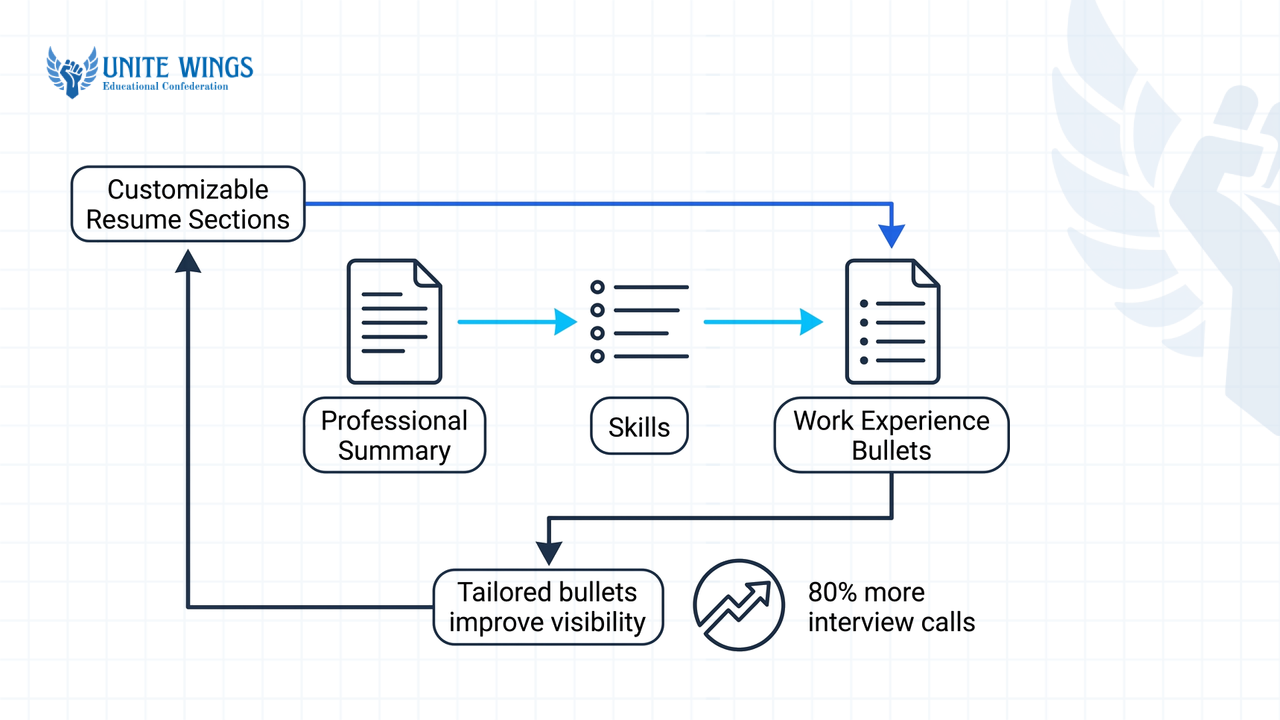
This three-section rule is confirmed by multiple 2026 career sources, including Resume.io and ResumifyAI. Here is what that change looks like in practice for an Indian fresher or junior analyst:
- Generic Bullet (Before): "Worked on college placement data using Excel and Python to find trends and made charts for the placement cell."
- Tailored Bullet for a Data Analyst JD (After): "Automated weekly placement reporting using Python (Pandas) and Advanced Excel (Power Query), building a Power BI dashboard to track offer conversion rates across [X] engineering branches."
While tailoring those three sections, keep your base document compliant with Indian ATS parsing rules:
- Use standard section headings: Stick to exact labels like "Work Experience", "Internships", "Projects", "Education", and "Skills". According to 2026 data from CV-Prime, creative headings like "My Journey" or "Professional Background" cause ATS parsers to misread employment data and assign zero weight to your work history.
- Keep a single-column layout: Both Monster and InterviewGPT confirm that multi-column layouts, tables, text boxes, and graphics cause parsing failures where keywords drop off before semantic scoring even begins.
- Follow Indian private-sector header norms: According to ResumeFast, you should strip out personal details like date of birth, marital status, religion, and photos. However, if you have work experience, explicitly add your Notice Period (e.g., "Notice Period: Immediate / 30 Days") in your contact header or summary block, as Indian recruiters filter Resdex and ATS databases by availability first.
- Watch your page count and file type: Keep your resume to 1 page as a student or fresher, and a strict maximum of 2 pages if you are an experienced professional applying for roles above 15 LPA (per a 2026 CVefy guide). Keep font sizes between 10 and 12 points (Calibri, Arial, or Inter) and save the file under 2.5MB. While text-based PDFs work on modern platforms, legacy enterprise portals and certain Naukri configurations still parse
.docxfiles more reliably without structural glitches—so keep both versions handy.
If your base document still uses a two-column Canva template or lacks quantifiable project bullets, fix the foundation first in our Resume Masterclass.
How many keywords from the job description should I match in my ATS resume?
Aim to match 70% to 80% of the critical keywords from the job description, focusing on 12 to 15 core hard skills placed in both your skills list and your experience bullets. Use each core term once or twice in natural context rather than aiming for an arbitrary repetition count.
Two 2026 guides—ApplyBuddy and ResumeOra—confirm that 12 to 15 hard-skill terms is the sweet spot for an ATS-optimized skills section. In the Indian market right now, ResumeRaja notes that the most frequently indexed technical terms across recruiter databases include Python, Advanced Excel (VBA/Power Query), Power BI/Tableau, Cloud platforms (AWS, Azure, GCP), and SAP/Oracle ERP.
However, do not obsess over hitting a "95% match" on free online resume checkers. Here is what most students get wrong: third-party resume graders only run a local text comparison on your browser. They have no connection to the proprietary algorithms inside Workday, Greenhouse, or Keka.
According to Raiesume and Jobloo, real ATS platforms rank candidates relativeto the rest of the applicant pool, not against a fixed pass/fail threshold. A 58% keyword match score might suffice in a small pool of 30 applicants but fail in a pool of 500.
Also, legacy career blogs often claim you must repeat a keyword 3 to 5 times to rank higher, while modern ATS documentation disagrees. Vendor systems like Greenhouse treat keyword searches as boolean yes/no conditions or semantic context checks, meaning using a term once in your Skills list and once inside a project bullet is enough to register full competency without looking like spam.
Does keyword stuffing get flagged by modern AI-powered ATS software?
Yes, keyword stuffing triggers modern ATS and AI detection layers, leading to 75% to 95% rejection rates and immediate recruiter distrust, according to a 2025 report by MokaHR. Hiding keywords in white text or cramming them into footers will get your application automatically flagged as spam.
Some college WhatsApp groups still circulate the old trick of pasting the entire job description at the bottom of your resume in size-1 white font. According to 2026 research from IsMyResumeGood and ATS Resume AI, deceptive tactics like hiding keywords in white text are easily detected by modern ATS systems, leading to immediate flagging or spam rejection.
Furthermore, a single 2026 report by Algnetic notes that major Indian employers—including Flipkart, Zomato, and top banking groups—have adopted second-generation AI screening tools. These systems use machine learning semantic matching models that evaluate whether a skill appears inside a believable sentence with an action and an outcome.
In addition to keyword alignment, modern platforms evaluate hidden resume signals such as skill recency, career progression, employment gaps, and quantitative achievements, according to a 2025 analysis by ATSGrade. Listing "Python" ten times in your skills box means far less to an AI parser than showing "Python" inside a project completed in the last six months.
What most Indian applicants miss on Naukri
Tailoring your uploaded PDF is only half the battle on Indian job portals. On Naukri, recruiters search the Resdex database using your portal Profile Summary, Key Skills tags, and Notice Period fields independently of your attached resume file. Every time you update your core skills for a target role type, update your Naukri profile tags and headline to match.
How do I tailor my ATS resume for a role when I don't have all the listed skills?
When you lack certain skills on a job description, use an evidence-based gap analysis prompt to highlight transferable tools and adjacent project work rather than faking proficiency. Never list a technology in your core Skills section if you cannot answer a basic interview question about how you used it.
Suppose you are applying for a Junior Business Analyst role in Bengaluru that asks for Tableau, SQL, and Jira, and you have used Power BI, MySQL, and Trello during your college capstone project. Modern semantic ATS engines like Workday use semantic similarity models to understand variations like 'JS' and 'JavaScript', while older legacy systems rely on strict literal string matching.
According to 2026 guidance from ApplyBuddy, the ethical way to bridge this gap without lying is to keep the unfamiliar tool out of your core Skills section, while referencing your adjacent experience in your summary or project context. Run this prompt when you are missing 20% to 30% of the job requirements:
Copy-Paste Prompt for Missing Skills: "I am applying for a role that requires [Insert Missing Skill, e.g., Tableau], which I have not used professionally. However, my master resume shows hands-on experience with [Insert Your Actual Skill, e.g., Power BI and Excel Pivot Tables]. Write one honest bullet point for my project section and one line for my summary that highlights my proficiency in [Your Actual Skill] and frames it as a transferable foundation for data visualization/reporting, without falsely claiming I have worked in [Missing Skill]."
This keeps your integrity intact for background verification and technical interviews while still feeding the semantic matcher the exact domain concepts (like "data visualization", "dashboarding", and "KPI reporting") it looks for.
Your next 3 steps before you click "Apply"
Do not close that job tab yet. Run this checklist in the next 10 minutes:
- Run the 4-prompt sequence: Paste the job description and your master resume into Claude or ChatGPT using the Extract, Map, Rewrite, and Audit prompts above.
- Update your 3 target zones: Swap in the new 3-line Summary, the 12 to 15 matched Skills, and the top 3 to 4 achievement bullets in your single-column template.
- Check your Indian formatting details: Confirm your file is named
FirstName_LastName_Role.pdf(or.docx), is under 2.5MB, uses standard section headers, and clearly shows your graduation year or notice period in the top block.
Set up a reusable resume-tailoring engine in Claude
Tired of pasting your master resume and typing rules from scratch for every job application? In the Claude Masterclass, you will learn how to use Claude Projects and Artifacts to store your master resume, project proof, and strict anti-hallucination instructions in one permanent workspace—so you can drop in any Indian JD and generate tailored, fact-checked resume bullets in under three minutes.
Frequently asked questions
Can I use ChatGPT to rewrite my entire resume in one click?
No, you should never use a single one-click prompt to rewrite your entire resume. Unconstrained AI prompts frequently invent metrics, inflate your job titles, or add tools from the job description that you have never used. Use a 4-step sequential prompt workflow instead so every bullet remains backed by real evidence.
What ATS score is required to guarantee an interview callback?
No specific ATS score guarantees an interview because platforms like Workday, Greenhouse, and Ashby rank candidates relative to the rest of the applicant pool. However, targeting a 70% to 80% match on critical hard skills gives you strong role alignment without triggering keyword-stuffing penalties.
Do Indian portals like Naukri read PDF or Word documents better?
Modern ATS platforms used by Indian companies read both text-based PDFs and Microsoft Word (.docx) files under 2.5MB. However, some older enterprise portals and specific Naukri parser configurations still extract text from .docx files more reliably without line-break errors, so keep both formats saved on your laptop.
Should I include my photo, date of birth, and notice period on an Indian corporate resume?
Omit personal details like your photo, date of birth, marital status, and religion on private-sector Indian resumes. You should, however, explicitly include your notice period (such as "Immediate Joiner" or "30 Days") in your contact header or summary, because Indian recruiters actively filter candidates by availability.
Why do resume checkers show high match scores while I still get rejected?
Free online resume checkers only calculate local text similarity between two documents and cannot see the internal algorithms or applicant pool volume inside a company's ATS. You may still get filtered out if 500 other applicants applied earlier, or if your resume lacks recent project proof and quantifiable results.
How does ATS handle skill abbreviations like JS versus JavaScript?
Second-generation semantic ATS platforms like Workday recognize that "JS" and "JavaScript" or "ML" and "Machine Learning" mean the same thing. Older boolean systems like legacy Taleo setups search for exact character strings, so mirror the exact spelling used in the job description or write "Machine Learning (ML)" once.
Newsletter
Stay updated with our latest news and insights.