How to Run a Live Mock Interview on ChatGPT Before Campus Drives
Set up ChatGPT Voice Mode as a strict HR or technical panellist that interrupts vague answers, scores your clarity out of 10 and fixes your filler words.
To run a spoken campus mock interview on ChatGPT, open a fresh chat on the mobile app, tap the sound-wave Voice icon before typing anything, and read out a system prompt that forbids mid-interview praise. According to Unstop's 2026 Talent Report, 73% of Indian undergraduates expect a starting salary above ₹5 LPA, yet only 40% receive offers at that band. The difference in campus drives often comes down to how clearly you defend your projects out loud when a panel interrupts you.
In short
- Tap the sound-wave Voice icon on a blank chat thread first; according to a 2026 AIWithAllie walkthrough, typing text first locks you out of full-duplex live voice for that thread.
- Paste both your anonymized resume and the exact job description into your prompt so the model grills your actual projects instead of asking textbook definitions.
- Include the exact line "Do not coach me mid-answer, do not praise me, and stay strictly in character" to stop ChatGPT from acting like a polite tutor.
- Configure a termination phrase like "STOP, give me feedback" to generate a scorecard on your grammar, defensive phrasing, and missing project metrics at the end.
How do I set up ChatGPT Voice Mode on my phone for a spoken HR mock round?
Open the ChatGPT iOS or Android app, start a brand-new empty chat, and tap the circular sound-wave icon on the far right of the message bar. Do not tap the microphone icon next to it, which only converts speech to text, and do not type a message first, or you will disable live voice for that thread.
Setting up a realistic spoken round requires avoiding three traps in the mobile app interface. Follow these exact steps before your next placement cell screening:
- Strip personal data from your resume text: Before opening ChatGPT, copy your resume into a notes app and delete your phone number, email, home address, and any unreleased proprietary data from past internships, as recommended by InterviewCoach.ai.
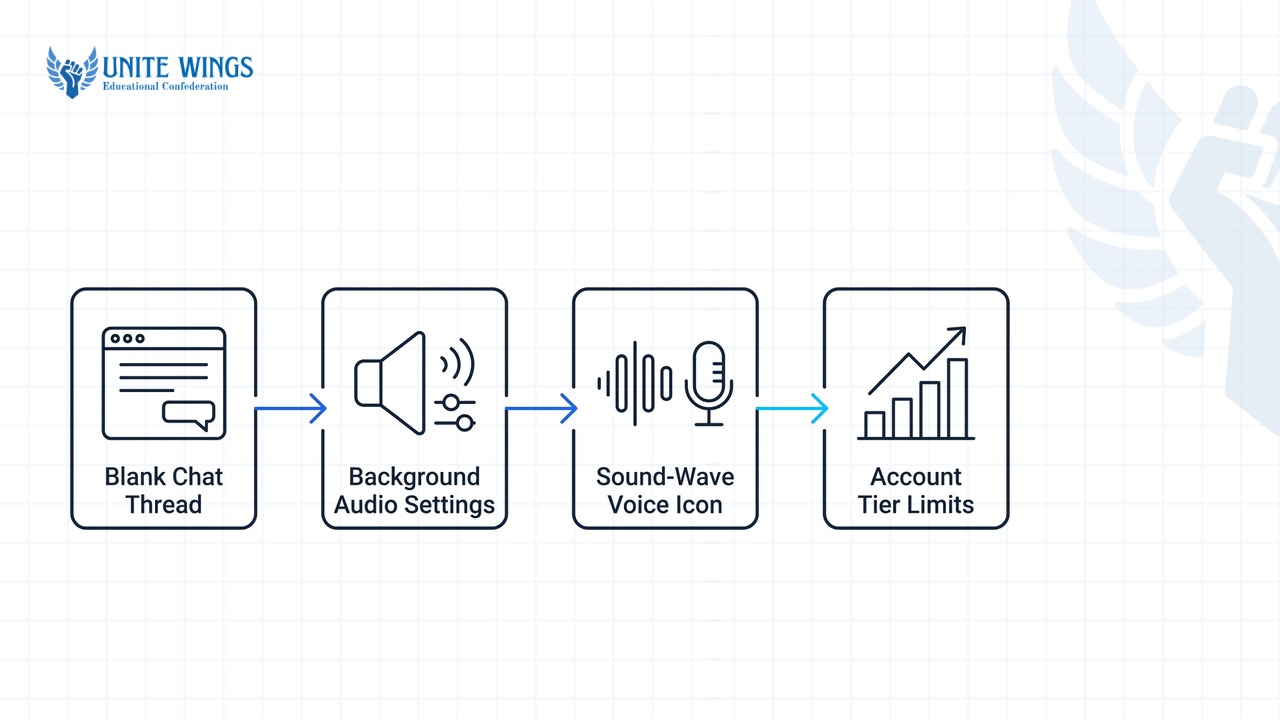
- Check your background audio settings: By default, the mobile app disables background listening so it does not record when your screen locks, according to Coursera. Go to Settings in the ChatGPT app and toggle "Background Conversations" on so a dimming phone screen does not cut off your mock interview mid-sentence.
- Open a completely blank chat thread: A 2026 walkthrough by AIWithAllie points out a quirk most students miss: if you send a typed text message first in a thread, ChatGPT disables native live duplex voice mode for that entire chat. Always start on an empty screen.
- Tap the sound-wave Voice icon: Coursiv notes that students frequently confuse the dictation microphone icon (which just transcribes speech into the text box) with the sound-wave Voice icon on the bottom right. Tap the sound-wave icon to launch the live audio interface.
- Know your account tier limits: According to SEO-Stuff and Substack, paid accounts run the flagship GPT-Live model with simultaneous full-duplex speech, whereas free accounts run lighter models like GPT-Live mini. If you are on a free account, keep each mock session to 5 to 8 questions so the lighter model does not lose track of your initial instructions.
What most students get wrong here is typing their prompt into the chat box, hitting send, and then tapping the voice button. If you need to feed a long resume and job description without reading it all out loud, paste the text into the message box while inside the voice setup, or put your resume and role instructions into ChatGPT's "Custom Instructions" under your profile settings before tapping the sound-wave icon on a blank thread. If you want to set up reusable workspaces for placement prep, the ChatGPT Masterclass walks through configuring Projects and custom GPTs step by step.
Why is ChatGPT being too polite in mock interviews and how do I make it strict?
ChatGPT defaults to an agreeable, helpful assistant persona that praises weak answers unless you explicitly forbid coaching. According to Mocky.pro and UseGreenroom, you must include negative constraints in your opening prompt: "Do not coach me mid-answer, do not praise me, and stay strictly in character as a skeptical interviewer."
When you tell standard ChatGPT to interview me for an HR round, it responds to a rambling two-minute answer with, That is a great example of leadership. Now, let's move to the next question." A real panelist at an off-campus drive or a mass-recruiter interview will interrupt you, question your numbers, or move on with a blank face. Learning how to use ChatGPT for mock interviews as a fresher means overriding that supportive default.
Copilot Interview identifies four rules every mock interview prompt needs to work: an explicit interviewer persona, a single-question-at-a-time limit, an instruction to wait for your spoken response, and delayed feedback until the session ends.
Copy and use this exact block to lock the model's tone:
"You are a skeptical, time-pressed senior hiring manager conducting a campus placement interview. Rules you must not break:
- Ask exactly one question at a time, then stop speaking and wait for my answer.
- Do not coach me mid-answer, do not praise me, do not say 'great answer' or 'thank you for sharing,' and stay strictly in character.
- If my answer is vague, lacks numbers, or sounds memorized, interrupt or ask a blunt follow-up question challenging the weak spot.
- Do not give me any tips or evaluation until I say the exact words: 'STOP, give me feedback.'"
Even with a strict opening prompt, long conversations suffer from what UseGreenroom calls politeness drift, where the model slowly reverts to a forgiving tutor during long sessions. The moment you hear ChatGPT say "That makes a lot of sense" during your voice session, interrupt it out loud and say: "Reminder: stay strictly in character as a skeptical interviewer and do not praise my answers."
What prompt makes ChatGPT ask follow-up questions based on my exact resume?
To make ChatGPT grill your actual work rather than asking generic listicle questions, Lorka.ai and Ishrafil.com confirm you must paste both your anonymized resume bullets and the target job description into the prompt, paired with a rule from SkillCopilotAI requiring five sequential questions with targeted single-probe follow-ups on missing metrics.
In Indian campus placements, a single-source 2026 report by HirePro (State of College Hiring in India) notes that while 51% of companies still filter initially by CGPA cutoffs, 21% have formally moved to skills-first hiring. Once you clear the aptitude test, the interviewer looks at your two-page college resume and picks one project to pull apart. According to UseGreenroom, a large share of rejections in mass-hiring technical drives like TCS Ninja happen in the managerial and HR rounds because freshers tell poor stories about their projects or give vague career motivations.
Put this prompt into your Custom Instructions (or paste it at the start of your voice session) to force resume-specific grilling:
"Act as a technical hiring manager interviewing me for the role of [Insert Role, e.g., Graduate Engineer Trainee]. Here is the Job Description: [Paste full JD text]. Here are my anonymized resume highlights and final-year projects: [Paste your resume projects, skills, and internship bullets]. Conduct a 5-question mock interview using the STAR (Situation, Task, Action, Result) framework. Ask one question at a time and wait for my spoken response. After every answer I give, you must ask one targeted follow-up probe that challenges a missing metric, asks why I chose a specific tool on my resume over an alternative, or tests whether I actually built the project myself versus my teammates. Do not praise me or give feedback until I say 'STOP, give me feedback.'"
Here is what happens when you use this setup. Suppose your resume has a bullet reading: "Built a fake news detection model using Python and Scikit-learn with 92% accuracy."
- Without the prompt: ChatGPT asks, "Can you tell me about a project you worked on?" and accepts any summary you give.
- With the prompt: ChatGPT asks, "On your fake news detector, what dataset did you train on, and why did you use Scikit-learn instead of a transformer model?" When you answer that your four-person B.Tech group downloaded a Kaggle dataset, its single-probe follow-up will ask: "Which exact Python files did you write yourself, and what was the precision-recall breakdown behind that 92% accuracy number?"
How can I make ChatGPT simulate a TCS Ninja, Infosys or Big 4 technical interview?
Tailor the system prompt to the exact hiring track by specifying the company's testing style. According to UseGreenroom and AceRound, TCS Ninja focuses on core CS fundamentals (OOP, DBMS, basic networking), project deep-dives, and simple coding tasks, while a 2025 InterviewCoach.ai guide notes Infosys and Big 4 roles lean on structured case scenarios and functional problem-solving.
Employer demand is active: a 2026 TeamLease EdTech survey reported by The Peoples Board put fresher hiring intent at 73% for the first half of 2026, and the India Skills Report via Unstop puts Computer Science and IT engineering employability at 80%, with women's overall employability reaching 54% compared to 51.5% for men. Compensation varies widely across campuses and skills: Placement.report lists 2026 median campus CTCs at ₹18 LPA for IIMs, ₹17.92 LPA for IITs, and ₹11.96 LPA for NITs, while Unstop reports that specialized skills in AI/ML, cybersecurity, and cloud command a 10% to 20% salary premium over standard campus packages.
Because the interview bar shifts depending on the package and company type, use the table below to configure your ChatGPT prompt for the exact drive visiting your college, based on AceRound, UniteWings, and InterviewCoach.ai:
| Interview track | What the real panel tests | Exact instruction to add to your ChatGPT prompt |
|---|---|---|
| TCS Ninja / Mass Recruiters (post-NQT aptitude, verbal, reasoning, and coding filtration) | Core CS fundamentals (OOP pillars, SQL joins, normalization, OSI model), academic project deep-dives, simple coding, and behavioral/career motivation readiness. | "Test me on OOP concepts, DBMS normalization, basic networking, and my final-year project. Finish with strict HR questions testing my project storytelling and career motivations." |
| Infosys / Wipro Service Tracks | Resume-mapped technical grilling, pseudocode logic explained verbally, and team-conflict behavioral questions. | "Ask me to verbally explain the logic and time complexity for basic string or array manipulation without writing code, then grill the exact tech stack listed on my resume." |
| Big 4 (Deloitte, PwC, EY, KPMG) / Analyst Roles | Structured business case studies, guesstimates, client-facing communication, and functional problem-solving. | "Give me one client scenario or business case study based on the JD. Force me to ask clarifying questions first, and challenge my assumptions as I talk through my structure." |
| Specialized Cloud / AI / Cybersecurity Roles (10%–20% salary premium band) | Architecture trade-offs, model evaluation metrics, security vulnerabilities, and deployment edge cases. | "Skip basic definitions. Ask scenario-based architecture and debugging questions about my AI/cloud projects, focusing on failure modes, cost, and latency." |
One platform limit to plan around: while mobile Voice Mode is great for spoken back-and-forth, you cannot share live code screens or draw system diagrams inside a voice-only mobile call. When practicing coding explanations or architecture for higher-tier drives, open the same chat on your laptop desktop app alongside your phone, or switch to text mode for the 5 minutes where you need to paste code blocks, as noted by Laura Bauer / Allblogs.
How do I get ChatGPT to critique my grammar and confidence after the mock call?
End your voice session by speaking your pre-set termination command, such as "STOP, give me feedback," followed by a prompt from Rezoom.io and UniteWings that instructs ChatGPT to flag defensive phrasing, list your two biggest problems, identify grammatical crutches, and rewrite your weakest answer.
If you simply ask "How did I do?" at the end of a call, ChatGPT gives you a generic pat on the back. According to Mocky.pro, pairing a hard stop phrase with a structured scorecard command forces the model to review the transcript of everything you said during the voice session. Because Copilot Interview confirms that ChatGPT preserves context between voice and text in the same thread, you can speak the stop command or exit Voice Mode and type this exact debrief prompt into the chat window:
"STOP, give me feedback. Break character and evaluate my spoken answers from this transcript using a strict campus recruiter rubric:
- Scorecard (out of 10): Rate me on Technical Accuracy, STAR Structure, Spoken Clarity, and Answer Length.
- Defensive or weak phrasing: Quote the exact phrases where I sounded unsure, defensive, or overly apologetic (e.g., 'I only worked on the frontend,' 'To be honest, my team did that part,' 'I think maybe').
- Grammatical crutches and filler patterns: List the grammar mistakes, tense switches, or repetitive starting words I used across answers.
- The two biggest problems: Tell me the top two reasons a TCS or Big 4 panel would reject me based on this call.
- Answer rewrite: Take my single weakest answer, show me what I said, and rewrite it into a crisp, 60-second spoken response using the metrics from my resume."
Keep one limitation in mind: AceRound points out that while AI voice tools sharpen how you structure and phrase answers, they cannot see your posture, eye contact, or nervous physical ticks, nor can they replicate the stress of three human panelists staring at you across a placement cell table. If you freeze up when real people watch you speak, pair your solo AI drills with live human practice in the Group Discussion and Speaking Masterclass.
Your 3-day campus interview prep plan before the drive
Do not wait until the night before your company presentation to test your audio setup. Run this schedule over the next 72 hours:
- Today (20 minutes): Strip your phone number and address from your resume text, copy the target company's JD from your placement notice, and save the strict persona prompt in your phone's notes app.
- Tomorrow night (30 minutes): Open a fresh chat on the ChatGPT mobile app, tap the sound-wave Voice icon before typing, and run a 5-question resume deep-dive out loud with your door closed. Run the scorecard prompt at the end and write down your rewritten weakest answer.
- Two days before the drive (30 minutes): Run a second voice session using the company-specific row from the table above (TCS Ninja, Infosys, or Big 4) and practice answering follow-up interruptions without using filler words.
Practice with a live mock round
If you want a repeatable framework for answering technical and HR questions plus a live mock round to test it under real pressure, join the Interview Masterclass. You will walk away with a structured answer template for any campus question and direct feedback on how you come across in a live round.
Frequently asked questions
Why does the ChatGPT voice button just transcribe my speech into text instead of talking back?
You are tapping the microphone dictation icon instead of the Voice Mode icon, or you sent a typed message in that chat first. According to Coursiv and AIWithAllie, you must open a completely blank chat thread and tap the circular sound-wave icon on the far right of the input bar to launch live two-way voice.
Can I use the free version of ChatGPT for spoken mock interviews?
Yes, free ChatGPT accounts support both text and mobile voice mock interviews, according to Allblogs. However, Substack notes that free accounts run on lighter voice models like GPT-Live mini rather than the full flagship voice model, so keep your mock rounds to 5–8 questions per thread so it does not forget your prompt rules.
Is it safe to paste my college resume into ChatGPT for interview prep?
Yes, provided you strip out personal identifiers first. InterviewCoach.ai recommends deleting your phone number, email address, physical address, and any confidential client or employer data from internships before pasting your project bullets and skills into the prompt.
How many questions should I ask ChatGPT to run in a single voice mock session?
Stick to 5 to 8 questions per session, with one follow-up probe per question, as recommended by SkillCopilotAI. Longer sessions cause ChatGPT to drift back into its polite, helpful assistant persona and make the final transcript too long for a detailed answer-by-answer scorecard.
What is the difference between TCS Ninja and Big 4 mock interview prompts?
According to UseGreenroom, a TCS Ninja prompt should instruct ChatGPT to test core CS subjects (OOP, DBMS, networking), final-year project ownership, and HR questions about project storytelling and career motivations. A Big 4 prompt should instead command the model to run structured business case studies and functional problem-solving scenarios.
Newsletter
Stay updated with our latest news and insights.