How to Prep for Campus Group Discussions in 15 Mins With ChatGPT?
Use ChatGPT Search to build a one-page cheat sheet of current Indian stats, for-and-against arguments and polite interruption lines in 15 minutes.
To learn how to use ChatGPT for group discussion preparation in 15 minutes, split your time into three five-minute blocks: pull verified 2026 Indian statistics using ChatGPT Search, generate a structured For-and-Against table using the PREP framework, and rehearse speaking for 45 seconds against an aggressive AI persona in Live Voice Mode. Campus Group Discussion (GD) rounds eliminate 40% to 60% of candidates across mass recruiters and campus drives in India, according to 2025–2026 placement tracking by TalkDrill and HireStepX. When you sit in a panel of 8 to 12 candidates for a 10 to 20-minute discussion, quoting one verified Indian metric separates you from the nine other students repeating generic opinions.
In short
- Evaluators weight Content and Knowledge at 25% to 30% and Communication at 25% to 30%, so you need both live Indian stats and spoken fluency to clear the 40% to 60% elimination cut.
- Turn on the web search icon in ChatGPT and force it to output a 3-column table (For, Against, 2026 Indian Stat from NASSCOM/RBI/NITI Aayog/Deloitte) in the first 5 minutes.
- Use the PREP framework (Point, Reason, Example, Point) to script a 115-word, 45-second opening statement that sets the agenda before the room turns into a shouting match.
- Enable "Live" under ChatGPT mobile Settings > Voice to practice speaking over realistic interruptions, keeping in mind the 3-hour rolling 24-hour cap on Plus accounts.
Why do 40% to 60% of students get eliminated in the first 10 minutes of a campus GD?
Recruiters eliminate 40% to 60% of candidates in the GD round because most students repeat emotional opinions without Indian data or freeze when interrupted. While 68% of college students believe they are job-ready from Day 1, single-source 2026 college-hiring research by HirePro via Haridwar University shows only 9% of employers agree. That gap shows up immediately in the GD room.
Look at how corporate panels actually score your sheet. Standard placement evaluation rubrics documented by MyVoiceCoach and TalkDrill split your score across five areas:
| Evaluation criteria | Weightage range | What gets you eliminated in the first 10 minutes |
|---|---|---|
| Communication and fluency | 25% – 30% | Speaking for 3 minutes straight without pausing, or staying silent because you cannot break into the noise. |
| Content and knowledge | 25% – 30% | Saying "many people are losing jobs to AI" instead of citing a specific NASSCOM or World Economic Forum number. |
| Leadership and initiative | 15% – 20% | Failing to define the scope of the topic at the start or failing to bring a derailed group back on track. |
| Teamwork and listening | 15% – 20% | Cutting off a quieter batchmate mid-sentence without acknowledging their point first. |
| Body language | 10% | Looking solely at the evaluator instead of addressing the 8 to 12 peers sitting in your circle. |
The stakes are unusually high in 2026. The India Skills Report 2026 puts overall youth employability at 56.35% (with Computer Science at 80%, IT at 78%, MBA at 72.76%, and B.E./B.Tech at 70.15%), yet the Unstop Talent Report 2026 found that 84% of undergraduate students remain unplaced even though 87.8% of companies are actively hiring on campus. A single-source 2026 VoiceCoach India Employability Report notes that 43.65% of Indian graduates lack the communication confidence required for active group discussions, and a single-source 2026 LinkedIn India report identifies communication deficiencies as the number one reason candidates fail early-stage domestic screening.
How do I use ChatGPT Search to get current 2026 Indian statistics for GD topics?
To pull verified 2026 Indian metrics in under three minutes, click the globe icon in ChatGPT to enable Search and prompt it to build a three-column table pairing arguments with numbers from Indian bodies like NASSCOM, RBI, NITI Aayog, PLFS, or Deloitte India. Standard ChatGPT without Search often guesses or gives outdated American data. Turning on live web retrieval forces the tool to pull current national policy developments and market statistics, as noted by MBAUniverse and PowerfulPanels.
What most students get wrong is typing a lazy prompt like "Tell me about AI and jobs." ChatGPT will hand you three paragraphs of fluff that you cannot memorize while walking from the placement cell waiting room to the interview panel. Fix this by forcing a "For / Against / Stat" table structure.
Copy and run this exact prompt for Minutes 1 to 5 of your 15-minute prep:
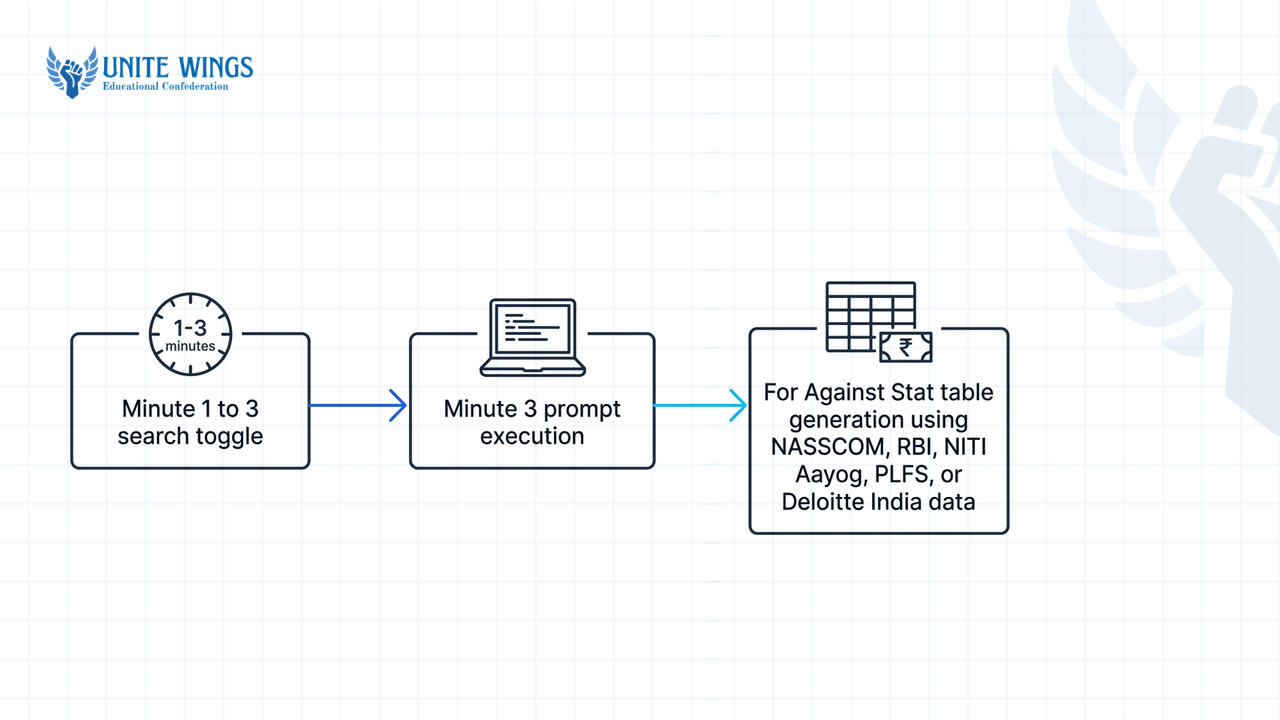
"Search the web for the latest 2025 and 2026 Indian data from NASSCOM, RBI, NITI Aayog, PLFS, or Deloitte India on the GD topic: '[Insert Topic]'. Create a 3-column table: Column 1 is 'For the motion', Column 2 is 'Against the motion', and Column 3 is 'Exact Indian Stat & Source to Quote'. Keep every cell under 25 words so I can memorize it in 3 minutes."
Here is what that table looks like when you run it for a real campus drive, using verified 2026 numbers you can memorize right now:
| GD topic cluster | Exact stat to quote in your panel | Source to credit out loud |
|---|---|---|
| AI replacing human jobs | AI will automate roughly 26% of current jobs globally by 2030, while India's direct tech sector employs over 5.4 million people. | World Economic Forum 2026 & NASSCOM (2025 single-source tracker) |
| Skill-based vs degree hiring | 21% of Indian companies now use skills-first fresher hiring, while 51% still filter initial shortlists by CGPA. | HirePro State of College Hiring 2026 via The People's Board |
| Campus hiring & AI skills | Campus recruitment budgets rose 19%, 86% of employers use AI in hiring, and AI/analytics skills pay a 20% to 25% salary premium. | Deloitte India Campus Workforce Trends 2026 |
| Graduate unemployment & pay | Indian graduate unemployment sits at 11.2% (over 3x the national average); 73% of undergrads expect over ₹5 LPA, but only 40% get it. | Government PLFS data via Raysolute & Unstop 2026 |
If you want to learn how to set up custom instructions and deep research workflows so ChatGPT formats these tables automatically without re-typing the prompt, check out our ChatGPT Masterclass.
What prompt generates both 'For' and 'Against' points on controversial placement GD topics?
Use a role-play prompt that combines ChatGPT for students/freshers with the PREP framework (Point, Reason, Example, Point) to generate three 'For' and three 'Against' arguments in one screen. Recommended by PlacementPreparation.io and Haridwar University, PREP keeps your spoken turns under 45 seconds and stops you from rambling. You must prepare both sides during Minutes 5 to 8 because if the first four speakers in your room all speak "For" the motion, switching to a data-backed "Against" point is the fastest way to earn the 15% to 20% Leadership score.
Copy this prompt into the same chat thread:
"Act as an expert placement mentor. For the controversial campus placement GD topic '[Insert Topic]', provide 3 data-driven 'For' points and 3 counter-arguments ('Against') backed by 2026 Indian economic data. Structure every single point using the PREP (Point, Reason, Example, Point) framework so each takes 30 to 40 seconds to speak aloud."
Here is a worked example of how the PREP output sounds on the topic "Skill-based hiring vs. Traditional degree-based recruitment":
-
For (Skills-first):
- Point: Indian companies are actively shifting toward skills-first hiring because degrees alone no longer predict day-one coding or analytical output.
- Reason: Specialised skills in AI and data analytics directly generate revenue, whereas syllabus theory lags behind industry tools.
- Example: According to Deloitte India's Campus Workforce Trends 2026 report, AI and data analytics skills command a 20% to 25% salary premium over standard campus offers, and HirePro's 2026 report shows over 21% of companies have fully moved to skills-first fresher hiring.
- Point: Therefore, building a verified project portfolio matters more for salary growth than relying solely on a degree certificate.
-
Against (Degrees and CGPA still rule the filter):
- Point: Treating college degrees and CGPA as obsolete is dangerous for freshers because mass recruiters still use academic cutoffs to manage application volume.
- Reason: When thousands of applicants apply for limited roles, automated resume parsers need a standardized baseline filter before evaluating practical skills.
- Example: HirePro's 2026 college-hiring research confirms that 51% of employers in India still weigh CGPA heavily during initial shortlisting, and Aon's 2026-27 campus study via LiveMint shows top Tier-1 engineering colleges and IIMs still command median TCC packages of ₹14.75 lakh and ₹26 lakh respectively.
- Point: Consequently, a student must maintain at least a 7.5+ CGPA to enter the room where their practical skills can actually be tested.
How do I use ChatGPT to prepare a 45-second opening or summary statement for a GD?
Prompt ChatGPT to write a 110-to-120-word script using the PREP structure that defines the core terms, drops one national metric, and hands a question to the group. Speaking at an average Indian campus pace of 150 words per minute, 115 words takes exactly 45 seconds. Spend Minutes 8 to 10 generating this script and reading it out loud twice.
Use this prompt to get both an opener and a closing template:
"Using the PREP framework (Point, Reason, Example, Point), write a concise 45-second opening script (110 to 120 words) for a GD on '[Insert Topic]' tailored for an Indian campus placement audience. Define the scope, cite one 2026 Indian metric, take a balanced stand, and invite the group to discuss. Also write a 45-second summary statement template I can adapt on the fly."
Sample 45-second opening script (116 words)
"Good morning everyone. Before we debate whether AI is a threat or an opportunity for Indian freshers, let's define the scope: we are looking at entry-level service and product roles over the next four years. My point is that AI is a role-filter, not a job-eraser. The reason is that while routine coding and testing are being automated, companies are expanding budgets for candidates who can audit and deploy AI outputs. For example, while the World Economic Forum estimates AI will automate 26% of global jobs by 2030, Deloitte India's 2026 campus report shows campus hiring budgets actually grew by 19%. So AI rewards upskilling. Let's discuss how our college curricula should adapt."
Plug-and-play 45-second summary template (108 words)
"As we wrap up our discussion on [Topic], our group covered three distinct dimensions. First, on the economic side, [Name/we] pointed out [Point 1], supported by data showing [insert 1 stat from your table]. Second, we examined the execution bottleneck in India, where several speakers noted that [Point 2 / Counter-argument]. While the panel was divided on [specific area of disagreement], we reached a clear consensus that [shared middle-ground solution, e.g., public-private upskilling / phased regulation] is the practical path forward rather than an extreme ban or unchecked adoption. Ultimately, balancing growth with guardrails remains the core takeaway from our table today."
How can I practice countering aggressive speakers using ChatGPT Voice Mode?
Open the ChatGPT mobile app on iOS or Android, go to Settings > Voice, select "Live" mode, and paste an aggressive co-participant prompt to rehearse defending your points for the final five minutes (Minutes 10 to 15) of your prep. As documented by Kim Komando and OpenAI's 2026 voice release documentation, Live mode supports continuous bi-directional audio streaming, meaning the AI will interrupt you mid-sentence and let you talk back over it just like a chaotic campus "fish-market" GD.
Before you start, watch your account limits. According to 2026 benchmarks from Copilot Interview, Free tier accounts have heavily restricted voice access, while Plus, Go, Team, and Enterprise tiers are capped at 3 hours of Advanced Voice Mode usage per rolling 24-hour period. Because pricing and hourly caps change frequently, check your remaining quota inside the ChatGPT mobile app settings before placement week. If you are on a free account, run your research in text mode and save your voice minutes strictly for this 5-minute drill.
Follow these 4 steps to run your simulation, a method backed by AI Workforce Alliance:
- Paste this prompt into the text box before tapping the soundwave icon: "Act as an assertive, aggressive co-participant in a high-pressure Indian campus placement group discussion on '[Insert Topic]'. Disagree with my opening arguments midway after 20 seconds, interrupt me sharply when my arguments lack specific facts, and force me to back up my points with statistics while I stay polite."
- Tap the voice soundwave icon and start reading your 45-second opening script without looking at the screen.
- When ChatGPT cuts you off midway, do not raise your volume and do not stop completely. Use the "Acknowledge-Bridge-Stat" recovery line: "I hear your concern on the cost side, Rahul, and let me finish my 10-second metric from the RBI before we connect both points..."
- After 4 minutes of back-and-forth, say: "Stop roleplay. Score my responses against the standard Indian placement rubric: 30% Communication, 25% Content, 20% Leadership, 15% Teamwork, and 10% vocal tone. Tell me one sentence where I sounded defensive."
If you freeze when real humans talk over you even after practicing with an AI bot, join our Group Discussion and Speaking Masterclass to practice live rounds with feedback.
What are the 20 most repeated campus placement GD topics in India right now?
The 20 most repeated campus placement GD topics in India for 2026 cluster around four buckets: AI and tech disruption, post-pandemic work policies, Indian macroeconomic shifts (UPI, EVs, Make in India), and abstract lateral-thinking statements. How panels pick from this list depends on the company vertical. Mass IT recruiters like TCS, Infosys, and Wipro favour technology and current affairs, while management consulting firms and MBA panels use abstract topics to test structured framing under pressure.
Use this master list compiled from 2026 placement trackers at HireStepX, TalkDrill, and PlacementPreparation.io to run your 15-minute ChatGPT prep drills:
- AI replacing human jobs: Threat or opportunity for freshers? (Pair with the WEF 26% automation by 2030 stat).
- Remote work vs. Office work: What works best for corporate India? (Split by IT service security vs tier-2 town rent savings).
- Skill-based hiring vs. Traditional degree-based recruitment. (Quote HirePro's 21% skills-first vs 51% CGPA filter data).
- India's Electric Vehicle (EV) transition: Are we ready for mass adoption? (Focus on charging infrastructure vs battery import reliance).
- Data privacy vs. National security in the digital age. (Anchor on India's DPDP Act implementation).
- Cashless economy and the long-term economic impact of UPI. (Discuss merchant MDR fees vs rural credit formalization).
- India's startup ecosystem: Structural growth engine or overvalued bubble? (Compare governance failures against deep-tech and SaaS profitability).
- Should coding and AI literacy be mandatory in school curricula? (Contrast rural foundational literacy gaps with NEP 2020 goals).
- Mental health crisis among Indian corporate youth and campus graduates. (Link to the 11.2% PLFS graduate unemployment pressure).
- Gig economy: Flexible career autonomy or systemic job insecurity? (Discuss social security codes for delivery and platform workers).
- Climate change responsibility: Developed vs. Developing nations (India's net-zero trajectory). (Balance coal baseload needs against solar capacity).
- Brain drain vs. Global opportunity for Indian engineering graduates. (Look at Global Capability Centres hiring inside India vs H-1B routes).
- Social media content regulation and deepfake management frameworks. (Focus on IT Rules intermediary liability and election integrity).
- Digital education vs. Traditional classroom learning post-pandemic. (Compare EdTech completion drops against hybrid tier-3 access).
- Is a college degree losing its value in the age of generative AI? (Compare B.Tech 70.15% employability via PW Skills with the fact that 84% of undergraduate students remain unplaced).
- Should India prioritize domestic manufacturing (Make in India) over services? (Weigh PLI electronics schemes against our 5.4M+ IT workforce).
- Ethics of utilizing generative AI tools for academic coursework or professional tasks. (Discuss disclosure rules vs ban policies).
- Success requires continuous upskilling in an economy where AI skills command a 20%–25% premium.
- Abstract: "A stitch in time saves nine" applied to modern engineering management. (Connect to cybersecurity patching, technical debt, or early EV battery safety standards).
- Abstract: "Empty vessels make the most noise." (Connect to corporate communication, vaporware startup valuations, or social media misinformation).
Your 7-day action plan before placement season starts
Do not wait until you are sitting outside the placement cell with 15 minutes left to try these prompts for the first time. Run this schedule this week so the workflow becomes automatic:
- Today (30 minutes): Pick topics #1, #3, and #6 from the list above. Run the 3-column ChatGPT Search table prompt for all three and save the output into a single Google Doc or Notion sheet on your phone.
- This week (15 minutes a day for 4 days): Pick one current affairs topic and one abstract topic (#18 to #20) each evening. Run the 5-minute Aggressive Speaker Live Voice drill to get comfortable using the "Acknowledge-Bridge-Stat" recovery phrase without losing your train of thought.
- The morning of your campus drive (15 minutes): Check the news via ChatGPT Search for any RBI policy rate changes or major tech layoffs from the last 48 hours, and write down three versatile Indian stats (like the 56.35% employability rate or 86% employer AI adoption) on an index card so you can weave them into any topic the panel throws at you.
Practice in a real panel before your campus drive
Practicing with ChatGPT Voice gets your facts and timing ready, but speaking up across 10 nervous peers takes live room practice. Join the Group Discussion and Speaking Masterclass to learn exact entry and summary structures, run a live mock GD round with an evaluator, and walk away with a personal score sheet on your body language, interruption recovery, and speaking pace.
Frequently asked questions
How do I integrate real-time 2026 statistics into an abstract GD topic where facts aren't obvious?
Map the abstract phrase to three concrete Indian buckets using the PESTEL lens (Political, Economic, Technological) and cite one 2026 metric for the economic bucket. For example, on "Empty vessels make the most noise," compare overhyped startups to actual execution, citing the Unstop 2026 stat that 84% of undergrads remain unplaced despite loud degree credentials.
What should I do if someone cuts me off mid-sentence during a placement GD?
Hold up an open palm at chest level, keep your voice at a steady volume, and say, "Let me take just 10 seconds to finish the RBI number on that point, and then I'd love to hear your view." Evaluators deduct from your 15%–20% Teamwork score if you shout back, and deduct from your 20% Leadership score if you immediately go silent.
How do I break the ice or initiate a group discussion without sounding aggressive?
Spend your first 15 seconds defining the terms of the topic and setting two or three sub-questions for the table before stating your own opinion. Evaluators reward candidates who create a structured roadmap for the group rather than those who treat the opening turn as a solo debate speech.
How do I use ChatGPT Voice Mode without hitting limits on a free account?
Do all your topic research, PREP argument generation, and 45-second script writing in standard text mode first, which does not touch your voice quota. Only turn on Voice Mode for the final 4-minute interruption drill, or use the free standard speech-to-text microphone icon in the text box if your daily Live Voice preview runs out.
What are the most frequent campus GD topics asked by mass recruiters like TCS, Infosys, and Wipro?
Mass IT recruiters almost always select from technology ethics, workplace models, and Indian digital infrastructure rather than complex management cases. Expect topics like AI replacing entry-level coding jobs, hybrid vs office return mandates, India's UPI and cashless economy growth, skill-based hiring vs CGPA cutoffs, and data privacy under India's digital laws.
Newsletter
Stay updated with our latest news and insights.