
How Freshers Use Perplexity Deep Research to Build Proof of Work
Turn zero internship experience into a published industry teardown or competitor report in 48 hours using Perplexity Deep Research and Pages.
To use Perplexity Deep Research for portfolio projects, run a structured specification prompt on a real Indian startup problem, manually verify the inline citations, add your own product or data fixes, and publish the output as a Perplexity Page or Notion document. Launched on February 14, 2025, by Perplexity AI, the Deep Research feature performs 20 to 50 targeted queries per task and reads over 100 to 200 sources per report, cutting research time by roughly 50% according to Espressio's 2026 update. For Indian freshers without internship experience, turning that raw data into a verified competitor teardown or unit economics audit is the fastest way to bypass the Naukri resume black hole.
In short
- Build 2 to 3 focused case studies following a 7-step framework (Problem to Learning) rather than a generic resume gallery (Craftup Learn).
- Entry-level Associate Product Manager (APM) pay in India ranges from ₹8 to ₹22 LPA (Instahyre / Masai School, 2026), while fresher Product Analysts make ₹5 to ₹10 LPA (MyInHand India, 2026).
- Run Deep Research one competitor at a time using a rigid specification prompt so your comparison tables line up cleanly (Competely).
- Always manually verify your links: a 2026 Columbia Journalism Review (Tow Center) report found a 37% citation error rate on Perplexity.
- Send cold LinkedIn DMs under 100 words that lead with a specific user drop-off metric and a direct
perplexity.ai/page/...link, never a bulky PDF attachment.
What kind of research portfolio project gets a fresher noticed for analyst, PM, or marketing roles?
Hiring managers at funded Indian startups and Global Capability Centres (GCCs) want 2 to 3 focused case studies that show your problem-solving reasoning, not a static gallery of certificates or toy datasets, according to 2025–2026 guides from NueCareer and Medium. According to the India Skills Report 2026 by Wheebox, project-based hiring in India has grown by nearly 40%, while traditional IT services firms still account for roughly 35% of fresher hiring. To break into the higher-paying product firms and GCCs without an internship on your resume, your proof of work must solve a live commercial problem for a company you actually want to join.
The compensation gap between mass-recruiting IT services and product-native companies makes a weekend of research worth the effort. For Product Analysts, a 2026 MyInHand India report puts fresher salaries at ₹5 to ₹9 LPA, scaling up to ₹10 LPA at funded product companies if you pair SQL with strong business sense. For Associate Product Managers (APMs), 2026 data trackers show a wider range depending on employer type: Intervue and Masai School cite ₹8 to ₹22 LPA across IT services and startups, while Instahyre's 2026 report lists APM bands starting at ₹12 to ₹22 LPA, with top-tier startup and big tech APM programs reaching ₹28 to ₹45 LPA. Salary bands shift every hiring cycle, so check Instahyre before you negotiate.
What most students get wrong is submitting generic bootcamp capstones, such as running a survival prediction on the Titanic dataset or proposing a dark-mode toggle for Spotify. Hiring managers reject these immediately because they show zero understanding of how an Indian business makes money. Instead, pick your project type based on the exact role you are targeting:
| Target role | What recruiters reject | High-signal proof of work project | Core framework or output |
|---|---|---|---|
| Associate Product Manager (APM) | Feature wishlists without business constraints | Quick-commerce checkout friction audit (e.g., Blinkit vs Zepto) | Problem → evidence → alternatives → decision → execution → metrics → learning (Craftup Learn) |
| Product / Business Analyst | Generic Kaggle datasets (Titanic, Iris, housing prices) | Customer cohort retention, churn analysis, and marketing funnel SQL/Python dashboards (Topfolio / WinInLife, 2026) | Unit economics breakdown + SQL query logic + retention table |
| Growth / Performance Marketing | Theoretical brand personas with fake budgets | Targeted brand teardown, landing page mockup (built in Lovable), and growth experiment with real pricing (Kraftshala, 2026) | Positioning matrix + ad copy variations + conversion funnel fix |
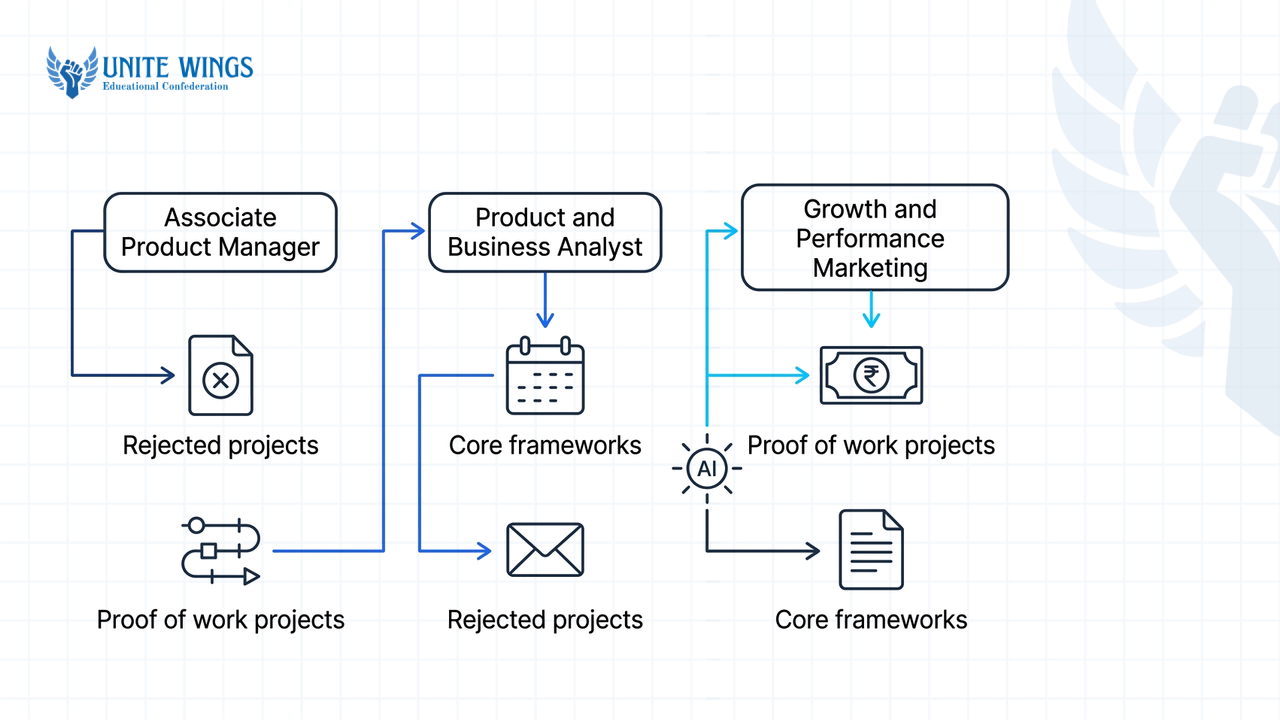
If you want to learn how to use Perplexity Deep Research for portfolio projects over a single weekend, build a 48-Hour Quick-Commerce Unit Economics Teardown (Blinkit vs Zepto). This single project works for PM, analyst, and growth roles because it combines public financial metrics from Indian tech media with raw user complaints. You will spend Saturday extracting the data with Perplexity Deep Research and Sunday verifying citations, designing fixes, and publishing your report.
How do I use Perplexity Deep Research to audit an Indian startup's competitors and user complaints?
To audit an Indian startup using Perplexity Deep Research, first create a dedicated Perplexity Space with standing instructions to prioritize Indian business sources, then run a rigid specification prompt for one competitor at a time. As Medium and Espressio note, Deep Research plans a multi-step trajectory, issues 10 to 30 sub-queries, and reads over 100 to 200 sources to produce a dense 5-to-6-page cited report.
Most tutorials treat Perplexity like a casual chatbot, telling you to type "Analyze Blinkit vs Zepto." That produces vague summaries. Furthermore, early-stage and domestic Indian startups rarely have deep review footprints on US-centric sites like G2. You have to force the agent to look at Indian tech media (like Inc42 and Entrackr) alongside Reddit India sub-communities and Twitter/X threads.
Follow this exact Saturday workflow (Hours 1 to 12 of your 48-hour blueprint) to extract clean data:
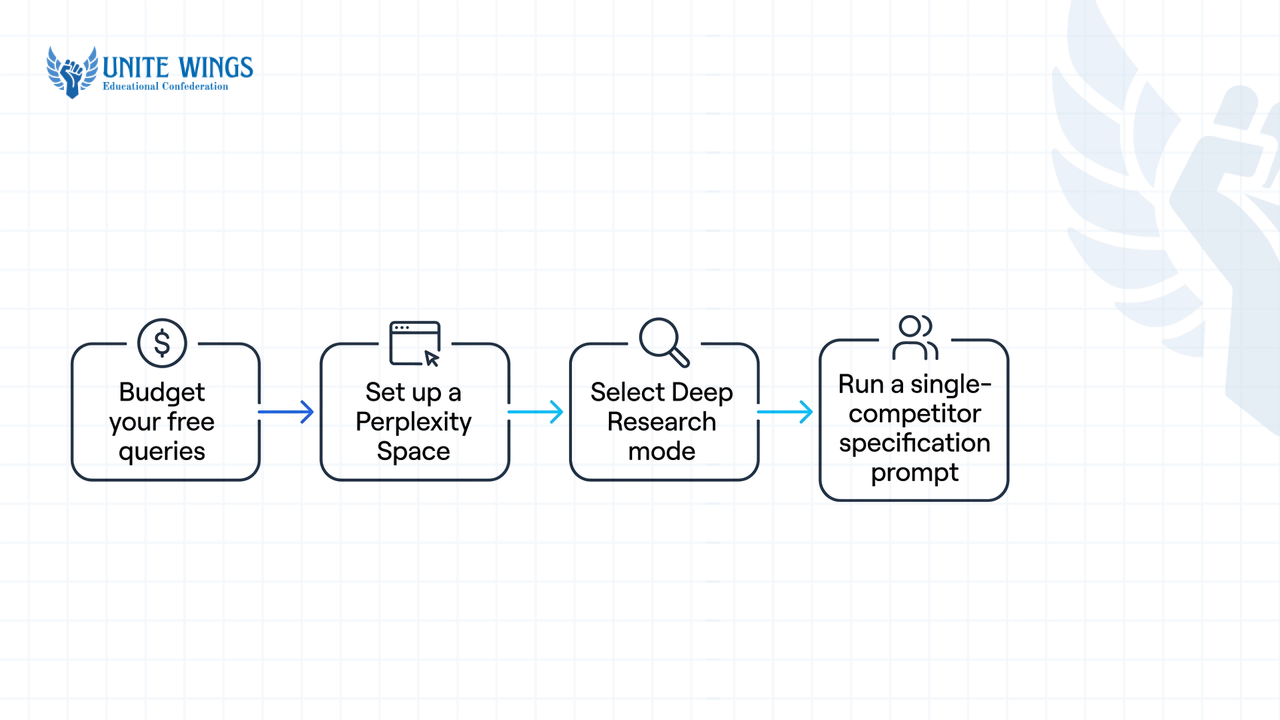
- Budget your free queries before you start: Free-tier users only get a small daily allotment of Deep Research runs (Perplexity AI), and heavy usage can trigger a silent fallback to lighter models. Perplexity Pro costs $20 per month or $200 per year (AI Weekly). Always check perplexity.ai for current pricing and daily free-tier limits. If you are on a free account, test and refine your prompt in standard search mode first so you do not waste your daily Deep Research quota on a bad prompt.
- Set up a Perplexity Space: Open Perplexity Spaces, which function as persistent project folders with custom instructions (GitHub / AI Weekly), and create a Space named "Indian Quick-Commerce Audit." In the custom instructions box, paste: "Prioritize primary filings, Indian business media (Inc42, Entrackr, Economic Times), and Indian Reddit communities (r/india, r/bangalore, r/mumbai). Always cite primary sources and report figures in INR."
- Select Deep Research mode: Go to
perplexity.aiinside your new Space, click the mode selector dropdown in the search box, and select "Deep Research" before submitting. (If you use the API, Perplexity's 2026 documentation notes you can set the Sonar Deep Research reasoning effort to "high"). - Run a single-competitor specification prompt: According to Competely, running Deep Research one competitor at a time using identical specs ensures your data points line up uniformly for a comparison matrix. Combining dimensions from Techpresso and Founder Prompts, paste this exact prompt for Blinkit first, and then run a second separate query for Zepto:
Copy-paste specification prompt: "Run a commercial and product audit of Blinkit in India (2025–2026 data). Structure the output into these exact 7 sections:
- Product Overview & Dark Store Footprint
- Unit Economics (Average Order Value in INR, delivery fees, handling charges, small cart fees, and platform fees)
- Target Audience & Positioning
- Key Features & Recent Launches (last 12 months)
- Strengths & Strategic Moats
- Weaknesses & Operational Bottlenecks
- Customer Complaints & Sentiment: Extract specific user complaints from Reddit and X regarding checkout friction, hidden fees, late-night surge pricing, and refund/support flows. Quote actual user complaints and link every claim inline."
If you want to pair Perplexity's web retrieval with document synthesis for deeper industry reports, we teach the complete two-tool workflow in our Research with AI: Perplexity and NotebookLM session.
How do I turn raw Perplexity research into a clean, shareable Perplexity Page or Notion doc?
To turn your research thread into a portfolio asset, click "Share" or "Create Page" at the bottom of your Perplexity session to generate a formatted perplexity.ai/page/... URL, or export the markdown into Notion to build side-by-side comparison tables. Launched in May 2024 (TechCrunch), Perplexity Pages transform messy search threads into publishable web documents that preserve inline citations and visual structure.
Recruiters screening 300 applications on LinkedIn or Internshala will not download a 15-megabyte PDF attachment on their phones. A public URL loads in two seconds and shows you know how to package documentation like an actual PM or analyst.
In Hours 13 to 24 of your weekend blueprint, convert your two separate Deep Research runs (Blinkit and Zepto) into a unified teardown using Craftup Learn's 7-part case-study structure:
- Generate the base document: If you want speed, click "Create Page" inside Perplexity to get a
perplexity.ai/page/...link, then use the section tools to delete repetitive introductory paragraphs. If you want to embed custom SQL snippets or interactive Figma/Lovable wireframes alongside your text, copy the Perplexity markdown into a public Notion page. - Merge the two competitor runs into one comparison matrix: Never paste two separate AI reports stacked on top of each other. Build a unified table right under your executive summary that compares Blinkit and Zepto across identical rows: Average Order Value (AOV), threshold for free delivery, rainwater/surge fee triggers, and average checkout clicks.
- Rewrite the headings to match the 7-part PM structure: Replace generic AI headings ("Introduction", "Conclusion") with action-oriented headers that follow the exact Craftup Learn sequence:
- Problem: Define the exact commercial leak (e.g., "Cart abandonment at the payment screen among tier-1 college students ordering sub-₹199 baskets").
- Evidence: Insert your Perplexity comparison table and 3 verbatim Reddit complaints with inline links.
- Alternatives: List 2 ways the company could fix this (e.g., raising the minimum order value vs introducing a student pass).
- Decision: State which option you recommend and why it protects unit economics.
- Execution: Embed a quick mockup (built using Lovable or Canva) or a SQL query logic block showing how you would segment the users.
- Metrics: Name the exact tracking metric (e.g., "Checkout-to-Payment conversion rate for carts between ₹149 and ₹199").
- Learning: Add a 3-sentence reflection on where your data had blind spots.
How do I fact-check and add my own original thinking so recruiters don't dismiss it as AI slop?
To prevent recruiters from rejecting your project as AI-generated slop, manually click through every inline citation to verify the source, run a secondary verification prompt to catch hallucinated numbers, and add an original "Counter-Thesis" section. While Deep Research scored 93.9% on the SimpleQA factuality benchmark and 21.1% on Humanity's Last Exam (InfoQ / Perplexity AI), a 2026 Columbia Journalism Review (Tow Center) study reported that Perplexity's citation error rate hovers around 37%.
Furthermore, AI Weekly notes that Perplexity cannot bypass subscription or journal paywalls. When auditing Indian startups or B2B software, the retrieval layer only reads public abstracts or secondary news summaries, which often contain outdated pricing or misattributed metrics. (Perplexity did launch Model Council on February 5, 2026, to cross-check queries across three frontier models simultaneously and generate a consensus-divergence report, but AI Weekly reports that feature is locked behind the $200/month Max plan).
In Hours 25 to 36 of your weekend blueprint, run this three-step verification and human-synthesis pass:
- Audit the inline citations manually: Perplexity places numbered links directly next to individual claims (Competely). Click through every single number in your comparison table. If a citation claims Blinkit's average order value is ₹612, make sure the linked article actually states ₹612 for the current quarter, not from a 2023 blog post.
- Run the EnterpriseDNA verification pass: According to EnterpriseDNA (2026), you should feed your draft and its source text into a reasoning model with strict instructions to flag unsupported claims. Paste your drafted section and the text of the cited articles into a new chat with this prompt: "Act as a fact-checker. Review my draft against the pasted source text. Flag any number, pricing tier, or claim in my draft that is not explicitly stated in the source text, and identify any context I omitted."
- Add the "What the AI Missed" section: Because Deep Research cannot see inside a mobile app's live login wall, take your phone, open both the Blinkit and Zepto apps at 11:00 PM on a Saturday, add a ₹150 item to your cart in both, and screenshot the exact fee breakdowns. Put those two real screenshots right next to your Perplexity research table, and write a 150-word paragraph titled "Live App Audit vs Public Data." Pointing out where live app pricing contradicts public news reports is the single fastest way to prove a human built the teardown.
If you want guided mentorship on scoping your project, verifying the data, and packaging the final case study, check out our AI Portfolio Sprint.
How should I pitch my research teardown to a founder or hiring manager on LinkedIn?
To pitch your teardown on LinkedIn, send a cold message under 100 words to a Product Manager, Analytics Lead, or founder that leads with a specific metric or friction point you uncovered, followed by the direct link to your Perplexity Page or Notion doc. Career education consensus in 2026 is clear: never ask "Are you hiring freshers?" in your first message, and never attach a PDF file.
Before you send your outreach in Hours 37 to 48, put the project on your resume so your profile matches your pitch. Do not list it under "Academic Projects." Create a section titled Product & Market Research Proof of Work and use this two-bullet template:
- Quick-Commerce Unit Economics & Checkout Teardown (Blinkit vs Zepto): Synthesized 120+ public sources and Reddit sentiment threads using Perplexity Deep Research to map fee structures and sub-₹199 cart abandonment triggers ([Link to Perplexity Page]).
- Retention & Funnel Recommendations: Audited live mobile checkout flows to identify 3 hidden-fee drop-off points; proposed a tiered student-pass alternative and SQL cohort tracking schema to improve checkout-to-payment conversion.
Once your resume and LinkedIn Featured section have the link, find 10 Senior Product Managers, Product Analysts, or Founders at your target companies on LinkedIn. Send this exact sub-100-word outreach message:
"Hey [First Name], I ran a Deep Research audit on [Company Name]'s checkout friction compared to [Competitor], combining 100+ public sources with real user complaints from Indian Reddit and X threads.
I found 3 specific drop-off triggers around small-cart fee disclosures and drafted two alternative checkout flows (plus the tracking metrics) on this Perplexity Page: [Insert perplexity.ai/page/... or Notion URL].
I'm a final-year student targeting [APM / Product Analyst] roles. Would love your quick take on whether my unit-economics assumptions in Section 2 hold up if you have 2 minutes."
This works because you are offering free competitive research that took you 48 hours to compile, and asking for a 2-minute critique on a specific section rather than begging for a job.
Your 7-day execution plan
Stop waiting for your college placement cell to bring product companies to campus. Set aside this weekend and follow this schedule:
- Today (30 minutes): Create a free Perplexity account, set up one Perplexity Space for your target Indian sector (Fintech, Quick-Commerce, EdTech, or SaaS), and paste in the India-specific custom instructions from Section 2.
- This weekend (48 hours): Pick two direct competitors (e.g., Blinkit vs Zepto, Groww vs Zerodha, or Swiggy Instamart vs BigBasket Now). Run the 7-part specification prompt on Saturday, verify every inline citation and add live app screenshots on Sunday morning, and publish your Perplexity Page or Notion doc by Sunday night.
- Next Tuesday (1 hour): Add the published URL to your resume and LinkedIn Featured section, then send the sub-100-word outreach script to 10 PMs, analytics leads, or startup founders.
Build your proof-of-work project with us
If you want a structured template and feedback on your teardown before you send it to hiring managers, join the AI Portfolio Sprint. You will pick a real startup problem, research and build the project using AI tools without writing generic slop, and walk away with a published portfolio link ready for your resume and cold DMs.
Frequently asked questions
Is Perplexity Deep Research free to use for students?
Yes, Perplexity offers Deep Research on its free tier, but free users only receive a small daily allotment of queries (Perplexity AI). If you need higher daily limits to run multiple competitor audits, Perplexity Pro costs $20 per month or $200 per year (AI Weekly). Always verify current student or trial pricing directly on perplexity.ai.
Can recruiters spot if my project or competitor teardown was written by AI?
Yes, recruiters immediately spot unedited AI output because it uses generic headings, lacks local Indian market nuances, and often contains broken or hallucinated citations. A 2026 Columbia Journalism Review (Tow Center) report found a 37% citation error rate on Perplexity, so you must manually check every link and add your own live app screenshots and counter-arguments.
How many competitor research projects should a fresher put in a portfolio?
You need 2 to 3 focused, deeply researched case studies rather than a gallery of 10 superficial projects, according to 2025–2026 portfolio guides from Medium and NueCareer. Two teardowns that show your complete decision-making process, covering raw evidence, user complaints, metrics, and trade-offs, are enough to get shortlisted for fresher interviews.
Are Perplexity Pages visible publicly on Google search?
Yes, when you convert a research thread into a Perplexity Page, it generates a public, shareable web document with a perplexity.ai/page/... URL (TechCrunch / AI Weekly). Anyone with the link, including recruiters and hiring managers who do not have a Perplexity account, can view your formatted report and click your inline citations in their browser.
How much do Product Analysts and Associate Product Managers make in India?
In 2026, entry-level Associate Product Manager (APM) salaries in India range from ₹8 to ₹22 LPA across IT services and startups, while top-tier startups and big tech APM programs pay ₹28 to ₹45 LPA (Masai School / Intervue / Instahyre, 2026). Fresher Product Analysts earn between ₹5 and ₹9 LPA, scaling up to ₹10 LPA at funded product companies (MyInHand India, 2026).
How do I structure a competitor teardown prompt for Perplexity?
Do not use vague chat prompts like "Compare Company A and Company B." According to Competely, you should run Deep Research on one competitor at a time using a rigid specification brief that forces the AI to report on identical categories: Product Overview, Pricing/Unit Economics, Positioning, Key Features, Strengths, Weaknesses, and Customer Complaints.
Newsletter
Stay updated with our latest news and insights.