Alumni Networking vs Cold Outreach to Recruiters: What Works for Freshers?
Side-by-side reply rates, time-to-interview, and referral odds across college alumni, hiring managers, and HR recruiters in India, split by Tier-1 and Tier-3 colleges.
For Indian college students and freshers, alumni networking yields a 25% to 40% reply rate (Offerloop, 2026), while generic cold outreach to recruiters and hiring managers returns 1% to 15% (Whali and TryKondo, 2025–2026). If you are from a Tier-1 or Tier-2 college applying to Indian IT services or product MNCs, spend 60% to 70% of your weekly LinkedIn requests on alumni who graduated one to five years ago. If you are from a Tier-3 college with few alumni in your target firms, or you are targeting early-stage startups, shift your focus to hiring managers and back up every message with public proof of work like a GitHub repo or live project.
In short
- Alumni win on response rate: Warm alma mater outreach gets 25% to 40% replies (Offerloop, 2026), compared to 10.3% on standard LinkedIn InMails (Syncwell, 2026) and 1% to 15% on cold emails (Whali, 2026).
- Referrals convert 4x to 6x better: Referred candidates convert from application to hire at 28.2% (EqoRefer and LinkedIn Global Talent Trends, 2026), and account for 30% to 40% of hiring pipelines in major Indian IT firms (NASSCOM data cited in 3university.io, 2026).
- Split your weekly LinkedIn cap: Keep weekly invitations at 80 to 100 for established accounts (20 to 50 for new accounts) and split them 60/40 between alumni seniors and active recruiters or hiring managers (Board Infinity, 2026).
- Guard your pending queue: Withdraw unanswered connection requests before your pending count hits 500, or LinkedIn's security filters may restrict your account for low acceptance rates (LinkedAPI, 2026).
Who replies faster on LinkedIn: HR recruiters, hiring managers, or alumni?
College alumni who graduated one to five years ago reply the fastest and most consistently, returning 25% to 40% of outreach messages (Offerloop, 2026). HR recruiters and hiring managers reply to generic cold outreach at 1% to 15% (Whali and TryKondo, 2026), while targeted LinkedIn InMails with personalized hooks reach 18% to 25% (Syncwell and Easy.jobs, 2026).
Evaluating alumni networking vs cold outreach to recruiters for freshers comes down to inbox volume and personal incentives. Corporate recruiters manage 15 to 30 open roles at once and process hundreds of applications per opening, forcing them to pattern-match keywords rather than read cold pitches closely (DearHiringManager.io, 2026). Hiring managers control the technical competency decisions and final hiring choices, yet they have the lowest bandwidth for unscheduled LinkedIn chats (Jobtrackker, 2026). Alumni who finished college within the last one to five years still remember campus placement pressure, know the current entry-level interview rounds, and have a financial incentive to help: employee referral bonuses in Indian firms range from ₹20,000 to over ₹1,00,000 depending on the role level (RecruitKar, 2026).
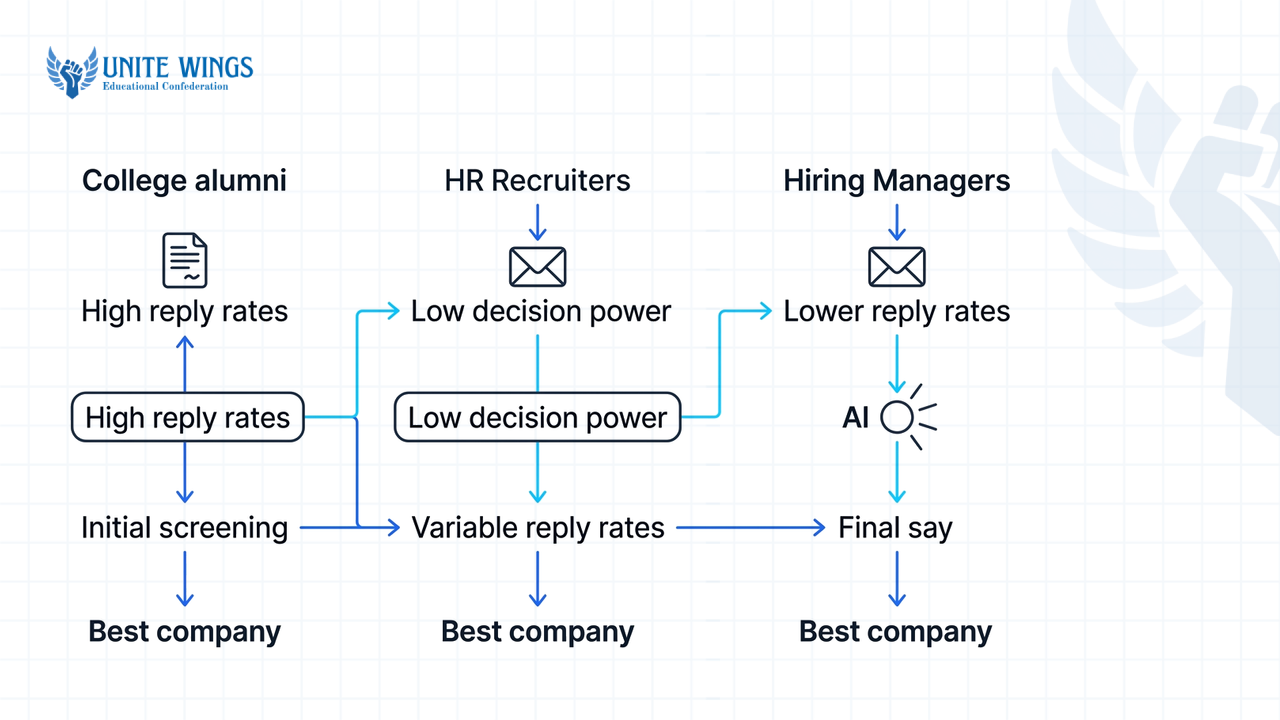
One caveat from Indian developer forums: while marketing benchmarks from Offerloop (2026) report 25% to 40% alumni response rates, student discussions on Reddit's r/developersIndia (2025–2026) note that cold messages to senior engineers at top-tier product companies often drop below a 10% reply rate because thousands of students message the same batchmates during placement season.
| Outreach target | Typical reply rate | Decision power | Best company type | Best for college tier | Primary goal of message |
|---|---|---|---|---|---|
| College alumni (1–5 yrs exp) | 25%–40% (under 10% if spammed at top product firms) | Flags resume for manual HR review via referral tag | Product MNCs and Indian IT services (TCS, Infosys, Wipro) | Tier-1 and Tier-2 (or Tier-3 where alumni exist) | 10-minute guidance chat or portal referral code |
| HR / Talent Acquisition | 1%–15% cold; 10.3% average on standard InMail | High-volume initial screening and administrative routing | Mid-sized tech firms and MNCs with active job requisitions | All tiers (when you closely match the job description keywords) | Confirming an active Job ID and getting into the screening queue |
| Hiring managers (Engg Managers, Founders) | 1%–15% generic; 18%–25% with targeted proof-of-work | Final technical evaluation and headcount approval | Early-stage startups and mid-sized firms without HR gates | Tier-3 students with strong GitHub/projects, and startup applicants | Direct technical interview bypassing HR screening |
What most students get wrong is sending a "Hi sir, please refer me" message to an alumnus they have never spoken to. According to C2Club (2026), alumni view cold referral requests from strangers as a direct risk to their internal company reputation. Furthermore, RecruitKar (2026) notes that referral bonuses in India are legally classified and taxed as salary income, which reduces an employee's eagerness to vouch for an unvetted fresher. Fix this by asking for a 10-minute review of your project or resume first, or by sending your exact proof of fit alongside the Job ID so the senior sees zero reputational risk in clicking the refer button.
Do employee referrals from alumni actually bypass the ATS in Indian MNCs?
An alumni referral does not skip the Applicant Tracking System parser, nor does it exempt you from coding assessments, but it bypasses the automated sorting backlog by attaching a priority tag to your profile (AssuredReferral and CareerEnlightenment, 2026). Referred candidates convert from application to hire at 28.2%, making them four to six times more likely to be hired than job board applicants (EqoRefer and LinkedIn Global Talent Trends, 2026).
A common myth on college campuses is that ATS software instantly deletes 75% of fresher resumes. Single-source data from ResumeAdapter cited in CareerEnlightenment (2026) shows that 92% of ATS platforms do not auto-reject resumes; instead, they parse, rank, and sort candidates by keyword match. However, the Ashby Talent Trends report cited by DearHiringManager.io (2026) points to a sharp rise in applications per hire, meaning a fresher ranked at number 400 in an unreferred queue will never be seen by a human recruiter before the role closes.
In Indian IT services and product firms, employee referrals account for 30% to 40% of total hiring pipelines (NASSCOM data cited in 3university.io, 2026). When a senior submits your resume inside an enterprise MNC using platforms like Workday or SAP SuccessFactors, the system explicitly tags your candidate profile with that employee's internal ID (3university.io, 2026). According to FACE Prep and Refer.me (2026), this referral tag routes your application into a separate, accelerated tracking queue that mandates manual recruiter review. AssuredReferral and EasyRefer (2026) report that this manual review increases your odds of landing an interview by roughly 400%.
To make sure the ATS tag attaches properly without disqualifying your application, follow this exact sequence:
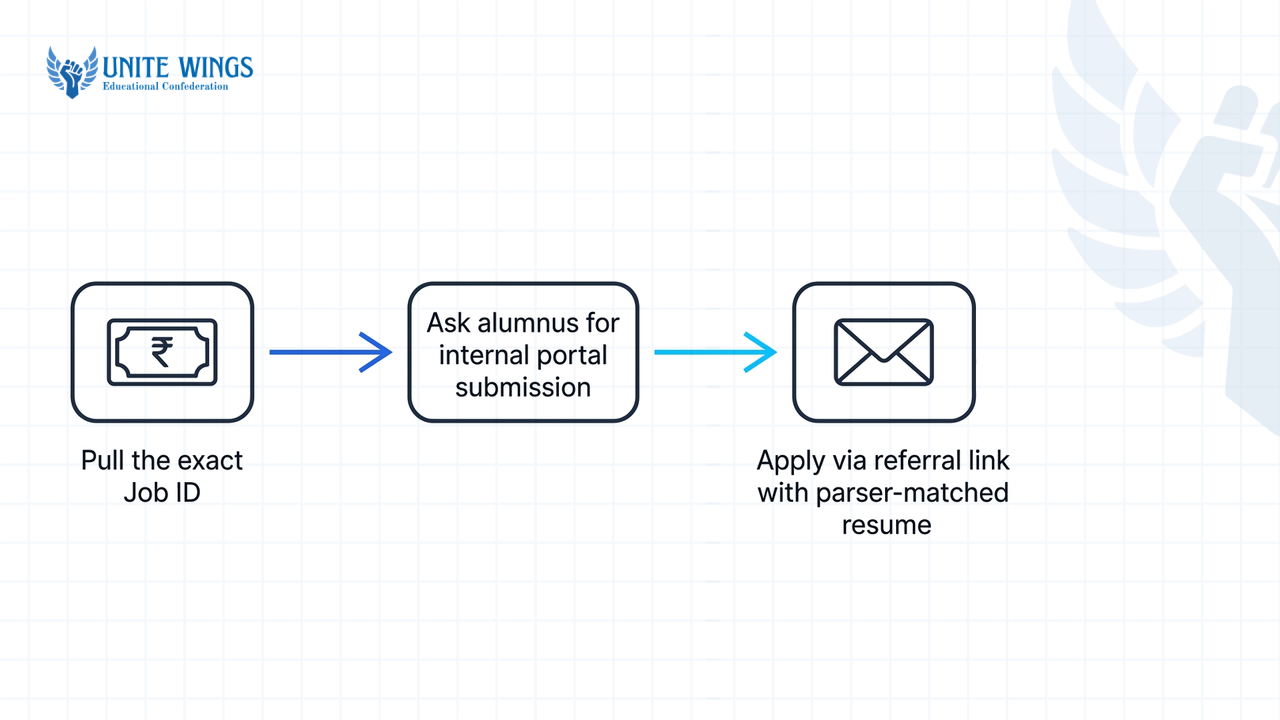
- Wait to apply on the public portal: In many enterprise MNCs, applying directly on the career site before an employee logs your email locks your profile in the general pool and blocks the referral tag. Ask your alumnus whether their company requires an internal portal submission link first.
- Pull the exact Job ID: Give your alumnus the specific alphanumeric requisition ID from the company career page, not a LinkedIn job URL.
- Match the parser keywords anyway: Since your resume still runs through Workday or SAP SuccessFactors parsing, mirror the exact skill nouns from the job description in your project bullets before sending the PDF. If your current draft isn't passing basic keyword checks, our Resume Masterclass walks you through rebuilding your bullets so a recruiter understands your fit in ten seconds.
When is it better to message a hiring manager directly instead of an alumnus?
Message a hiring manager directly when you are applying to early-stage startups or mid-sized companies that lack structured HR screening gates, or when your college has zero alumni inside the company (UCanLy, 2026). While generic cold messages get a 1% to 15% reply rate, targeted outreach with a specific technical hook reaches 18% to 25% (Syncwell and Onehour, 2026).
Traditional Indian IT services companies (like TCS, Infosys, and Wipro) and large global capability centers run rigid, bureaucratized pipelines where service-line hiring and fresher intakes go strictly through campus placement cells, national qualifier tests, or internal referral portals. Cold messaging an Engineering Manager at a 100,000-person IT firm rarely works because they cannot override central HR compliance for entry-level headcount.
Startups and mid-sized tech firms work the opposite way. UCanLy (2026) confirms that contacting a founder, CTO, or engineering manager directly beats messaging a recruiter in smaller firms because the hiring manager feels the immediate pain of the open role and can approve an interview on the spot.
Use these decision rules to pick your channel:
- If the company is a large-scale enterprise with an active Job ID: Contact an alumnus (1 to 5 years out of college) to get an internal ATS referral tag, and message the assigned HR recruiter with the Job ID.
- If the company is a seed to Series B startup: Skip HR and alumni. Message the Engineering Manager, Head of Product, or Founder directly with a working demo or GitHub link.
- If you attended a pre-placement talk or hackathon: Message the hiring manager or recruiter who spoke at the event within 48 hours. FACE Prep (2026) notes that reply rates drop sharply if you wait past 72 hours after a live interaction.
When you write to any of these three personas, keep your message under 100 words. On a free LinkedIn account, you only get 3 to 5 personalized connection notes per month with a 200-character limit, while LinkedIn Premium allows notes on all requests up to 300 characters (LinkedIn Help Center and Search-cora, 2026). Here is how to write for each within those limits:
- 200-character connection note to an alumnus (Free account): "Hi [Name], I'm a final-year CSE student at [College]. Saw your career path from our campus to [Company]. Would love to ask 2 quick questions about how your team evaluates fresher backend projects." (194 characters)
- Under-100-word message to a startup Hiring Manager (after connecting or via cold email): "Hi [Name], saw [Company] is hiring a Frontend Intern (Job ID: 402). I noticed your checkout page takes 4 seconds to load on mobile. I built a lightweight React prototype that cuts the bundle size by 30% (live link here: [URL] and GitHub repo here: [URL]). I've used TypeScript and Next.js across 3 production projects. Open to a 10-minute chat this week to see if I can help ship your Q3 roadmap?" (76 words)
What should I do if I am from a Tier-3 college with very few alumni in top firms?
If your Tier-3 college lacks alumni in target companies, replace institution-based networking with public proof of work, such as GitHub repositories, open-source contributions, and competitive programming ratings, and network through city-level tech meetups and open-source communities (CCBP and Reddit r/developersIndia, 2025–2026).
When you search LinkedIn for your college name plus a target product company and find zero results, you cannot rely on the 25% to 40% alma mater reply rate. CCBP (2025–2026) reports that companies hiring off-campus from Tier-3 colleges increasingly filter candidates by off-campus coding challenges, HackerRank profiles, and GitHub commit history rather than college pedigree. Community insights from r/Btechtards and r/developersIndia (2025–2026) point to three specific channels that replace an institutional alumni network:
- Open-source contributor graphs: Fix a documented bug or write documentation for an open-source repo maintained by engineers at your target firms. Raising a clean Pull Request puts you in direct technical conversation with senior developers without needing a LinkedIn connection request.
- Regional tech meetups in Tier-1 hubs: If you are near Bengaluru, Hyderabad, Pune, or NCR, attend weekend developer meetups (such as local Python, React, or AWS user groups). Following up within 48 hours of meeting an engineer in person gives you the same warm conversion rate that Tier-1 students get from college alumni (FACE Prep, 2026).
- Parallel WhatsApp and Discord communities: FACE Prep (2026) highlights that fresher hiring and referral sharing in India run heavily on active WhatsApp groups alongside LinkedIn.
When a Tier-3 student messages a stranger at a top firm for a referral, the message must eliminate the referrer's fear of looking bad internally (C2Club, 2026). Do not lead with your college name. Lead with verifiable technical output: state your HackerRank rating, link a deployed project that solves a problem in their domain, and attach a one-page resume alongside the exact Job ID.
How many connection requests should I split between recruiters and seniors each week?
Cap your weekly LinkedIn outbound activity at 80 to 100 connection requests for an established account, splitting them 60% to 70% toward alumni or technical seniors and 30% to 40% toward active recruiters and hiring managers (ConnectionTracker and Board Infinity, 2026). New accounts should stay between 20 and 50 requests per week (Linkdify, 2026).
LinkedIn does not publish official weekly invitation limits, so third-party tools report slightly different safe zones, ranging from 50 to 200 per week, depending on your account age and Social Selling Index (LinkedClient, Linkdify, and ConnectionTracker, 2026). Across established fresher accounts, keeping your rolling 7-day total between 80 and 100 requests (roughly 15 to 20 per day) prevents velocity throttling (ConnectionTracker and LinkedNav, 2026). Never use automated browser scraping extensions; ConnectionTracker (2026) confirms that aggressive automation triggers a mandatory 7-day restriction block on sending invitations. While LinkedIn's hard lifetime cap is 30,000 first-degree connections (LinkedIn Help Center, 2026), freshers hit temporary blocks long before that due to poor acceptance ratios.
Avoid the 500 pending request trap
Most students watch their weekly sending limit but ignore their unanswered outgoing requests. According to single-source data from LinkedAPI (2026), letting your pending (unaccepted) outgoing invitations cross 500 signals to LinkedIn's security filters that you are spamming strangers, which triggers account restrictions. Open My Network > Manage invitations > Sent every Sunday and withdraw any request older than 14 days.
Because recruiters manage 15 to 30 roles at once (DearHiringManager.io, 2026), they accept far fewer requests from freshers than college seniors do. Sending 100 requests purely to HR will tank your acceptance rate and push your pending queue toward the 500-request danger zone. Use the 60/40 or 70/30 split recommended by Board Infinity (2026) to keep your account healthy:
- 50 to 60 requests per week to Alumni and Technical Seniors (60%): Target graduates who are 1 to 5 years into their careers at companies where you plan to apply this semester (Offerloop, 2026). Their higher acceptance rate protects your account's trust score.
- 20 to 30 requests per week to HR Recruiters (25%): Only add recruiters who have posted about freshers, university hiring, or a specific entry-level Job ID.
- 10 to 15 requests per week to Hiring Managers (15%): Reserve your 3 to 5 monthly free personalized notes (Search-cora, 2026) for Engineering Managers at startups where you have built a matching project.
- Follow up once after 5 to 7 business days: If an accepted connection does not reply to your first message, send a single polite follow-up after 5 to 7 business days, then move on so you do not burn goodwill.
If your profile headline and summary are still blank, seniors and recruiters will ignore your invite regardless of your message; our LinkedIn Masterclass shows you how to set up a profile recruiters can find and build the weekly habits that keep you visible.
Your 7-day outreach plan for this week
Do not wait until your final semester placement drives dry up to build your network. Run this schedule over the next seven days:
- Today (30 minutes): Open your LinkedIn Sent Invitations tab and withdraw every pending request older than two weeks so you stay well below the 500-pending threshold (LinkedAPI, 2026).
- Days 2 to 4 (20 minutes/day): Shortlist 10 target companies. Send 12 connection requests per day to college alumni (1 to 5 years post-graduation) or open-source peers at those firms, and 5 requests per day to active recruiters or startup hiring managers.
- Days 5 to 7 (30 minutes/day): For everyone who accepts, send an under-100-word message asking either for a 10-minute guidance chat or, if you have a strong keyword match, a referral for a specific Job ID. Log every contact in a tracking sheet and set a calendar reminder to send one follow-up in 5 business days.
Build your off-campus outreach system
If you want ready-to-use message templates, a prospect tracking sheet, and a step-by-step workflow to uncover hidden roles, join the Job Search and Outreach Masterclass. You will walk away with personalized cold messages that get replies and a complete tracker to manage your referrals and follow-ups in one sheet.
Frequently asked questions
Who replies faster on LinkedIn: HR recruiters, hiring managers, or alumni?
College alumni who graduated within the last one to five years reply the fastest, with response rates between 25% and 40% (Offerloop, 2026). HR recruiters and hiring managers reply to generic cold messages at 1% to 15% (Whali, 2026) because recruiters juggle 15 to 30 open roles simultaneously (DearHiringManager.io, 2026).
How do I ask an alumnus for a referral without sounding desperate?
Keep your message under 100 words, lead with shared college context, and remove the reputational risk for the senior (C2Club, 2026). Instead of asking for a job blindly, attach the exact Job ID, write one sentence proving your project matches the tech stack, or ask for a 10-minute resume review first.
Does LinkedIn Premium actually help freshers get a job faster in India?
LinkedIn Premium is primarily useful for bypassing the free account limit of 3 to 5 personalized connection notes per month, giving you unlimited 300-character notes (Search-cora, 2026) plus InMail credits. While standard InMails average a 10.3% reply rate, targeted hooks can push responses to 18% to 25% (Syncwell, 2026).
Is cold emailing effective for landing tech internships as a fresher?
Generic, unpersonalized cold emails yield a low 1% to 15% reply rate (Whali and TryKondo, 2026). Cold emailing works best for freshers when targeting founders or hiring managers at early-stage startups that lack HR screening gates (UCanLy, 2026), provided you include a live project link or GitHub repository.
What happens if I send too many LinkedIn connection requests in a week?
Exceeding LinkedIn's practical ceiling of 100 to 200 weekly requests for established accounts, or 20 to 50 for new accounts, triggers velocity throttling (Linkdify and ConnectionTracker, 2026). Using automated scraping tools or letting unanswered pending requests pass 500 can lock your account from sending invitations for a full week (LinkedAPI, 2026).
Does an employee referral guarantee an interview in Indian IT companies?
An employee referral does not guarantee a job offer or skip technical coding rounds, nor does it bypass ATS parsing. However, in Indian MNCs using systems like Workday, a referral tags your profile with the employee's ID (3university.io, 2026), routing you out of the automated sorting queue into manual recruiter review (AssuredReferral, 2026).
Newsletter
Stay updated with our latest news and insights.