The Tier-3 Student's Networking Playbook for Off-Campus Placements
No big brands visiting your campus? Follow this 6-month off-campus networking roadmap built for Tier-3 students using proof-of-work projects and startup communities.
Over 75% of Indian engineering students study in Tier-2 and Tier-3 colleges where product companies rarely visit campus, according to AISHE government data and CCBP's 2025 analysis. If your college has no alumni at top tech companies, the standard advice to "reach out to seniors" fails on day one. To figure out how to build a network for off campus placements from tier 3 college campuses, replace empty "please refer me" messages with the Build-Then-Ping method: deploy 2 to 3 live applications on Vercel or Render, then send those live links directly to startup founders and hiring managers. One 2026 guide by Skillzeno found that over 65% of developers hired by funded tech startups come through off-campus channels and direct portfolio submissions, and cold messaging with a specific project value proposition gets a 4x higher response rate than generic messages.
In short
- Start in your 5th semester (10 to 12 months before graduation) by adding 3 to 5 engineers or founders on LinkedIn every month and tracking them in a spreadsheet.
- Pin 4 to 6 repositories on GitHub, ensuring your top 2 to 3 projects have live demo links hosted on Vercel, Netlify, Render, or Streamlit because recruiters spend only 60 seconds skimming your profile.
- Target founders at early-stage startups (under 50 employees) via direct cold DMs for ₹6 to ₹14 LPA roles, while using employee referrals for MNCs (₹3.5 to ₹7 LPA) and Global Capability Centres (₹12 to ₹20 LPA).
- Keep LinkedIn connection notes under the strict 300-character limit using a 3-part formula: who you are, the live project link you built for their stack, and a specific question.
How do I get noticed by recruiters if my college name isn't famous?
You get noticed by bypassing the resume pile through employee referrals and direct cold outreach backed by a single-column, ATS-compliant resume and a live project link. CareerLens and GetPersonalisedCV data from 2026 show that employee referrals are 6 to 8 times more effective than cold portal applications, and off-campus recruitment accounts for 40% to over 65% of all entry-level hiring in India, according to JoinSaarthi and PrivateNaukriOnline.
First, understand the market numbers so you stop blaming your degree. "Tier-3" is not an official government or AICTE label; it is a colloquial term for colleges with minimal recruiter footfall and small alumni footprints. While the Mercer | Mettl India Graduate Skill Index 2025 puts Tier-3 college employability at 43.4% (compared to 48.4% for Tier-1 and 46.1% for Tier-2, with overall national employability at 42.6%), the gap between tiers is only five percentage points. The ETS, CII, AICTE, AIU, and Taggd India Skills Report 2026 is even more optimistic, placing overall graduate employability at 56.35% (up from 54.81% in 2025), BE/BTech employability at 70.15% to 71.5%, and Computer Science and IT employability at 78% to 80%. Both reports differ because they test different candidate pools and psychometric criteria, yet both prove that skills beat college tags.
What most students get wrong is the "spray-and-pray" routine: applying to 200 jobs on Naukri with a two-page Canva resume full of profile photos, skill bars, and two-column tables. Enterprise Applicant Tracking Systems (ATS) like Workday and iCIMS fail to parse multi-column tables and discard those resumes in seconds. Fix this by restricting your resume to one single-column page with zero graphics, matching at least 80% of the keywords in the target Job Description (JD). If you need to fix your formatting before sending cold messages, the Resume Masterclass walks you through rebuilding a one-page resume that passes parser filters and reads cleanly in ten seconds.
Once your resume passes the parser, run the Parallel Outreach Engine every time a relevant role opens:
- Hour 1: Submit your tailored, single-column resume on the official company career portal so your profile exists in their database.
- Hour 2: Send a cold email under 120 words to the hiring manager or engineering lead, pasting the live URL of a project you built that matches their tech stack.
- Day 2 or 3: Send a 300-character LinkedIn connection note to an alternate engineer on the same team, mentioning the application ID and your live project link.
- Hour 48 to 72 after any reply: Follow up immediately; FacePrep's 2026 outreach data notes that reply conversion rates drop sharply past the 72-hour mark.
Why is 'proof of work' the best networking currency for Tier-3 students?
Proof of work (live, deployed applications on Vercel or Render, documented GitHub repositories, and hackathon builds like the Smart India Hackathon) lets a hiring manager verify your engineering skill in 60 seconds without relying on a college brand. TaskVeda and FreshersFlow data from 2026 confirm that recruiters spend roughly 60 seconds skimming a GitHub link before deciding whether to read your code.
According to the Economic Survey and Nationalskillsnetwork.in (2025), over 53% of graduates and 36% of postgraduates in India end up in roles below their educational qualifications due to market skill mismatches. At the same time, the India Skills Report 2026 notes that 92.8% of Indian students seek practical exposure through internships, and a single 2026 survey by TeamLease EdTech shows 75% of employers plan to hire freshers, rising to 93% among technology startups and e-commerce firms. Employers want to hire, and they use proof of work to filter out the 53% who only have paper degrees.
If you are targeting AI roles, this matters even more. India holds 16% of global AI talent with over 600,000 active AI professionals (India Skills Report 2026), and Mercer | Mettl's 2025 index shows 46% of Indian graduates are job-ready for AI and Machine Learning roles. To stand out among them, follow the Build-Then-Ping method instead of cloning ten YouTube tutorials:
- Set up your GitHub identity: Use your real name, upload a clear headshot, and write a profile-level README stating your core stack and the problems you build for.
- Build 2 to 3 deployed applications: TaskVeda's 2026 portfolio analysis recommends 2 to 3 finished, deployed builds over 10 half-baked tutorial clones. Host full-stack apps on Vercel, Netlify, or Render, and host data or AI tools on Streamlit.
- Curate your pinned repositories: FreshersFlow (2026) recommends pinning 4 to 6 repositories on your GitHub profile that show full-stack, cloud, or data science capabilities, each with an architecture diagram, setup instructions, and the live URL at the top of the README.
- Execute the Ping: Find a company using that exact stack, record a 45-second Loom video or take a screenshot of your live app solving a problem similar to theirs, and send the URL to an engineer on their team.
Here is the exact under-120-word cold email template to use for the Ping:
Subject: Built a [React/FastAPI] tool for [Company Name]'s checkout flow ([Your Name])
Hi [First Name],
I noticed [Company Name] is scaling its [specific feature/team]. Over the past three weeks, I built and deployed a live prototype that handles [specific technical problem, e.g., real-time cart syncing under 200ms]: [Live Vercel/Render Link].
The source code and system architecture are documented here: [GitHub Repo Link].
I am a final-year CS student graduating in [Month, Year] and just applied for the [Role Name, Req ID] on your portal. Since you lead the [Team Name] pod, could you take a 60-second look at the live link and let me know if my stack aligns with what you need?
Best, [Your Name] | [Phone] | [LinkedIn URL]
Which online communities in India actually help freshers land off-campus roles?
High-hit-rate off-campus communities in India split into two categories: startup hiring platforms like Wellfound and Cutshort for direct founder access, and active Discord or Telegram channels like Corporate Chat India (~15,500 members), r/IndianWorkplace, UptoSkills, and FresherOffCampus for real-time referrals and job alerts. Anvil Career's 2026 placement funnel analysis ranks Wellfound, Cutshort, and direct Twitter/X and LinkedIn DMs as the primary channels for startup conversion.
Most freshers make the mistake of sitting exclusively in public Telegram and WhatsApp channels. While a single-source report from FresherOffCampus in 2026 notes that their channel has helped over 10,000 fresh graduates discover daily off-campus updates (alongside peer channels like OffCampusJobs4u), a job link posted to 50,000 subscribers gets tens of thousands of generic applications within 15 minutes. Use Telegram channels only as an early-warning radar to spot which companies are hiring, never as your sole application method.
Once you spot an opening on Telegram, switch to interactive communities to find an insider who can refer you. StudyDuo's 2026 Discord platform analysis identifies three communities where Indian software engineers and freshers actively exchange referrals and review resumes:
- Corporate Chat India: Tracks around 15,500 active accounts on Discord (note that community metrics often fluctuate between self-reported marketing numbers and live API counters). Use their career and referral channels to ask specific questions about company interview loops.
- r/IndianWorkplace and r/developersIndia (Discord & Reddit): Strong for verifying company culture, checking whether a startup delays salaries, and getting blunt feedback on your GitHub READMEs from mid-level developers.
- UptoSkills: Focused on peer learning, hackathons, and fresher referral swaps.
- Wellfound and Cutshort: Create a profile displaying your live Vercel/Render links at the top of your bio; startup founders filter directly by tech stack and message candidates without an HR middleman.
Should Tier-3 students network with startup founders or MNC employees first?
Network with founders at early-stage startups (under 50 employees) first if you want fast replies, direct interviews without DSA elimination rounds, and ₹6 to ₹14 LPA packages; network with mid-level engineers at MNCs and Global Capability Centres (GCCs) if you want structured training, job security, or ₹12 to ₹20 LPA GCC compensation.
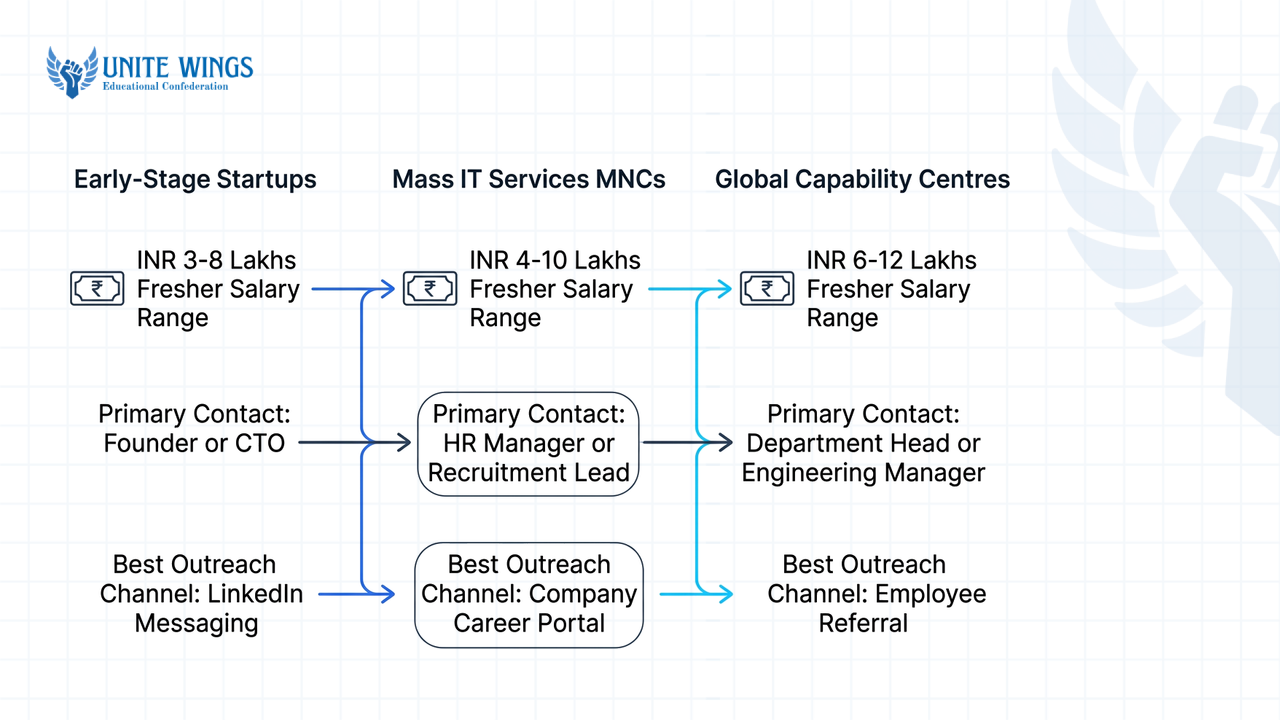
Salary ranges and hiring mechanics vary sharply across company types, so check live bands on Wellfound and AmbitionBox before applying. Based on 2026 compensation data from 3University, CareerLens, and Beyond Campus, here is how your networking strategy must change by target:
| Company Type | Typical Fresher Salary (2026) | Who to Contact First | Best Channel | Primary Risk to Watch |
|---|---|---|---|---|
| Early-Stage Startups (under 50 staff) | ₹6 to ₹14 LPA | Founder | Wellfound, Twitter/X DM, Cold Email | High failure and layoff rates, lack of structured training |
| Mass IT Services MNCs | ₹3.5 to ₹7 LPA | Employees / SDE-1 or SDE-2 | LinkedIn + Structured Applicant Portals | Lower compensation compared to startups and GCCs |
| Global Capability Centres (Walmart, Target, JPM) | ₹12 to ₹20 LPA | SDE-1 or SDE-2 | LinkedIn 300-char note + Employee Referral | Strict automated ATS screening |
What top results miss when hyping ₹14 LPA startup salaries is the high failure and layoff rate of early-stage companies. Before accepting an off-campus startup offer, check their funding history on Crunchbase, search the founder's name on r/IndianWorkplace, and talk to a former employee on LinkedIn to verify that salaries are paid on time.
On the flip side, standard career blogs completely overlook Global Capability Centres (GCCs). A 2026 CareerLens report notes that GCCs like Walmart Global Tech, Target, and JP Morgan operate ₹12 to ₹20 LPA off-campus fresher pipelines with minimal public advertising. Because GCCs and MNCs use structured portals, messaging their CEOs is useless. Instead, message an SDE-1 or SDE-2 on LinkedIn using a strict 300-character connection request (LinkedIn's hard limit in India, per FacePrep and LinkedIn Help Center 2026).
Use this 3-part formula (Self-Identity + Specific Reason/Proof + Bounded Ask) that fits inside 300 characters:
For a Startup Founder (248 characters): "Hi [Name], I'm a final-yr CS student. Saw [Startup] is building in fintech. I deployed a live UPI reconciliation dashboard in Next.js/Go ([short-link]) that handles 1k txns/min. Would love your brutal feedback on the UI if you have 2 mins."
For a GCC / MNC Engineer (266 characters): "Hi [Name], I'm a 2026 BTech grad following your work at [GCC Name]. Built a distributed cache in Java ([short-link]) matching the stack in Req #40921. My single-page resume hits 85% of the JD keywords. Open to a 5-min look for a referral?
If you want to set up your profile so engineers accept these requests and learn a repeatable tracking system, the Job Search and Outreach Masterclass covers finding unadvertised roles, writing outreach messages, and tracking replies in one sheet.
When should I start networking if I want an off-campus job before graduation?
Start networking in your 5th semester (the beginning of your pre-final year), giving yourself a 6-to-12-month runway before graduation to clear core CS fundamentals, deploy 2 to 3 live projects, and build warm relationships before asking for referrals. Uncodemy, Anvil Career, and FacePrep (2026) all confirm that starting in your final semester leaves no time to warm up contacts before hiring windows close.
Follow this 6-month pre-final-to-final-year roadmap to build your network from scratch:
- Months 1–2 (Build Foundation & Radar): Clean your GitHub profile and deploy Project #1 on Vercel or Render. Follow 20 to 30 target companies (15 startups on Wellfound, 10 GCCs, 5 IT MNCs) on LinkedIn and turn on the notification bell on their pages.
- Months 3–4 (The 5-Per-Month Habit): Deploy Project #2. Send 3 to 5 LinkedIn connection requests per month to engineers and founders at your target 30 companies using the 300-character script, without asking for a job yet. Ask one technical question about their product architecture or share your deployed build for feedback.
- Month 5 (Community & Hackathon Proof): Participate in a national hackathon like the Smart India Hackathon or ship an open-source PR via UptoSkills or Discord communities. Share a 60-second demo post of your build on LinkedIn and tag the tools you used.
- Month 6 (Referral Conversion & Tracking): When off-campus drives and startup roles open, message the 20+ warm connections you nurtured over Months 3 to 5. Log every interaction in a contact-tracking spreadsheet with five columns:
Contact Name,Company & Role,Date Contacted,Link Shared, and48-Hour Follow-Up Due Date. FacePrep's 2026 guide notes that maintaining this sheet prevents dropped conversations past the 48-to-72-hour conversion window.
Your next 7 days: start the Build-Then-Ping habit
Do not wait until your placement cell announces that no product companies are coming this semester. Take these three steps before Sunday night:
- Today (30 minutes): Open Google Sheets and create your 5-column contact tracker (
Name,Company,Date,Proof Link,Follow-Up Date). List 10 early-stage startups from Wellfound and 10 GCCs (like Walmart Global Tech, Target, or JP Morgan). - This Weekend (6 hours): Take your best local college project, strip out the broken features, write a clean README with an architecture diagram, and deploy it live on Vercel, Netlify, Render, or Streamlit.
- Monday Morning (20 minutes): Send 5 LinkedIn connection notes (under 300 characters each) to engineers or founders at the companies on your sheet, linking your newly deployed URL.
Need a live project to send in your cold DMs?
If your GitHub only has classroom assignments or empty repositories, join the AI Portfolio Sprint. You will pick a real-world problem, build a working project with AI assistance, and publish a live portfolio link you can paste into founder DMs and LinkedIn notes this week.
Frequently asked questions
How do I get an off-campus tech job if my college name is unknown?
Bypass college-filtered campus drives by targeting funded startups (which hire over 65% of developers off-campus, per Skillzeno 2026) and Global Capability Centres using live proof of work. Deploy 2 to 3 full-stack or AI projects on Vercel or Render, then cold-message founders and engineers with your live URL, which increases reply rates by 4x.
Why are my resume applications ignored for off-campus roles?
Enterprise ATS software like Workday and iCIMS automatically rejects resumes that use multi-column layouts, tables, graphics, or profile photos, or that fall below an 80% keyword match with the job description. Switch to a single-column, one-page text resume and pair every portal application with an internal employee referral, which is 6 to 8 times more effective.
Should I target startup founders or HR managers on LinkedIn first?
Target startup founders or CTOs directly if the company has fewer than 50 employees, as they make immediate hiring decisions based on your GitHub and deployed links. For larger MNCs and Global Capability Centres, message SDE-1 or SDE-2 engineers on the target team for a portal referral before contacting HR.
Which Telegram or Discord groups actually post real fresher jobs?
For daily job alerts, Telegram channels like FresherOffCampus (which has helped over 10,000 freshers, per their 2026 data) and OffCampusJobs4u post verified links, though competition is fierce. For actual referrals, resume reviews, and company culture checks, join Indian Discord and Reddit communities like Corporate Chat India (~15,500 members), r/IndianWorkplace, and UptoSkills.
What kind of projects matter on GitHub for freshers in India?
Recruiters spend only 60 seconds skimming your GitHub, so 2 to 3 finished, live-deployed applications on Vercel, Netlify, Render, or Streamlit beat 10 unhosted tutorial clones. Pin 4 to 6 repositories on your profile that solve a specific problem, and include a live demo URL and setup guide at the top of every README.
Is a Tier-3 degree a permanent barrier for product-based companies?
No, a Tier-3 degree is only an entry hurdle during campus season, not a permanent barrier. Mercer | Mettl's 2025 index shows Tier-3 employability (43.4%) trails Tier-1 (48.4%) by just five percentage points, and 40% to 65% of entry-level tech hiring happens off-campus where live projects and referrals outweigh college tags.
Newsletter
Stay updated with our latest news and insights.