How a Strong Personal Brand Unlocks Off-Campus Placements
A 16-week roadmap for Tier-2 and Tier-3 college students to replace weak campus drives with public project proof and warm founder referrals.
Building a visible online footprint is the fastest way to bypass the resume black hole when your college placement cell only brings in mass recruiters or sales roles. While standard mass-application methods on job boards like Naukri or LinkedIn yield a fresher reply rate under 2% according to a 2026 CareerLens report, targeted cold emails backed by a public portfolio achieve 8% to 25% reply rates across benchmarks from Whali and JobChef.in. You do not need 10,000 followers to get hired; you need 2 live deployed projects, a clear LinkedIn or X profile that proves you can build, and a weekly outreach habit.
In short
- Over 65% of developers hired by funded tech startups come through off-campus channels and direct portfolio submissions (Skillzeno.in, 2026).
- Stop clicking "Easy Apply": generic job board applications get under a 2% response rate, whereas personalized cold emails with a live project link get 8% to 18% replies (Whali, 2026).
- You only need 2 to 4 hours a week during your final year to publish 2 project updates and spend 20 minutes daily commenting on engineering leads' posts.
- Never attach a PDF resume to your first cold email; keep the message between 75 and 125 words and link directly to a deployed app or GitHub repository.
Can personal branding really help a Tier-3 college student get an off-campus job?
Yes, because off-campus startups and product companies evaluate freshers on demonstrable proof of work rather than college pedigree. Over 75% of engineering students in India study in Tier-2 and Tier-3 colleges with limited campus placements (Ccbp.in, 2025), yet Skillzeno.in's 2026 placement guide shows that over 65% of developers hired by funded tech startups came through off-campus channels and direct portfolio submissions.
When a company visits an IIT or NIT, they use the entrance exam as a filter. When you apply off-campus from a local affiliated college, the recruiter does not trust your semester CGPA because grading standards vary wildly across Indian universities. NACE's 2026 Job Outlook report (cited via Orienthink) found that 70% of surveyed employers now use skills-based hiring, and a 2025 Inspiria Knowledge Campus report notes that over 70% of recruiters screen candidates online via LinkedIn, GitHub, and digital footprints before shortlisting.
What most students get wrong is treating personal branding for students and freshers as "motivational posting." Writing generic posts about "Day 45 of 100DaysOfCode" or sharing quotes about hard work only attracts other unemployed students, driving up vanity metrics like likes and impressions while keeping your interview invites at zero.
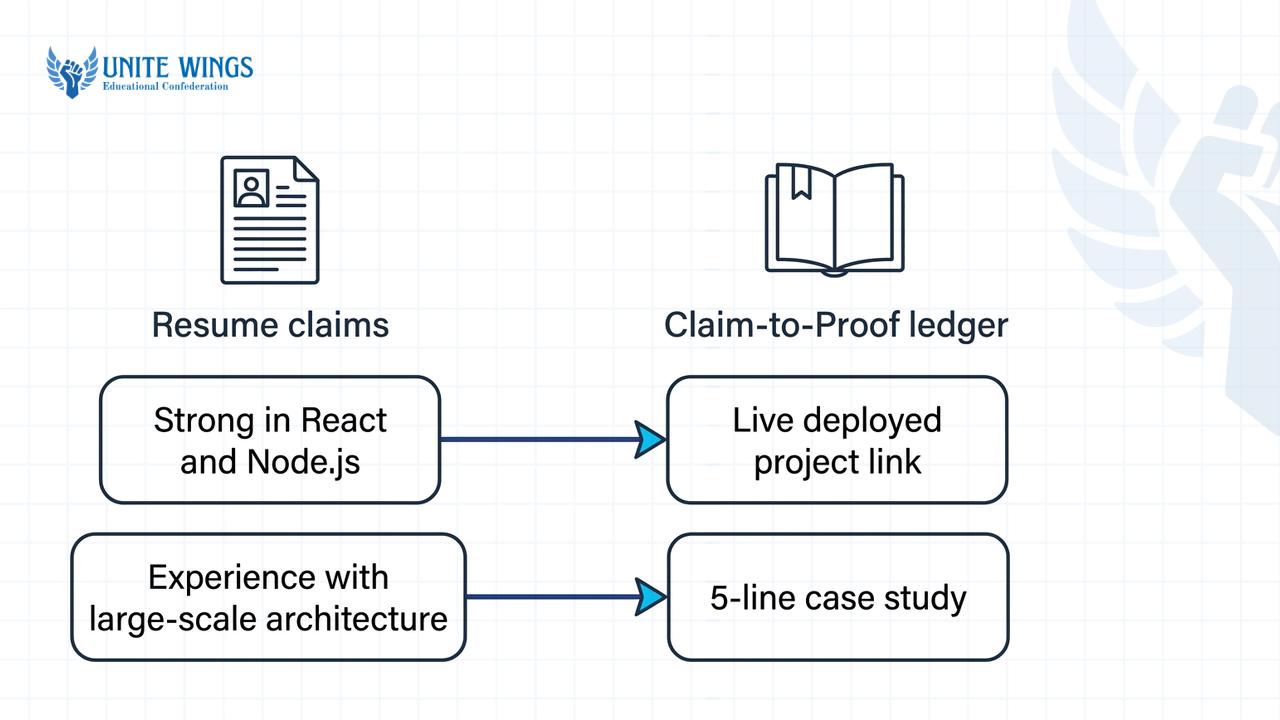
The fix is building a Claim-to-Proof ledger. Instead of claiming "Strong in React and Node.js" on a resume, you convert your semester coursework and side projects into public, 5-line case studies. According to AnvilCareer's 2026 Tier-3 Placement Guide, startups evaluate freshers through GitHub profile links, live deployed projects, and technical case studies. Your portfolio must feature at least 2 live-deployed web or app systems with database persistence rather than static, unhosted GitHub repositories alone.
| Outreach method | Typical reply rate | Why it works or fails |
|---|---|---|
| Naukri / LinkedIn "Easy Apply" | Under 2% (CareerLens, 2026) | You compete with a massive pool of applicants in an automated ATS queue where college tier filters you out. |
| Generic cold email ("Please find attached my resume") | Under 1% (Whali, 2026) | Attaching a PDF triggers spam filters and forces the reader to do the work of figuring out where you fit. |
| Average B2B cold email across industries | 3.4% (Whali / Instantly data, 2026) | Lacks specific technical context or a reason for an engineering manager to care right now. |
| Personalized cold email + specific context | 8% to 18% (Whali, 2026) | Mentions a specific team feature or bug and stays between 75 and 125 words. |
| Hyper-targeted pitch + visible portfolio / proof link | 15% to 25% (JobChef.in, 2026) | Gives a startup founder or tech lead immediate, clickable proof that you can solve their exact problem. |
When should I start building my personal brand before graduation?
The ideal time to start building your professional footprint and off-campus strategy is your 3rd year of undergraduate studies, or at least 6 to 12 months before graduation (Uncodemy, 2026). Starting as early as your first semester gives you the longest runway (Ansh Pasari Placement Guide, 2023), while a structured 90-day plan is the minimum viable window for final-year students (Schedulenchill, 2026).
If you are in your 1st or 2nd year, your only job is to document what you learn in public once a week and commit code to GitHub so your contribution graph has history. If you are already in your 6th, 7th, or 8th semester and campus drives have dried up, you do not have two years. You need a compressed 90-day pre-placement roadmap that moves from setup to outbound interviews.
Here is how to structure a 90-day (12-week) plan if you are starting from zero in your pre-final or final year:
- Month 1: The 4-Week Student Starter Plan (Foundation). Follow Orienthink's 2026 starter framework. In Week 1, pick one target role (for example, Backend Python Developer or Product Analyst) and write a 1-sentence positioning statement. In Week 2, build your Claim-to-Proof ledger by taking two existing college projects, adding database persistence, deploying them live, and writing a 5-line case study for each. In Week 3, rewrite your LinkedIn headline and About section using exact tech stack keywords rather than "Aspiring Engineer." In Week 4, list target startups and begin commenting thoughtfully on posts by their founders and engineering leads. If you need help turning your raw profile into one that passes a recruiter's 10-second scan, our LinkedIn Masterclass walks through this setup step by step.
- Month 2: Rhythm establishment (Weeks 5 to 8). Following Schedulenchill's 2026 90-day framework, shift from setup to publishing. Post 2 to 3 times a week showing screenshots, architecture diagrams, or short Loom videos of the features you are building or debugging. Every post must end with a link to the live app or repository.
- Month 3: Compounding visibility and outreach (Weeks 9 to 12). Take the problems you see startups talking about, build micro-solutions, and begin sending personalized cold emails with your live project links to founders and hiring managers.
How do Indian startup founders discover freshers through personal branding?
Indian startup founders and engineering leads discover freshers through inbound direct messages, public project showcases, and technical comments on LinkedIn and X (Twitter). A 2026 India Today report documented how a startup founder hired a 20-year-old with zero formal experience after the candidate sent an unsolicited DM showing genuine interest and proof of skill.
How to build a personal brand for off campus placements depends on where your target companies hang out. Opinions on which platform works best diverge, so use this decision rule:
- Pick LinkedIn if you are targeting structured product companies, funded B2B SaaS startups, IT services, or data/analyst roles. LinkedIn has crossed 100 million members in India (Boldface Online, 2026), and a single-source 2025 Edelman-LinkedIn study cited by Schedulenchill found that 64% of decision-makers spend over an hour a week consuming professional content on the platform.
- Pick X (Twitter) if you are targeting early-stage AI startups, Web3, DevTools, or YC-backed Indian founders. Viral tech hires frequently happen on X through casual, immediate DMs where you reply to a founder's tweet with a working prototype or a fixed UI component.
- Do not try to build on 4 or 5 platforms at once. Career benchmarks from 2026 warn that consistency on a single primary platform beats sporadic posting across LinkedIn, X, Instagram, and Medium. Pick one primary platform, and use GitHub as your permanent code warehouse.
Indian freshers often freeze up here because of a psychological barrier: the fear of bragging in front of classmates or relatives. You worry that if you post about Python or React, a hostel mate will mock you for acting like an expert when you have zero internship experience.
The fix is to stop writing like a guru and start writing like a builder asking for a code review. Never write: "5 ways to optimize React rendering." A senior engineer reading that knows you have never worked on a production codebase. Instead, write a breakdown of a specific bottleneck you hit in your own project:
- Line 1 (The problem): "My e-commerce cart API was taking 1.8 seconds to load 50 items on a free-tier PostgreSQL database."
- Line 2 (What failed): "I initially ran a loop of individual SELECT queries inside the Node controller, which caused an N+1 query issue."
- Line 3 (The fix): "Replaced the loop with a single JOIN query and added a composite index on
user_idandproduct_id, dropping response time to 140ms." - Line 4 (The proof): "Here is the exact commit and the live deployed link: [Link]."
- Line 5 (Low-friction ask): "For folks running Node in production, would you cache this in Redis at this scale or is indexing enough?"
If you don't have two deployable projects ready to write about yet, the AI Portfolio Sprint helps you pick a problem, build a working project with AI assistance, and publish it cleanly.
How does a visible personal brand increase reply rates on cold emails?
A visible personal brand turns you from an unknown stranger into a familiar name before the hiring manager even opens your email, lifting reply rates from under 1% for generic blasts to between 8% and 18% for personalized outreach (Whali, 2026), and up to 15% to 25% when backed by a visible portfolio (JobChef.in, 2026). Recruiting cold emails also get 38% to 45% open rates when personalized, compared to 20% to 25% for generic platform InMail (GoPerfect / Gem Recruiting Benchmarks, 2025).
Skillzeno.in's 2026 data shows that cold messaging hiring managers with specific project value propositions gets up to a 4x higher response rate than generic "Are you hiring?" messages. When you comment on a CTO's LinkedIn post on Tuesday and Thursday, and then land in their work inbox on Friday with a link to a live project, they click your name, see your active profile, and reply.
Follow these exact rules from 2024–2026 outreach benchmarks when writing your email:
- Keep the subject line between 36 and 50 characters. Whali's 2026 analysis of Snovio data shows this length, combined with specific project context or an exact Job ID and tech stack, maximizes open rates. Example:
SDE Intern / built a flow for [Company Name](44 characters). - Keep the email body strictly between 75 and 125 words. A 2024 Boomerang study cited by GoPerfect found that emails between 75 and 125 words see up to 51% higher engagement than longer messages.
- Never attach a PDF resume in your first email. NueCareer's 2026 guide on cold emailing hiring managers confirms that attachments on the first touchpoint trigger corporate spam filters and scream "mass blast."
- End with a low-friction ask. Do not ask for a job in email one. Ask for feedback on what you built or a 15-minute chat.
- Follow up twice, then stop. Following up once or twice with an extra piece of value (like a new feature you added) boosts replies, but NueCareer advises stopping after 3 total attempts if you get no response.
Copy-paste cold email template (98 words)
Subject: Backend role + built a webhook tester for [Company]
Hi [First Name],
I'm a final-year CS student at [College Name]. I've been following your LinkedIn posts on how [Company Name] handles high-volume payment webhooks.
Over the weekend, I built a lightweight webhook retry queue using FastAPI, Redis, and PostgreSQL to test how dead-letter queues handle failed payloads.
You can test the live deployed app here: [Live URL] The GitHub repo and architecture notes are here: [GitHub URL] (and I broke down the build on my LinkedIn here: [Post URL]).
If your team has 10 minutes this week, I'd love quick feedback on my retry logic—or to discuss any backend intern openings.
Best, [Your Name]
What is the minimum weekly time needed to build a brand during final year?
You need between 2 and 4 hours per week to build and maintain a personal brand during your final year. Orienthink's 2026 student guide puts the minimum effective dose at 2 to 3 hours a week, while Schedulenchill's 2026 90-day plan recommends 3 to 4 hours per week divided between batching content and daily engagement.
What most career influencers miss is the burnout risk for final-year Indian students. Between 75% attendance rules, final-year major project submissions, semester exams, and daily LeetCode/DSA practice, advising a student to post every single day is a recipe for quitting by week three. Purple Peak Media's 2026 routine confirms that posting 2 to 3 times per week consistently builds momentum without burnout, provided you pair it with 20 to 30 minutes of daily comment engagement (BrandBaddie, 2026).
| Weekly activity | Minimum plan (2 hrs/week) | Ideal plan (3.5 to 4 hrs/week) | Exact output |
|---|---|---|---|
| Topic selection & strategy | 20 minutes (Sunday) | 1 hour (Sunday) | Pick 2 problems you solved in your code or coursework this week. |
| Drafting & batching posts | 40 minutes (Sunday) | 1 hour (Sunday) | Write 2 to 3 text posts with screenshots or short videos; schedule them for Tue/Thu/Sat. |
| Repurposing & GitHub docs | Skipped (use raw links) | 30 minutes (Sunday) | Turn your best LinkedIn post into a clean GitHub README or a short X thread. |
| Daily comment engagement | 10 mins/day (Mon–Sat) | 20–30 mins/day (Mon–Fri) | Leave 3 technical comments per day on posts by Indian startup founders, CTOs, and recruiters. |
When you spend those 20 minutes commenting, never write "Great post, sir!" or "Interested." Read the engineer's post, add a specific observation from your own testing, or ask a sharp technical question about their stack. That comment puts your name and headline directly in front of the person who signs off on fresher hiring.
Your action plan for the next 7 days
Do not wait until your final semester exams end to start. Take these three steps this week:
- Today (45 minutes): Audit your GitHub and LinkedIn. Pick your single best college project, deploy it on a free hosting tier so it has a live clickable URL, and put that URL in the Featured section of your LinkedIn profile.
- This weekend (90 minutes): Write two 150-word posts using the 5-line Claim-to-Proof structure (Problem, What failed, The fix, Proof link, Question). Schedule one for Tuesday morning at 9:30 AM and one for Thursday morning.
- Next Monday to Friday (20 minutes/day): Find target startups on LinkedIn or X. Follow their founders and engineering managers, comment on their posts during the week, and send cold emails using the 75–125 word template on Friday.
Turn your projects into interview invites
If you want the exact system to find hidden startup roles, write cold emails that get replies, and track every follow-up in one place, join the Job Search and Outreach Masterclass. You will walk away with a ready-to-send outreach pipeline and a tracker built for off-campus placements.
Frequently asked questions
Can a Tier-3 college student really get a high-paying product job off-campus?
Yes. Over 65% of developers hired by funded tech startups are sourced through off-campus channels and direct portfolio submissions (Skillzeno.in, 2026). Product companies care about whether your code works in production, so 2 live deployed full-stack apps and a visible GitHub history outweigh a Tier-3 college tag.
What should a fresher write about on LinkedIn if they have zero professional experience?
Document your coursework and side projects as technical case studies rather than giving career advice. Write 5-line breakdowns of bugs you fixed, database schemas you designed, API latency you reduced, or research papers you implemented, always linking to the live working application or GitHub commit.
Should I use LinkedIn or Twitter/X to find off-campus fresher roles in India?
Choose LinkedIn as your primary platform if you want roles at established product companies, funded B2B SaaS startups, or data teams, as it has over 100 million Indian users (Boldface Online, 2026). Choose X (Twitter) if you are targeting early-stage AI, Web3, or DevTools founders who hire directly via DMs.
How many projects do I need on my resume and GitHub to stand out?
You need at least 2 live-deployed web or mobile systems with database persistence, rather than 10 unhosted static repositories or tutorial clones. Hiring managers click live links to verify your app handles real user inputs before they read your source code or invite you to an interview.
Is cold emailing recruiters still effective in India, or is it a waste of time?
Cold emailing works when it is personalized and short, earning 8% to 18% reply rates compared to under 2% on job board mass applications (Whali and CareerLens, 2026). Email engineering managers or founders directly alongside recruiters, keep the message between 75 and 125 words, and link to a live project instead of attaching a resume.
Newsletter
Stay updated with our latest news and insights.