15 Informational Interview Questions for Students (Plus Invite Script)
A 15-minute call agenda, the exact invite script to book a 1-on-1 chat, and 15 sharp questions that cannot be answered by a quick Google search.
An informational interview is a 15-to-30-minute conversation with a working professional to gather career advice rather than ask for a job, a concept career counselor Richard Bolles coined, according to OphyAI. When preparing informational interview questions to ask professionals for college students, you need 3 to 5 open-ended questions split across role clarity, skill gaps, and referral transitions that cannot be answered by a quick search. While standard mass IT services roles in India pay freshers ₹3.36 LPA to ₹4.5 LPA (like the TCS NQT Ninja track, per a 2026 JoinSaarthi salary guide) and specialized AI or product roles pay ₹8 LPA to ₹40 LPA (according to 2026 Hyring and EasyPlace guides), a single 15-minute chat helps you cross that gap: a 2026 JobCopilot study analysis found that employee referrals account for 37% of all completed hires despite making up only 6% of total applications.
In short
- Keep your LinkedIn connection note under 200 characters and your email outreach under 150 words (80 to 120 words across 4 sentences gets the highest response rate).
- Never attach your resume or ask for a referral in the first message; doing so turns an advice request into an unsolicited job pitch.
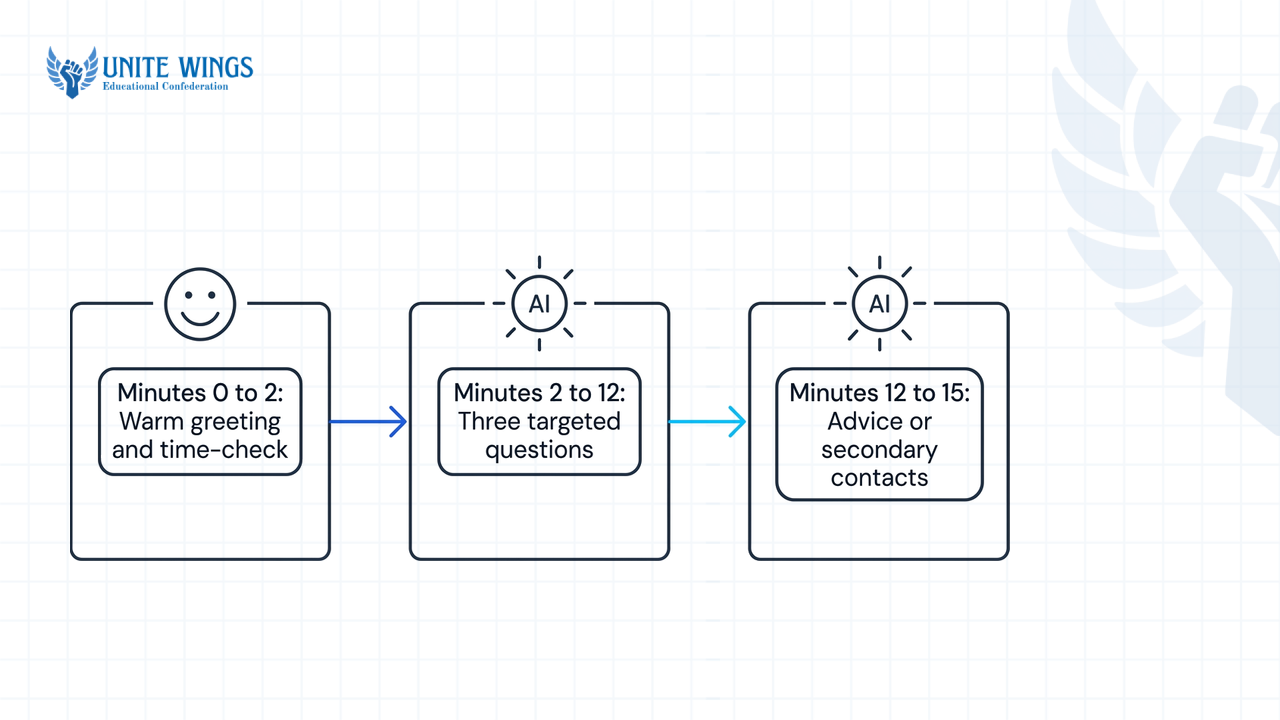
- Run a strict 15-minute clock: Minutes 0 to 2 for a warm greeting and time-check, Minutes 2 to 12 for three targeted questions, and Minutes 12 to 15 for advice or secondary contacts.
- Send a thank-you email within 24 to 48 hours mentioning one specific piece of advice you are acting on; a single-source TopResume survey cited by Extern notes 68% of hiring managers say skipping a thank-you note hurts a candidate's evaluation.
How do I ask a busy professional for a 15-minute informational interview?
To get a busy professional on a call, send a 4-sentence message under 150 words (80 to 120 words is the sweet spot, per Resumly and Angld.ai outreach guides) that praises one specific project of theirs, states your student status, asks for a strict 15-minute window, and offers two exact time slots. If you are sending a LinkedIn connection request on a free account, Extern notes you must stay under the 200-character limit, and 2026 Angld.ai messaging analysis shows text messages under 400 characters get much higher reply rates.
India has over 130 million LinkedIn users according to a 2026 Edumanch report, which means senior managers at firms like Flipkart, Razorpay, or TCS get dozens of generic "Hi sir, please refer me" messages every week. In Indian corporate culture, freshers often hesitate to message a Vice President or Engineering Manager, or they go too far and write a 400-word essay calling them "Respected Sir/Ma'am" with a resume attached. Skip both extremes. Address them by their first name, skip the resume attachment (both Resumly and Dale Callahan's networking rules state you should never send a resume unless asked), and only mention a mutual connection if that person explicitly gave you permission, as Interview Pilot warns that unauthorized name-dropping backfires.
Use this 188-character LinkedIn connection note for a college alumnus or second-degree contact:
"Hi [First Name], I'm a 3rd-year CS student at [College]. I read your post on migrating [Company]'s payment service. Could I ask 3 quick questions over a 15-min call next Tue or Thu at 4 PM?"
If you have their email address from your placement cell's alumni directory, send this 108-word script:
Subject: [Your College] student, quick question on your data engineering work at [Company]
Hi [First Name],
I found your profile through the [College Name] alumni directory and saw you moved from a campus analyst role into product management at [Company]. I am currently a pre-final year student building an inventory prediction project in Python, and I want to understand how your team evaluates real-world model deployment.
Would you be open to a strict 15-minute call next Tuesday at 11:00 AM IST or Thursday at 4:30 PM IST? I have 3 specific questions prepared and am purely looking for career advice, not pitching for a job.
Best regards, [Your Name] [LinkedIn URL]
Offering two concrete time options increases your positive response rate, according to VAA Global. If they do not reply, Interview Pilot confirms that sending one polite follow-up after 7 days on the same channel is acceptable, rather than chasing them across WhatsApp, Instagram, and email. If you want to set up your profile so senior engineers actually accept your invite before reading the note, our LinkedIn Masterclass walks through the exact headline and project sections that get replies.
How do I structure a 15-minute call so I don't waste their time?
Structure a 15-minute call by dividing it into three timed blocks: Minutes 0 to 2 for a warm greeting and time-check, Minutes 2 to 12 to ask three targeted questions, and Minutes 12 to 15 for advice or secondary contacts. While some guides like Nuecareer suggest 20 to 30 minutes for deeper conversations, asking for a strict 15 minutes lowers the barrier for busy managers to say yes.
Most students panic once the Google Meet or Zoom call connects, spending 6 minutes reciting their semester projects or waiting for the professional to lead the meeting. Because you requested the meeting, you run the agenda. Keep a physical clock in front of you and follow this minute-by-minute breakdown, adapted from frameworks by Interview Pilot and Nuecareer:
- Minutes 0 to 2 (The Time-Check and Hook): Thank them, state the hard stop, and give a 20-second summary of who you are. Say: "Thanks for doing this, [Name]. I promised a strict 15 minutes, so I'll watch the clock and wrap us up by 4:15. I'm a final-year ECE student at VIT, currently building a RAG chatbot, and I'm trying to decide between backend engineering and data roles."
- Minutes 2 to 12 (Targeted Questions): Ask 3 targeted questions about daily team challenges, skill gaps, and entry paths. Listen for 80% of this block. If you are a first-year or second-year student with zero internships, anchor your follow-up comments around a specific campus club or GitHub repo rather than apologizing for having no corporate experience. Use this time to learn about off-campus drives, unadvertised internships, and what their team looks for in a portfolio.
- Minutes 12 to 15 (The Secondary Ask and Close): At minute 12, announce that three minutes remain. Ask who else you should speak with, confirm how they prefer to stay in touch, and end the call on the dot unless they explicitly tell you they have extra time.
15 informational interview questions to ask professionals for college students
Prepare a prioritized list of 4 to 10 open-ended questions before the call, as recommended by OphyAI and VAA Global, and pick the top 3 to 5 during your 15-minute window based on where the conversation flows. As student guides from Queen's University and McMaster University point out, these chats exist to help you test career fit, learn industry vocabulary, and uncover unadvertised roles before campus placements begin.
Goal 1: Role clarity (Minutes 2 to 6)
Use these questions to uncover what the job looks like past the HR job description.
- "What did you spend the majority of your working hours doing this past week, and how does that compare to what you expected when you joined?"
- Why it works: "What is a typical day like?" gets a generic answer; asking about this past week forces them to name specific meetings, code reviews, or client decks.
- "Which part of your current project is giving your team the biggest headache right now?"
- Why it works: Knowing a team's active bottleneck tells you the exact problem you should build a portfolio project around.
- "When you moved from a college campus environment into [Company], what was the hardest engineering or workflow habit you had to unlearn?"
- Why it works: Highlights the gap between academic grading (writing code that runs once) and production standards (writing maintainable, documented code).
- "How much of your week is spent on actual technical execution versus cross-team alignment, documentation, and stakeholder calls?"
- Why it works: Helps you decide if you want an individual contributor track at a startup or a process-heavy role at a large enterprise.
- "If you look at the junior analysts or freshers who joined your team in the last year, what separated the ones who ramped up in 30 days from the ones who struggled?"
- Why it works: Gives you the exact grading rubric that manager uses during probation periods.
Goal 2: Skill gaps and student prep (Minutes 6 to 10)
Use these questions to figure out which syllabus topics or side projects actually matter for ₹8 LPA to ₹15 LPA product roles versus ₹3.5 LPA mass-recruiter roles.
- "I am currently learning [Tool A, e.g., LangChain] and [Tool B, e.g., FastAPI] for my final-year project; in your team's stack, which of those actually gets used in production, and what am I missing?"
- Why it works: Shows you are already building things and invites a senior to critique your tech stack.
- "When you review a fresher's GitHub or portfolio for an entry-level role, what makes you close the tab in 10 seconds?"
- Why it works: Saves you from putting cloned Titanic dataset notebooks or basic calculator apps on your resume.
- "What is one tool, framework, or workflow your team adopted in the last six months that colleges aren't teaching yet?"
- Why it works: Gives you a specific keyword and skill to learn before your next interview round.
- "Since I only have campus club work and academic projects rather than a big-brand internship, what kind of proof-of-work would convince a manager like you that I can handle the job?"
- Why it works: Directly solves the tier-2/tier-3 college fresher dilemma by getting the hiring manager to define what counts as substitute experience.
- "Which industry newsletters, benchmarks, or technical blogs does your team actually read to keep up with changes in [Field]?"
- Why it works: Gives you the vocabulary to sound like an insider during future placement rounds.
Goal 3: Referral transition and network expansion (Minutes 10 to 15)
Use these questions at the end of the call to learn how hiring works on their team and multiply your contacts.
- "For freshers who break into your team off-campus, what does their entry path usually look like: the six-month internship route, hackathons, or direct junior openings?"
- Why it works: Uncovers the hidden hiring funnel without directly asking "Can you give me a job?"
- "When your department opens an entry-level requisition, at what month of the year does that usually happen, and how do candidates outside IITs/NITs get noticed for it?"
- Why it works: Gives you a calendar date to follow up with them before the role hits Naukri or LinkedIn.
- "How should someone with my background position their resume projects to pass your company's initial screening for [Target Role]?"
- Why it works: Often prompts the professional to say, "Send me your resume and I'll take a look," which opens the door naturally.
- "If I spend the next 4 weeks building a small prototype that solves [Problem they mentioned in Question 2], would it be alright if I sent you a 2-minute Loom video of it for your feedback?"
- Why it works: Turns a one-off 15-minute chat into an ongoing mentorship relationship backed by proof of work.
- "Based on what we discussed today, who is one other person, maybe a junior member on your team or a peer at another firm, you think I should speak with for 15 minutes?"
- Why it works: This "secondary ask" keeps your networking chain alive so one coffee chat turns into three more.
What questions should I never ask during a networking call?
Never ask questions that can be answered by a 30-second search on Google, Perplexity, or the company's "About Us" page, and never ask directly for a job or referral during the call. WiseBread confirms that asking for basic company facts, sales numbers, or public metrics wastes the professional's time, while OphyAI notes that demanding a referral upfront violates the unwritten agreement of an informational interview.
Before you write a question down on your notepad, run it through the AI Filter Test: paste your question into ChatGPT or Perplexity with the company's name. If the AI gives you a complete, accurate answer using public web data, delete the question from your script. You are on the call to get the human's personal judgment, team friction points, and unwritten hiring rules.
| Bad question (Fails the AI Filter Test) | Why it ruins the call | Sharp replacement question |
|---|---|---|
| "What does your company do and who are your main clients?" | Shows you did zero homework before taking 15 minutes of their workday. | "I saw your firm launched an AI claims tool for insurance clients in Q1; how has that changed your analytics team's daily workload?" |
| "Can you refer me to an open software engineer role at your company?" | Breaks the "advice-only" promise and puts a stranger on the spot to vouch for your unverified skills. | "When your team hires entry-level developers off-campus, what kind of project depth makes a candidate worth an interview?" |
| "Tell me about your career journey from college until now." | Too broad (flagged by Interview Pilot); they will spend 12 minutes reading their LinkedIn profile aloud to you. | "You spent two years at Infosys before moving to a Series B fintech startup—what specific skill got you across that jump?" |
| "What is the work-life balance and salary for freshers on your team?" | Sounds transactional and self-serving before you have even been invited to interview. | "What does the first 90-day onboarding curve look like for a fresher joining your pod?" |
How do I transition from an informational chat to asking about internships or jobs?
Transition from an advice chat to internship or job opportunities by asking how candidates with your profile position themselves for their team, then waiting until after you have acted on their advice, or until they bring up openings first, before discussing a referral. Research from the Federal Reserve Bank of New York cited by Extern shows a referral appears somewhere in the hiring process for roughly half of all jobs, and a 2025 Resumly guide citing LinkedIn survey data notes 70% of professionals land opportunities through networking, but forcing the ask on Minute 12 kills the trust required to get one.
As HireConsulting and Interview Pilot point out, the transition should happen through positioning questions (like Questions 11 through 14 above) or when the professional prompts it. However, there is an edge case most guides ignore: what to do when the senior professional unexpectedly says mid-call, "Actually, we are looking for an intern right now, send me your resume."
If they offer an opening or referral unprompted during the call, do not babble or say "I haven't updated my resume yet." Follow this 3-step response:
- Confirm the exact role requirement immediately: Ask, "That would be great. Before I send my resume over tonight, what is the number one skill or project type the hiring manager is filtering for on this role so I can highlight the relevant work?"
- Verify the mechanics: Ask whether they need your PDF via email, a specific Job ID from their careers portal, or a third-party link.
- Deliver within 4 hours: Tailor your top two project bullets to match the exact words they used on the call, export to PDF, and send it the same evening. If you want to practice finding unadvertised roles and tracking these referral conversations in a single system, our Job Search and Outreach Masterclass covers the full off-campus workflow.
What should I send in the thank-you message after the call ends?
Send a structured email or LinkedIn message within 24 to 48 hours of the call that thanks them for their time, names one specific insight you gained, and states the action you are taking on their advice. Both Nuecareer and Extern confirm the 24-to-48-hour window, and 2025 networking guidelines by Chris Scherting warn that a lazy "thx for the call sir" on WhatsApp looks unprofessional compared to a proper note with action items.
Copy and customize this 24-hour thank-you script (you can also compare formatting variations on Resume Worded):
Subject: Thank you for the conversation today, [First Name]
Hi [First Name],
Thank you for taking 15 minutes out of your Tuesday to speak with me about how the data science pod operates at [Company]. Hearing your point about how freshers over-index on model accuracy while ignoring SQL query optimization and Docker deployment gave me a clear checklist for my next project.
Based on your suggestion, I am refactoring my inventory project this week to containerize it with Docker. Once I have it running, I will share the GitHub link with you in a few weeks as promised.
You also mentioned that [Secondary Contact's Name] on the platform team would be a good person to speak with. If you are still comfortable introducing us, I pasted a short 2-line blurb below that you can forward to save you time.
Thanks again, [Your Name]
Do not let the contact go cold after the thank-you note. Nuecareer recommends sending a progress update 2 to 4 weeks later showing that you actually executed their advice. That second email is where referrals happen: *"Hi [Name], four weeks ago you advised me to learn Docker and FastAPI. I just deployed my project using both (link here). I also noticed Job ID #4092 for a Graduate Engineer Trainee just opened on [Company]'s portal today. Given our conversation and this update, would you feel comfortable referring me for the role?" Because you proved you listen and execute, saying yes is effortless for them.
Your 7-day informational interview action plan
Do not wait until final-year campus placements dry up to start building contacts. Put this system into motion over the next seven days:
- Today (30 minutes): Open LinkedIn, filter by your college's alumni page, and list 10 alumni working in your target role who graduated 2 to 6 years ago (they remember the student struggle best and reply faster than VPs).
- Tomorrow (45 minutes): Send 5 customized connection notes (under 200 characters) or alumni emails (under 150 words) offering two specific 15-minute time slots for next week.
- Before your first call (20 minutes): Pick 5 questions from the list above, run them through ChatGPT to make sure none of them have obvious public answers, and write them on a physical notepad next to your laptop clock.
- Within 24 hours after the call: Send the thank-you script above and put a calendar reminder 3 weeks out to send your proof-of-work update.
Turn your coffee chats into job offers
Once your informational interviews start converting into formal referrals and interview invites, you need to clear the actual hiring rounds. Join the Interview Masterclass to learn a repeatable structure for answering technical and behavioral questions, plus practice in a live mock round so you don't freeze when the referral comes through.
Frequently asked questions
How many questions should I prepare for a 15-minute coffee chat?
Prepare a prioritized list of 4 to 10 open-ended questions, as recommended by OphyAI and VAA Global, and expect to ask 3 to 5 of them during a 15-minute call. Having backups prevents awkward silence if the professional answers your first two questions quickly.
Is it okay to attach my resume when asking for an informational interview?
No, do not attach your resume in your initial outreach message unless the professional explicitly asks for it. According to networking guidelines from Resumly, sending an unrequested resume signals that you are secretly pitching for a job rather than seeking genuine career advice.
What should I do if the professional doesn't reply to my LinkedIn outreach message?
Wait seven full days and send one polite follow-up message on the exact same channel restating your 15-minute request with two fresh time slots for the upcoming week. Interview Pilot advises against messaging non-responders across multiple platforms like WhatsApp, Instagram, and email simultaneously.
How can college students with zero work experience build a credible profile for networking?
Anchor your outreach and questions around a specific academic project, hackathon build, or campus club initiative you are actively working on. Referencing a concrete problem, such as deploying a Python script or analyzing a public dataset, gives the professional something real to advise you on without needing prior internship credentials.
How do I politely steer a professional back on track if they start rambling during a call?
Wait for them to take a breath, validate their point by repeating one specific phrase they used, and use the clock as your excuse to pivot. Say: "That point about database indexing is super helpful. Since I promised to keep us to a strict 15 minutes and we have 5 minutes left, could I quickly ask how your team evaluates freshers on that skill?"
Can I ask for a referral during an informational interview?
Do not ask for a referral during the call itself unless the professional brings up an open role first, as OphyAI and HireConsulting note this breaks networking etiquette. Instead, ask about entry paths during the call, act on their advice over the next 2 to 4 weeks, and ask for a referral in your follow-up update email.
Newsletter
Stay updated with our latest news and insights.