
11 Claude Prompts for Interview Preparation for Freshers
11 copy-paste system prompts that turn Claude into a strict technical or HR panelist for mass recruiters and startups, complete with answer scoring rubrics.
If you tell Claude to "help me prepare for my campus placement interview," it will dump 20 generic questions and write out fake, robotic answers that get you rejected in two minutes by an Indian HR panel. To get real practice, you have to force Claude to ask one question at a time, wait for your answer, and grade what you actually said without rewriting your words. Below are 11 structured claude prompts for interview preparation for freshers built around how Indian campus drives, mass recruiters, and startup hiring managers actually test you.
In short
- Set up a free Claude Project with your resume and job description before running any prompt so your context carries across sessions (Claude's free tier gives you 5 Projects).
- Always add the constraint "Ask one question at a time and wait for my response" so Claude runs a live mock round instead of printing a static list.
- Forbid Claude from writing scripts for your final-year project; tell it to output bullet outlines and flag missing metrics so you don't sound memorised.
- Use Claude's native voice mode on mobile or desktop to speak your answers out loud, since typing hides filler words and pacing issues.
Why do freshers need structured Claude prompts for Indian placements?
Indian campus and off-campus interviews filter candidates across sharply divided pay brackets, from ₹3.36 LPA mass-recruiter roles to ₹15+ LPA product tracks. Default AI prompts fail here because they generate memorised paragraphs that hiring managers spot immediately. Structured prompts turn Claude into an active evaluator that tests your unscripted thinking.
According to CIISkills, India produces over 20 lakh engineering graduates every year, and roughly 82% of employers report difficulty finding job-ready candidates (by contrast, the Wheebox India Skills Report 2026 puts graduate employability at 54.81%, depending on whether you measure basic degree readiness or Day Zero project skills). That gap has split the fresher market into three distinct tiers. Entry-level IT services packages sit at ₹3.5 to ₹4.5 LPA according to Hyring, with JoinSaarthi noting that TCS NQT offers ₹3.36 LPA for Ninja tracks and ₹4.5 to ₹7 LPA for Digital streams. Meanwhile, freshers entering AI, machine learning, and cloud roles earn ₹6 to ₹15 LPA (Jobvumi), and the top 10% of engineering graduates take home ₹15 to ₹21 LPA or more (Hyring).
Recruiters know you are using AI. The Wheebox India Skills Report 2026 notes that 70% of IT companies and 50% of BFSI firms in India now use AI-driven recruitment tools, and 2025 data from Whizi and Greenhouse shows that hiring managers easily detect rehearsed, AI-written answers. Even Anthropic's own candidate guidelines (Whizi) encourage using Claude to research and practice beforehand while strictly banning AI during live assessments. If you want to learn how to set up workspaces and context files before placement season starts, our Claude Masterclass walks through Projects and Artifacts step by step.
How do you set up a Claude Project before running interview prompts?
Before running a single prompt, open claude.ai/projects and create a dedicated workspace containing your resume, final-year project report, and target job description. According to CoPilot Interview, Claude's Free plan gives you up to 5 Projects and free voice mode access (Pro plans cost $17/month billed annually or $20 monthly if you hit the rolling hourly message cap).
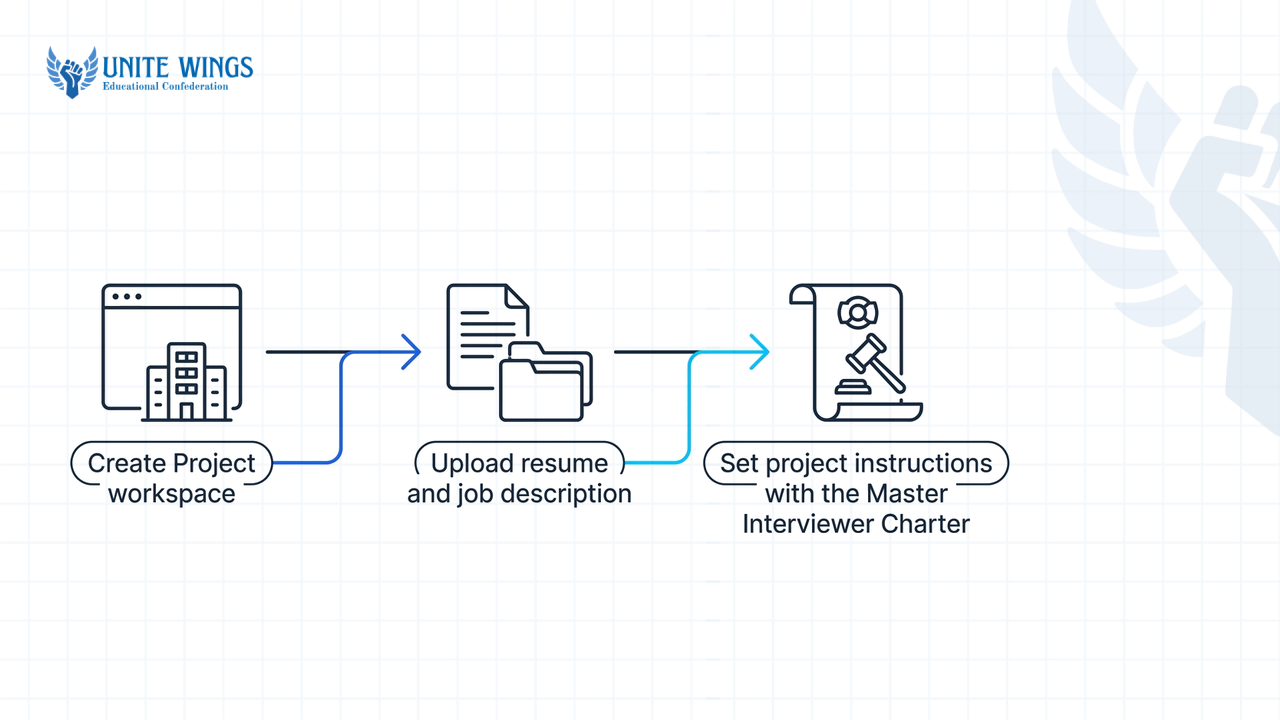
Most students make the mistake of pasting their resume into a single long chat window. Over 15 messages, standard chat windows lose track of details and start repeating questions. Setting up a Project fixes this in three steps:
- Create a Project named after your target drive, such as "TCS Digital - System Engineer" or "Razorpay - Backend Intern."
- Upload your PDF resume, the raw text of the job description, and your final-year project abstract into the Project Knowledge panel.
- Click Set project instructions (what CoPilot Interview calls the "Interviewer Charter") and paste Prompt 1 below so every chat inside that folder follows the same strict grading rules.
Prompt 1: The Master Interviewer Charter (paste into Project Instructions)
"You are an Indian technical and HR interviewer evaluating me (a final-year student/fresher) for the role uploaded in the project files. Follow these rules in every chat: 1. Ask only one question at a time and wait for my response. 2. Never write full answers or rewrite my text unless I explicitly type 'show model answer.' 3. Do not invent metrics, tools, or team sizes not present in my uploaded resume. 4. After every response I give, score it from 1 to 4 across Structure, Specificity, and Individual Ownership, then ask a follow-up probe if my answer is vague."
How do I prompt Claude to take a realistic step-by-step mock interview?
To stop Claude from printing 20 questions at once, instruct it to simulate a live round by asking one question, pausing for your reply, and cross-questioning weak claims. HowToAI and CoPilot Interview both confirm that enforcing a single-question wait loop is the only way to replicate real interview pressure.
Turn on Claude's native voice mode (tap the sound wave icon on the mobile or desktop app) or use a dictation tool like Wispr Flow (Medium) so you speak your answers out loud instead of typing them. Use Prompt 2 for mass-recruitment drives and Prompt 3 when you need a tougher product-company grill.
Prompt 2: The Mass-Recruiter Technical + MR Round Simulator (TCS/Infosys/Wipro style)
"Act as a Technical and Managerial (TR/MR) panelist for an Indian IT services drive evaluating a fresher for a ₹4.5 to ₹7 LPA role. Using my uploaded resume, conduct a 6-question mock interview. Start with a question on my core programming language, move to OOPS/DBMS/SQL fundamentals, then ask 2 questions on my academic project, and finish with 1 situational team question. Ask Question 1 now and wait for my reply. After I answer, point out one technical gap in my explanation before asking Question 2."
Prompt 3: The Tough Follow-Up Probe Simulator (Startup / Product Company style)
"Act as a skeptical Senior Engineer at an Indian product startup interviewing me for a ₹10+ LPA fresher role. Pick one claim from my resume or project file and ask me a deep 'how' or 'why' question about it. Wait for my response. If I give a surface-level textbook definition, interrupt me in the next turn and ask what happens when that system fails under load or edge cases. Keep probing the same topic for 3 turns before switching subjects."
What prompt helps me convert my final-year project into STAR format answers?
Feed Claude your raw project milestones, bugs fixed, and tech stack, then forbid it from writing a full script so it outputs a bulleted outline instead. According to LevelOp and HRLens, asking for an outline with a metric check prevents you from memorising robotic paragraphs and stops the AI from hallucinating fake performance numbers.
When Indian freshers explain their B.Tech or BCA final-year project, 90% of them say "We built an app using React and Node, and we trained a model." The interviewer immediately asks, "What did you write versus your three teammates?" and the student freezes. According to Huru.ai, your prompt must isolate your personal architecture and code commits from the group effort. MIT Career Advising guidelines cited by Whizi recommend spending 60% of your project answer on the Action phase.
You also have a choice between two frameworks:
| Framework | What it stands for | When to use it in Indian placements | Source |
|---|---|---|---|
| STAR | Situation, Task, Action, Result | Standard HR rounds and project walkthroughs where the interviewer wants a clean timeline of what you delivered. | CuroHQ |
| SOAR | Situation, Obstacle, Action, Result | Technical rounds at product startups where hiring managers care more about the specific bug, bottleneck, or constraint you overcame. | The Interview Guys |
If you are explaining your project from scratch, use Prompt 4. If the interviewer asks "Tell me about the hardest bug you faced," switch to Prompt 5.
Prompt 4: The Individual-Ownership STAR Outline Builder
"Here are the messy notes on my 4-person college final-year project: [paste what the project does, the tech stack, and the specific modules/files YOU coded]. Convert this into a 90-second STAR outline. Allocate 60% of the bullet points to the 'Action' section focusing strictly on my individual code and design choices, replacing 'we' with 'I'. Do not write full sentences for me to memorise. At the bottom, list 3 places where I am missing quantifiable metrics (like latency, accuracy, or dataset size) and ask me for the real numbers instead of inventing them."
Prompt 5: The SOAR Technical Obstacle Formatter
"Take this problem I ran into during my internship/college project: [describe the bug, crash, or accuracy drop you faced]. Structure it into a SOAR (Situation, Obstacle, Action, Result) bullet outline. Make the 'Obstacle' section highlight why a simple Google/StackOverflow fix didn't work, and make the 'Action' section list the exact debugging steps and trade-offs I made. Keep every fact true to my notes."
How can Claude generate role-specific technical questions from a job description?
Paste the complete job description into Claude and instruct it to parse the text into core tools, fundamentals, and architectural judgment calls. As iCertGlobal and The Interview Guys note, breaking a JD into competency buckets produces targeted questions instead of random LeetCode trivia.
With TalentGro reporting a 74% year-on-year jump in data science and machine learning postings on LinkedIn India, off-campus JDs often list 15 tools even for a fresher role. Use Prompt 6 to extract what they will actually ask you in Round 1, and Prompt 7 to find where your resume falls short of the JD before the interviewer does.
Prompt 6: The JD-to-Question-Bank Extractor
"Read the job description uploaded in this project. Parse the requirements into three buckets: 1. Core language/tool syntax, 2. CS or domain fundamentals, and 3. Practical debugging scenarios a fresher would face in the first 3 months. Generate 4 interview questions per bucket (12 total) ordered from easy to hard. Do not write the answers. After listing them, ask me which bucket I want to practice first in a one-by-one mock round."
Prompt 7: The Resume-vs-JD Skill Gap Spotter
"Compare my uploaded resume against the target job description. Identify the top 3 required skills or tools in the JD that are completely missing or weakly proven on my resume. For each gap, write the exact toughest question an interviewer will ask to expose that weakness, and give me a 3-bullet strategy on how to bridge it using my existing college coursework or projects without lying."
How do I ask Claude to critique my rough spoken answers without rewriting them?
Give Claude a 1-to-4 grading rubric across Structure, Specificity, Ownership, and Impact, and add an explicit negative constraint forbidding it from generating a polished rewrite. Both Techpresso and HRLens recommend using Claude Sonnet with strict rubric constraints so you fix your own spoken habits rather than reading out AI prose.
When you practice alone, you don't notice how often you say "basically," trail off at the end of a sentence, or forget to state the outcome of your work. According to RequireHire, strong communication and soft skills act as a multiplier that can earn freshers a 20% to 30% pay premium on initial offers. If you want live human feedback alongside AI practice, our Interview Masterclass pairs an answer structure with a live mock round.
Run Prompt 8 right after dictating a messy voice transcript into Claude.
Prompt 8: The 1–4 Rubric Grader (No Rewrites Allowed)
"Here is the raw voice-to-text transcript of how I just answered the question '[insert question]' out loud: [paste messy spoken transcript]. Evaluate my answer strictly using a 1-to-4 score on four dimensions: 1. Structure (did I follow STAR/SOAR?), 2. Specificity (did I name exact tools and numbers?), 3. Ownership (did I say 'I' instead of 'we'?), and 4. Impact (did I state the final result?). Rules: Be a strict evaluator, not a polite assistant. Quote the exact weak phrases from my transcript that lowered my score. Do NOT rewrite my answer for me; tell me what to fix and make me try again."
Prompt 9: The Rambling and Filler-Word Cutter
"Read my spoken transcript above. Estimate how long it takes to speak at a normal pace (130 words per minute). Highlight every sentence that is repetitive, overly defensive, or adds zero technical value. Tell me which 30% of this answer I should cut so it lands under 90 seconds, while keeping 100% of my natural Indian English speaking tone."
Which prompt helps prepare for tricky HR questions like salary expectations or gap years?
Prompt Claude to identify the hiring manager's underlying risk, show you a "danger-zone" bad answer to avoid, and write a 20-second pivot script. Techpresso and The Interview Guys use this three-part structure so candidates handle gap years, backlogs, or CTC questions without over-explaining.
In Indian HR rounds, two traps sink freshers right at the finish line: getting defensive about a drop year (for JEE, GATE, UPSC, or health reasons) or quoting a random CTC number when HR asks "What are your salary expectations?" Note that Claude's training data can have stale salary bands if web search is turned off, so feed it current 2026 Indian market brackets (such as ₹3.5–4.5 LPA for IT services or ₹6–15 LPA for AI/cloud roles) inside your prompt.
Use Prompt 10 for gap years, low CGPA, or cleared backlogs, and Prompt 11 before your final HR salary discussion.
Prompt 10: The Gap Year / Low CGPA / Backlog Pivot Script
"I am a fresher interviewing at [Company type, e.g., mid-sized IT firm / FinTech startup]. I have a [state issue: e.g., 1-year drop after 12th for JEE / 6-month gap after graduation / 6.4 CGPA due to first-year subjects]. 1. Explain the exact underlying risk the Indian HR manager is worried about when they ask about this. 2. Show me a 'danger-zone' defensive answer that would get me rejected. 3. Give me a clean, honest 20-second spoken context statement that owns the fact without excuses and pivots directly to [mention a recent proof point, e.g., my 8.2 SGPA in the final two semesters / my deployed GitHub project]."
Prompt 11: The 3-Way CTC & Salary Expectation Responder
"I am in the final HR round for a [Role name] position in [City, e.g., Bengaluru / Pune / Hyderabad]. Based on 2026 Indian market data, this role pays between [insert researched range, e.g., ₹6 LPA and ₹9 LPA]. Generate three short, polite spoken replies for 'What are your salary expectations?': Variant A (Deflecting to learn their approved band for freshers first), Variant B (Giving a defended range tied to my internship/project skills), and Variant C (How to respond if HR pushes me for a single fixed CTC number or mentions a 2-year service bond). Keep the tone respectful and suited for an Indian campus/off-campus HR round."
What most students get wrong when using Claude for mock interviews
Three habits ruin AI interview prep for Indian students. Fix these before your next drive:
- Memorising AI paragraphs word-for-word: If you ask Claude for a "model answer" and recite it on Zoom, your eyes track across the screen and your voice flattens out. When the panelist interrupts with a basic counter-question, you lose your place. Always prompt for bullet outlines (Prompts 4 and 5) and speak the sentences in your own words.
- Burning through free message limits mid-interview: Claude's free tier operates on a rolling hourly token limit (CoPilot Interview). If you upload a 40-page PDF project report into your Project Knowledge, every single back-and-forth message re-reads that massive file and locks your account after 6 turns. Upload only a 1-page resume, the text JD, and a 300-word summary of your project.
- Practicing by typing instead of speaking: Typing gives you 30 seconds to edit a sentence before hitting Enter. In a real TCS or startup panel, silence beyond 4 seconds makes you look unprepared. Always use voice mode or voice-to-text when running Prompts 2, 3, and 8.
Your 3-day interview prep plan for this week
Do not wait until the night before your placement drive to test these prompts. Follow this schedule over the next three days:
- Today (30 minutes): Open
claude.ai/projects, create a Project for your next target company, upload your 1-page resume and the JD, and paste Prompt 1 into the Project Instructions. - Tomorrow (45 minutes): Run Prompt 4 to turn your final-year project into an "I-focused" STAR outline, then run Prompt 6 to generate your 12 role-specific technical questions.
- Day 3 (30 minutes): Turn on voice mode on the Claude mobile app, run Prompt 2 or Prompt 3 for a 6-question spoken mock round, and grade your messiest answer using Prompt 8.
Practice with a live interviewer before the real drive
AI catches structure problems, but speaking in front of a real person builds nerve control. Join the Interview Masterclass to learn a repeatable framework for answering any technical or HR question and test it in a live mock round.
Frequently asked questions
Can I use Claude for free for campus placement preparation?
Yes, Claude's free plan gives you access to Claude Sonnet, voice mode, and up to 5 permanent Projects (CoPilot Interview). To avoid hitting the free rolling hourly message limit during a mock interview, upload only short text files (your 1-page resume and the job description) rather than heavy 50-page college project PDFs.
How do I stop Claude from giving me all the interview questions at once?
Include the exact line "Ask me one question at a time and wait for my response before moving on" inside your prompt or Project Instructions (HowToAI). Without that explicit stop condition, Claude defaults to printing a numbered list of 10 to 20 questions in a single message.
Is it better to use STAR or SOAR for final-year project questions?
Use STAR (Situation, Task, Action, Result) when HR or a manager asks for an overview of what your project does and how you built it (CuroHQ). Switch to SOAR (Situation, Obstacle, Action, Result) when a technical interviewer asks about a specific bottleneck, bug, or failure you solved (The Interview Guys).
Can Indian recruiters tell if I memorised an AI-generated answer?
Yes. According to 2025 hiring data cited by Whizi and Greenhouse, hiring managers easily spot overly polished, generic AI phrasing, especially when your spoken English suddenly shifts into textbook American corporate jargon. Use Claude only to outline bullet points and grade your own natural spoken transcripts.
Does Claude have a voice mode for spoken mock interviews?
Yes, Claude includes a native voice mode across its mobile, desktop, and web apps on both Free and Pro plans (CoPilot Interview). Tap the sound wave icon next to the chat bar to speak your answers out loud while Claude tracks the resume and job description saved inside your Project.
Can I use Claude during a live online assessment or video interview?
No. Even Anthropic's own candidate guidelines strictly prohibit using AI during live coding assessments or video interviews while encouraging it for advance practice (Whizi). Furthermore, the Wheebox India Skills Report 2026 notes that 70% of Indian IT firms use AI recruitment tools that flag tab-switching and eye-tracking anomalies.
Newsletter
Stay updated with our latest news and insights.