
Morning vs Night Study Routine for College Students: Which Works?
Side-by-side comparison of 5 AM and 2 AM study schedules tested against 8:30 AM college attendance, noisy hostels and exam retention.
Picking between a morning vs night study routine for college students comes down to two hard constraints: your biological chronotype and your college's 8:00 AM or 8:30 AM lecture attendance rule. According to 2026 data from Padhaao.in and India Education, about 25% of people are wired as morning larks, 25% are night owls, and 50% fall in the middle. If you live in a shared Indian hostel that only quiets down after 11:00 PM, studying late works only if you still get 7 to 9 hours of total sleep before your morning lab.
In short
- If you have an 8:00 AM or 8:30 AM mandatory lecture, cap night study at 12:00 AM so you do not drop below the 7-hour minimum sleep threshold for 18 to 25-year-olds.
- Use morning blocks (6:00 AM to 7:30 AM or 9:00 AM to 12:00 PM) for math, complex problem sets, and analytical subjects; save night blocks (10:00 PM to 11:30 PM) for revision and factual recall right before sleep.
- Test your biological fit with a 7-day split: do 3 days of 5:30 AM to 7:30 AM study and 3 days of 10:30 PM to 12:30 AM study, then grade your output on Day 7.
- If you are starting a 9:00 AM corporate internship, shift your dinner to 7:30 PM, get 5 to 10 minutes of morning sunlight, and lock your weekend wake-up time to match your weekday alarm.
Morning vs night study routine for college students: side-by-side comparison
A morning study routine gives you a rested mind for analytical subjects and keeps you safe from 8:30 AM attendance shortages, but it requires sleeping through noisy 10:30 PM hostel corridors. A night routine gives you zero external interruptions after midnight and better factual retention before sleep, but it routinely collapses when morning labs force you onto 5 hours of sleep.
| Decision factor | Early morning routine (5:30 AM – 7:30 AM) | Late night routine (10:30 PM – 1:00 AM) |
|---|---|---|
| Biological peak alignment | Leads into the 9:00 AM – 12:00 PM primary alertness window (Padhaao.in). | Follows the 4:00 PM – 8:00 PM secondary peak; relies on pre-sleep memory consolidation. |
| Hostel and PG noise | Quiet room, but your alarm and desk light can wake sleeping roommates. | Corridors quiet down after 11:00 PM or midnight (Hostel360.in), though going to bed at 10:00 PM is hard when roommates are awake. |
| 8:00 AM / 8:30 AM attendance | Low risk. You are already awake and dressed before mess breakfast opens. | High risk. Sleeping at 1:30 AM leaves under 6 hours of sleep before an 8:00 AM lab. |
| Best subject types | New theoretical concepts, complex problem sets, math, and analytical subjects. | Revision, factual memorization, extensive reading, and creative tasks. |
| Corporate internship readiness | Matches standard early morning corporate internship schedules. | Requires a multi-week circadian reset before joining a company. |
Use these decision rules to pick your slot:
- If you are a day scholar with a 60-minute morning commute, pick the night routine (9:30 PM to 11:30 PM) and sleep until 6:30 AM, because waking at 4:30 AM to study before a bus ride will cut your sleep below 6 hours.
- If you live in a 3-sharing hostel room and have 8:00 AM labs, use the campus library from 5:00 PM to 8:00 PM for heavy study, sleep at 10:30 PM with earplugs, and do a 6:00 AM to 7:30 AM desk session while your roommates are dead asleep.
- If you are in your final year with no morning lectures, you can run a 10:30 PM to 1:30 AM study block, provided you sleep until 9:00 AM every day until your internship or placement joining date approaches.
Is it better to study at 4 AM or late at night in college?
Forcing an early morning routine like a 4:00 AM schedule can backfire for many students, causing severe circadian misalignment and cognitive fatigue unless they can maintain a very early bedtime. Medical guidance reported by the Times of India and Edulist India advises against forcing 4:00 AM pre-dawn sessions when they cause circadian misalignment.
A 2025 University of Nevada Reno study published in Frontiers in Human Neuroscience (reported by the Times of India) found that college students actually peak in learning efficiency between 11:00 AM and 9:30 PM, outperforming rigid dawn windows. Chronobiology research cited by Quick Exam AI confirms the "synchrony effect": your cognitive performance peaks when you study inside your biologically preferred window, not when you copy an influencer's 4:00 AM timetable.
According to Padhaao.in, human alertness follows two biological peaks during the day: a morning peak between 9:00 AM and 12:00 PM driven by cortisol, and an evening peak between 4:00 PM and 8:00 PM. Almost everyone also hits a biological post-lunch dip between 1:00 PM and 3:00 PM, whether you eat a heavy rice meal at the mess or skip lunch entirely.
Test your focus with this 7-day hostel testing protocol:
- Days 1 to 3 (Morning block): Sleep by 10:30 PM and study a high-focus subject (like Data Structures or Thermodynamics) from 5:30 AM to 7:30 AM. Track how many practice problems you finish.
- Days 4 to 6 (Night block): Study the same subject of equal difficulty from 10:30 PM to 12:30 AM, and sleep from 12:45 AM to 7:45 AM. Track your completed problem count.
- Day 7 (Audit): Test yourself on 20 recall and application questions from both blocks without looking at your notes. Lock in whichever window gave you the higher score and fewer reread paragraphs.
How do hostel students study at night and still attend morning lectures?
Hostel students only survive late-night study and 8:00 AM or 8:30 AM lectures when they cap their night session by 11:30 PM or 12:00 AM, move early evening focus blocks to the campus library, and set roommate boundaries. Studying until 2:30 AM and waking up at 7:45 AM for an 8:00 AM attendance roll call destroys memory consolidation if your total sleep drops below 5.5 to 6 hours.
Indian hostels and PGs typically quiet down only after 11:00 PM or midnight, according to Hostel360.in. That tempts students into starting their real study at midnight. If your college has mandatory 8:00 AM or 8:30 AM classes, a midnight-to-3:00 AM schedule leaves you with 4.5 hours of sleep, meaning you sit through morning lectures in a state of acute sleep debt and retain nothing.
To build a sustainable routine for students and freshers living in shared rooms, anchor your blocks around fixed college and mess timings (Hostel360.in / Schools of Dehradun):
| Time block | Activity | Where to do it and why |
|---|---|---|
| 6:00 AM – 7:30 AM | Deep study (1 high-priority subject) | Hostel desk. Corridors and roommates are completely silent. |
| 7:30 AM – 8:00 AM | Shower and mess breakfast | Mess hall. Get 5 to 10 minutes of outdoor sunlight on the walk over. |
| 8:00 AM – 5:00 PM | College lectures and labs | Campus classrooms. Use the 1:00 PM – 3:00 PM post-lunch dip for low-load admin or a 20-minute nap. |
| 6:00 PM – 7:00 PM | Lab files and routine assignments | Campus library or reading room to avoid evening hostel corridor noise. |
| 7:30 PM – 8:30 PM | Mess dinner and walk | Eat 3 hours before your 11:00 PM sleep target to avoid digestive disruption. |
| 8:30 PM – 9:30 PM | Active revision block | Hostel desk or reading room with noise-canceling headphones. |
| 10:30 PM – 11:00 PM | Light factual recall + 3-minute desk reset | Hostel room. Clear your desk for tomorrow so you can start at 6:00 AM without friction. |
If you share a 2-bed or 3-bed room, set up these four tactical rules from Stayflh.com and Hostel360.in during the first week of the semester:
- Swap the tube light for a narrow-beam desk lamp: Never keep the central overhead tube light on past 11:00 PM. Buy a clip-on directional LED desk lamp so you can finish your 10:30 PM to 11:00 PM recall block while your roommate sleeps, or vice versa.
- Sign a written roommate quiet-hours agreement: Agree in writing on WhatsApp that after 11:00 PM, all phone calls happen in the corridor, overhead lights go off, and music or reels require earphones.
- Run a 3-minute nightly desk reset: At 10:55 PM, put away old notebooks and leave only tomorrow's 6:00 AM textbook and pen open on the desk.
- Use the 20-minute afternoon power nap: If an 8:00 AM lab leaves you exhausted during the 1:00 PM to 3:00 PM post-lunch dip, set a strict, un-snoozable 20-minute alarm. A 20-minute nap clears mental clutter before your brain enters slow-wave deep sleep, preventing afternoon grogginess.
Which subjects are better for morning study vs night study?
Morning study sessions are best for learning new theoretical concepts, mathematics, and complex problem sets because your brain is refreshed after sleep. Night study windows, particularly the 1 to 2 hours right before bed, work best for revision, extensive reading, and memorizing facts because slow-wave sleep immediately consolidates those memories.
Research compiled by India Education and AEMI Consultancy shows that morning slots support logical, structured problem-solving. Conversely, Padhaao.in cites single-source Harvard Medical School findings where students who studied new material in the evening and slept on it retained 20% to 30% more than students who studied in the morning and were tested after a full day of waking interference. Quick Exam AI notes a similar mechanism: material studied 1 to 2 hours before bed takes a direct route to long-term storage during slow-wave sleep.
There is one caveat to the "math in the morning" rule: while most chronobiology sources place analytical subjects in the morning peak (9:00 AM to 12:00 PM), some procedural problem-solving studies note that mild evening fatigue can stop you from overthinking and help you spot alternative solutions. Test where you solve coding or math problems faster during your 7-day trial, and assign your subjects accordingly:
- Morning block (6:00 AM – 7:30 AM or 9:00 AM – 12:00 PM): Mathematics, complex problem-solving, scientific formulas, and analytical subjects.
- Afternoon dip (1:00 PM – 3:00 PM): Formatting lab records, organizing PDF notes, watching recorded lecture replays at 1.5x speed, or taking a 20-minute power nap.
- Evening peak (4:00 PM – 8:00 PM): Mock tests, group project work, debugging existing code, and practicing aptitude questions for campus placements.
- Pre-bed window (9:30 PM – 11:00 PM): Factual memorization, extensive reading, revision, and light active recall.
When you are reviewing 40-page syllabus PDFs in your pre-bed window and need to turn them into concise revision flashcards without staying up past midnight, our Research with AI: Perplexity and NotebookLM session walks through setting up an audio and flashcard synthesis workflow in under thirty minutes.
How many hours of sleep do college students actually need before exams?
College students aged 18 to 25 need 7 to 9 hours of uninterrupted sleep per night according to the National Sleep Foundation, while 14 to 17-year-old first-year students and teens need 8 to 10 hours according to the CDC and the American Academy of Sleep Medicine (Edulist India). Dropping below 6 hours before an exam degrades the working memory required to pass.
An Indian undergraduate sleep study published in the International Journal of Indian Psychology (IJIP) found that roughly 60% of college students sleep 6 hours or less per night, and 74.5% check digital devices right before bed, both of which lower academic grades. When you sit at your desk reading PDFs late at night, apply the 20-20-20 rule to reduce eye strain: every 20 minutes, look at an object 20 feet away for 20 seconds, and keep digital devices away from your bed.
What most students get wrong: the cumulative sleep debt trap
Most students think sleeping 6 hours a night from Monday to Friday is harmless as long as they get 8 hours the night before a Saturday exam, or they assume a single all-nighter is a smart trade for 6 extra hours of syllabus coverage. Both assumptions fail on basic sleep math.
First, according to Colgate Professional and the Sleep Foundation, pulling a single all-nighter produces cognitive impairment equivalent to a 0.05% blood alcohol concentration. You are walking into the examination hall near the legal drink-driving limit, which ruins logical deduction and working memory (G.P. Birla Educational Foundation).
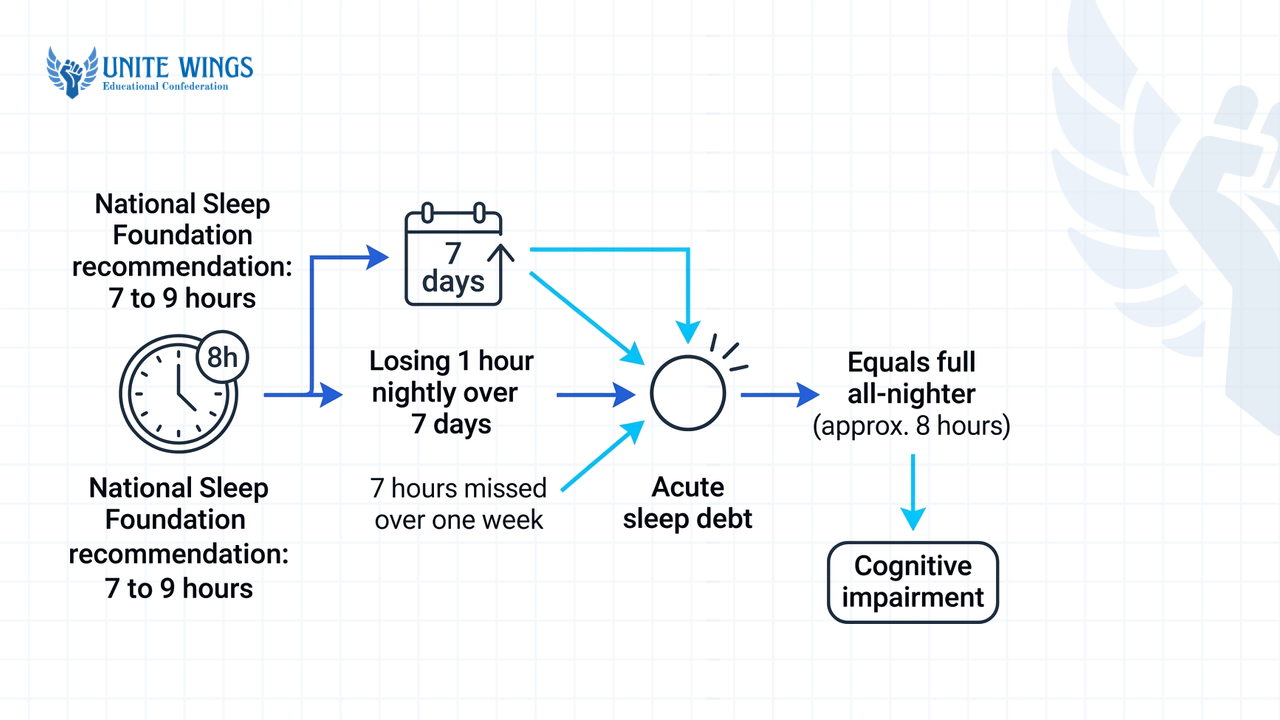
Second, Colgate Professional notes that sleeping just 1 hour less than your biological requirement every night for 7 days creates a cumulative sleep debt equal to a full all-nighter. If you need 8 hours of sleep and you sleep from 1:00 AM to 8:00 AM (7 hours) for a week during mid-terms, your brain enters Friday's paper functioning as if you did not sleep at all on Thursday night. An MIT college student analysis cited by Edulist India confirmed this: steady, consistent sleep across the weeks leading up to an exam affects final grades far more than a single night of cramming before the test.
The fix: Protect a 7 to 9-hour sleep window for the weeks leading up to your semester exams. If you have 3 modules left uncovered at 11:30 PM the night before a 9:00 AM paper, stop studying new topics, spend 20 minutes reviewing the summary formulas of the 2 modules you already know (to trigger slow-wave sleep consolidation), and go to sleep by midnight.
How do I switch from a night owl routine to a morning routine for internships?
To switch from a 2:00 AM college sleep schedule to a 7:00 AM wake-up for a corporate internship, shift your dinner 3 to 4 hours before bedtime, get 5 to 10 minutes of natural sunlight right after waking, place your alarm across the room, and keep the exact same wake-up time on Saturdays and Sundays.
Whether you join TCS, Infosys, a Big 4 firm, or a Bengaluru startup for your summer internship or final-semester training, standard office hours and corporate internships typically start around 9:00 AM. If you spend six semesters sleeping at 3:00 AM and try to flip your clock the Sunday night before your Monday onboarding, you will spend your first week at the office fighting severe circadian misalignment.
Start this 5-step transition protocol (The Flexible Chef, Reddit productivity guides, and Quora shift-work strategies) 14 days before your internship start date:
- Move your final meal to 7:00 PM – 8:00 PM: Stop eating heavy meals and cut off caffeine 3 to 4 hours before your target bedtime (or cut caffeine entirely after 12:00 PM) so active digestion does not delay deep sleep.
- Put your phone and alarm across the room: Charge your smartphone on your study desk outside arm's reach of your bed. This stops you from joining the 74.5% of students scrolling before sleep (IJIP) and forces you to stand up on your feet to turn off the 6:30 AM alarm.
- Get 5 to 10 minutes of outdoor sunlight within 15 minutes of waking: Step out onto your hostel balcony or walk to the mess gate without sunglasses. Natural morning light anchors your circadian clock and triggers melatonin onset 14 to 16 hours later.
- Lock in your weekend wake-up time: If you wake up at 6:30 AM Monday through Friday and sleep until 11:00 AM on Saturday and Sunday, you undo five days of circadian shifting in 48 hours. Wake up within 30 minutes of your weekday time on weekends.
- Use a 20-minute afternoon nap instead of evening coffee: During week one of the shift, if you crash at 2:00 PM, take a 20-minute nap rather than drinking a 5:00 PM coffee that will keep you awake past midnight.
Your 7-day plan to lock in your study schedule this week
Stop switching between 4:00 AM alarms and 2:00 AM cramming sessions every other day. Pick one protocol and test it over the next seven days:
- Tonight at 10:30 PM: Clear your hostel or bedroom desk for 3 minutes, plug your phone into a socket across the room, and set a directional lamp on your desk so you do not use the overhead tube light after 11:00 PM.
- Days 1 to 6: Run the 3-day morning (5:30 AM – 7:30 AM) vs 3-day night (10:30 PM – 12:30 AM) split test on your hardest analytical subject, while keeping your total sleep above 7 hours every night.
- Day 7: Count your completed practice problems from both windows, lock in the winning time block for the rest of the semester, and agree on 11:00 PM quiet hours with your roommates.
Cut your night reading time in half with AI
If your night study blocks keep dragging past midnight because you are manually summarizing 50-page syllabus PDFs and research papers, join our Research with AI: Perplexity and NotebookLM masterclass. You will walk away with a two-tool workflow that finds cited sources, turns dense chapter PDFs into structured study guides, and gets you into bed on time.
Frequently asked questions
Can I pull all-nighters and still pass my college semester exams?
Pulling an all-nighter produces cognitive impairment equal to a 0.05% blood alcohol concentration (Colgate Professional / Sleep Foundation), which degrades working memory and logical deduction during the exam (Edulist India). Even if you pass by regurgitating definitions, an MIT analysis shows consistent weekly sleep raises grades far more than last-minute cramming.
Does studying right before going to sleep improve factual recall?
Studying 1 to 2 hours before bed improves factual recall because slow-wave sleep immediately follows the session and transfers facts from short-term to long-term memory (Quick Exam AI). Single-source Harvard Medical School data via Padhaao.in showed 20% to 30% higher retention for evening study followed by sleep, provided you still sleep 7 to 9 hours.
How do I handle a noisy roommate when studying in a hostel?
Shift your 4:00 PM to 8:00 PM deep-work sessions to the campus library, use noise-canceling headphones at your desk, and set a written roommate agreement enforcing quiet hours after 11:00 PM (Hostel360.in / Stayflh.com). Swap the shared room tube light for a narrow-beam desk lamp so late study never wakes sleeping roommates.
What is the best way to fix a ruined sleep schedule during mid-terms?
Stop pulling late nights that drop you below 7 hours of sleep, because losing just 1 hour of required sleep per night for a week equals the cognitive deficit of a full all-nighter (Colgate Professional). Place your alarm across the room, get 5 to 10 minutes of morning sunlight upon waking, and cut caffeine 4 hours before bed.
Is 6 hours of sleep enough for an engineering or degree student?
Six hours of sleep is not enough for the vast majority of 18 to 25-year-olds, who need 7 to 9 hours per night according to the National Sleep Foundation. An Indian undergraduate study in IJIP found that the 60% of college students getting 6 hours or less suffered direct drops in academic performance.
Newsletter
Stay updated with our latest news and insights.