
Daily Routine for College Students Preparing for Placements (2026)
A realistic 3-hour evening timetable that fits aptitude, skill building and mock interviews around 9-to-5 college lectures and travel.
A realistic daily routine for college students preparing for placements requires 3 to 4 hours of focused study split around your 9-to-5 lecture schedule, rather than the 8-hour marathon plans meant for students on semester break. According to CareerNova AI (2026) and The Boring Education (2026), final-year students who block 90 minutes for aptitude and coding in the morning and 90 to 120 minutes for core subjects in the evening clear campus rounds without burning out mid-semester. The secret is separating high-focus problem solving from passive college tasks and guarding your post-lecture transition time.
In short
- Daily target: 3 to 4 hours on college days (90 minutes aptitude/DSA, 45 minutes core CS or domain revision, 15 minutes speaking practice, plus 1 hour of implementation).
- Attendance math: Keep an 80% attendance buffer per subject using
(Classes Attended ÷ Total Classes Held) × 100so a fever or outstation interview does not drop you below the 75% placement cell cutoff. - Morning vs. evening rule: Solve LeetCode and timed aptitude from 6:45 AM to 8:15 AM before college noise starts; move DBMS, OS, CN, and project work to the 6:00 PM to 9:00 PM slot.
- Hostel vs. day scholar fix: Hostelers must go straight to the library at 5:00 PM instead of their room bed; day scholars must convert their 2-hour commute into a flashcard and aptitude review block.
- Project strategy: Stop coding heavy Java/Spring Boot or Machine Learning features on Tuesday nights. Shift all development sprints to Friday evening through Sunday afternoon.
How many hours should a final year student study for placements daily?
Final-year students attending regular college classes need 3 to 4 hours of focused daily preparation, according to 2026 roadmaps from CareerNova AI and The Boring Education. While 2024 guides from Careersparxprep recommend 6 to 8 hours daily for full coverage of aptitude, coding, core subjects, and mock tests, that volume is only possible during semester breaks or non-teaching final semesters.
Trying to force 7 hours of placement prep on top of an 8-hour college timetable leads to sleep debt and mid-season drop-offs. Instead, match your daily hour target to your current academic load and the companies visiting your campus. Service-based mass recruiters like TCS, Wipro, and Infosys offer ₹3 to ₹7 LPA (with 15% to 30% variable pay and 1-year bonds, per Anvil Career's 2026 data) and test heavily on speed aptitude and basic coding. Mid-tier and product firms paying ₹6 to ₹18 LPA (per CollegeOption and Siddhartha 2026 reports) demand deeper Data Structures and Algorithms (DSA) and deployed projects.
Follow this daily time split on active college days:
- 90 minutes for screening readiness: Split this between 15 to 30 quantitative aptitude questions on IndiaBix or PrepInsta and 2 to 3 pattern-based problems on LeetCode or NeetCode. CareerGrowKaro (2026) notes that aptitude and reasoning tests eliminate 60% to 70% of candidates in the first campus round.
- 45 to 60 minutes for core subject revision: Rotate one subject per day across Operating Systems (OS), Database Management Systems (DBMS), Computer Networks (CN), and Object-Oriented Programming (OOPs), as recommended by Arya College's 2026 placement guide. For Mechanical or Civil branches (where 2026 fresher packages average ₹3 to ₹7 LPA per Siddhartha and KS Verse), replace CS subjects with your core branch topics.
- 45 minutes for implementation or resume proof: Write small code modules, review GitHub commits, or practice AI tools. Deloitte India's Campus Workforce Trends 2026 report (cited by Kaabil AI) found that 86% of Indian employers now use AI in hiring and expect tool familiarity from freshers.
- 15 minutes for spoken communication: A 2026 Rungta International Skills University report citing Mercer | Mettl's India Graduate Skill Index states that only 55.1% of graduates have adequate communication skills and 54.6% show strong critical thinking. Spend 15 minutes reading technical explanations out loud or recording a 2-minute answer to a standard HR question on your phone.
If your internal semester exams or lab practicals start in 7 days, scale this 3-hour routine down to a 45-minute maintenance block (2 LeetCode problems and 15 aptitude questions) so you do not lose your coding streak while passing your university papers.
How do I manage placement preparation with 75% attendance rules?
Manage the 75% attendance rule by maintaining an 80% buffer in every individual subject and turning low-value lecture gaps into passive revision slots. Across AICTE, UGC, and major affiliating universities like VTU, AKTU, and Mumbai University, falling below 75% attendance triggers exam disqualification and an automatic block from the campus placement portal, as confirmed by ExamMint and AttendanceCalculators.net in 2026.
What most students get wrong is tracking only their overall semester average. Your college ERP might show 78% overall attendance, but if you sit at 68% in a single subject like Compiler Design or Control Systems, the head of department can withhold your hall ticket and the placement cell will delist you from upcoming drives. Some autonomous or tier-1 private colleges enforce an even stricter 80% or 85% cutoff.
Use two exact formulas from AttendancePercentageCalculator.com and ExamMint (2026) to control your calendar:
- Current Attendance Percentage:
(Classes Attended ÷ Total Classes Held) × 100 - Safe Bunk Limit (classes you can miss and stay at 75%):
(Classes Attended ÷ 0.75) − Total Classes Held - Recovery Requirement (consecutive classes needed to hit 75%):
(0.75 × Total Classes Held − Classes Attended) ÷ 0.25
For example, if 40 classes have been held in DBMS and you attended 27, your attendance is 67.5%. Plugging into the recovery formula: (0.75 × 40 − 27) ÷ 0.25 = (30 − 27) ÷ 0.25 = 12. You must attend the next 12 DBMS lectures without a single miss just to touch 75%. Download an app like SelfAttend or an Attendance Percentage Calculator at the start of the 5th or 7th semester and log every lecture independently of your faculty's register.
According to PixelVoltApps (2026), keeping an 80% attendance buffer gives you a safety margin for viral fever or travel to off-campus interviews. Furthermore, HireStepX (2026) points out that a single campus placement drive often spans 12 to 16 hours on interview day, starting with a pre-placement talk, a 2-to-3-hour online assessment, and technical rounds running late into the night. If you do not have an 80% buffer, missing two full days of classes for recruitment drives will push you into the penalty zone.
To extract study time from a strict 9-to-5 college day, Focus Room (2026) recommends two rules:
- Use dead hours between lectures: When a professor cancels a 11:00 AM slot or a lab finishes 40 minutes early, do not go to the canteen. Open IndiaBix on your phone and solve 15 syllogism or data interpretation questions, or review your OS deadlock notes.
- Use the back bench in lenient lectures: In theory classes where the faculty reads directly from slides, sit in the last two rows and trace dry runs of tree and graph algorithms on paper. Never pull out a laptop if the professor is strict; getting thrown out costs you the attendance mark you came for.
What should I study in the morning vs evening for campus placements?
Use morning hours (6:45 AM to 8:15 AM) for high-cognitive-load tasks like new DSA patterns and timed quantitative aptitude, and reserve evening hours (6:00 PM to 10:30 PM) for core CS revision, coding implementation, and project work. Guides from Scribd, CareerNova AI, and The Boring Education (2026) confirm that your brain handles analytical logic fastest before college lectures drain your willpower.
Scheduloom's 2026 cognitive research notes state that while analytical focus peaks vary by personal chronotype, early morning hours guarantee zero WhatsApp group notifications, hostel corridor noise, or family interruptions. However, if you are a true night owl who cannot fall asleep before 1:00 AM, do not force a 6:00 AM wake-up call. Coding with 5 hours of sleep ruins your logic retention. Shift the high-focus DSA block to 10:00 PM to 11:30 PM after your hostel floor quiets down, and sleep until 7:30 AM.
Here are two complete, hour-by-hour weekday routines tailored to how you actually live in college.
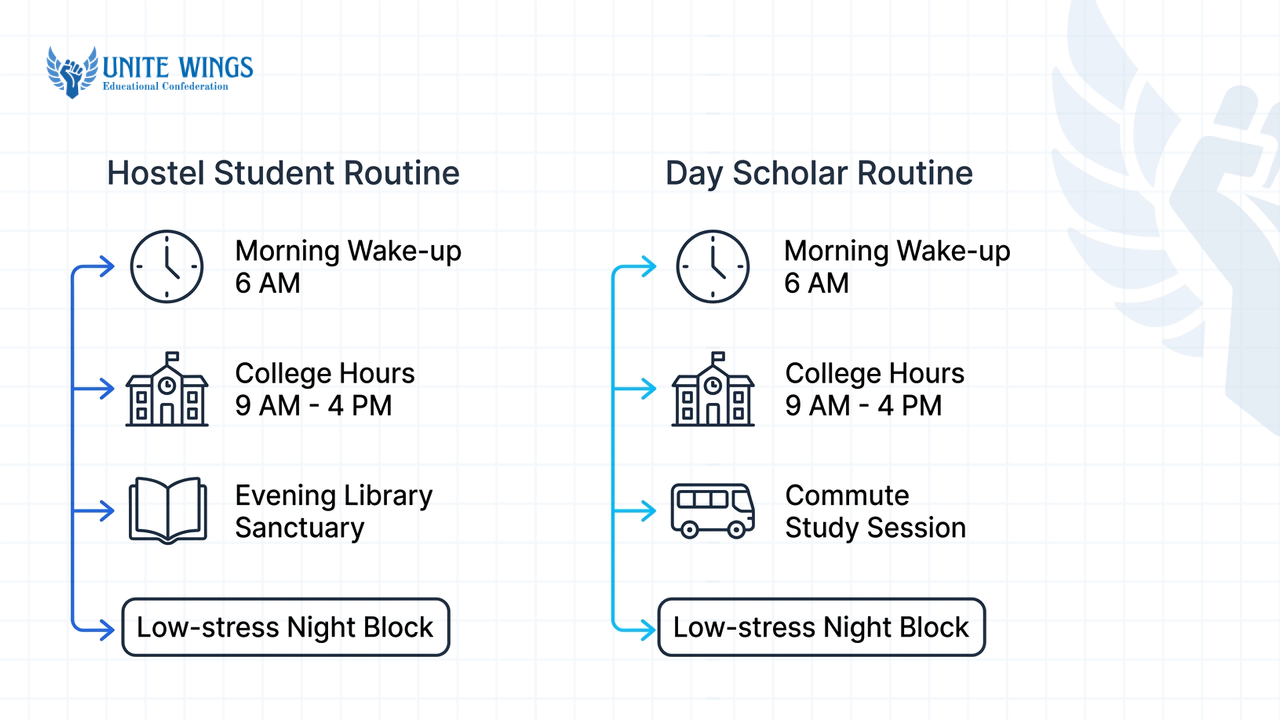
| Time Slot | Hostel Student Routine (No Commute) | Day Scholar Routine (2-Hour Total Commute) |
|---|---|---|
| 6:30 AM – 7:00 AM | Wake up, wash up, black coffee or tea. No social media. | Wake up, get ready, pack lunch and water. |
| 7:00 AM – 8:15 AM | High-focus block (75 mins): Solve 3 new LeetCode problems or 25 timed aptitude questions. | High-focus block (60 mins, 6:45–7:45 AM): Solve 2 LeetCode problems + 10 quantitative aptitude questions. |
| 8:15 AM – 9:00 AM | Breakfast at mess and walk to department building. | Morning commute (7:45–8:45 AM): Bus/metro ride. Review core CS flashcards or watch a NeetCode concept video. |
| 9:00 AM – 5:00 PM | College hours: Attend classes for 80% buffer. Use 1 free period (45 mins) for 15 IndiaBix reasoning questions. | College hours: Attend classes for 80% buffer. Use 1 free period (45 mins) to finish lab files so you take zero homework home. |
| 5:00 PM – 6:00 PM | Snacks, quick walk. Rule: Do not lie down on your hostel bed. Go straight to the central library at 5:30 PM. | Evening commute (5:00–6:00 PM): Listen to recorded voice notes of your HR answers or read GeeksforGeeks interview experiences. |
| 6:00 PM – 8:30 PM | Library sanctuary (150 mins): 60 mins core subject revision (OS/DBMS/CN) + 90 mins coding implementation or Upsolving morning OA problems. | Rest + Evening block (6:00–6:45 PM rest/tea; 6:45–8:45 PM study): 60 mins core subject revision + 60 mins solving 3 pattern-based DSA problems. |
| 8:30 PM – 9:30 PM | Mess dinner and 15 mins English speaking practice with a serious wingmate. | Family dinner and 15 mins recording a mock technical explanation on your phone. |
| 9:30 PM – 10:30 PM | Low-stress block: Push code to GitHub, tailor resume bullets, check placement cell notices. Lights out at 10:45 PM. | Low-stress block: Revise morning LeetCode solutions, update GitHub/resume. Lights out at 10:30 PM. |
For hostel students, Focus Room (2026) highlights one critical transition rule: never return to your hostel bed at 5:00 PM. Once you lie down with your phone after 7 hours of lectures, decision fatigue takes over and your 30-minute nap turns into a wasted evening until 8:30 PM mess dinner. Walk straight from your department to the college library or an empty classroom and finish your 2.5-hour evening block before returning to your hostel block.
How do I fit coding or domain projects into a busy semester?
Fit coding and domain projects into a busy semester by restricting weekday coding to 60-minute micro-slots for DSA patterns and moving all heavy development work, such as Java Spring Boot backends or Machine Learning pipelines, to Friday-through-Sunday sprints. Scribd's 2026 Complete Placement Preparation Plan notes that context-switching into a full-stack codebase takes 25 minutes alone, making 45-minute weeknight blocks useless for building projects.
According to Atyant (2026), software placement preparation requires a benchmark of roughly 300 LeetCode problems organized by patterns (such as arrays, strings, trees, and graphs). On weekdays (Monday to Thursday), Scribd's schedule recommends solving up to 5 DSA problems daily or spending 1 hour on pure implementation practice. Do not open your full-stack project IDE between Monday and Thursday.
For projects, The Boring Education (2026) advises building 1 to 2 flagship projects that are fully deployed, live on a public URL, and documented on GitHub, rather than keeping 6 half-baked clones on your local drive. WhereUElevate's 2026 sequencing guide states you must order your semester prep strictly:
- Clear eligibility checks (such as the 75% attendance rule).
- Lock in screening test readiness (aptitude + core DSA).
- Master one core technical skill (e.g., Data Science, where 2026 fresher salaries range from ₹6 to ₹15 LPA per Siddhartha).
- Build proof of work via deployed projects.
- Run mock interviews.
If you are in your 6th or 7th semester and still do not have a working project deployed on a live link, you can compress weeks of trial-and-error into a single weekend through the AI Portfolio Sprint. Once your flagship project is live, write a clean README.md with system architecture diagrams and exact setup steps so a technical interviewer can test it in 30 seconds during a campus drive.
What is the best weekend schedule for placement preparation?
The best weekend schedule for placement preparation splits Saturday and Sunday into three distinct blocks: morning timed assessments (7:30 AM to 10:00 AM), mid-day project development sprints (10:30 AM to 1:30 PM), and afternoon/evening mock interviews or live coding contests. Both Scribd (2026) and The Boring Education (2026) recommend using weekends to simulate the exact time pressure of campus online assessments (OAs).
During the week, you learn concepts untimed. On the weekend, you must test yourself with a ticking clock. As noted by Ashish Code (2025), participating in weekend coding contests, like the LeetCode Weekly Contest on Sunday morning, replicates the panic of seeing an unfamiliar graph problem during a 90-minute company test.
Follow this plug-and-play weekend timetable:
Saturday: Assessment and Building Day
- 7:30 AM – 9:30 AM (Full-length mock OA): Take one timed test combining 30 minutes of quantitative/logical aptitude and 60 minutes of 2 medium-level coding questions. Close all browser tabs and do not use AI autocomplete.
- 9:30 AM – 10:30 AM (Break and error log): Eat breakfast, then spend 20 minutes writing down why you missed specific questions in your mock test.
- 10:30 AM – 1:30 PM (Project sprint block 1): 3 uninterrupted hours of feature building on your flagship project (e.g., integrating an authentication API, fixing database schemas, or training a model). Commit your code to GitHub before lunch.
- 3:00 PM – 5:30 PM (Weekly DSA pattern review): Re-solve the hardest 5 LeetCode problems you struggled with between Monday and Friday without looking at your previous submission.
- 6:00 PM onwards: Complete rest. Go out with friends, play a sport, or watch a movie. Protecting Saturday night prevents semester burnout.
Sunday: Contest, Mock Interviews, and Planning Day
- 8:00 AM – 9:30 AM (Live coding contest): Participate in the LeetCode Weekly Contest (or run a virtual contest on LeetCode). Spend 9:30 AM to 10:30 AM upsolving the first question you failed to pass during the live window.
- 11:00 AM – 1:30 PM (Project sprint block 2): UI polish, project deployment, or writing documentation and unit tests.
- 3:00 PM – 5:00 PM (Peer mock interview and communication drill): Pair up with a classmate. Spend 45 minutes grilling each other on DBMS normalization, OS paging, and resume projects, then switch roles. If you freeze up when speaking in front of groups, use the Group Discussion and Speaking Masterclass to practice structured frameworks for GDs and HR rounds.
- 6:00 PM – 7:00 PM (Target mapping for next week): Check your college training and placement (T&P) notice board and off-campus trackers. List the companies visiting over the next 7 days, check their past question papers on PrepInsta or GeeksforGeeks, and pre-pack your college bag.
Your action plan for this week
Do not wait until Monday morning to start a routine from scratch. Take these three steps before this weekend ends:
- Tonight (20 minutes): Open your college ERP or attendance register and calculate your exact percentage for every individual subject using `(Classes Attended ÷
Newsletter
Stay updated with our latest news and insights.