
How to Cold Email IIT and IIM Professors for Research Internships
Three academic cold email templates for IIT, IISc, and IIM faculty, plus a 20-minute workflow to reference a professor's latest paper without faking interest.
Sending a cold email to a professor for a research internship in an IIT or IIM works only when your message is 150 to 250 words long, lands between December and March, and references a specific method from their recent publications. Professors delete generic templates on sight because hundreds of students send identical, AI-generated praise every week. To get a reply, your email must prove in four short paragraphs that you have read their lab's latest paper and possess the exact technical skill needed to run their experiments or clean their datasets.
In short
- Send your first batch of emails between December and January for May–July summer slots, scheduled for Tuesday, Wednesday, or Thursday between 8:00 AM and 11:00 AM.
- Keep the email between 150 and 250 words across 3 to 4 paragraphs, and attach a 1-page black-and-white PDF academic CV named
Firstname_Lastname_CV.pdfwithout a separate cover letter. - Read the abstract and introduction of a recent paper from the professor's group to write a simple question or observation about its methodology instead of praising their work.
- Tier-3 students with a 7.5 CGPA can bypass formal portal cutoffs (like IIT Hyderabad's top-20% rule) by emailing early-career faculty directly with links to working GitHub repositories or NPTEL coursework.
- Send exactly one polite follow-up in the same email thread after 10 to 14 days if you do not hear back, then move on to the next faculty member.
When should I start cold emailing IIT and IIM professors for summer internships?
Start sending your cold emails between December and January if you want a May–July summer research internship, though the wider outreach window stays open until March, according to 2026 academic outreach data from Asuraa and IISERConnect. Reaching out two to four months before summer begins gives professors time to check their active grant funding (such as DST or SERB projects) and lab space before formal institute portals fill their quotas.
Wait until April and you will find most lab slots already taken by students who applied during the winter semester break. You also need to track whether a professor accepts direct emails or requires you to apply through a centralized institute portal. Several IIT faculty members state on their homepages that they ignore direct internship emails and only recruit through official annual advertisements released around February, as noted by Asuraa and IIT Bhubaneswar.
| Application Route | Peak Application Window | Typical Stipend & Terms | CGPA / Eligibility Rules |
|---|---|---|---|
| Direct Cold Email (IITs / IIMs) | December to January (extends to March) | Often unpaid or hostel-only, unless tied to a professor's external grant (Atyant) | Professor's discretion; 7.5 CGPA works if backed by strong projects |
| Science Academies' SRFP | Closes 31 January 2026 (Asuraa) | Funded national fellowship | Strict academic merit evaluation |
| IIT Kanpur SURGE | Check official portal | Formal institute programme | Minimum CPI/CGPA of 6.0 for non-IIT B.Tech students (NM7) |
| IIT Hyderabad SURE | Check official portal | Formal summer exposure programme | Must be in the top 20% of your discipline by CGPA/percentage (IIT Hyderabad) |
| IIT Madras Summer Fellowship | Check official portal | Rs. 15,000 per month for 2 months (NM7) | Central screening |
| IIT Bombay Research Internship Awards | 2026–27 cycle | Rs. 15,000 per month for 4 to 6 months full-time (IIT Bombay) | Requires 4–6 month commitment |
If your target department at an institute like IIT Guwahati or IIT Bhubaneswar mandates a central portal in February, submit your formal application there first. You can still send a brief note to the professor referencing your portal application ID, provided their webpage does not explicitly ban emails.
How do I summarize a professor's research paper in my email without sounding fake?
Read the abstract and introduction of a recent paper from the professor's lab and write one or two sentences about a concrete method, dataset, or open question, as recommended by IISERConnect and ResearchMatch. Never copy-paste the paper title in bold or claim you were "fascinated by their advanced work," because faculty inboxes are flooded with ChatGPT-written emails that use those exact words.
You do not need three days to read a 15-page IEEE or Springer paper before writing a single email. Use this 15-minute workflow with Google Scholar and AI research tools to write two hyper-specific lines about their methodology:
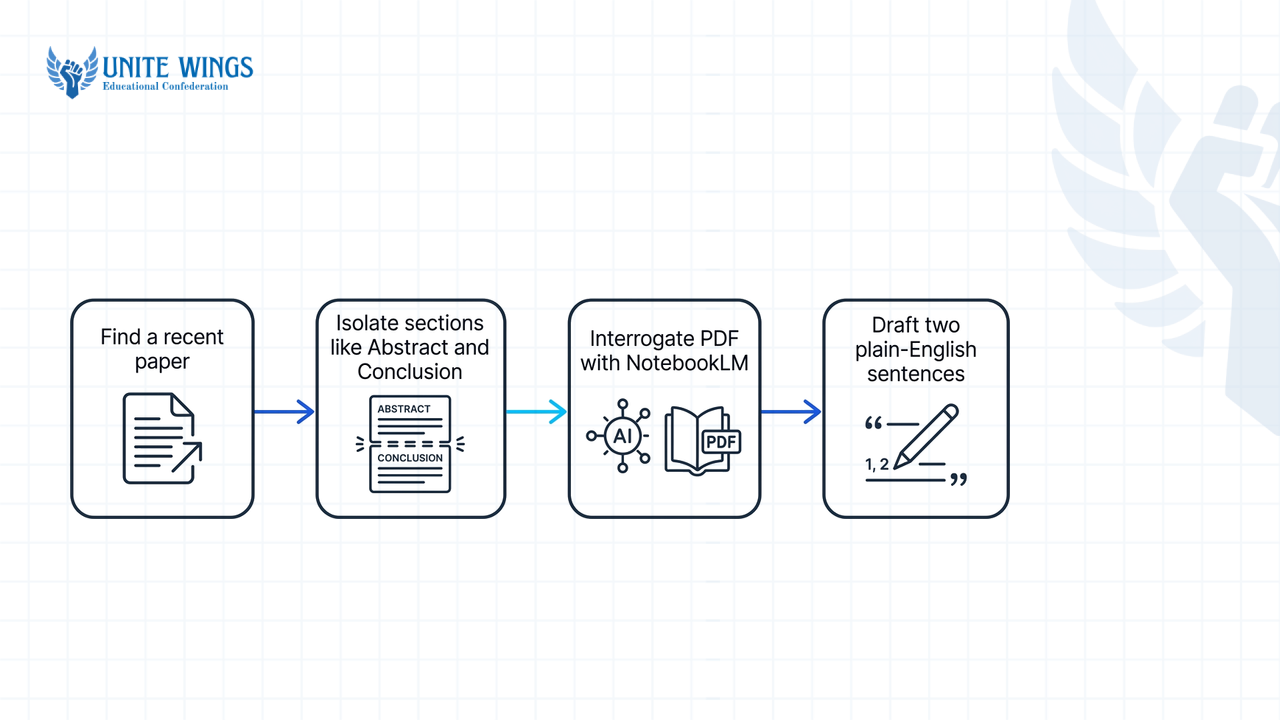
- Find a recent paper or project from the lab (Minutes 1–3): Open the professor's profile or Google Scholar page to find a recent publication or active lab project. For IIM faculty, check institute directories in quantitative management, economics, or decision sciences (a targeting strategy shared in a 2022 YouTube guide) and download their latest working papers.
- Isolate the sections that matter (Minutes 4–6): Skip the literature review and heavy mathematical proofs. Read the Abstract, the last paragraph of the Introduction (which always states what the paper actually builds or tests), and the last paragraph of the Conclusion (which lists limitations and future work).
- Interrogate the PDF with NotebookLM or Perplexity (Minutes 7–11): Upload the two PDFs into Google NotebookLM and run this exact prompt: "Extract the exact dataset size, the baseline model or experimental setup used in the methodology section, and one limitation or future extension the authors mention in the conclusion. Do not use adjectives; give me the raw technical parameters." If you want to practice this exact setup for literature reviews and technical outreach, check out our Research with AI: Perplexity and NotebookLM session.
- Verify and draft two plain-English sentences (Minutes 12–15): Cross-check the AI output against the PDF to ensure it did not hallucinate a metric, then write two sentences: Sentence 1 connects a specific method in their paper to something you have tested, and Sentence 2 asks a simple question or proposes a small task based on their future work section.
Here is the difference between an email that gets deleted and one that gets forwarded to a PhD scholar in the lab:
- What most students write (gets deleted): "I recently read your paper 'Deep Learning for Traffic Flow Prediction in Indian Cities' and found it deeply insightful. Your innovative approach to solving urban congestion aligns with my passion for AI."
- What you should write (Engineering/Science): "In your 2025 paper on urban traffic prediction, I noticed your Spatio-Temporal Graph Convolutional Network dropped in accuracy during monsoon anomalies due to missing loop-detector data. While building a PyTorch traffic-Forecasting project last semester (GitHub link), I used KNN-based imputation for missing sensor timestamps, and I was wondering if your group is testing multi-modal weather inputs for the next phase of this dataset."
- What you should write (IIM Economics/Decision Sciences): "While reading the methodology of your 2025 working paper on rural microfinance defaults, I saw that you merged RBI district-level credit data with rainfall deviations using a difference-in-differences estimator in Stata. I have cleaned similar NSSO household panel datasets using Python (
pandasandstatsmodelsrepo linked here) and would like to ask if you need research assistance for data scraping or regression checks this summer."
How to structure your 200-word cold email (with copy-paste template)
Keep your cold email between 150 and 250 words divided into three to four short paragraphs, and use a subject line that names the professor's specific research area or paper rather than generic phrases like "Summer Internship Inquiry", according to Rise Global Education and Asuraa. Every line must earn its place on a mobile screen.
Use this four-paragraph architecture:
- Subject Line:
Inquiry regarding your recent paper on [Specific Topic] - [Your Name], [Your College]orResearch Assistantship Inquiry: [Specific Sub-field/Lab Name] - Paragraph 1 (1–2 sentences): State your name, current year of study, branch/major, and college name. Specify the exact window you are available (for example, May 15 to July 15, 2026).
- Paragraph 2 (2–3 sentences): Insert the two methodology sentences you drafted from their recent paper.
- Paragraph 3 (2–3 sentences): State one or two technical skills or completed projects that prove you can execute the work, with a direct hyperlink to your GitHub repository, code notebook, or deployed project.
- Paragraph 4 (1–2 sentences): Ask a low-friction question: whether they are taking summer interns this cycle or are open to a 10-minute call/assignment to test your fit.
Sample Cold Email (188 words):
Subject: Inquiry regarding your 2025 paper on battery thermal management - Rohan Verma, VIT Vellore
Dear Prof. [Last Name],
I am a third-year B.Tech Mechanical Engineering student at [College Name], writing to ask if you have openings for a summer research intern in your lab from May 10 to July 15, 2026.
I read your 2025 Applied Thermal Engineering paper on phase-change material (PCM) cooling for Li-ion battery packs. In Section 3, you noted that paraffin-based composites showed localized hotspots at 3C discharge rates due to low thermal conductivity near the tab regions. I was curious whether your team is currently running ANSYS Fluent simulations with fin-assisted hybrid cooling geometries to address that gradient.
Over the past six months, I modelled a 2D conjugate heat transfer problem for a cylindrical cell module in ANSYS Fluent and automated the mesh sensitivity scripts using Python ([Link to GitHub repository/project report]). I have also completed the NPTEL course on Computational Fluid Dynamics with an 88% score.
I have attached my 1-page academic CV (Rohan_Verma_CV.pdf). Would you be open to considering me for an unpaid or project-funded summer internship, or sharing a small preliminary simulation task to evaluate my skills?
Sincerely,
Rohan Verma
Department of Mechanical Engineering, [College Name]
[Phone Number] | [Portfolio/GitHub Link]
Can Tier-3 college students with a 7.5 CGPA get research internships via cold email?
Yes, Tier-3 college students with a 7.5 CGPA can secure research internships at IITs and IIMs via cold email if they back up their pitch with concrete technical skills, working project links, and relevant online coursework like NPTEL or Coursera, as confirmed by Atyant and Reddit's r/Btechtards community. While centralized institute portals often filter out applicants below an 8.0 or top-20% class threshold, individual professors recruiting via email have full discretion over whom they allow into their labs.
If you are applying from a lesser-known college with a 7.5 CGPA, follow these five rules to shift the evaluation from your college tag to your technical output:
- Target Assistant Professors (early-career faculty): According to 2026 data from Reddit's r/Btechtards community, junior faculty members who joined the institute within the last one to four years reply far more often than senior Deans or HoDs. Early-career professors are actively setting up their labs, have fewer PhD scholars, and need motivated undergraduates to write code, build hardware rigs, or clean datasets.
- Send from your institutional email domain: Send your email from your college-issued address (such as
name@college.ac.inor.edu.in) rather than a generic Gmail address to establish immediate credibility and stay out of university spam filters. - Never round up your CGPA: Report your exact CGPA on your CV if you include it. Official placement and internship rules—such as the IIT Madras 2025–2026 Internship Resume Guidelines—explicitly prohibit rounding up grades (for example, a 7.49 or 7.99 must never be written as 7.5 or 8.0). If your overall CGPA is 7.5, you can supplement your grades and highlight your coursework in directly relevant NPTEL courses or state your score alongside a live GitHub link to your projects.
- Know who actually screens you: What most guides miss is lab hierarchy. Professors rarely supervise summer undergraduates day-to-day; their PhD students, postdocs, or lab managers review your code and assign your daily tasks. When you link a GitHub repository in Paragraph 3, include a clean
README.mdwith charts and reproducible steps so a busy PhD scholar can verify your skill in 30 seconds. - Be clear about funding expectations: According to Atyant, most informal cold-email internships at IITs and IIMs are unpaid or provide only subsidized hostel accommodation, unless the professor happens to have surplus funds in an external research grant. Stating that you can self-fund your stay or work remotely removes a major administrative hurdle for a professor whose grant budget is already tied up.
Should I attach a 1-page academic CV or a cover letter in the email?
Attach a 1-page academic CV formatted as a PDF and skip the separate cover letter document altogether, because the body of your cold email acts as your cover letter, according to Cornell University and IISERConnect. Asking a professor to download and open two separate files doubles the friction before they even know who you are.
While Cornell University notes that an academic CV can span one to two pages, IISERConnect recommends restricting a first-time undergraduate research CV strictly to a single page. Use clean black-and-white text without profile photographs, skill-percentage bars, or multi-column Canva graphics. Save the file strictly as Firstname_Lastname_CV.pdf (for example, Ananya_Sharma_CV.pdf), never Resume_final_v2.pdf. If you need help stripping out fluff and writing sharp project bullets that pass a 10-second scan, our Resume Masterclass walks you through the exact formatting step by step.
Watch out for institutional spam filters
While attaching a 1-page PDF CV is standard practice across Indian academia, contributors on Academia StackExchange warn that strict university firewalls sometimes flag emails from external domains that contain PDF attachments and multiple hyperlinks. If you are concerned about spam filters, test sending your next batch with no PDF attachment—place a single hyperlink to a clean personal webpage instead.
What day and time are professors most likely to read student emails?
Send your cold emails on a Tuesday, Wednesday, or Thursday morning between 8:00 AM and 11:00 AM in the professor's local time zone, according to 2026 outreach analyses by ResearchMatch, Acatrix, and IISERConnect. Monday mornings are buried under weekend administrative backlogs, and Friday afternoon messages get pushed down by weekend announcements.
Schedule your emails the night before using Gmail's or Outlook's "Schedule send" feature for 8:15 AM IST so your email sits near the top of the professor's inbox when they open their desktop before 9:00 AM lectures or lab meetings.
Once you send an email, follow two non-negotiable etiquette rules from Asuraa:
- Never mass-mail an entire department at once: Professors in the same IIT or IIM department talk to each other over tea and forward internship inquiries to their colleagues or lab PhD groups. If you email five professors in the IIT Bombay CSE department on the same Tuesday morning claiming each of their sub-fields is your "sole research interest," your emails will be discarded immediately. Space your emails within the same department by at least two weeks.
- Send exactly one follow-up after 10 to 14 days: If you do not receive a reply after 10 to 14 days, reply directly inside the exact same email thread (so they do not have to search their inbox for your original pitch and CV) on a Tuesday or Wednesday morning. Keep the follow-up under 50 words: "Dear Prof. [Last Name], I am following up on my email below regarding a summer research internship in your group from May to July 2026. I remain very interested in assisting with your work on [specific topic] and have attached my CV again for convenience. Sincerely, [Your Name]." If there is no response after that single follow-up, close the tab and move on to the next faculty member on your tracking sheet.
Your action plan for this week
Do not wait until you have a "perfect" profile to start reaching out. Block four hours this weekend and execute this exact sequence:
- Today (60 minutes): Open the faculty directories of five target departments across IITs, NITs, IISc, or IIMs. Build a Google Sheet with 15 early-career professors whose research matches your branch. Verify on each professor's webpage whether they accept direct emails or mandate a central portal like SURGE or SURE.
- Tomorrow (90 minutes): Download the two most recent 2025–2026 Google Scholar papers for the first five professors on your list. Run the 15-minute Abstract/Intro/Conclusion check and write two specific methodology sentences for each professor.
- Monday evening (45 minutes): Export your 1-page black-and-white CV as
Firstname_Lastname_CV.pdf(double-checking that your CGPA is not rounded up) and schedule your first five customized emails to go out Tuesday morning at 8:15 AM.
Read papers in 15 minutes with Perplexity and NotebookLM
If reading dense academic PDFs slows down your outreach, join our Research with AI: Perplexity and NotebookLM workshop. You will build a repeatable two-tool workflow to find verified papers, extract exact experimental methods without hallucinations, and write technical outreach messages with real citations.
Frequently asked questions
Do IIT professors reply to cold emails from non-IIT students?
Yes, IIT and IIM professors regularly accept non-IIT students through cold emails, especially early-career faculty who need extra hands to run experiments, write code, or clean data. Your reply rate depends on whether you reference a specific method from their recent papers and link a working project that proves your skill.
What is the ideal word count for an academic cold email?
The ideal length for an academic cold email is 150 to 250 words broken into three to four short paragraphs, according to Rise Global Education. Anything longer than 250 words forces a professor to scroll on their phone and obscures your core technical pitch and availability dates.
How many follow-ups can I send to a professor before it becomes spam?
Send exactly one polite follow-up email 10 to 14 days after your initial message, keeping it inside the same email thread so the original context stays visible, as advised by Asuraa. Sending a second or third follow-up annoys faculty and risks getting your email address flagged as spam.
Do IIT professors pay stipends for summer research internships?
Informal research internships secured via cold email are usually unpaid or provide only hostel accommodation, unless the professor pays you out of an active external project grant (such as SERB or DST), according to Atyant. Fixed stipends like Rs. 15,000 per month are typically tied to formal institute fellowships at IIT Bombay or IIT Madras.
Are cover letters mandatory when cold emailing for academic internships?
No, you should never attach a separate cover letter file when cold emailing a professor, according to Cornell University and IISERConnect. The 150-to-250-word body of your email acts as your cover letter, so the only file you should attach is your 1-page academic CV as a PDF.
Can I email multiple professors in the same IIT or IIM department at once?
No, bulk-mailing multiple professors in the same department on the same day is heavily discouraged by Asuraa because faculty members frequently compare notes or share lab resources. Email one professor per department, wait 10 to 14 days for your follow-up window to close, and only then contact a second professor in that department.
Newsletter
Stay updated with our latest news and insights.