
Data Analyst Jobs Salary in India for Freshers (2026 Breakdown)
Calculate your real monthly in-hand pay from CTC offers and see how to target packages of ₹6 LPA to ₹12 LPA at product companies instead of the standard ₹3.5 LPA service track.
The typical starting salary for a fresher data analyst in India in 2026 ranges from ₹3.5 LPA to ₹6 LPA, according to Intervue.io. That translates to a monthly in-hand take-home pay between ₹30,000 and ₹50,000 after statutory deductions like Provident Fund (PF) and professional tax. However, your actual offer depends heavily on where you land: traditional IT service firms start at ₹3.36 LPA, while Global Capability Centres (GCCs) and product companies pay ₹6 LPA to ₹12 LPA for candidates with strong SQL, Python, and business intelligence skills.
By the end of this guide, you will know how to calculate your real monthly take-home pay from any CTC offer, compare fresher packages across company tiers and cities, and identify the exact skills and portfolio proof required to skip the ₹3.5 LPA mass-recruiter bracket.
Key takeaways
- Baseline fresher pay: The standard data analyst jobs salary in India for freshers sits between ₹3.5 LPA and ₹6 LPA (₹30,000 to ₹50,000 monthly in-hand), though Excel-only reporting roles can start as low as ₹2.5 LPA to ₹3 LPA.
- The company tier gap: Mass IT recruiters (TCS, Infosys, Wipro) cap base entry tracks at ₹3.36 LPA to ₹5 LPA, mid-size analytics firms (Mu Sigma, Fractal) offer ₹5 LPA to ₹7 LPA, and product unicorns or GCCs pay ₹7 LPA to ₹12 LPA.
- CTC is not bank credit: Your monthly in-hand salary will be roughly 70% to 75% of your annual gross CTC after PF, gratuity, professional tax, and variable bonus deductions.
- Skills that unlock ₹6+ LPA: Combining advanced SQL, Python (Pandas/NumPy), and Power BI or Tableau with 2 to 3 hosted portfolio projects can boost starting offers by 15% to 35%.
- Fastest path to ₹10+ LPA: Internal annual hikes at service firms average 8% to 12%, so analysts who cross ₹10 LPA within three years usually do so by switching companies at the 18-to-24-month mark.
What is the starting in-hand salary for a fresher data analyst in India?
The starting in-hand salary for a fresher data analyst in India is between ₹30,000 and ₹50,000 per month, based on the standard ₹3.5 LPA to ₹6 LPA entry-level CTC range reported by Intervue.io. According to Evika Academy, your monthly take-home pay typically equals 70% to 75% of your annual gross CTC after mandatory deductions like Provident Fund (PF), professional tax, and deferred gratuity components.
When your college placement cell announces a ₹6 LPA offer, it is easy to divide 6,00,000 by 12 and expect ₹50,000 in your bank account on the first of every month. That is the single biggest miscalculation final-year students make during placement season.
Headline Cost to Company (CTC) includes employer PF contributions, insurance premiums, gratuity (which you only see if you stay for five years), and performance-linked variable pay. A rigid ₹5.5 LPA fixed package often puts more cash in your bank account every month than an inflated ₹6.5 LPA package loaded with variable elements.
Here is how the math works across the four main company tiers hiring freshers for data analyst jobs in 2026. Note that exact salary structures change by company policy and individual tax elections, so always check the detailed compensation annexure before signing an offer letter.
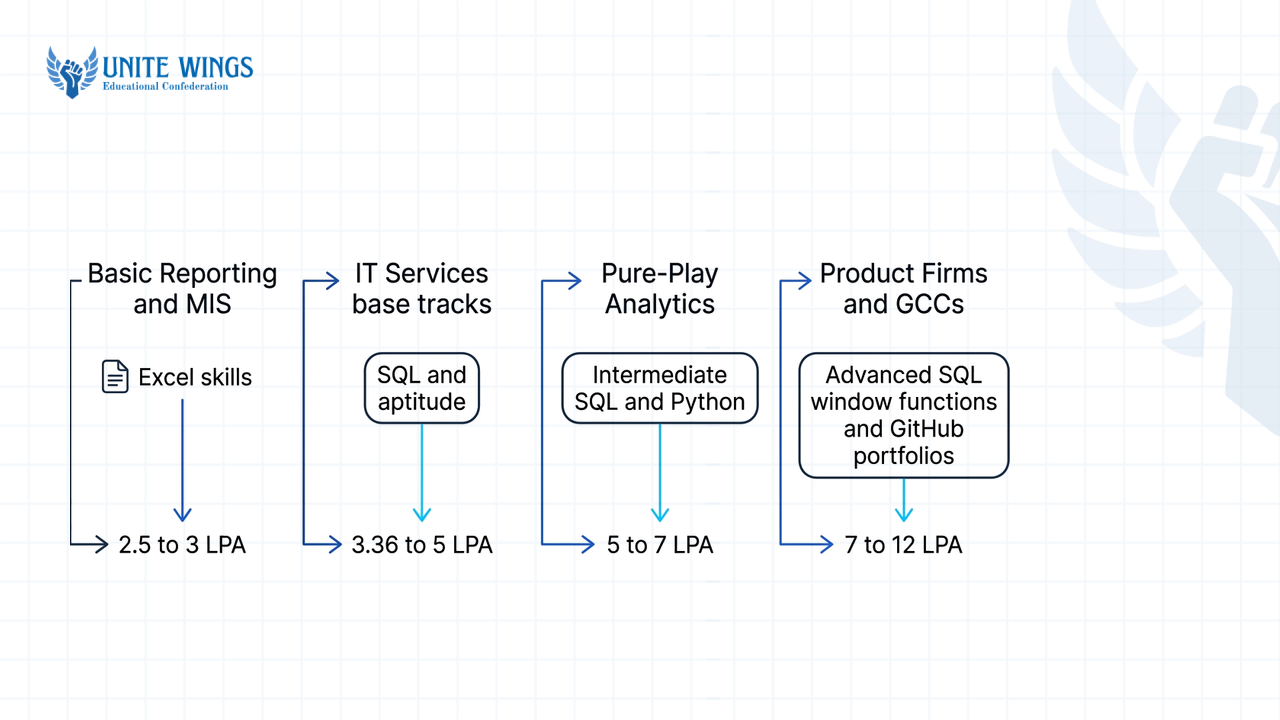
| Company Tier | Representative Employers | Typical Fresher CTC (2026) | Estimated Monthly In-Hand (70%–75% of CTC) | Primary Skill Expectations |
|---|---|---|---|---|
| Basic Reporting / MIS | Local tier-2/3 firms, non-tech SMEs | ₹2.5 LPA – ₹3 LPA | ₹15,000 – ₹18,750 | Advanced Excel, VLOOKUP, pivot tables, basic MIS reporting |
| IT Services (Base Tracks) | TCS (Ninja), Infosys (SE), Wipro (Elite) | ₹3.36 LPA – ₹5 LPA | ₹19,600 – ₹31,250 | Basic SQL, aptitude, foundational programming, communication |
| Pure-Play Analytics & Startups | Mu Sigma, Fractal, Tiger Analytics, funded startups | ₹5 LPA – ₹7 LPA | ₹29,100 – ₹43,750 | Intermediate SQL, Python (Pandas), Power BI/Tableau, case study logic |
| Product Firms & GCCs | Amazon, Flipkart, top fintechs, banking GCCs | ₹7 LPA – ₹12 LPA | ₹40,800 – ₹75,000 | Advanced SQL (window functions), Python, end-to-end GitHub/BI portfolio |
Table data compiled from CrackInterviewAI, Skillfloor, Evika Academy, and Intervue.io.
What most students get wrong about salary portals
If you search Glassdoor, PayScale, or AmbitionBox today, you will see the national average salary for a data analyst listed between ₹5.8 LPA and ₹6.9 LPA, as noted by UpGrad and BootcampGuide. Do not anchor your fresher expectations to that number without context.
Salary aggregators frequently suffer from averaging bias. Some portals pool 0-to-1-year freshers with 1-to-3-year junior analysts under the single label of "entry-level," while others blend mass-recruiter packages with ₹12 LPA product unicorn offers. If you have zero full-time experience and only college coursework on your resume, your true baseline market rate is ₹3.5 LPA to ₹4.5 LPA. Crossing into the ₹6 LPA to ₹8 LPA bracket as a true fresher requires proving you can work like someone who already has a year of job experience.
How much do TCS, Infosys, and Wipro pay entry-level data analysts?
Traditional IT services firms like TCS, Infosys, and Wipro pay ₹3.36 LPA to ₹5 LPA for standard entry-level and trainee roles, according to CrackInterviewAI. However, if you clear their higher-tier technical assessments—such as TCS Digital (₹7 LPA), TCS Prime (₹9 LPA), or Infosys Specialist Programmer (up to ₹11 LPA)—you can secure significantly higher starting packages and direct placement into analytical or data engineering tracks.
For most students in tier-2 and tier-3 engineering or degree colleges, mass recruiters are the backbone of campus placements. Here is what you need to know about how they hire and pay for data roles:
- Standard Mass Tracks (₹3.36 LPA – ₹3.6 LPA): When you get hired through TCS Ninja, Wipro Elite, or as an Infosys System Engineer, you are rarely hired directly as a "Data Analyst." You are hired as a generic trainee and assigned to a domain during training. You might be placed into a SQL/Power BI support project, or you might be assigned to manual software testing.
- Elevated Technical Tracks (₹7 LPA – ₹11 LPA): According to CrackInterviewAI, clearing higher-tier technical tracks like TCS Digital or Prime offers elevated entry brackets for tech-focused analytical tracks.
- Pure-Play Analytics Firms (₹5 LPA – ₹7 LPA): If you want guaranteed analytics work from day one without relying on random project allocation, target mid-size decision sciences firms like Mu Sigma, Fractal Analytics, and Tiger Analytics, which Skillfloor confirms pay freshers between ₹5 LPA and ₹7 LPA.
- Product Companies and GCCs (₹6 LPA – ₹12 LPA): A single-source 2026 report by Skillset Master notes that product companies and startups generally pay 30% to 50% higher fresher packages than traditional IT services firms for equivalent roles. Furthermore, Appwars Technologies and AIMNXT confirm that freshers equipped with strong SQL, Python, and a BI tool can command ₹6 LPA to ₹8 LPA at product firms and Global Capability Centres (GCCs), with top fintech and e-commerce unicorns pushing up to ₹12 LPA.
Target pure-play analytics firms and banking or retail GCCs off-campus if your college only brings ₹3.5 LPA service companies to campus. If you aren't sure how to locate these off-campus roles or message hiring managers directly, the Job Search and Outreach Masterclass walks you through finding openings beyond campus drives and tracking your outreach in one sheet.
Which Indian city pays the highest salary for fresher data analyst jobs?
Bengaluru pays the highest salaries for fresher data analyst jobs in India, with entry-level packages typically ranging from ₹4.5 LPA to ₹7 LPA, according to Evika Academy. Mumbai follows closely with fresher salaries between ₹4 LPA and ₹6.5 LPA, while other tier-1 tech hubs like Hyderabad, Pune, and Delhi NCR (Gurugram/Noida) offer entry ranges between ₹3.5 LPA and ₹6.5 LPA depending on the local industry concentration.
Where you start your career affects both your first paycheck and the pool of companies you can switch to two years later. Different Indian cities dominate different verticals of the analytics market, as documented by Evika Academy and a 2026 city-wise breakdown from GrowAI:
| City | Fresher Salary Range (2026) | Dominant Hiring Sectors | Why Target This Hub |
|---|---|---|---|
| Bengaluru | ₹4.5 LPA – ₹7 LPA | Product unicorns, SaaS, global tech GCCs, e-commerce | Highest volume of data openings and highest median tech pay in India. |
| Mumbai | ₹4.0 LPA – ₹6.5 LPA | BFSI (Banking, Financial Services, Insurance), fintech, FMCG | Best hub if you have a finance, economics, or commerce background. |
| Hyderabad | ₹3.5 LPA – ₹6.5 LPA | Tech and enterprise GCCs | Expanding GCC ecosystem. |
| Delhi NCR (Gurugram/Noida) | ₹3.5 LPA – ₹6.5 LPA | E-commerce, tech, and GCCs | Strong concentration of tech and GCC hubs. |
| Pune | ₹3.5 LPA – ₹6.5 LPA | IT services, traditional manufacturing, and FMCG | Good balance of IT services and manufacturing/FMCG sectors. |
Why does the industry sector matter so much when choosing a city? According to a 2026 report by GrowAI, fintech, e-commerce, and healthcare analytics sectors pay top dollar for early-career data talent—offering top freshers ₹7 LPA to ₹12 LPA—whereas traditional manufacturing and FMCG sectors offer lower fresher brackets around ₹4 LPA to ₹6 LPA. Applying to a fintech GCC in Mumbai or an e-commerce startup in Bengaluru gives you a structural pay advantage over applying to a traditional manufacturing plant with the exact same SQL skills.
Do SQL and Power BI skills increase starting salary packages?
Mastering SQL alongside Python and a visualization tool like Power BI or Tableau boosts a fresher's starting salary potential by 15% to 35%, according to Skillset Master. While basic Excel-only reporting roles start at ₹2.5 LPA to ₹3 LPA, freshers who pair SQL, Python, and Power BI with a documented project portfolio routinely secure offers in the ₹6 LPA to ₹8 LPA bracket at product companies and GCCs.
Let's look at the numbers behind your technical stack. A single-source 2026 report from Fusion Institute points out that freshers who only know basic Excel, VLOOKUP, and manual reporting start at the bottom of the scale, around ₹2.5 LPA to ₹3 LPA. At that level, your job title might say "Data Analyst," but your daily work is copy-pasting rows as an MIS executive.
To jump from the ₹3 LPA bracket into the ₹6 LPA to ₹8 LPA bracket confirmed by Appwars Technologies and AIMNXT, you need the minimum viable ₹6+ LPA technical stack:
- Advanced SQL (The Non-Negotiable Filter): Almost every ₹6+ LPA interview starts with a live SQL screening round. Basic
SELECT *andGROUP BYqueries will not pass. You must write complex joins, subqueries, Common Table Expressions (CTEs), and window functions (ROW_NUMBER(),RANK(),LEAD(),LAG()) without syntax hints. - Python for Data Manipulation: You do not need to build deep learning neural networks for an analyst role. You do need to use Python libraries—specifically Pandas and NumPy—to clean messy CSVs, handle missing values, automate repetitive data transformations, and run exploratory data analysis (EDA).
- One Business Intelligence Suite (Power BI or Tableau): Companies pay analysts to help managers make decisions. According to a single-source finding by Skillset Master, holding a recognized certification in tools like Microsoft Power BI (such as the PL-300 exam) or Tableau can add a 20% to 25% negotiation advantage during salary discussions.
Why course certificates fail in interviews
Listing five Udemy or Coursera completion certificates on your resume will not get you a ₹7 LPA offer. Every other applicant has the exact same certificates, and everyone has the exact same Titanic survival or Iris flower dataset on their resume. According to GrowAI, freshers who capture ₹6 LPA to ₹8 LPA offers are the ones who show published Power BI dashboards or GitHub code repositories with clear README documentation. Interviewers want to click a live link, see how you cleaned a messy Indian public dataset (like UPI transactions or Zomato delivery delays), and read your business recommendations.
If you know the tools in theory but have nothing live to show a recruiter, you can join the AI Portfolio Sprint to pick a real problem, build a verifiable project with AI assistance, and publish it before your next interview.
Here is how you should rewrite your resume project bullets to prove business value rather than just listing tools:
- Weak bullet (₹3.5 LPA tier): Created a sales dashboard in Power BI using SQL and Excel data to show monthly revenue trends.
- Strong bullet (₹6+ LPA tier): Cleaned 1.2M rows of messy e-commerce return logs using SQL window functions and Python (Pandas); built an interactive Power BI dashboard that identified 3 high-return logistics pin codes, simulating a 14% reduction in reverse-shipping costs.
How fast does a data analyst salary grow in the first 3 years?
A data analyst's salary in India grows from the fresher band of ₹3.5 LPA–₹6 LPA to an early-career range of ₹5 LPA to ₹9 LPA within 1 to 3 years, according to Appwars Technologies. By years 3 to 5, mid-level analysts earn ₹8 LPA to ₹15 LPA (Intervue.io), and professionals who switch companies strategically at the 18-to-24-month mark routinely cross ₹10 LPA before completing three years (AIMNXT).
If you are a final-year student stressed because your only campus offer is ₹3.6 LPA or ₹4 LPA, relax. Your starting salary in data analytics is a launchpad, not a permanent ceiling. According to a single-source projection cited by Win In Life Academy, India's big data market is projected to grow from USD 16.75 billion in 2025 to USD 28.90 billion by 2030 (an 11.53% annual growth rate), which keeps demand for experienced analysts high.
Here is the realistic career progression timeline across India's analytics sector:
- 0 to 1 Year (Fresher / Trainee Analyst): ₹3.5 LPA to ₹6 LPA (Intervue.io). You spend this year learning how production databases work, writing daily SQL queries, and maintaining existing team dashboards.
- 1 to 3 Years (Junior / Associate Data Analyst): ₹5 LPA to ₹9 LPA (Appwars Technologies). You start owning stakeholder meetings, building dashboards from scratch, and automating weekly reports with Python.
- 3 to 5 Years (Mid-Level / Senior Data Analyst): ₹8 LPA to ₹15 LPA (Intervue.io and Appwars Technologies). You lead analytics for a specific product or business unit, mentor freshers, and handle diagnostic and predictive modeling.
- 5+ Years (Lead / Principal Analyst or Analytics Manager): ₹15 LPA to ₹35 LPA, particularly in product firms and GCCs, as confirmed by Evika Academy and AIMNXT.
The 18-month switch rule
Why do some analysts stay stuck at ₹4.8 LPA after three years while their college batchmates earn ₹11 LPA? The difference is how corporate appraisals work.
According to AIMNXT, internal annual appraisal hikes in traditional IT services firms average around 8% to 12%. If you start at ₹3.6 LPA and stay in the same company for three years at a 10% annual hike, your salary after three years will be roughly ₹4.79 LPA.
To cross ₹10 LPA within three years, you must treat your first 18 to 24 months as paid training and execute one strategic switch to a product company, startup, or GCC. Once you have 18 months of real project experience, SQL optimization stories, and production Power BI dashboards under your belt, you are no longer evaluated in the crowded fresher pool. You compete in the lateral hiring market, where 40% to 70% switches from low-base service companies to GCCs are common.
Should you pivot to Data Science for higher pay?
Students often ask whether they should skip data analytics and apply directly for Data Scientist roles. According to Appwars Technologies, entry-level data scientists do command a higher premium, typically starting around ₹6 LPA to ₹14 LPA.
However, true fresher Data Scientist openings are scarce and heavily favor M.Tech graduates, tier-1 engineering colleges, or candidates with deep machine learning, linear algebra, and deployment skills. For 90% of B.Tech, BCA, B.Sc, and B.Com students, entering the market as a Data Analyst at ₹4.5 LPA to ₹7 LPA and transitioning internally into Data Science or Analytics Engineering after two years is a much higher-probability career path.
How to negotiate your first data analyst offer
Even as a fresher, you have leverage during off-campus hiring—especially with startups and mid-size analytics firms. Before you sign any offer letter, follow these three practical rules:
- Demand the fixed-to-variable split in writing: If a recruiter quotes ₹6 LPA on the phone, ask: "Could you share the compensation breakup showing the fixed monthly base, employer PF deduction, and performance-linked variable pay?" Never resign from a campus offer or reject another company until you see the fixed base pay.
- Use verified local benchmarks to counter low-ball offers: If a Bengaluru startup offers you ₹3.2 LPA after you passed a tough SQL and Python round, counter politely using market data. You can use this exact script:
"Thank you for the offer—I really enjoyed solving the SQL case study with the team. Based on current 2026 benchmarks on AmbitionBox and Glassdoor for entry-level analysts in Bengaluru working with SQL, Python, and Power BI, the standard fixed base sits between ₹4.5 LPA and ₹5.5 LPA. Given my performance in the technical assessment and my deployed portfolio, can we adjust the fixed component closer to ₹4.8 LPA?"
- Leverage tool certifications and live repos: According to the practical negotiation benchmarks from Skillset Master, holding a recognized certification in tools like Microsoft Power BI (such as the PL-300 exam) or Tableau can add a 20% to 25% negotiation advantage during salary discussions.
Your next steps to target the ₹6+ LPA bracket
Do not wait until your final semester placement drives begin to start preparing. Take these three concrete actions this week to move yourself out of the ₹3.5 LPA crowd:
- Audit your SQL depth today: Stop watching passive tutorial videos. Open a free platform like LeetCode or HackerRank and solve 20 medium-to-hard SQL problems covering
LEFT JOIN,GROUP BY ... HAVING, CTEs, and window functions (RANK,DENSE_RANK,ROW_NUMBER). - Replace generic course projects with 2 messy Indian datasets: Delete the Titanic, Iris, or sample Superstore projects from your resume. Download a messy public dataset from Kaggle or data.gov.in, clean it using Python (Pandas) and SQL, and publish an interactive dashboard on Tableau Public or Power BI Service.
- Write a business-first GitHub README: For each project, write a 300-word README on GitHub that states the business problem, the data cleaning steps you took, three charts from your dashboard, and two specific actions a company manager should take based on your findings.
Build a portfolio that proves you belong in the ₹6+ LPA tier
Recruiters at GCCs and product startups do not pay ₹6 LPA to ₹8 LPA for course completion certificates—they pay for proof that you can solve messy data problems on your own. Join the AI Portfolio Sprint to pick a real-world project, build and document it using AI workflows, and walk away with a live, shareable portfolio link you can put at the top of your resume and LinkedIn profile.
Frequently asked questions
What is the starting in-hand salary for a data analyst fresher in India?
The starting monthly in-hand salary for a fresher data analyst in India ranges from ₹30,000 to ₹50,000, based on an entry-level CTC of ₹3.5 LPA to ₹6 LPA. After statutory deductions like Provident Fund (PF), professional tax, and gratuity, your monthly take-home pay is roughly 70% to 75% of your gross annual CTC.
Do TCS, Infosys, and Wipro hire data analysts directly, and what do they pay?
Yes, they hire entry-level talent, though base tracks (TCS Ninja, Wipro Elite, Infosys System Engineer) usually hire generic trainees at ₹3.36 LPA to ₹3.6 LPA and assign data projects later. To get hired directly into specialized analytics tracks with higher pay, target their elevated assessments like TCS Digital (₹7 LPA) or TCS Prime (₹9 LPA).
Are SQL and Power BI sufficient skills to secure a 6 LPA job package?
SQL and Power BI alone can get you interviews, but securing a ₹6 LPA to ₹8 LPA fresher package at a product company or GCC usually requires adding Python (Pandas/NumPy) and a live project portfolio. Freshers with only basic Excel or foundational SQL typically start closer to the ₹3 LPA to ₹4.5 LPA bracket.
Is a non-IT background a barrier to getting a good data analyst salary?
No, a non-IT degree in commerce, economics, mathematics, or mechanical engineering is not a barrier if you can pass technical SQL screenings and show a published portfolio. In fact, BFSI and consulting employers in hubs like Mumbai and Gurugram actively value finance, statistics, or business domain knowledge alongside SQL and Power BI.
Should I pursue data analytics or data science for higher starting pay?
Data science pays a higher starting salary (₹6 LPA to ₹14 LPA) compared to data analytics (₹3.5 LPA to ₹6 LPA), according to Appwars Technologies. However, fresher data scientist roles are rare and require advanced machine learning and math credentials. Starting as a data analyst and transitioning into data science after 18 to 24 months is far more realistic for most undergrads.
What is the actual difference between CTC and monthly in-hand salary for entry-level analysts?
Cost to Company (CTC) is the total annual expense an employer spends on you, including cash salary, employer PF contributions, insurance, gratuity, and variable bonuses. Your monthly in-hand salary is the actual cash credited to your bank account after taxes and deductions, which usually equals 70% to 75% of the headline CTC.
Newsletter
Stay updated with our latest news and insights.