
Data Analyst vs Business Analyst Jobs for Freshers in India
Compare starting salaries of ₹3 to ₹7 LPA, daily SQL tasks, and campus placement rounds to pick the right analyst career path for your degree.
When comparing data analyst vs business analyst jobs for freshers, the core difference comes down to code versus conversation. Data Analysts spend their days writing SQL queries, cleaning raw datasets, and building dashboards in Power BI or Tableau, while Business Analysts focus on requirement gathering, process mapping, and stakeholder meetings with minimal to no coding. Entry-level pay for both tracks in India is closely matched at ₹3.5 LPA to ₹7 LPA, making your comfort with technical syntax the deciding factor.
By the end of this guide, you will know which track fits your degree, how to pass the specific campus placement rounds for each, and what your first week on the job will actually look like.
Key takeaways
- Coding split: Data Analyst roles require daily SQL and often Python, whereas Business Analyst roles rely on documentation tools like Jira, Confluence, and Visio with little to no coding.
- Starting salaries: Entry-level pay overlaps heavily in India (₹3.5–7 LPA for Data Analysts; ₹3–6 LPA for Business Analysts), though management consultancies pay a premium for Business Analysts and product startups pay more for Data Analysts.
- Non-tech eligibility: BCom and BBA graduates can enter either track within 3 to 5 months by mastering Advanced Excel, SQL, and Power BI, holding a natural advantage in banking and retail domains.
- Interview format: Data Analyst placement drives test you with live SQL queries and dataset cleaning, while Business Analyst drives use case discussions, process flow scenarios, and requirement role-plays.
Side-by-side comparison: Data Analyst vs Business Analyst
If you are shortlisting roles on your campus placement portal or Naukri right now, you need to know how these two jobs differ on paper and in practice. Choose the Data Analyst track if you enjoy building proof through datasets and technical tools, and choose the Business Analyst track if you prefer structuring ambiguous business problems into clear written specifications.
According to 2026 comparisons by The InGrade, Evika Academy, and 360DigitalTransformation, the core differences for Indian freshers break down across six criteria:
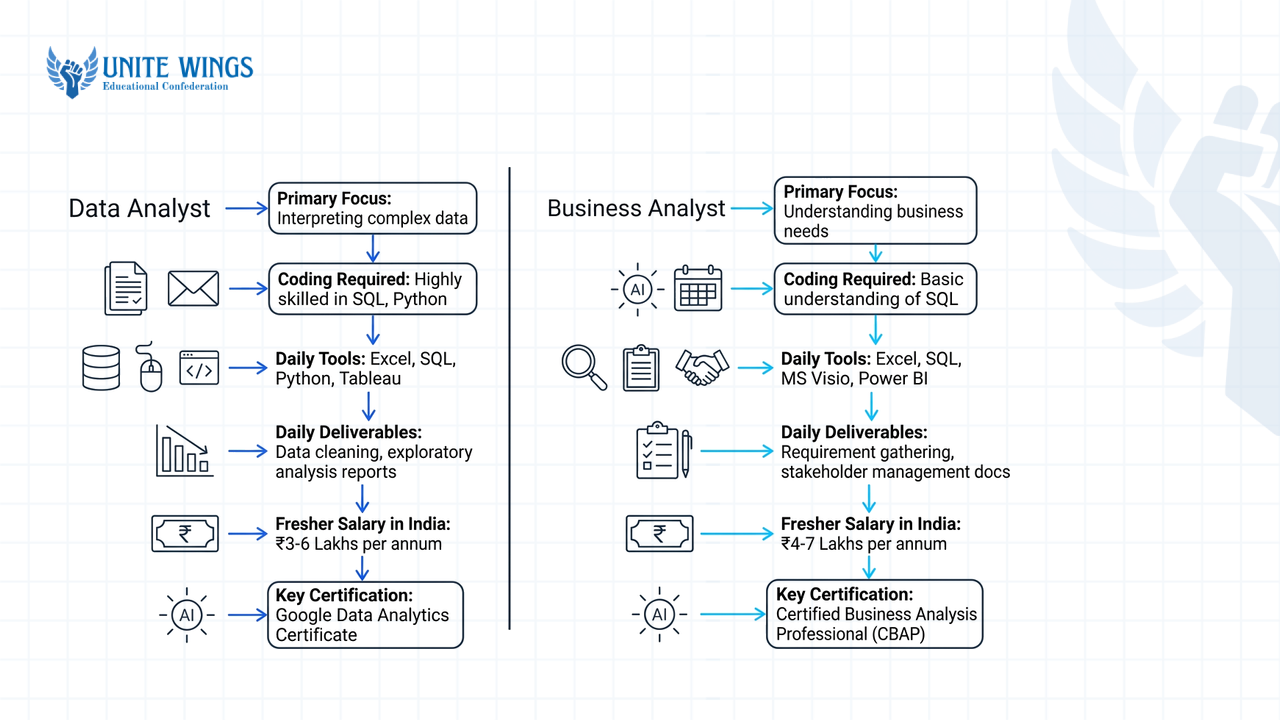
| Criteria | Data Analyst (Fresher) | Business Analyst (Fresher) |
|---|---|---|
| Primary Focus | Extracting, cleaning, and visualizing data to answer why metrics moved | Translating client or business needs into structured instructions for tech teams |
| Coding Required | High (SQL is mandatory; Python or R expected for data manipulation) | Minimal to none (Basic SQL literacy is helpful, no heavy programming) |
| Daily Tools | Advanced Excel, SQL, Power BI, Tableau, Python (Pandas/NumPy) | Advanced Excel, Jira, Confluence, Microsoft Visio, Lucidchart |
| Daily Deliverables | SQL queries, cleaned CSV/database tables, interactive Power BI dashboards | Business Requirement Documents (BRDs), Functional Specs (FRDs), user stories |
| Fresher Salary (India) | ₹3.5 LPA to ₹7 LPA (averages cluster around ₹4–6.5 LPA) | ₹3 LPA to ₹6 LPA (higher in tier-1 consulting and BFSI) |
| Key Certification | Microsoft PL-300 (Power BI Data Analyst, around USD 165) | IIBA ECBA (Entry Certificate in Business Analysis, USD 395) |
| Prep Timeline | 3 to 5 months for zero-experience freshers | 3 to 4 months for zero-experience freshers |
Which role requires less coding between data analyst and business analyst?
Business Analyst roles require far less coding than Data Analyst positions, often needing zero programming knowledge at the entry level. According to 2026 reports by The InGrade and 360DigitalTransformation, Business Analysts focus on requirement gathering, process documentation, and stakeholder management, whereas Data Analysts face mandatory SQL screening and increasing expectations for Python or R.
If you get anxious looking at terminal errors or nested syntax, the Business Analyst track is your safer bet. According to Evika Academy's 2026 analysis, your daily output as a Business Analyst revolves around writing Business Requirement Documents (BRDs), drafting functional specifications, creating user stories in Jira and Confluence, and mapping workflows using Microsoft Visio or Lucidchart. You use Advanced Excel (Pivot tables and XLOOKUP) and occasionally read basic SQL to check a table, but you are hired for your logical clarity and stakeholder communication rather than your code.
Data Analysts, by contrast, write code every single day. GrowAI and The Data Training note in their 2026 reports that SQL is a non-negotiable filter for data analyst jobs. You cannot pass the first technical round without knowing how to write JOIN statements, GROUP BY aggregations, Common Table Expressions (CTEs), and window functions. Beyond SQL, recruiters increasingly expect you to use Python (specifically Pandas and NumPy) or R for data preprocessing and cleaning before feeding that data into Power BI or Tableau.
What most students get wrong about job titles in India
When applying off-campus on LinkedIn or Naukri, do not trust the job title alone. Many Indian mid-market tech companies, Global Capability Centers (GCCs) in Bengaluru or Hyderabad, and startups blur the titles "Business Analyst" and "Data Analyst." At the same time, IT services firms sometimes use "title inflation," labeling basic entry-level MIS (Management Information Systems) or operational Excel reporting roles as "Business Analyst" positions with lower salary floors.
Always read the "Tools" or "Requirements" bullet points in the job description:
- If a "Business Analyst" role lists SQL window functions, Python, and ETL pipelines, it is actually a Data Analyst job in disguise.
- If a "Data Analyst" role lists client calls, Agile/Scrum ceremonies, and BRD writing, you are applying for a Business Analyst seat.
A 1-week real task calendar at an Indian tech company
Generic career guides tell you that analysts "solve business problems," which tells you nothing about what you actually do at 10:30 AM on a Tuesday. Looking at a realistic Monday-to-Friday calendar for a fresher at a mid-sized Indian tech company shows you whether you will enjoy the daily grind of either role.
Here is how the exact same feature launch—fixing a drop in checkout completions on an Indian e-commerce app—plays out for a fresher Data Analyst versus a fresher Business Analyst on the same team:
| Day | Fresher Data Analyst (Technical Track) | Fresher Business Analyst (Process Track) |
|---|---|---|
| Monday | Pull last week's checkout drop-off logs using SQL (LEFT JOIN across users and orders tables). Clean null UPI transaction IDs in Python. | Join a 45-minute call with the Product Manager and payments team to understand why customers are abandoning the UPI payment screen. |
| Tuesday | Build a funnel table in SQL using CTEs to compare failure rates across payment gateways. Export the clean dataset to Power BI. | Map the current checkout workflow in Lucidchart using BPMN (Business Process Model and Notation) to spot where the timeout screen fails. |
| Wednesday | Design an interactive Power BI dashboard using DAX measures to show hourly failure spikes by device type and state. | Write a Business Requirement Document (BRD) in Confluence detailing the new "Retry Payment" pop-up logic and edge cases. |
| Thursday | Present dashboard findings to the engineering lead; rewrite two slow SQL queries after a senior analyst flags a duplicate row bug. | Break the approved BRD into 6 developer user stories in Jira, complete with acceptance criteria (Given / When / Then), and walk developers through them. |
| Friday | Automate the weekly checkout CSV export and document column definitions in the data dictionary. | Run User Acceptance Testing (UAT) on the staging app to verify the developers built the retry screen exactly as written in the BRD. |
Notice the split. The Data Analyst spends 70% of the week inside database editors and Power BI, proving where the problem is happening. The Business Analyst spends 70% of the week in meetings, flowcharts, and documentation tools, defining what the software team needs to build next.
Can BCom or BBA students get data analyst jobs in India?
Yes, BCom, BBA, and other non-engineering graduates regularly secure entry-level data and business analyst jobs in India by pairing their degrees with technical tool skills. According to 2026 reports from SPARC, CyberSuccess, and Evika Academy, commerce and management students actually hold a strong domain advantage when applying to Banking, Financial Services, and Insurance (BFSI), FMCG, and retail companies.
A BTech student might know how to write a Python loop, but a BCom student already understands balance sheets, working capital, GST reconciliation, and customer acquisition cost. According to Masai School's 2026 reporting on the World Economic Forum's Future of Jobs data, 30% of employers operating in India expected to adopt skills-based hiring by removing traditional degree barriers. Furthermore, Naukri and Indeed hiring data from 2026 confirms that major IT services firms—including TCS, Infosys BPM, Wipro, and Accenture—along with banking GCCs actively run campus drives and off-campus walk-ins for BCom and BBA graduates targeting reporting, MIS, and junior analytics roles.
However, non-tech freshers face a reverse hurdle depending on which role they pick:
- For Data Analyst roles: Recruiters will doubt your technical rigor. You must prove you can code in SQL and build dashboards without an engineering degree.
- For Business Analyst roles: Pure BA roles often require prior domain or ERP experience, and consulting firms frequently filter for tier-1 colleges or MBAs. For a tier-2 or tier-3 BCom fresher, breaking into a Data Analyst role via a strong project portfolio is often easier than convincing a recruiter to trust you with client requirement calls on day one.
Actionable 3-step roadmap for BCom and BBA freshers
According to Uncodemy's 2026 career timeline analysis, a zero-experience fresher can become job-ready for a Data Analyst role in 3 to 5 months (and 3 to 4 months for a Business Analyst track) by following a structured plan:
- Lock down the core tool stack (Months 1–3): Master Advanced Excel (Pivot tables, XLOOKUP, conditional formatting), then spend at least six weeks on SQL (Joins, subqueries, CTEs, and window functions). Finally, learn Power BI, which The Data Training (2026) notes dominates the Indian corporate ecosystem because so many enterprises already use Microsoft 365.
- Build 2 to 3 domain-specific portfolio projects (Month 4): Do not build generic Titanic survival models. Use your commerce background. Build a credit-card default dashboard or an FMCG inventory shrinkage tracker in Power BI, and publish your SQL code on GitHub alongside written business conclusions. If you want a guided structure to build and publish a live project recruiters can click on, the AI Portfolio Sprint walks you through taking an idea to a finished proof-of-work piece.
- Target domain-aligned employers (Month 5): Direct your resume toward BFSI firms, fintechs, retail chains, and GCCs where your commerce vocabulary gives you an edge over a generic computer science applicant.
How do campus placement tests differ for BA and DA roles?
Campus placement tests for both roles start with the same general aptitude filter, but diverge sharply in the second round: Data Analyst drives test live SQL coding and dataset manipulation, whereas Business Analyst drives test case analysis, requirement elicitation role-plays, and process mapping. This structural split is confirmed by 2026 placement analyses from Mettl, MyInternships, and 360DigitalTransformation.
When a company visits your campus or sends you an off-campus assessment link, here is how the funnel changes after the initial Quantitative Aptitude, Logical Reasoning, Verbal Ability, and Data Interpretation test:
Data Analyst technical rounds
According to Evika Academy and 360DigitalTransformation (2026), your biggest elimination point in a Data Analyst drive is the live SQL and dataset round. You will typically face:
- Live SQL Querying: You share your screen or type into an online judge (like HackerRank or Mettl) to write 3 to 5 queries using
INNER/LEFT JOIN,GROUP BYwithHAVING, and window functions likeROW_NUMBER()orRANK(). - Dataset Cleaning & Case Exercise: You are given a messy CSV file (with missing values, duplicate IDs, and date formatting errors) and asked to clean it in Excel or Python and pull three actionable findings within 60 minutes.
- Dashboard Critique: An interviewer shows you an existing Power BI or Tableau chart and asks what is wrong with the metrics or visual layout.
Business Analyst technical rounds
According to 360DigitalTransformation (2026), Business Analyst technical rounds evaluate how you think and communicate under ambiguity rather than how you code:
- Requirement Elicitation Role-Play: The interviewer acts as an impatient client (for example, a hospital administrator who wants an appointment booking app). Your job is to ask structured clarifying questions for 15 minutes to uncover hidden constraints.
- Process Mapping & Gap Analysis: You are given a broken workflow—such as a food delivery refund process taking 7 days—and asked to draw a before-and-after process flowchart and write two user stories with acceptance criteria.
- Guesstimates and Case Discussions: Especially in consulting and BFSI drives, you will estimate numbers (such as the daily number of metro commuters in Delhi) to show structured arithmetic. To practice structuring your answers clearly under interview pressure, you can use the frameworks in the Interview Masterclass.
Which role has higher starting salaries in Indian IT companies?
At the entry level (0 to 1 year of experience), starting salaries for both roles in India are nearly identical at ₹3.5 LPA to ₹7 LPA, but who earns more depends entirely on the sector you join. According to GrowAI's 2026 salary report, Business Analysts earn higher starting pay in management consulting firms and BFSI, while Data Analysts command higher starting and mid-career packages in tech product startups and e-commerce companies.
When you check salary portals, you will see conflicting numbers. Here is why: single-source 2026 data from The Data Training notes that Glassdoor's national average across all experience levels sits between ₹6.87 LPA and ₹9 LPA. However, for true freshers, multi-source data from GrowAI, The InGrade, and WinInLife Academy (2026) shows a tighter reality:
- Data Analyst fresher range: ₹3.5 LPA to ₹7 LPA (with most offers clustering between ₹4 LPA and ₹6.5 LPA).
- Business Analyst fresher range: ₹3 LPA to ₹6 LPA in standard IT and corporate roles.
- Portal comparison: Single-source 2026 tracking from Skillcept (citing AmbitionBox fresher data) puts Junior Business Analysts at ₹4.2–4.7 LPA and Junior Data Analysts at ₹3.9–4.4 LPA. That slight edge for Business Analysts happens because elite consulting firms pull the average up.
The real compensation split happens when you compare company tiers and 3-to-5-year career growth, as documented in GrowAI's 2026 report:
| Company Type / Career Stage | Data Analyst Compensation | Business Analyst Compensation | Why the Pay Differs |
|---|---|---|---|
| Standard IT & Corporate (Fresher) | ₹3.5 – ₹7 LPA | ₹3 – ₹6 LPA | Closely matched starting salaries across standard entry-level roles. |
| Tech Product & E-Commerce (Mid-level, 3–5 yrs) (Swiggy, Razorpay, Zepto) | ₹12 – ₹22 LPA | — (Data Analysts command a premium) | Product firms pay a premium for technical depth in SQL, Python, and experimentation. |
| Management Consulting & BFSI (Senior) (McKinsey, BCG, Deloitte, Accenture Strategy) | — (Business Analysts match or exceed senior DA) | ₹18 – ₹35 LPA (with MBA) | Consultancies and banks pay top tier for domain expertise and C-suite client management. |
Note: Compensation bands change every placement season based on hiring demand. Always check current company-specific fresher salaries on AmbitionBox or Glassdoor before negotiating an offer.
Can a business analyst switch to a data analyst role later?
Yes, switching from a Business Analyst to a Data Analyst role is one of the most common internal career moves in Indian tech companies, typically requiring 3 to 6 months of part-time upskilling. According to 2026 reports by Evika Academy and 360DigitalTransformation, professionals make this jump by mastering advanced SQL, data modeling, Python, and BI tools like Power BI.
Because Business Analysts already sit in product meetings and understand which metrics the leadership team cares about, they have half the job figured out. However, making the switch from Business Analyst to Data Analyst while working full-time is noticeably harder than moving in the opposite direction.
If you are a Data Analyst who wants to become a Business Analyst, you already know the data; you just need to volunteer to write documentation and join client calls. If you are a Business Analyst trying to become a Data Analyst, you have to learn technical coding (SQL window functions, Python Pandas, and Power BI data modeling) in your evenings after 9 hours of daily client delivery meetings.
To execute an internal transfer from BA to DA within your current company:
- Ask your database administrator for read-only SQL access to your project's staging database so you can practice writing queries on real company tables instead of waiting for a Data Analyst to pull CSVs for you.
- Spend 3 to 6 months completing a structured evening track in SQL, Python, and Power BI, optionally validating your dashboard skills with Microsoft's PL-300 certification (listed around USD 165, according to 360DigitalTransformation's 2026 data; check Microsoft Learn for current regional pricing).
- Volunteer to build the reporting dashboard for your next feature launch, giving you an internal project you can put on your resume before asking your manager for a role transfer.
5-question self-test: Pick your track in 2 minutes
Stop applying blindly to both tracks with the same generic resume. Answer these five questions with A or B to see which role you should prioritize this semester:
- When a group project goes wrong in college, what is your natural reaction?
- A: Open the spreadsheet or code file by yourself, find the exact calculation error, and fix it quietly.
- B: Call the team together, figure out who misunderstood the instructions, and rewrite the task list.
- How do you feel about debugging syntax errors (missing commas, broken SQL joins) for two hours?
- A: It is frustrating, but getting the query to finally run feels great.
- B: I would rather write a 5-page project report than stare at code errors for two hours.
- Which assignment sounds more interesting to you right now?
- A: Given 100,000 rows of Swiggy delivery logs, find out which rain zones cause the highest late-delivery penalties.
- B: Interview five restaurant owners to understand why they reject Swiggy orders during rain, and design a better app workflow for them.
- What is your current college background and post-graduation plan?
- A: I want a high-paying tech job based purely on my technical portfolio without doing an MBA later.
- B: I enjoy management/commerce subjects and might pursue an MBA or move into Product Management/Consulting in 3 years.
- In a campus placement drive next week, which round are you more confident surviving?
- A: Sharing my screen to write 4 SQL queries and build a pivot table in 30 minutes.
- B: A 30-minute case discussion and role-play where I ask a mock client questions and draw a process flowchart.
Your result:
- Mostly As — Go all-in on Data Analyst: You have the temperament for technical problem-solving. Focus 80% of your prep time on SQL, Excel, Power BI, and Python.
- Mostly Bs — Target Business Analyst (with basic SQL): Your strength is structure and communication. Focus on Excel, Jira, Confluence, BPMN flowcharts, and case interview prep—plus just enough SQL (
SELECT,WHERE,JOIN) so you do not get filtered out of hybrid Indian BA roles.
What to do next this week
Do not wait until your placement cell announces a company drive to start preparing. Take these three steps over the next seven days:
- Tailor your resume to one primary track: If you chose Data Analyst, put your SQL, Power BI, and Excel projects in the top half of page one. If you chose Business Analyst, highlight process improvements, case competitions, requirement documentation, and stakeholder coordination.
- Write one sample bullet point using real deliverables: Replace vague lines like "Analyzed data for college fest" with track-specific proof:
- Data Analyst resume line:
"Cleaned 12,000+ rows of e-commerce sales data using SQL (CTEs, Window Functions) and built an interactive Power BI dashboard tracking regional return rates." - Business Analyst resume line:
"Authored a 10-page Business Requirement Document (BRD) and 15 Jira user stories with acceptance criteria to redesign the student hostel registration workflow, reducing form steps by 40%."
- Data Analyst resume line:
- Publish one piece of visible work: Recruiters hiring freshers in 2026 want to see proof before they interview you. Upload either a documented SQL/Power BI dashboard or a complete BRD and Lucidchart process map to a public portfolio link on your resume.
Build a portfolio project recruiters can actually test
Whether you are aiming for Data Analyst or Business Analyst roles, an empty resume with a list of tool names gets ignored in off-campus screening. In the AI Portfolio Sprint, you will pick a real role-aligned project, build and document it step-by-step using AI tools, and walk away with a published portfolio link you can drop straight into your resume and LinkedIn profile.
Frequently asked questions
Are coding skills mandatory for entry-level business analyst jobs in India?
No, heavy coding skills are not mandatory for entry-level Business Analyst jobs in India. According to 2026 industry analyses by The InGrade and 360DigitalTransformation, Business Analysts primarily work with Advanced Excel, Jira, Confluence, and Visio. However, learning basic SQL queries is strongly recommended because many Indian tech firms run hybrid BA roles.
Do I need Python for an entry-level data analyst job in India?
You can pass many fresher Data Analyst interviews with strong Advanced Excel, SQL, and Power BI skills, as SQL is the primary mandatory filter. However, 2026 reports from GrowAI and The Data Training show that Python (specifically Pandas and NumPy) is increasingly expected for data cleaning and acts as a strong salary accelerator in product startups.
What tools should I learn to become a data analyst from scratch?
Start with Advanced Excel (Pivot tables, XLOOKUP), then master SQL (Joins, subqueries, CTEs, and window functions), and finally learn a visualization tool like Power BI or Tableau. According to The Data Training (2026), Power BI dominates the Indian corporate market due to widespread Microsoft enterprise adoption. Uncodemy notes this stack takes 3 to 5 months to learn.
Which certifications are best for fresher data analysts and business analysts?
For Data Analysts, Microsoft's PL-300 (Power BI Data Analyst) is the most widely recognized credential in India, priced around USD 165. For Business Analysts pursuing formal process tracks, the International Institute of Business Analysis (IIBA) offers the entry-level ECBA certification at USD 395, according to 2026 data from 360DigitalTransformation.
Which companies hire the most freshers for analytics roles in India?
Major IT services firms—including TCS, Infosys BPM, Wipro, and Accenture—along with Global Capability Centers (GCCs) in banking and retail hire the highest volume of freshers. For higher starting and mid-career tech pay, product startups like Swiggy, Razorpay, and Zepto hire Data Analysts, while McKinsey, BCG, and Deloitte hire Business Analysts.
Newsletter
Stay updated with our latest news and insights.