A 20-Minute Daily English Speaking Routine for Freshers at Home
A 20-minute solo speaking workout using voice notes, AI voice mode and the mirror test to fix hesitation before HR rounds and GDs.
You can build interview-ready English fluency alone in your hostel room or home using a 4-block daily routine consisting of a 3-to-5 minute warm-up, a 4-to-5 minute focused drill, a 5-minute real-time conversational response, and a 3-minute review. Most Indian engineering and business students sit at CEFR level B1, meaning you understand English movies, textbooks, and code documentation effortlessly, but hesitate the second an HR recruiter says, "Walk me through your resume" (TalkDrill). That hesitation is a physical muscle-memory gap, not a vocabulary gap, and fixing it requires moving your mouth out loud for 20 minutes every single day.
In short
- The 15-to-20 minute daily routine: Run four distinct blocks, a 3-to-5 minute read-aloud warm-up, a 4-to-5 minute targeted skill drill, a 5-minute real-time conversational prompt response, and a 3-minute review.
- Realistic timeline: Indian students who already understand written English reach comfortable interview fluency in 3 to 6 months with 30 to 45 minutes of daily speaking, while 15 to 20 minutes daily builds steady neural habits without burnout.
- Stop changing topics daily: Repeat the exact same interview prompt for 3 days straight during your voice recording block so sentence structures lock into long-term memory.
- Kill the mental translator: If you freeze mid-answer, plant your feet flat, exhale slowly, and use an honest stalling bridge ("Let me take a moment to find the best example") instead of translating word-for-word from your regional mother tongue.
How can a fresher practice English speaking daily at home alone?
A fresher can follow a daily english speaking practice routine for freshers at home by running four distinct blocks: a 3-to-5 minute read-aloud warm-up, a 4-to-5 minute targeted skill drill (like shadowing), a 5-minute real-time conversational prompt response, and a 3-minute review (Get Fluently, PracticeMe).
Why does watching English shows or reading newspapers silently fail to help you clear a TCS, Infosys, or Deloitte HR round? Passive vocabulary recognition and active speech generation run on completely separate neural circuits and physical muscle memory (Speak English With Tiffani). Your brain knows the words, but your tongue, jaw, and vocal cords are not trained to assemble and pronounce them at 130 words per minute. Spreading speaking practice across short, daily 15-to-20-minute windows, called distributed practice, wires those motor pathways much faster than cramming for three hours on a Sunday (TalkDrill).
Set a recurring alarm for 8:00 PM, close your room door, put on earphones so you aren't self-conscious about family members or hostel roommates overhearing, and run these four steps in order:
- Block 1 (3 to 5 minutes): Read aloud or tongue twisters (Mouth warm-up). Spend this block reading aloud or practicing tongue twisters to activate your mouth and tongue muscles. Alternatively, you can play a 2-minute English podcast at 0.9x speed, pausing immediately to repeat sentences to match the speaker's cadence (PracticeMe).
- Block 2 (4 to 5 minutes): Focused drill (Targeted practice). Focus on a skill drill like shadowing native audio or expanding your phrases (Get Fluently). You can also practice unscripted voice journaling on familiar themes like daily activities, past events, or a mini-interview question (The 3nglish Club).
- Block 3 (5 minutes): Live AI voice mock (Interactive pressure). Open the ChatGPT mobile app, tap the headphones/voice icon, and run a 5-minute conversational prompt response session where you handle real-time feedback or interruption (SpeakShark).
- Block 4 (3 minutes): Single-error review and reflection. Play back your recorded audio, identify one structural error, say the corrected sentence structure out loud, and repeat it to lock in the correction (Get Fluently).
| Block | Time | Tool Needed | Primary Physical / Mental Target |
|---|---|---|---|
| 1. Read Aloud & Shadowing | Mins 0–5 | YouTube at 0.9x speed + any text | Warms up jaw/tongue motor muscles; fixes monotone cadence |
| 2. Topic Framing Recording | Mins 5–10 | Phone Voice Recorder app | Forces active English sentence building without a script |
| 3. AI Voice Mock | Mins 10–15 | ChatGPT Mobile App (Voice Mode) | Builds real-time response speed under follow-up questioning |
| 4. Audio Audit & Redo | Mins 15–20 | Your Block 2 audio file + notes | Fixes 1 specific grammar pattern and locks in the correction |
What most students get wrong: Freshers usually spend 90% of their prep time collecting lists of "50 high-scoring GD idioms" or watching interview tips on YouTube with their mouths shut. If your vocal cords are not vibrating for at least 15 minutes of your 20-minute session, you are studying about English, not practicing speaking.
Why do I know the answer in my head but get stuck while speaking in interviews?
You freeze mid-sentence during interviews because mild evaluative stress triggers an amygdala hijack in your brain, releasing adrenaline that shuts down your prefrontal cortex working memory, and if you simultaneously translate word-for-word from your mother tongue, your restricted working memory overloads and goes completely blank (Attenglish, Piripiriai, My English Matters).
Neuroscience research from Yale University (Amy Arnsten, Nature Reviews Neuroscience, 2009) shows that even mild social pressure flips a chemical switch in the brain, shifting control from the logical prefrontal cortex to the primitive survival center (Piripiriai). You know how a SQL join works or how you built your final-year React project. When four panelists stare at you on Zoom, your brain's "smoke alarm" fires, narrowing your mental bandwidth (Attenglish).
If you use that narrowed bandwidth to run three tasks at once, thinking of the technical concept in Hindi or Telugu, translating each word into English, and checking past-tense grammar rules, your mental RAM crashes (My English Matters). That crash feels like sudden silence, throat tightness, or repeating "actually... basically... like..." five times in a row.
Here is how you stop both the mental translation loop and the adrenaline freeze during home practice and live interviews:
- Switch to "Tarzan English" during solo practice to kill translation. When you translate in your head, you worry about connecting words (articles, prepositions, complex tenses) before speaking the core idea. During Block 2 of your home routine, force yourself to attach English labels directly to mental images, think
[Database]→[Slow]→[Added Index], and speak short, 6-to-8-word sentences. Two short, clear sentences beat one complex translated sentence that collapses halfway through. - Use physical grounding plus a 4-word stalling bridge when you blank out. The moment your mind goes empty in an interview, press both feet flat against the floor and take one slow exhale to lower the adrenaline spike (Piripiriai). Instead of panic-filling the gap with "ummm," say an honest stalling bridge out loud: "Let me take a moment to find the best example." Saying a pre-memorized bridge phrase keeps your vocal apparatus moving while your prefrontal cortex brings your working memory back online.
- Anchor answers to a 3-word micro-framework. Do not try to hold a 2-minute paragraph in your head. Write three words on your scratchpad, Problem, Action, Result for technical or HR rounds or Point, Reason, Example for GDs. Looking at three anchor words relieves working memory so you only have to generate 15 seconds of speech at a time. If you want structured templates and live moderator feedback for high-pressure campus rounds, the Group Discussion and Speaking Masterclass drills these exact speaking frameworks in live student cohorts.
What should I talk about during my daily 5-minute voice recording?
During your daily 5-minute voice recording (Block 2), talk through familiar, high-utility themes, narrate your daily work, explain a past college project, or answer a core interview prompt like "What are you working on right now?", and repeat the exact same prompt for 3 consecutive days before switching topics (The 3nglish Club, Get Fluently, PracticeMe).
What most students get wrong: Almost every beginner picks a brand-new, abstract topic every single day, Day 1 on climate change, Day 2 on cryptocurrency, Day 3 on work-from-home policies. Single-source cognitive guidance from Get Fluently notes that constantly changing topics hurts long-term retention, whereas repeating the same spoken recording task across multiple sessions locks in fluency gains and sentence structures. When you answer the same question three days in a row, Day 1 is messy and full of pauses, Day 2 fixes the vocabulary gaps you looked up during review, and Day 3 trains smooth, automatic delivery.
Follow this 4-week, 3-day-repeat topic rotation designed specifically for Indian campus placements and off-campus fresher drives:
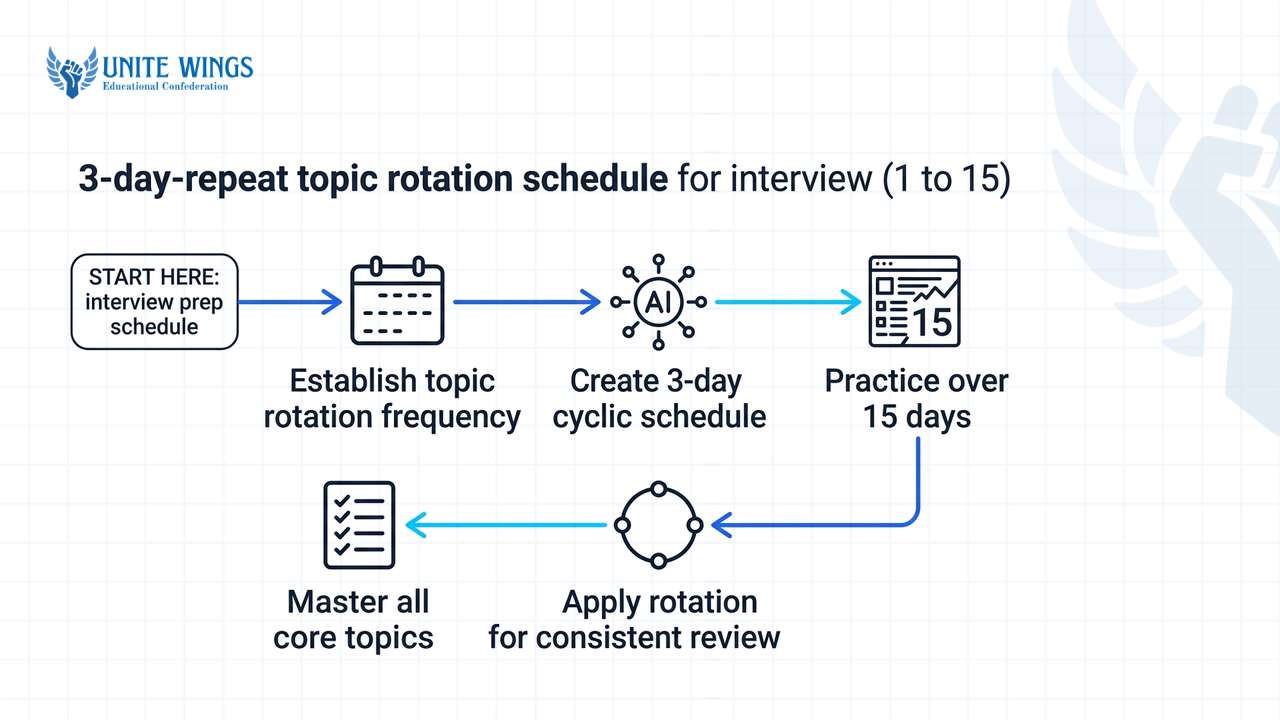
- Days 1 to 3 (The Daily Standup & Self-Intro): Speak for 2 minutes on your background and core skills ("Tell me about yourself"), then 3 minutes unscripted on what you studied today, one bug or tough concept you hit, and what you plan to tackle tomorrow (PracticeMe).
- Days 4 to 6 (Deep-Dive Project Walkthrough): Pick the top project on your resume. Explain the problem statement (1 min), why you chose your tech stack or methodology over an alternative (2 mins), one mistake you made while building it (1 min), and the final outcome (1 min).
- Days 7 to 9 (Behavioral Failure / Conflict Story): Narrate a real college team situation, when a teammate dropped out before a hackathon or mini-project deadline, how you split the remaining tasks, and what you delivered.
- Days 10 to 12 (Group Discussion Stance Drill): Pick a classic placement GD prompt ("Will AI replace entry-level software and analyst jobs in India?"). Spend 2 minutes arguing for the motion with one concrete industry example, 2 minutes arguing against it, and 1 minute summarizing a balanced middle ground.
- Days 13 to 15 (Technical Concept to a Non-Tech Person): Explain a core concept from your branch, such as APIs, object-oriented programming, financial depreciation, or supply chain bottlenecks, as if you are explaining it to a 12-year-old relative using only plain English.
When you listen back during Block 4 (Minutes 15–20), use this 3-point checklist:
- Timestamp the longest freeze: Note the exact second where you paused for more than 3 seconds. What specific word or idea were you searching for? Look up the simple English phrase for it right now.
- Spot your pet crutch word: Count how many times you said "basically," "actually," "like," or "only" (as in "I did it yesterday only"). Next day's goal is cutting that count in half by replacing the filler word with a silent 1-second breath.
- Fix one tense slip: Freshers frequently mix present continuous with past events ("In my 6th semester, we are building a web app..."). Rewrite that one sentence in clean past tense ("In my 6th semester, we built a web app...") and record it again.
How do I use ChatGPT voice mode for daily interview speaking practice?
To use ChatGPT Voice Mode for Block 3 of your routine, open the free ChatGPT mobile app on Android or iOS, tap the waveform/headphones icon at the bottom right, select a voice in Settings, and speak a strict roleplay prompt that forces the AI to ask one interview question at a time and hold all grammar feedback until the end (SpeakShark, CopilotInterview.com).
ChatGPT's Advanced Voice Mode handles sub-second latency, natural intonation, and real-time interruptions, using Whisper for speech-to-text input and Text-to-Speech (TTS) output (SpeakShark, Speak Tech English). According to OpenAI documentation cited by CopilotInterview.com, ChatGPT offers three voice setups: Live (simultaneous dual-direction audio where you can interrupt each other), Advanced, and Standard (turn-by-turn transcription).
What about cost for a college student? Free ChatGPT voice access is available on the iOS and Android apps with rolling daily caps updated by OpenAI (SpeakShark). If you hit the free limit during peak placement season, paid tiers in India, ChatGPT Go at ₹399/month and ChatGPT Plus at ₹1,999/month or $20/month globally, provide 3 hours of voice interaction per rolling 24-hour window (CopilotInterview.com, SpeakShark). Check OpenAI's pricing page directly before subscribing, as tier caps and regional rupee plans change frequently.
If you just tap the microphone and say "Help me practice English," ChatGPT will talk for two minutes straight like a textbook, eating up your 5-minute drill. Set it up properly in three steps:
- Create a dedicated Project folder (Web or App): Before starting the voice timer, paste your resume text and the target job description (for example, a Capgemini Analyst or Infosys Specialist Programmer role) into a ChatGPT chat or Project folder so the AI asks about your actual projects (CopilotInterview.com).To learn how to set up custom instructions, Projects, and study workflows properly, check out our ChatGPT Masterclass.
- Pick the right mode in Settings → Voice: If you get flustered when cut off, start with Standard turn-by-turn mode for your first two weeks. Once you can speak for 60 seconds without freezing, switch to Live / Advanced mode so the AI reacts to long pauses just like a real panelist (CopilotInterview.com).
- Copy-paste this exact prompt before tapping the Voice icon:
Copy-paste prompt for Block 3 (5-minute AI mock)
"Act as a strict HR and technical interviewer hiring a college fresher in India for a [insert role, e.g., Software Engineer / Business Analyst] role. I have pasted my resume above. Ask me ONE short question at a time. Wait for my complete spoken response. Keep your own spoken replies under 2 sentences so I do 80% of the talking. If my answer is vague, ask one sharp follow-up question. Do NOT correct my English or give feedback after each answer. Only when I say the exact words 'END SESSION AND REVIEW', give me 3 specific grammar or phrasing corrections based on what I said and rewrite my weakest answer in natural corporate English."
Know what ChatGPT Voice cannot do: Do not treat ChatGPT as a complete speech coach. Because it converts your speech to text via Whisper before analyzing it, ChatGPT often auto-corrects mispronounced words using sentence context (Speak Tech English, SpeakShark). It lacks phoneme-level error scoring, syllable stress grading, and true human social pressure (SpeakShark). That is why you must keep Block 1, shadowing native audio at 0.9x, and Block 4, listening to your own raw voice recording, in your routine, because your own ears will catch pronunciation slips that ChatGPT transcripts ignore.
How long does it take to become fluent for job interviews with daily practice?
Most Indian college students who already read and understand English (a lower-intermediate or B1 base) can build comfortable, professional interview fluency in 3 to 6 months with 30 to 45 minutes of daily speaking practice (SpeakSaathi). Complete beginners who struggle with basic vocabulary comprehension need 12 to 18 months of consistent daily practice to reach the same professional level (SpeakSaathi).
Ignore YouTube thumbnails and coaching ads promising "Fluent English in 30 Days." Standardized language research from the Cambridge English CEFR framework estimates that moving up to solid B2 conversational fluency requires roughly 500 to 600 guided learning hours (PracticeMe, TalkDrill). Why can an Indian engineering or commerce fresher get interview-ready in 3 to 6 months instead of 500 hours? Because you are not starting from zero. If you passed 10th and 12th board exams and read college textbooks in English, you have already banked hundreds of passive input hours (TalkDrill). You only need to bridge the oral output gap for a predictable set of 30 to 40 workplace and interview scenarios.
| Your Current Starting Point | Daily Speaking Volume | Realistic Time to Interview Readiness | What You Should Expect First |
|---|---|---|---|
| B1 Intermediate (Understand movies/text easily, freeze when speaking) | 20 mins (1 routine/day) | 4 to 6 months | By Week 3, self-intro and project walkthroughs stop requiring mental translation (SpeakSaathi) |
| B1 Intermediate (Placement season is 90 days away) | 40 mins (Run the 20-min routine morning + night) | 3 months | Fast reduction in filler words and blank-outs on core HR/technical questions (SpeakSaathi, Berlitz) |
| A1/A2 Beginner (Struggle to understand fast English or build basic sentences) | 45 to 60 mins daily | 12 to 18 months (500–600 guided hours) | Focus first 90 days on 0.9x shadowing and basic past/present tense narration (PracticeMe, SpeakSaathi) |
Does putting in these 20 to 40 minutes a day actually change your placement outcome in India? Look at the 2026 hiring numbers:
- While India's overall graduate employability nudged up to 56.35% in 2026 (up from 54.81% in 2025 according to the India Skills Report 2026 by ETS, CII, AICTE, AIU, and Taggd via InsightsIAS and CII Skills), a single-source 2026 Unstop Talent Report found that 85% of engineering graduates and 74% of business school students still struggle to land offers despite company hiring intent.
- Why do technically capable students get filtered out after clearing the coding or aptitude test? Recruiter feedback from Deloitte and KPMG (cited via CareerTigers) identifies professional communication as the single most common missing skill in fresh graduates, and Michael Page data (cited by ELTIS) shows 37% of employers rank communication as their most in-demand capability.
- Even state-level assessments show room to grow: in the ETS India Skills Report 2025, Maharashtra led in English as a Second Language (ESL) proficiency at 67.45%, followed by Karnataka (63.5%) and Uttar Pradesh (60.48%).
- On compensation, a widely cited economic study by Mehtabul Azam, Aimee Chin, and Nishith Prakash (using 2005 India Human Development Survey data, cited in 2026 by SpeakWisely and ELTIS) found historical hourly wage premiums of 34% for men and 22% for women who spoke fluent English compared to non-English speakers. While that percentage reflects 2005 baseline data rather than a guaranteed 2026 CTC multiplier, the campus reality remains unchanged: the student who can explain their code or case study clearly in English converts the 6–10 LPA analyst or product role, while the student who freezes gets stuck in the first elimination round.
Your action plan for the next 7 days
Do not wait until your placement cell announces a company drive next month; language memory fades across gaps, and weekend cramming does not wire speech muscles (Berlitz).
- Tonight (10 minutes): Create a folder in your phone's Voice Recorder app named
20-Min-English-Drill. Open the ChatGPT app, paste your current resume into a new chat, and save the Block 3 interviewer prompt from this article in your phone notes. - Days 1 to 3 (20 minutes/day at a fixed time): Run the 4-block timer using "Tell me about yourself and what you worked on today" as your Block 2 recording topic all three days. Compare your Day 1 recording against your Day 3 recording, you will hear fewer pauses and cleaner past-tense verbs within 72 hours.
- Days 4 to 7 (20 minutes/day): Switch your 3-day recording and ChatGPT mock topic to "Walk me through your main college project and one challenge you faced." If you want to accelerate your progress, consider aiming for 30 to 60 minutes of daily speaking practice distributed across short-burst sessions (Berlitz).
Move from solo practice to live group pressure
Practicing alone with voice notes and AI builds your baseline sentence speed, but campus Group Discussions and HR panels add 8 competing voices and real human eyes. Join the Group Discussion and Speaking Masterclass to learn plug-and-play speaking structures for GDs, HR rounds, and presentations, and test them in live practice rounds so your voice holds steady when the room gets loud.
Frequently asked questions
Can I become fluent in English at home without a speaking partner?
Yes, you can build professional speaking fluency alone by combining 0.9x audio shadowing, unscripted 5-minute smartphone voice recordings, and ChatGPT Voice Mode (PracticeMe, SpeakShark). Shadowing and reading aloud train your physical mouth muscles, while recording and reviewing your own voice forces active sentence generation without needing a friend in the room.
Is 20 minutes of English speaking practice a day enough for campus placements?
Twenty minutes of daily focused speaking is enough to build consistent oral habits and eliminate freezing over 4 to 6 months (Get Fluently, SpeakSaathi). To accelerate your progress and reach comfortable professional fluency within 3 to 6 months, aim for 30 to 45 minutes of daily speaking practice (SpeakSaathi).
Is ChatGPT Voice Mode completely free for students in India?
The ChatGPT mobile app on Android and iOS gives free users daily access to Voice Mode, though OpenAI enforces rolling daily usage limits on the free tier (SpeakShark, CopilotInterview.com). For a 5-minute daily interview drill, the free app is sufficient; paid tiers like ChatGPT Go (₹399/month) expand access to 3 hours per 24-hour window (CopilotInterview.com).
Why should I repeat the same speaking topic for 3 days instead of picking a new one daily?
Repeating the exact same recording prompt for 3 days in a row cements corrected sentence patterns and vocabulary into your long-term memory (Get Fluently). When you switch topics every single day, you repeat the same grammar mistakes on new words instead of training smooth, automatic delivery on high-frequency interview answers.
How do I stop translating from Hindi or my regional language into English while speaking?
Stop trying to speak in long, complex sentences during practice, as simultaneous translation, word retrieval, and grammar checking overload your working memory (My English Matters). Train yourself during your 5-minute voice recording to link mental pictures directly to short, 6-to-8-word English phrases (Subject + Action + Object) and build speed before adding complex connectors.
Does watching English movies with subtitles count toward my 20-minute speaking routine?
No, watching movies or news is passive input that only trains listening comprehension, not the oral motor cortex required to produce speech (Speak English With Tiffani). Only count minutes where your vocal cords and jaw are physically moving, reading aloud, shadowing a video at 0.9x speed, recording a voice note, or answering AI prompts out loud.
Newsletter
Stay updated with our latest news and insights.