A 6-Hour Daily Routine for Unemployed Freshers Looking for a Job
How to structure an 8-hour day after graduation into focused blocks for cold outreach, skill proof and interview prep without burning out.
A balanced 6-hour daily routine for an unemployed fresher typically divides time into 2 to 3 hours of upskilling and projects, 1.5 to 2 hours for targeted applications, and 30 minutes to 1 hour for professional networking and outreach. Academy of Learning and Resumly career guidelines from 2025 and 2026 confirm this 6-hour split, and a 2025 Resumly report found that following a fixed daily schedule lowers job-search stress by 22% and raises the odds of getting hired within three months by 30%. You close your laptop at 5:00 PM instead of doom-scrolling Naukri and LinkedIn until midnight.
In short
- Cap your daily output at 5 to 10 tailored applications; Huntr's 2026 tracking data shows conversion rates drop from 9.25% (at 11 to 20 total tracked applications) to 2.58% once you blast past 100 untailored submissions.
- Follow a structured 6-hour daily routine: spend 2 to 3 hours on project-based upskilling, 1.5 to 2 hours on targeted applications, and 30 to 60 minutes on professional networking.
- Filter job boards to "Past 24 hours" or "Past 48 hours" every morning, as a 2026 LiftmyCV study found applying within the first 48 hours makes you 2.5 times more likely to get an interview.
- Budget for a two-month sprint: FastApply and Huntr tracking data from 2025 puts the median time to a first job offer at 68.5 days.
How should an unemployed fresher spend the day at home?
An unemployed fresher should spend their day following a structured 6-hour routine. CareerThinker and Academy of Learning 2026 guidelines recommend waking up between 6:30 AM and 7:00 AM and dressing in work clothes at a desk to treat the search like a salaried shift.
Most freshers sit on their bed with a laptop at 10:00 AM, click "Easy Apply" on 30 LinkedIn posts while watching YouTube, feel guilty by 4:00 PM, and refresh job portals until 1:00 AM. That habit produces zero artifacts and burns you out in three weeks. Replace open-ended scrolling with this fixed 9:00 AM to 5:00 PM timetable on Monday through Friday:
| Time block | Rule bucket | Exact task and output by the end of the block |
|---|---|---|
| 09:00 AM – 10:15 AM | Outreach (Part 1) | Filter Naukri, LinkedIn, and company portals to "Past 24 hours". Shortlist 5 roles, rewrite 3 to 4 resume bullets per role to match the job description, and submit. |
| 10:15 AM – 11:00 AM | Outreach (Part 2) | Send 5 customized LinkedIn connection notes or cold emails to alumni, engineering managers, or HR leads at the exact 5 companies you just applied to. |
| 11:00 AM – 11:30 AM | Break | Step away from all screens. Eat breakfast or walk outside. |
| 11:30 AM – 01:30 PM | Portfolio proof | Build and publish one piece of public work: push a feature commit to GitHub, clean a dataset in SQL/Python, or write a teardown deck for a target company. |
| 01:30 PM – 02:30 PM | Lunch break | Full lunch and rest away from your desk. Do not check email or job apps. |
| 02:30 PM – 04:30 PM | Interview prep | Practice 2 DSA or SQL problems, run 30 minutes of quantitative aptitude, and speak 3 technical or HR answers out loud into your phone recorder. |
| 04:30 PM – 05:00 PM | Admin and log off | Log all 5 applications and 5 outreach messages in a Google Sheet with follow-up dates. Update your Naukri profile headline, close the laptop at 5:00 PM. |
Follow two operational rules inside the 9:00 AM block to beat Indian portal algorithms. First, BluffHR and CVefy reported in 2026 that Naukri and LinkedIn internal recruiter searches bury profiles with missing salary preferences or skill tags; log into Naukri at 9:00 AM and edit one line in your profile summary so recruiter filters register your profile as "recently updated". Second, LiftmyCV's 2026 data shows candidates who apply within 48 hours of a job going live are 2.5 times more likely to land an interview, so never waste your morning block on 14-day-old listings.
How many job applications should a fresher send per day?
A fresher should send between 3 and 10 tailored job applications per day, depending on how many matching roles were posted in the last 48 hours. FastApply, JobMate, and ResumeMakero set the sustainable daily target at 3 to 5 tailored applications (15 to 25 a week), while Indian market guides from My Career Solution and Asuraa recommend 5 to 10 tailored applications a day to offset high applicant volume on Naukri and LinkedIn.
Look at the conversion math before you touch an auto-apply Chrome extension. MyJobB and ApplyCove confirm that Naukri caps standard accounts at 50 applications per rolling 24-hour window, and thousands of desperate graduates treat that 50-application cap as a daily to-do list. Yet Huntr's 2026 Job Search Trends Report and apply-mate.com found that job seekers who logged 11 to 20 tracked, high-fit applications hit a 9.25% interview conversion rate, whereas people who blasted over 100 applications watched their conversion rate collapse to 2.58%. A separate Q2 2026 Huntr dataset cited by Asuraa shows that over 61% of candidates who landed a job offer submitted 50 or fewer total applications across their entire search.
Use this decision rule to set your daily number inside your 2-hour outreach block:
- If you are targeting specialized tech, product, data, or finance roles (₹6 LPA to ₹15 LPA+ range per JobVumi and HirePal 2026 data): Send 3 to 5 applications a day. Spend 15 minutes per role matching your project bullets to the job description and finding a team member on LinkedIn to message.
- If you are targeting generalist IT services, operations, or BFSI roles (₹2.5 LPA to ₹4.5 LPA range per JobVumi and HirePal 2026): Send 5 to 10 applications a day, using two or three pre-built role-family resumes (for example, one for QA/testing, one for support/analyst, one for Java developer) and swapping the top skill keywords before submitting.
If you want a ready-made tracking sheet and cold-message templates for that 9:00 AM block, the Job Search and Outreach Masterclass walks you through finding off-campus roles and writing outreach notes that get replies.
Why does applying to jobs all day not get interview calls?
Applying to jobs all day fails because generic resumes get blocked by Applicant Tracking Systems (ATS) before a human ever opens them. Scale.jobs and Medium data from 2026 show that up to 94% of online applications are filtered out by ATS software due to missing keywords or broken formatting, while CVefy's 2026 report notes that only 3 out of 100 resumes submitted on Indian portals like Naukri and LinkedIn convert into an interview call.
According to the India Skills Report 2026 (published by ETS, CII, AICTE, AIU, and Taggd), 70% of IT companies and 50% of BFSI companies in India now run AI-based recruitment filters. When you send the same one-page PDF to a Python backend role, a business analyst role, and a manual testing role, the parser scores your keyword overlap against the job description, ranks you in the bottom half of a 2,000-applicant queue, and hides your file. Minds and UpGrad Pune identified this single "master resume" habit in 2026 as the primary reason freshers receive zero interview calls.
What most students get wrong is assuming their resume was rejected because of their tier-3 college name or a 6.8 CGPA, when the parser actually failed to read their Canva template. A 2026 Scale.jobs analysis found that formatting and parsing errors alone cause roughly 43% of ATS rejections. Multi-column layouts, text boxes, skill progress bars, and tables scramble the text order when an ATS extracts your file into plain text.
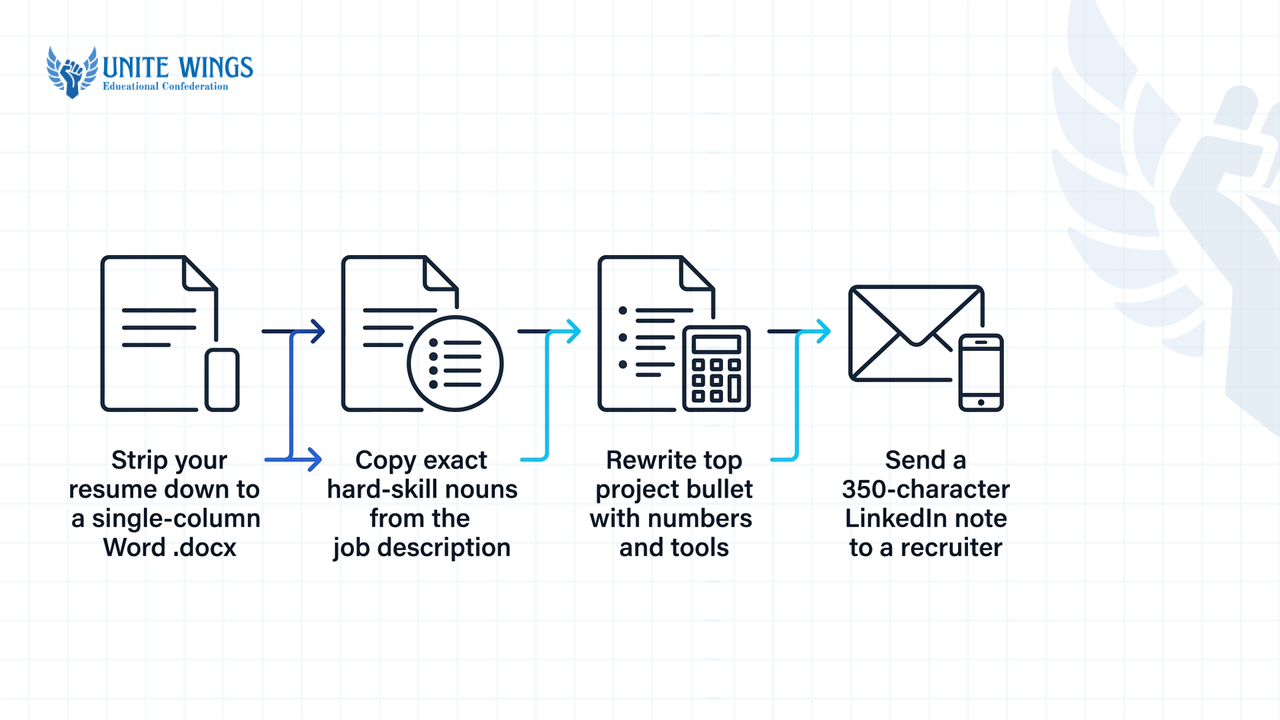
Fix your application conversion rate in 20 minutes per job using this four-step checklist:
- Strip your resume down to a single-column Word
.docxor clean text-selectable PDF with standard section headers (Education,Projects,Skills,Internships). If you need to rebuild your layout from scratch, the Resume Masterclass shows you how to format a parser-safe file that a recruiter can scan in ten seconds. - Copy the exact hard-skill nouns from the job description (for example,
REST APIs,Power BI,Financial Modelling,Selenium WebDriver) and paste them into your project bullet points where you actually used them, rather than dumping them in an isolated skills box at the bottom. - Rewrite your top project bullet to show a number and a tool: change "Worked on a customer churn project using Python" to "Built a logistic regression churn model in Python (scikit-learn) on a 10,000-row telecom dataset, reaching 84% recall and deploying a Streamlit dashboard." Huntr's Q2 2026 data via Asuraa shows tailored resumes get interviews at 5.71%, nearly double the 3.09% rate of untailored resumes.
- Send a 350-character LinkedIn note to a junior engineer or recruiter at that company right after applying: "Hi [Name], I'm a 2026 CS grad from [College]. Just applied for the Junior Data Analyst role (Job ID 4821). I built an automated SQL + Power BI sales pipeline similar to what your team tracks: [GitHub link]. Would appreciate a quick pointer on who leads hiring for this team."
How much time should go to upskilling vs applying for jobs?
An unemployed fresher should allocate their daily routine to structured skill-building, projects, and applications. This matches 2025–2026 career benchmarks from Academy of Learning, Asuraa, and Resumly, which typically allocate 2 to 3 hours to project-based upskilling, 1.5 to 2 hours to targeted applications, and 30 to 60 minutes to networking and outreach.
Spending 8 hours a day watching passive Udemy videos is just as useless as spending 8 hours clicking "Apply". RequireHire's 2026 market analysis points out that India's fresher job market recovery is K-shaped: generalist freshers average ₹3.8 LPA, while high-utility specialists who can prove hands-on execution earn ₹6.5 LPA to ₹13 LPA. Meanwhile, India Today reported in 2025 that AI and automation are forcing 16.2 million Indian workers to reskill while creating 4.7 million new tech roles, and the India Skills Report 2026 notes that over 90% of Indian corporate employees now use Generative AI tools at work.
To move from the ₹3.8 LPA generalist pile into the specialist bracket, your midday 2-hour "Portfolio proof" block (11:30 AM to 1:30 PM) must produce a public link you can paste into your resume and LinkedIn messages by Friday afternoon. According to a Nasscom report cited by the Times of India in 2026, 73% of Indian employees rely on self-driven learning like online courses, peer learning, and hands-on practice rather than classroom lectures. Stop building clone calculators or Titanic survival notebooks; build a one-week proof project matched to your degree and target sector:
- CS / IT freshers (IT accounts for 35% of all fresher hiring, per the India Skills Report 2026): Pick one real company's broken workflow or public API. Build a working microservice or an AI-assisted RAG support bot with a live Vercel or Render URL, a README with architecture diagrams, and 3-minute Loom video walkthrough.
- Commerce / BBA / Finance freshers (Commerce employability hit 62.81% in the India Skills Report 2026, led by BFSI and fintech, ahead of Science at ~61% and Arts at ~55.55%): Download an Indian listed company's annual report from BSE, build a 3-statement financial model or credit-risk dashboard in Excel and Power BI, and publish a 5-slide teardown on LinkedIn tagging two analysts at the company.
- Core engineering / Non-CS freshers targeting analytics or operations: Scrape or download a 50,000-row public supply-chain or healthcare dataset, clean it in SQL, automate a weekly anomaly report using Python or an AI workflow, and host the documented query file on GitHub.
Use your dedicated upskilling and project-building blocks to ensure your technical skills are sharp and well-documented. Consistently work on real-world projects and core technical concepts so you are ready to speak confidently about your hands-on execution during recruiter calls.
How do you stay motivated when you are unemployed after graduation?
You stay motivated during post-graduation unemployment by measuring daily input tasks you control (such as submitting tailored applications and sending outreach messages) rather than waiting on recruiter phone calls. FastApply and Huntr tracking data from 2025 puts the median time to a first job offer at 68.5 days, which means silence in weeks one through four is normal math, not personal failure.
The hiring numbers in 2026 are actually moving in your favor if you stay in the game carefully. The India Skills Report 2026 shows national graduate employability rose to 56.35% in 2026 (up from 54.81% in 2025), with women's employability reaching 54% and passing men's at 51.5% for the first time in five years. Naukri's JobSpeak index, cited by 360 Digital Transformation in 2026, also recorded fresher hiring (0 to 3 years experience) growing between 7% and 17% year-on-year from February to May 2026, with the strongest hiring concentrated across IT, BFSI, manufacturing, pharma/healthcare, and FMCG, and top employability scores coming from Uttar Pradesh, Maharashtra, and Karnataka.
When week five hits and relatives start asking about your placement status at dinner, two traps wreck unemployed freshers: panic-paying scammers and complete isolation.
Never pay for a job offer or 'guaranteed placement' batch
In June 2026, the Network of Information Technology Employees Senate (NITES) reported via the Times of India that waves of unemployed freshers in hubs like Pune suffered heavy financial losses to fraudulent offline coaching institutes and fake placement agencies promising guaranteed IT jobs. If a training center, consultancy, or HR contact asks for a registration fee, security deposit, laptop fee, or paid training bond before giving you a job, close the tab immediately. Legitimate companies pay you; you never pay them.
Put three guardrails around your week so you can sustain the 68.5-day median search without burning out:
- Track weekly response rate as an experiment, not a verdict: Every Friday at 4:30 PM, calculate your conversion rate in your Google Sheet. If you sent 25 tailored applications and 25 LinkedIn DMs over five days and got zero profile views or replies, do not apply harder next week—change one variable on Monday, such as your resume headline, your project link, or the job title tier you are targeting.
- Add a small freelance or gig milestone in Month 2: The India Skills Report 2026 projects India's gig and freelance workforce will reach 23.5 million by 2030, and India already holds 16% of global AI talent (projected to reach 1.25 million professionals by 2027). Picking up one small paid project or pro-bono automation build for a local business during your 11:30 AM portfolio block gives you real client proof to talk about in interviews.
- Enforce a hard 5:00 PM shutdown and offline weekends: Once you log your 5 applications at 5:00 PM, close Naukri and mute LinkedIn notifications until 9:00 AM the next morning. Take Saturday afternoon and all of Sunday completely off from job portals so your brain is sharp enough to write tailored bullets on Monday morning.
Your next 7 days on the 2-2-2 routine
Do not wait until Monday to start organizing your search. Set up your pipeline in three steps:
- Today (in the next 2 hours): Create a Google Sheet with six columns:
Company,Role & Link,Date Applied,Resume Version Used,LinkedIn Contact Messaged, andStatus / Follow-up Date. Strip tables and two-column formatting out of your base resume. - Tomorrow at 9:00 AM: Run your first full 6-hour 2-2-2 day. Filter Naukri and LinkedIn to "Past 24 hours", submit 5 tailored applications, send 5 alumni or recruiter DMs before 11:00 AM, spend 11:30 AM to 1:30 PM scoping one public portfolio project, and spend 2:30 PM to 4:30 PM drilling aptitude and recorded mock answers.
- This Friday at 4:30 PM: Review your first 25 logged applications and 25 outreach messages, check which resume version or message hook got profile views or replies, and lock your laptop at 5:00 PM for the weekend.
Shortcut your 9:00 AM outreach block
If you want the exact job-tracker sheet, AI prompts to tailor resume bullets without lying, and cold-outreach messages that get replies from Indian recruiters and hiring managers, join the Job Search and Outreach Masterclass. You walk away with a working off-campus job-hunting system and your first batch of outreach messages ready to send.
Frequently asked questions
How many job applications should a fresher send per day in India?
Send 5 to 10 well-matched, tailored applications per day on Indian portals like Naukri and LinkedIn. While Naukri allows up to 50 applications in a 24-hour window, Huntr's 2026 data shows interview conversion drops from 9.25% (at 11 to 20 total tracked applications) to 2.58% when you mass-apply to over 100 jobs without tailoring.
Why am I not getting any interview calls despite applying to 100+ jobs?
You are likely sending one generic master resume that gets blocked by Applicant Tracking Systems (ATS). Scale.jobs 2026 data shows up to 94% of applications are filtered out before human review, with 43% rejected for formatting and parsing errors like multi-column layouts or tables, and the rest dropped for missing job-description keywords.
How much time should I spend on upskilling vs applying for jobs?
Split your 6-hour daily routine into 2 hours of targeted applications, 2 to 3 hours of project-based upskilling, and 30 to 60 minutes of networking. Academy of Learning and Asuraa 2025–2026 guidelines confirm this balance keeps your application pipeline active while building the practical skills needed to secure employment.
What are the real entry-level salary packages for freshers in India in 2026?
Entry-level fresher salaries in India follow a K-shaped split in 2026. According to JobVumi, HirePal, and RequireHire 2026 market reports, generalist freshers in mass-hiring and support roles earn between ₹2.5 LPA and ₹4.5 LPA (averaging ₹3.8 LPA), whereas freshers with specialized tech, AI, data, or finance skills command ₹6 LPA to ₹15 LPA+.
How long does it take an unemployed fresher to get a first job offer?
Expect an active, structured job search to take two to three months. Tracking data from FastApply and Huntr in 2025 puts the median time to a first job offer at 68.5 days, though a 2025 Resumly report found that following a fixed daily schedule increases the likelihood of getting hired within three months by 30%.
Are paid placement agencies or pay-after-training institutes safe for freshers?
Never pay upfront registration fees, training charges, or security deposits to offline consultancies promising guaranteed jobs. In June 2026, NITES and the Times of India reported widespread financial fraud targeting unemployed freshers in cities like Pune through fake placement agencies and coaching classes. Apply only through verified portals and company career pages.
Newsletter
Stay updated with our latest news and insights.