
50 Presentation Topics for College Students With 5-Slide Outlines
50 non-boring seminar topics for engineering, MBA and arts students in 2026, each paired with a 5-point slide flow so you can start building immediately.
If you have a mandatory communication skills class or technical seminar due this week, drop broad titles like "Artificial Intelligence" or "Global Warming" because Indian college evaluators immediately cut marks for vague scope. Pick a narrow, mechanism-driven angle backed by local Indian benchmarks like UPI backend architecture, Zepto dark-store logistics, or the Digital Personal Data Protection (DPDP) Act 2023. Below are 28 presentation topics for college students with ppt outlines, structured for a strict 5-minute slot using a 5-slide flow and an Indian opening anchor.
In short
- Stick to 5 slides for a 5-minute presentation (roughly 40 to 60 seconds per slide) and cap your spoken script at 650 to 750 words (Copresent).
- Engineering faculty reward live code notebooks, architecture diagrams, and Indian infrastructure cases like FASTag RFID or ISRO's Reusable Launch Vehicle (PitchWorx).
- MBA and BBA evaluators give top marks to presentations that combine a business framework with secondary data from SEBI, NSE, or BSE (Amity Projects Online).
- Use the 5-slide formula for every deck: Slide 1 (Hook), Slide 2 (Mechanism/Concept), Slide 3 (Indian Case/Data), Slide 4 (Trade-offs/Where It Breaks), and Slide 5 (Takeaway).
What are the best 5-minute presentation topics for first-year students?
First-year undergraduate students score highest in communication skills classes when they pick relatable everyday systems or local shifts like UPI in rural banking, rather than dense academic theory (PPTMaker India, AI Presentations). You do not need lab data in semester one; you need a clear 5-slide flow where each slide carries one message.
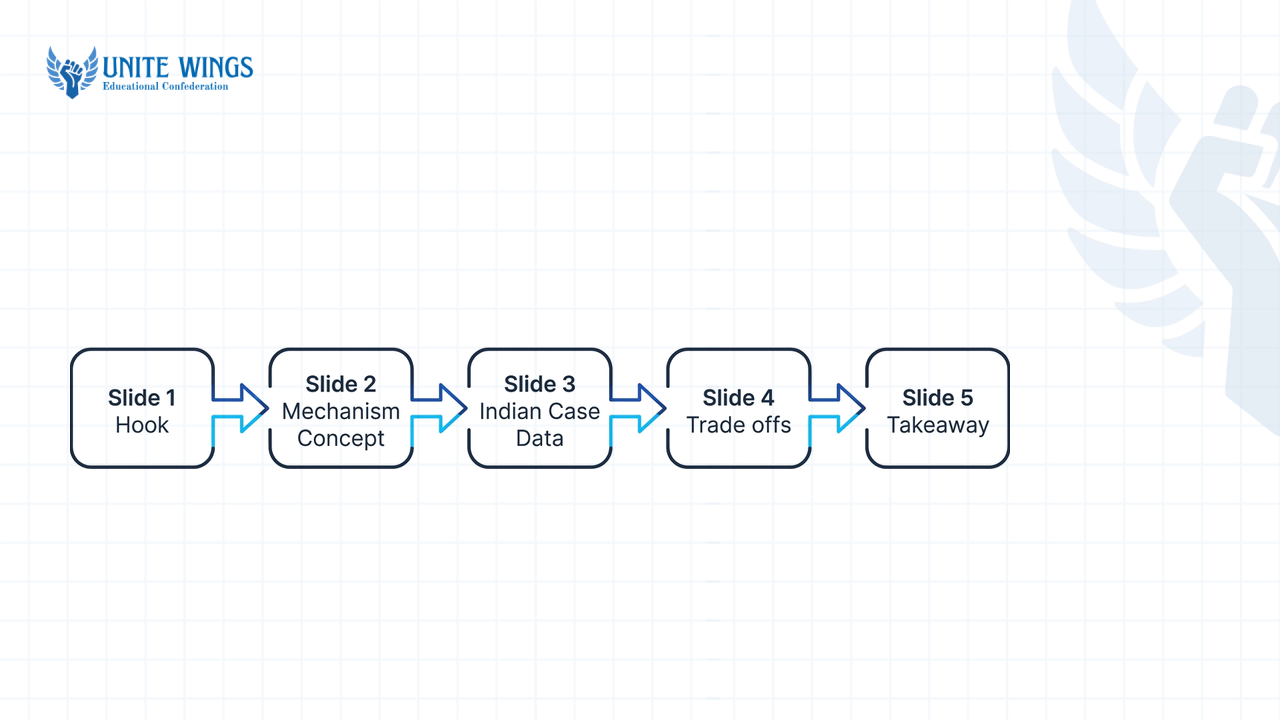
In the table below, the 5-slide flow column maps directly to Slide 1 through Slide 5 (S1 to S5).
| # | Topic title | Indian opening hook (Slide 1) | 5-slide flow (S1 to S5) |
|---|---|---|---|
| 1 | How UPI transformed rural kirana credit | Open with a rural shopkeeper replacing a paper khata book with a BharatQR soundbox. | S1: Soundbox hook; S2: Three-party UPI routing flow; S3: Rural digital payment adoption case; S4: Offline network drop trade-offs (UPI 123Pay); S5: Digital trail leads to formal micro-loans. |
| 2 | How recommendation algorithms shape your feed | Compare the Instagram Reels feed of two batchmates sitting on the same hostel bench. | S1: Hostel feed test; S2: Collaborative vs content filtering diagram; S3: Watch-time optimization on Indian short-video apps; S4: Echo chambers and attention span drop; S5: How to reset your algorithm train. |
| 3 | Why music changes your mood during exam week | Compare heart-rate changes between listening to high-tempo tracks vs Hindustani instrumental music before an exam. | S1: Exam hall anxiety hook; S2: Auditory cortex to dopamine pathway; S3: Campus study playlist experiment; S4: Lyrics vs focus interference during problem-solving; S5: Rule for picking task-specific audio. |
| 4 | Why first impressions form in seconds during campus interviews | A placement panellist decides your confidence level before you finish saying "Good morning, sir." | S1: Walk-in interview hook; S2: Thin-slicing psychology mechanism; S3: Campus mock interview posture breakdown; S4: Cognitive bias and halo effect traps; S5: Three non-verbal fixes for freshers. |
| 5 | Digital literacy gaps between urban and rural Indian households | Sharing a smartphone among four family members in a tier-3 town vs 1-to-1 device access in metros. | S1: Shared device hook; S2: Access vs actual digital literacy framework; S3: Rural e-governance portal usage friction; S4: Phishing and vernacular UI barriers; S5: Voice-first interface takeaway. |
| 7 | Why multitasking with WhatsApp Web ruins engineering study blocks | Keeping a class WhatsApp group open while solving differential equations costs you context-switching time. | S1: Hostel desk tab-switching hook; S2: Attention residue mechanism in working memory; S3: 2-hour deep work vs fragmented study comparison; S4: Fear of missing out on lab updates; S5: Notification batching schedule. |
| 10 | Why cramming the night before semester exams fails long-term retention | Passing a semester exam with an overnight one-shot video vs blanking out in a final-year placement test. | S1: Night-before-exam hook; S2: Ebbinghaus forgetting curve vs spaced repetition; S3: Recall score comparison across 30 days; S4: Why Indian syllabus volume tempts cramming; S5: 1-3-7 day revision template. |
Which current technical topics impress engineering faculty in 2026?
In 2026, engineering and IT professors award top seminar marks to topics covering agentic AI, post-quantum cryptography, edge AI acceleration, and Indian infrastructure systems, provided you include an architecture diagram or code notebook (Engineers Planet, Zonduo). According to a 2026 Engineers Planet report, the global semiconductor market surged by 25.6% to reach $791.7 billion in 2025 and is tracking toward the trillion-dollar mark in 2026, making hardware and VLSI topics stand out for ECE and EEE branches.
Computer science and IT (CSE/IT)
- Retrieval-augmented generation (RAG) to reduce LLM hallucination (Zonduo)
- Indian hook: Querying an LLM on the Indian Penal Code vs Bharatiya Nyaya Sanhita without external retrieval produces outdated legal sections.
- 5-slide flow: S1: Legal hallucination hook; S2: Vector database + embedding retrieval architecture; S3: Live notebook demo querying an Indian college syllabus PDF; S4: Chunk-size vs latency trade-offs; S5: When to pick RAG over fine-tuning.
- Agentic AI multi-step workflows in software testing (PitchWorx)
- Indian hook: How Indian IT services teams are moving from single-prompt chatbots to autonomous bug-triage agents.
- 5-slide flow: S1: Prompt vs autonomous agent hook; S2: Planner-Executor-Critic agent loop diagram; S3: Automated PR review workflow demo; S4: Infinite loop risks and token cost spikes; S5: Guardrails for production agents.
- Post-quantum cryptography and the "harvest now, decrypt later" threat (Engineers Planet)
- Indian hook: Why Indian banking records encrypted with RSA today could be stored and decrypted once quantum hardware matures.
- 5-slide flow: S1: Harvest-now threat timeline hook; S2: Lattice-based cryptography vs RSA math; S3: NIST post-quantum standard migration steps; S4: Key-size overhead on Indian banking servers; S5: Hybrid cryptographic transition plan.
- UPI backend architecture scalability during festive peak loads (PitchWorx)
- Indian hook: How NPCI switches handle millions of concurrent requests on Diwali evening without double-debiting accounts.
- 5-slide flow: S1: Diwali peak-load hook; S2: Asynchronous API call flow across Payer PSP, NPCI, and Remitter Bank; S3: Read/write database sharding strategy; S4: Bank server timeout causes and reconciliation delays; S5: Lessons for distributed system design.
- How serverless functions cut idle server cost for Indian SaaS startups (Zonduo)
- Indian hook: Why a college fest ticketing portal crashes on registration day or burns AWS credits sitting idle for 29 days.
- 5-slide flow: S1: Fest portal traffic spike hook; S2: Event-driven serverless execution lifecycle; S3: Cost comparison between always-on EC2 vs AWS Lambda in Mumbai region; S4: Cold-start latency penalties; S5: Decision rule for serverless vs containers.
- Federated learning for privacy-preserving healthcare diagnostics (Engineers Planet)
- Indian hook: Training a tuberculosis detection model across AIIMS and state hospitals without moving patient X-rays off local servers under DPDP Act rules.
- 5-slide flow: S1: Hospital data-sharing bottleneck hook; S2: Local training and central weight aggregation diagram; S3: Chest X-ray model accuracy benchmark; S4: Non-IID data skew and communication overhead; S5: Privacy-utility balance.
- GitHub Copilot and its impact on entry-level developer hiring in India (PPTMaker India)
- Indian hook: Why campus coding rounds at Indian recruiters now test system debugging and code review alongside boilerplate syntax.
- 5-slide flow: S1: Campus coding test shift hook; S2: Context-window code completion mechanism; S3: Speed vs security vulnerability rates in AI-generated code; S4: Junior developer skill atrophy risk; S5: How freshers should pair-program with AI.
- Zero-trust security architecture for remote Indian IT workforces (Zonduo)
- Indian hook: Why legacy VPN perimeters fail when developers access client repositories from home broadband networks across tier-2 cities.
- 5-slide flow: S1: Perimeter breach hook; S2: Policy Engine and continuous identity verification schema; S3: Micro-segmentation case in an IT enterprise; S4: Authentication friction and latency; S5: 3-step zero-trust rollout.
Electronics, electrical, mechanical, and civil (ECE/EEE/Mech/Civil)
- FASTag passive RFID implementation and toll lane latency (PitchWorx)
- Indian hook: Why your car waits 15 seconds at an NHAI toll plaza even when the FASTag sticker is right on the windshield.
- 5-slide flow: S1: Toll queue bottleneck hook; S2: UHF passive RFID backscatter signal waveform; S3: Tag read-range vs vehicle entry angle data; S4: Metal-tint interference and blacklist sync lag; S5: Transition path to GNSS tolling.
- Edge AI acceleration on microcontrollers for smart agriculture (Engineers Planet)
- Indian hook: Running a crop pest-detection neural network directly on a low-power board in a Punjab field with zero 4G coverage.
- 5-slide flow: S1: Zero-connectivity farm hook; S2: Model quantization (FP32 to INT8) block diagram; S3: Inference latency and milliwatt power budget on hardware; S4: Accuracy drop after heavy pruning; S5: Hardware selection rule for TinyML.
- Smart antenna systems with beamforming for 6G networks (PitchWorx)
- Indian hook: Solving signal dead-zones inside dense Mumbai high-rise clusters using directional millimetre-wave beams.
- 5-slide flow: S1: Urban high-rise signal drop hook; S2: Phased-array constructive interference radiation pattern; S3: Signal-to-noise ratio gain in dense urban multipath environments; S4: High power draw in RF chains; S5: Beam tracking hardware roadmap.
- VLSI design bottlenecks in India's semiconductor manufacturing push (PitchWorx, Engineers Planet)
- Indian hook: With the global semiconductor market hitting $791.7 billion in 2025 and a major manufacturing push underway, India is experiencing a massive VLSI design boom.
- 5-slide flow: S1: $791.7B market and Indian fab hook; S2: RTL-to-GDSII physical design flow diagram; S3: Timing closure and leakage power at smaller nodes; S4: EDA tool licensing cost and verification time; S5: Open-source RISC-V opportunity for Indian students.
- Li-Fi optical wireless communication in RF-restricted environments (PitchWorx)
- Indian hook: Transmitting high-speed patient telemetry inside an Indian hospital ICU where Wi-Fi RF interference is restricted.
- 5-slide flow: S1: Hospital ICU RF restriction hook; S2: LED modulation (OFDM) to photodiode receiver schema; S3: Throughput vs distance lab curve; S4: Line-of-sight blockage and ambient sunlight noise; S5: Hybrid Wi-Fi + Li-Fi deployment model.
- ISRO's Reusable Launch Vehicle (RLV) autonomous landing mechanics (PitchWorx)
-
Indian hook: How ISRO's Pushpak RLV adjusts for crosswinds to land autonomously on a runway at Challakere.
-
5-slide flow: S1: Pushpak runway landing hook; S2: Navigation, guidance, and control (NGC) closed-loop diagram; S3: Aerodynamic lift-to-drag ratio during high-speed approach; S4: Thermal protection tile wear and weight penalties; S5: Cost-per-kilogram reduction impact.
-
Indian hook:
-
5-slide flow:
-
Indian hook:
-
5-slide flow:
-
Indian hook:
-
5-slide flow:
-
Indian hook:
-
5-slide flow:
-
What are good business and FinTech topics for MBA and BBA presentations?
MBA and BBA evaluators reward presentations that combine a management framework, secondary data from SEBI, NSE, or BSE, and one hard numerical key performance indicator (KPI) (Zonduo, Amity Projects Online). Instead of broad titles like "Study of Banking in India," narrow your focus to a specific question such as consumer adoption determinants or quick-commerce unit economics (Qollabb, PPTMaker India).
Avoid picking topics like proprietary algorithmic trading or internal Central Bank Digital Currency (CBDC) bank ledgers for a 5-minute class talk, because you will hit a wall trying to access private banking APIs and non-public data. Stick to topics where investor relations decks or RBI/SEBI reports are public.
- Quick-commerce 10-minute delivery unit economics and dark-store logistics (PPTMaker India)
- Indian hook: How Blinkit, Zepto, and Swiggy Instamart optimize average order values by bundling high-margin impulse items.
- 5-slide flow: S1: 10-minute delivery cost hook; S2: Dark-store layout and localized picking workflow; S3: Average Order Value (AOV) and contribution margin KPI breakdown from listed investor decks; S4: Rider attrition and high-street rent inflation; S5: Break-even order density threshold.
- Alternative credit scoring for thin-file borrowers in India (Board of Innovation)
- Indian hook: How a first-time gig worker with no credit score gets underwritten using qualitative alternative data points like social network signals, similar to global models like Nova Credit.
- 5-slide flow: S1: Zero-CIBIL rejection hook; S2: Traditional bureau vs alternative data underwriting matrix; S3: Default rate comparison on small-ticket digital loans; S4: DPDP Act consent barriers and algorithmic bias; S5: Account Aggregator framework integration.
- Analyzing Non-Performing Assets (NPA) in Indian Public Sector Banks (2019–2025) (Amity Projects Online, StudyMafia)
- Indian hook: How Indian PSU banks cleaned up corporate balance sheets and brought down Gross NPA ratios between 2019 and 2025.
- 5-slide flow: S1: PSU bank turnaround hook; S2: IBC resolution vs write-off accounting mechanism; S3: Gross vs Net NPA trend chart using BSE/NSE bank filings; S4: Haircut percentages in NCLT recoveries; S5: Early warning signals for retail loan stress.
- Buy-Now-Pay-Later (BNPL) adoption and default risks among urban Indian millennials (Amity Projects Online, StudyMafia)
- Indian hook: Why one-tap credit lines on food and fashion checkouts became a regulatory target for the RBI.
- 5-slide flow: S1: Zero-cost checkout hook; S2: Merchant discount fee vs late-fee revenue model; S3: Millennial adoption and repeat-usage KPIs; S4: RBI restrictions on non-bank prepaid instrument loading; S5: Shift from pure BNPL to co-branded credit cards.
- Embedded finance in Indian B2B kirana supply-chain apps (Board of Innovation, StudyMafia)
- Indian hook: Why a distributor app offers embedded credit directly inside the inventory checkout screen.
- 5-slide flow: S1: Kirana restocking cash-crunch hook; S2: API-led embedded lending flow between marketplace and NBFC; S3: Customer Acquisition Cost (CAC) drop vs standalone loan apps; S4: First-Loss Default Guarantee (FLDG) regulatory caps; S5: Margin expansion rule for B2B platforms.
- Alternative insurance underwriting via lifestyle and health telemetry (Board of Innovation)
- Indian hook: Replacing static age-bracket health insurance premiums with dynamic discounts tied to smartwatch step counts, drawing on insurtech models like Carpe Data.
- 5-slide flow: S1: Static actuarial table hook; S2: Wearable telemetry to dynamic risk-pricing loop; S3: Claim ratio reduction in wellness-linked policies; S4: Adverse selection and step-spoofing fraud; S5: IRDAI sandbox opportunity for usage-based insurance.
- Regulatory compliance automation (RegTech) for video KYC in Indian FinTechs (Board of Innovation, StudyMafia)
- Indian hook: Cutting customer onboarding costs and verification friction using RegTech solutions.
- 5-slide flow: S1: Onboarding drop-off hook; S2: Liveness detection, OCR, and PAN verification pipeline; S3: Per-user KYC cost and conversion rate KPI; S4: Deepfake spoofing risks and rural bandwidth drops; S5: RegTech vendor evaluation matrix.
- Determinants of digital banking adoption among tier-3 Indian consumers (Qollabb)
-
Indian hook: Why a customer uses digital payments daily for minor transactions but still walks into a physical branch for long-term investments.
-
5-slide flow: S1: UPI vs FD branch visit hook; S2: Technology Acceptance Model (TAM) applied to semi-urban banking; S3: Trust vs perceived complexity survey metrics; S4: Fear of unauthorized auto-debits and zero human recourse; S5: Phygital branch-lite distribution model.
-
Indian hook:
-
5-slide flow:
-
Indian hook:
-
5-slide flow:
-
Indian hook:
-
5-slide flow:
-
Indian hook:
-
5-slide flow:
-
Indian hook:
-
5-slide flow:
-
Indian hook:
-
5-slide flow:
-
Indian hook:
-
5-slide flow:
-
Indian hook:
-
5-slide flow:
-
Indian hook:
-
5-slide flow:
-
Indian hook:
-
5-slide flow:
-
Indian hook:
-
5-slide flow:
-
Indian hook:
-
5-slide flow:
-
If you need to pull verified Indian stats for Slide 3 without spending all night opening twenty browser tabs, our Research with AI: Perplexity and NotebookLM session shows you how to source cited papers and turn PDFs into a clean 5-slide outline.
Which overused presentation topics should college students avoid?
College students should avoid generic umbrella topics like "Global Warming," "Social Media Impact," and broad "Artificial Intelligence" overviews, along with personal essays about last-minute sports victories or generic travel accounts (PPTMaker India, CollegeVine, Magoosh). Faculty have heard these hundreds of times, and automated slide generators output surface-level bullet points for them that fail Q&A cross-examination.
What most students get wrong is pasting a broad title into an AI slide maker, reading the generated definitions off the projector, and freezing when the external examiner asks, "Where is your architecture diagram or primary metric?" Fix this by swapping the cliché for a mechanism or local dataset:
- Drop "Artificial Intelligence" or "Cloud Computing" → Use "Retrieval-augmented generation to reduce hallucination" or "How serverless functions cut idle server cost" (Zonduo).
- Drop "Study of Banking in India" → Use "Understanding the determinants of adoption of digital banking by consumers" (Qollabb).
- Drop "Global Warming" → Use "Battery thermal management systems for electric two-wheelers in Indian summers."
- Drop "Social Media Impact" → Use "How recommendation algorithms shape your feed" (AI Presentations).
- Drop "My High School Resume / Sports Victory" (Sarah Harberson, CollegeVine) → In intro communication classes, replace personal trophy lists with a specific behavioural mechanism like "Why first impressions form so quickly."
How do you turn a broad topic into a sharp 5-minute presentation angle?
To turn a broad subject into a high-scoring 5-minute presentation, apply the reframe formula "Everyone assumes X — but the data says Y" (Presenti.ai), lock your structure to 5 slides at 40 to 60 seconds per slide, and keep your script between 650 and 750 words (Copresent). Speaking at a measured pace of 130 to 150 words per minute prevents rushing and helps you maintain eye contact (Copresent, SlideStack).
Follow these 4 steps tonight to build and rehearse your deck:
- Run the two-filter scope check: Take your broad subject (e.g., "FinTech") and add one technical or business mechanism plus one Indian constraint. Using the Presenti.ai reframe: "Everyone assumes 10-minute delivery burns cash on riders — but the data shows dark-store AOV bundling drives positive contribution margin."
- Map the 5-slide time budget: Build exactly 5 slides with one core message per slide (AI Presentations, Copresent):
- Slide 1: Title and Hook (0:00–0:45): Open with your Indian statistic or friction point; skip the "Myself Rahul from Section B" bio.
- Slide 2: Core Concept / Mechanism (0:45–1:45): Show one clean block diagram, signal waveform, or business matrix (Engineers Planet).
- Slide 3: Real-World Use Case or Data (1:45–2:45): Show one Indian company metric from NSE/BSE filings, SEBI, or a live code snippet (Zonduo, Amity Projects Online).
- Slide 4: Where It Breaks or Trade-offs (2:45–3:45): Explain latency limits, security flaws, or compliance costs. If your rehearsal runs over 4 minutes, trim this slide first (Copresent).
- Slide 5: Conclusion and Takeaway (3:45–5:00): State one decision rule and invite evaluator questions.
- Cap your script at 700 words: Paste your speaker notes into a word counter. If your script exceeds 750 words, you will speak past 150 words per minute, lose eye contact, and get cut off by the faculty timer (Copresent, SKG Gurukul School).
- Prep one backup defence slide: Evaluators cross-examine the block diagram on Slide 2 and the data source on Slide 3. Keep one hidden Slide 6 with your raw citation URL or code parameters ready for the Q&A round. If your stage nerves kick in during that Q&A or while speaking without reading off the screen, the Group Discussion and Speaking Masterclass walks you through structuring impromptu answers and practicing live.
Your 48-hour checklist to finish the deck
- Tonight (30 minutes): Pick 1 topic from the options above that matches your branch and write down the 5-bullet flow on paper before opening PowerPoint or Canva.
- Tomorrow morning (1 hour): Pull 1 architecture diagram for Slide 2 and 1 verified Indian metric (from SEBI, NSE, NPCI, or a peer-reviewed paper) for Slide 3.
- Tomorrow evening (45 minutes): Write a 650-to-700-word spoken script and run two timed 5-minute out-loud rehearsals on your phone stopwatch, trimming Slide 4 if you cross 4 minutes 45 seconds.
Cut your seminar research time in half
If you want to find verified Indian data points and turn dense research papers or company filings into a tight 5-slide outline without hallucinated citations, join the Research with AI: Perplexity and NotebookLM masterclass. You will walk away with a repeatable two-tool workflow to source real numbers, summarize technical PDFs, and defend every slide in your professor's Q&A round.
Frequently asked questions
How many slides should I create for a 5-minute presentation?
Create 3 to 5 slides for a standard 5-minute college presentation, spending 40 to 60 seconds per slide (Copresent, Movoai). Only change this count if your college enforces a specialized ruleset, such as the University of Queensland 3MT format (1 static slide for 3 minutes) or an Ignite Talk (20 slides auto-advancing every 15 seconds) (Movoai).
How many words is a 5-minute presentation script?
A 5-minute presentation script should be 650 to 750 words long (Copresent). This word budget keeps your delivery at a natural speaking pace of 130 to 150 words per minute, giving you room to pause at diagrams on Slide 2 and maintain eye contact with your evaluators.
How can I back up a technical presentation with a live demo in 5 minutes?
Record a 20-second silent screen capture of your Google Colab notebook or terminal output and embed it directly on Slide 3 (Zonduo). Live Wi-Fi in college seminar halls frequently drops, so an embedded video of your RAG pipeline or quantization script proves your code works without burning two minutes loading packages.
Where can MBA and BBA students find free Indian data for finance presentations?
Pull secondary data from NSE and BSE company filings, SEBI publications, and the investor relations pages of listed Indian companies (Amity Projects Online). Quarterly investor presentations from companies like Zomato (for Blinkit metrics) or State Bank of India (for NPA trends) give you ready-made charts and verified KPIs for Slide 3.
Can I use AI tools to generate my college presentation slides?
Use AI to format slide layouts and organize your outline, while you supply the specific block diagram and verified data source (PitchWorx). One-click AI deck generators often produce vague bullet points and unverified numbers that professors quickly catch during the Q&A defence round.
Newsletter
Stay updated with our latest news and insights.