Why Your Professional Resume Looks Empty and 6 Ways to Fill It
Use a 48-hour weekend sprint to build two live, verifiable portfolio links and add Forage simulations. This helps your resume pass a recruiter's seven-second scan.
Your resume looks empty because you are only listing formal job titles and waiting for a company to give you permission to work. When you have zero internships, low college society involvement, or an average CGPA, a standard chronological template leaves you with half a page of awkward blank space. You can fix this in a single weekend by replacing missing employment history with deployed micro-projects, structured academic case studies, and verified virtual job simulations.
By the end of this guide, you will have a 48-hour sprint plan to build two legitimate proof-of-work entries and format your document so it passes both automated screens and a recruiter's seven-second scan.
Key takeaways
- A half-empty page happens when you treat a fresher resume like a work log instead of a proof-of-skills document.
- You can legally and ethically replace a missing "Work Experience" section with 2 to 4 structured academic or weekend micro-projects.
- Virtual simulations from platforms like Forage add strong corporate keywords, provided you place them under "Projects" or "Certifications" rather than formal employment.
- Never hide a half-page deficit with 14-point fonts, multi-column graphic templates, or outdated Indian biodata details like your father's name and marital status.
- Following the 48-hour weekend sprint below gives you two live, verifiable portfolio links before Monday morning.
Why does my fresher resume look so empty?
Your resume looks bare because traditional templates are built for mid-career professionals with five years of corporate job titles, not college students. According to 2021 standards from Resume-Library and Tools for Transition, recruiters spend an average of just 6 to 7.4 seconds scanning a resume. When your top half only lists your B.Tech, B.Com, or BA degree followed by a generic skills list, the bottom half stares back as dead white space.
In the 2026 Indian job market, that blank space is expensive. According to Hyring's 2026 Fresher Salary Guide, standard IT and services roles pay between ₹3.5 LPA and ₹4.5 LPA (with mass-hiring drives like the TCS NQT starting around ₹3.36 LPA for standard tracks and ₹4.5 LPA to ₹7 LPA for Digital or Ninja roles, per a 2026 JoinSaarthi report), while specialized AI, ML, and product roles command ₹8 LPA to ₹15 LPA. Similarly, JoinSaarthi notes that Chartered Accountancy (CA) freshers at Big 4 firms start at ₹7 LPA to ₹12 LPA, scaling to ₹15 LPA to ₹25 LPA in top investment banks. Across all streams, EasyPlace and RequireHire 2026 data show the median Indian fresher salary sits between ₹2.5 LPA and ₹4.5 LPA—a sharp K-shaped split where candidates with verifiable proof of work pull far ahead of generalists. (Note that actual monthly in-hand take-home pay typically lands at 65% to 85% of quoted CTC after Provident Fund, variable pay, and tax deductions, and salary bands shift each hiring cycle.)
What most students get wrong: Panicking over a half-empty page, freshers often pad the bottom with "Personal Details" copied from old cyber-cafe templates—father's name, date of birth, religion, marital status, and full permanent address. According to a 2026 guide by ResumeFast, private-sector Indian recruiters expect all biodata identifiers and photos to be excluded. Others try to hide the gap by using multi-column Canva templates with huge skill progress bars, which actually destroys your chances with automated software. Instead of padding, you need six legitimate content blocks.
What can I put on my professional resume if I have zero internships?
If you have zero formal internships, you should replace the "Work Experience" header with a dedicated "Projects & Applied Experience" section featuring two to four structured entries. According to 2025/2026 fresher resume guides from Coursera, Quora, and CareerGuideline, recruiters accept personal code repositories, classroom case studies, open-source contributions, part-time seasonal work, family business operations, and verified MOOC projects as valid substitutes.
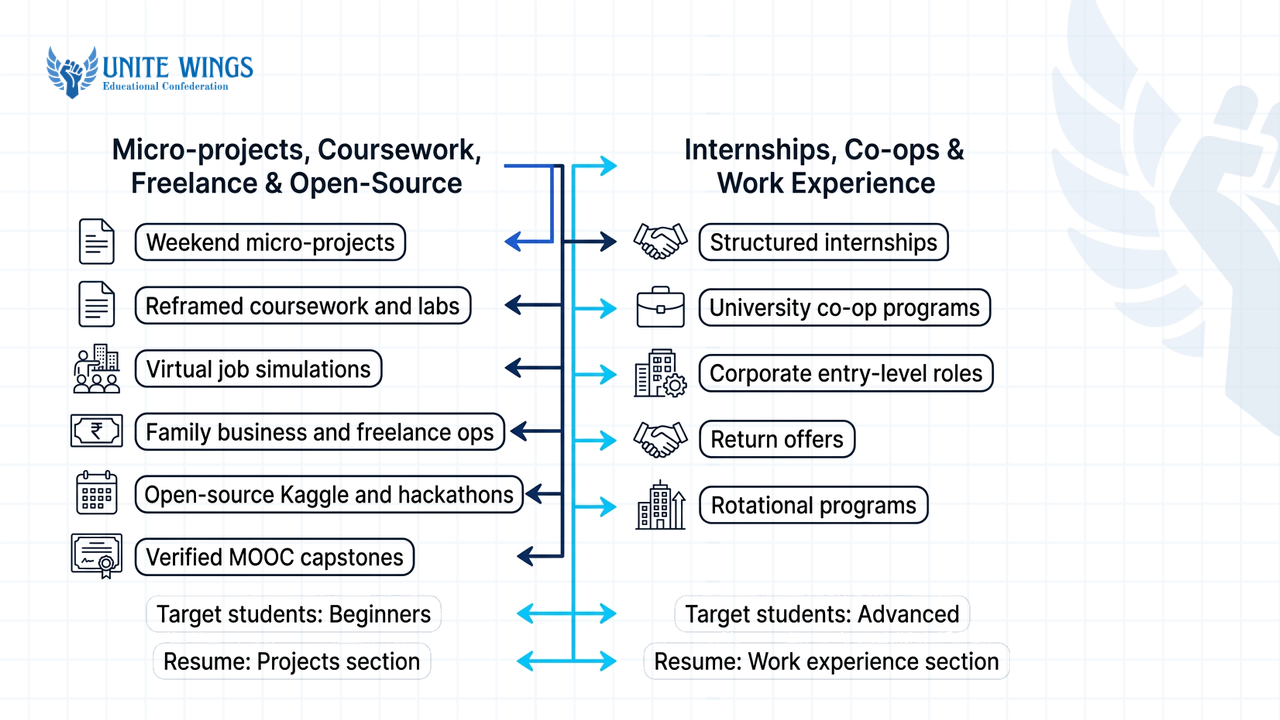
Mercer | Mettl's Graduate Skill Index (cited by BluffHR in 2026) shows that modern recruiters heavily prioritize verified technical skills and project evidence over generic, unprovable soft-skill adjectives like "hardworking team player." If you are wondering why my professional resume looks empty and how to fill it before campus placements or off-campus drives begin, look at the six legitimate entry types below:
| Entry Type | Who It Suits Best | Time to Build | Where It Goes on Your Resume |
|---|---|---|---|
| 1. Weekend Micro-Projects | CS/IT, Data, Design, Marketing | 12–20 hours | Projects (Top half of page) |
| 2. Reframed Coursework & Labs | All engineering, commerce, and arts streams | 1–2 hours | Academic Projects or Education |
| 3. Virtual Job Simulations | Finance, Consulting, Data, Software | 4–10 hours | Certifications or Projects |
| 4. Family Business / Freelance Ops | Commerce, BBA, Operations, Generalists | 2 hours (to document) | Experience or Leadership |
| 5. Open-Source / Kaggle / Hackathons | Tech, AI/ML, Analytics freshers | 8–15 hours | Projects or Achievements |
| 6. Verified MOOC Capstones | Career switchers and core branch students | 10–15 hours | Certifications & Continuous Learning |
Concrete example for non-tech or family business involvement: Even helping run a family retail shop or a small college society counts if you frame the operational output. Instead of leaving it off, write:
Operations & Inventory Coordinator | Sharma Textiles (Family Enterprise) | May 2025 – Jul 2025- Digitized 400+ monthly supplier invoices using Microsoft Excel pivot tables, reducing end-of-month reconciliation errors by 25%.
If you already have rough drafts of these experiences but struggle to write them cleanly, our Resume Masterclass walks you through rebuilding your bullet points so a recruiter understands your value in ten seconds.
Can I add coursework and classroom assignments to fill a fresher resume?
Yes, university coursework, semester lab assignments, and classroom case studies belong on a fresher resume as long as you highlight the specific tools used, datasets analyzed, and measurable outputs. According to 2026 student resume guides from Internshala and CollegeConnectUs, recruiters treat rigorous academic assignments like entry-level experience when you strip away passive student language and format them with action verbs.
Most students waste their three or four years of college syllabus by writing a single line under Education: B.Com (Hons), Delhi University — 7.1 CGPA. You already spent hundreds of hours submitting term papers, lab files, and minor projects. Pull the two best assignments out of your syllabus and turn them into full project blocks.
Here is how to rewrite passive classroom tasks into action-oriented resume bullets:
- Finance / Commerce Student:
- Weak (Student phrasing): "Studied financial modeling and corporate valuation in 5th semester."
- Strong (Recruiter-ready, per 2026 Student Resume Writing Guide standards): "Researched and built a cash-flow projection model for a 5-year business simulation in Excel, presenting final findings to a panel of 30 peers."
- Computer Science / Engineering Student:
- Weak (Student phrasing): "Made a database management project for library books using SQL."
- Strong (Recruiter-ready): "Designed a normalized relational database in MySQL across 8 tables to track 2,500+ library book checkouts, writing stored procedures to automate overdue fine calculations."
- Marketing / Humanities Student:
- Weak (Student phrasing): "Did a survey on consumer behavior for my final year assignment."
- Strong (Recruiter-ready): "Collected and cleaned survey responses from 180 college students using Google Forms and SPSS to identify pricing sensitivity for D2C skincare brands."
How do I build a weekend micro-project that counts as resume experience?
To make a weekend micro-project count as valid resume experience, you must format it exactly like a professional job—with a clear title, plain-text tech or tool stack, date range, and two to three past-tense impact bullets—and deploy it to a live link. According to 2025/2026 guides from Scaler, Code Like A Girl, and ApplyCove, recommended micro-projects include CRUD task managers, API-connected weather dashboards, and chart-backed expense trackers.
What most students get wrong (The Tutorial Trap): Thousands of Indian freshers copy-paste a standard YouTube Netflix clone or basic To-Do app onto their GitHub. Technical interviewers spot tutorial code in thirty seconds during screening rounds because every variable name is identical and the README file is blank. According to Scaler, essential polish elements that separate real projects from clones are a deployed live link (via Vercel, Netlify, or Render), a descriptive README file, and basic unit testing or error handling.
The 48-Hour Weekend Sprint: Build 2 Resume Entries Before Monday
If your resume is sitting at half a page on Friday evening, follow this exact schedule to add two legitimate, verifiable entries by Sunday night:
- Saturday Morning: Build Micro-Project #1 (Data or Utility Tool)
- Tech/Data option: Build a command-line inventory tracker in Python/SQLite or an API-connected expense dashboard.
- Non-Tech/Business option: Pull a public dataset (from Kaggle or RBI reports) and build an interactive Google Looker Studio dashboard or a 10-page competitor teardown deck.
- Saturday Afternoon: Deploy, Document, and Write Bullets
- Push your code to GitHub (or publish your deck/dashboard to a public view link). Deploy web apps for free on Vercel, Netlify, or Render.
- Write a clean
README.mdstating the problem solved, tools used, and a screenshot of the working output. - Add this exact structure to your resume (per ApplyCove 2026 guidelines):
Inventory Tracker CLI | Python, SQLite, PyTest | Oct 2026 | [Live Link / GitHub]- Built a command-line inventory manager handling 500+ SKU records; reduced manual lookup time by 30%.
- Implemented automated input validation and basic unit tests to prevent duplicate stock entries.
- Sunday Morning: Complete Virtual Simulation #2 or Audit Project
- Pick a 5-hour industry module on Forage (detailed below) or build a second small workflow automation using Google Sheets and AI.
- Sunday Evening: Final Integration and ATS Check
- Paste both project blocks into your single-column document, verify all hyperlinks open in an incognito browser tab, and export as a text-selectable PDF.
If you want guided mentorship while building your first live proof-of-work project, join our AI Portfolio Sprint to pick a scoped problem, build it with AI assistance, and publish it properly.
Do virtual job simulations on Forage count on a professional resume in India?
Virtual job simulations on Forage do count on an Indian fresher resume as proof of applied skills and corporate familiarity, provided you list them under "Projects" or "Certifications" rather than formal employment history. According to 2026 data from Forage and The Internship India, the platform hosts over 250 simulations across 90+ enterprise partners with over 9 million students, and these 4-to-10-hour modules are 100% free, self-paced, and require zero prior application.
Forage's internal 2026 Impact Report states that candidates utilizing their simulations are 3.3x more likely to secure job interviews and employment afterward. However, there is an important conflict you must handle carefully in India.
Warning: Where to place Virtual Simulations
While virtual simulation platforms frame their modules like internships, human recruiters in India and engineering communities (such as discussions on Reddit r/developersIndia and OpportunitiesFeed's 2026 guide) strongly advise against listing them under "Work Experience." You do not have an employment contract with J.P. Morgan, Deloitte, or KPMG. Claiming you worked there will cause you to fail Background Verification (BGV) or get rejected when an interviewer asks about your manager. Always place them under Projects, Certifications, or Continuous Learning.
To make a simulation stand out to Indian recruiters—who often treat standalone completion certificates skeptically—pair the certificate with your actual task output. Follow these three steps:
- Go to Forage and select a 4-to-10-hour module matching your target role (for example, Data Analytics, Software Engineering, or Investment Banking).
- Complete the technical or analytical deliverables, upload your code or slides to your own Google Drive or GitHub folder, and download the verified certificate.
- Add the entry under your
Projects & Continuous Learningheading using this exact wording:Data Analytics Virtual Job Simulation (Completed via Forage) | Oct 2026- Completed a 6-hour corporate simulation designed by KPMG, performing raw financial data cleaning on 3,000+ transaction rows in Excel and drafting a 5-slide client insight deck.
How do I format my resume layout so a half-page of content looks balanced?
To balance a half-page or three-quarter-page resume without looking amateurish, use a single-column layout with 11-point body text, 1.15 line spacing, 12 to 16 points of space above section headers, and 0.75-inch to 1-inch margins. According to 2026 formatting manuals from MiraResume, ResumeGenius, and 1Template, these exact proportions distribute white space naturally across the page without triggering red flags for visual padding.
In India, approximately 90% to 94% of companies use Applicant Tracking Systems (ATS) to filter entry-level applications, according to TaskVeda's 2026 Student Resume Template report. Furthermore, a 2026 ResumeOptimizerPro guide found that single-column simple formats achieve 90% to 95% field extraction accuracy across major ATS platforms, compared to just 60% to 70% for multi-column or graphic-heavy designer templates. ResumeFast and Resume Hero confirm that single-column layouts prevent automated parsers from shuffling your text blocks out of order.
Even if your content still only reaches 75% of the page after adding projects, do not panic. While traditional convention mandates filling one full page (CampusFirstIndia 2026), modern career coaches and community discussions on Reddit r/ResumeCoverLetterTips and NovoResume agree that natural white space is far better than padding a document with giant fonts or fluff. Some guides suggest narrowing margins to 0.5 inches, but ResumeFast and MiraResume warn that ultra-thin margins cause printing clips and make sparse resumes look even emptier; stick to 0.75 to 1 inch.
Use this exact checklist to configure your document in Google Docs or MS Word:
| Formatting Element | Exact Setting to Use | Why It Works (Source Standard) |
|---|---|---|
| Layout Structure | Single-column, reverse-chronological | Prevents ATS parsing scrambles (90–95% extraction accuracy) |
| Font Family | Calibri, Arial, Georgia, or Garamond | Web-safe, clean readability across all recruiter screens |
| Font Sizes | Name: 16–24pt; Headers: 12–14pt bold; Body: 10–12pt (11pt ideal) | MiraResume & 1Template 2026 typography standards |
| Page Margins | 1 inch on all sides (or 0.75 inch if adjusting space) | ResumeFast & MiraResume 2026 layout guidelines |
| Line & Section Spacing | 1.0 to 1.15 line spacing; 12–16pt above headers; 6–10pt between entries | NovoResume & 1Template visual hierarchy rules |
| Section Sequence | Header → Education → Projects → Skills → Certifications/Leadership | CampusFirstIndia 2026 standard for freshers with no jobs |
| File Export Format | Text-selectable PDF (Firstname_Lastname_Resume.pdf) | MiraResume & ResumeGenius 2026 file standards (use .docx only if requested) |
Your next steps for this weekend
Stop staring at a blank cursor or shopping for fancy resume templates. Do these three things over the next 48 hours:
- Delete the biodata fluff and switch to one column: Open a clean Google Doc, set 1-inch margins, 11-point Arial or Calibri font, and 1.15 line spacing. Remove your photo, full street address, father's name, and generic "Objective" paragraph.
- Rewrite two college assignments into project blocks: Pick the two hardest subjects or labs you completed in the last two semesters and write three past-tense bullet points for each, naming the exact software, dataset size, and outcome.
- Ship one live weekend project and one virtual simulation: Spend Saturday building and deploying a small tool or dashboard with a live URL, and spend Sunday afternoon completing one 5-hour Forage module in your target domain.
Build real proof of work in one weekend
If you have zero internships and do not know what project to build first, join the AI Portfolio Sprint. In this hands-on session, you will pick a practical problem in your domain, build a working project using AI tools, document it properly, and walk away with a live, verifiable portfolio link you can paste directly onto your resume before your next application drive.
Frequently asked questions
What is the ideal section order for a fresher student applying in India?
Start with your contact header, followed immediately by Education, then Projects, Technical Skills, and finally Certifications or Extracurricular Leadership. According to 2026 Indian campus hiring standards from CampusFirstIndia, leading with your degree and hands-on projects puts your strongest proof of capability in the top half of the page where recruiters look first.
Should I include my 10th and 12th board marks on an Indian fresher resume?
Include your 10th and 12th percentages only if you are applying for on-campus placement drives that enforce strict historical academic cut-offs (such as a 60% or 7.5 CGPA filter across all boards). For off-campus startups and modern tech roles, listing only your undergraduate degree and graduation year saves space and looks cleaner.
How many bullet points should I write for a college project entry?
Write two to three impact-driven bullet points per project entry, keeping each bullet to one or two lines maximum. According to 2026 fresher layout standards from ApplyCove, starting each bullet with a past-tense action verb—covering what you built, the tools you used, and the measurable result—gives recruiters enough depth without wall-of-text fatigue.
Is it okay to submit a resume that only fills three-quarters of a page?
Yes, a clean, well-proportioned three-quarter page resume is always better than a full page padded with irrelevant fluff or 14-point fonts. Career coaches on NovoResume and 1Template note that setting 1-inch margins and 1.15 line spacing makes a slightly shorter document look crisp, honest, and easy for a human recruiter to scan.
Can I include part-time work or helping in my family business on my resume?
Yes, working in a family business, tutoring, or managing college festival budgets counts as valid experience if you focus on measurable operations. According to 2026 fresher guides from Reddit r/resumes and CareerGuideline, quantifying how you handled inventory, customer queries, or spreadsheets proves real-world accountability that most college students lack.
Do I still need a Career Objective statement at the top of my resume in 2026?
Skip the traditional "Career Objective" paragraph asking for a challenging role to grow your skills, as recruiters ignore generic self-praise. If you need two extra lines at the top, write a factual "Profile Summary" stating your degree, your core technical stack, and the specific types of projects you have already built and deployed.
Newsletter
Stay updated with our latest news and insights.