How to Turn Professors and Internship Mentors Into Job Referrals
Before cold-messaging strangers online, tap the warm contacts right in front of you. 4 scripts to ask professors, guest speakers, and internship leads for intros.
You turn professors and internship mentors into job referrals by building goodwill during your semester or internship, staying in touch once every 3 to 4 months after it ends, and sending a specific Job Requisition ID when a full-time role opens. Most students waste months messaging strangers on LinkedIn for off-campus drives while ignoring the faculty, guest speakers, and former managers who already know their work. While standard IT service fresher salaries in India sit around 3.5 to 4.5 LPA in 2026 (according to Hyring's 2026 fresher salary report), breaking into the 8 to 15+ LPA band at product startups, cloud firms, or Global Capability Centres (GCCs) tracked by Jobvumi almost always requires a warm referral or a strong third-party recommendation.
In short
- Never ask for a referral with "let me know if anything opens up"; wait until a live role drops and send the exact Job Requisition ID (Req ID) so your contact can attach you in their Applicant Tracking System (ATS).
- Current interns cannot submit full-time referrals in almost any corporate ATS, so always route referral requests to Full-Time Employees (FTEs) like your former manager or mentor.
- Connect with visiting college guest lecturers on LinkedIn within 24 to 48 hours of their talk, and quote one specific concept from their session in your connection note.
- Maintain contact with past internship managers using the 3-times-a-year rule (once every 3 to 4 months) by sharing a project update or an industry link rather than an empty "just checking in" text.
- When asking a professor or manager for a LinkedIn recommendation, attach 3 to 4 drafted bullet points of your project outcomes so they do not face a blank page.
Do Indian college professors actually have industry contacts for placements?
Yes, Indian college professors hold industry contacts through alumni networks, research grants, and corporate MoUs, though their direct hiring pull depends heavily on your college tier and whether the professor does external consulting. At premier institutes like IIT Madras and IIT Delhi, structured Placement and Internship Offices manage formal corporate relationships, while professors in tier-2 and tier-3 colleges rarely connect directly to corporate HR pipelines, according to a 2025 analysis by ask4clg.com.
Understanding how to network with professors and internship mentors for job referrals starts with knowing which faculty member holds which type of access. In a tier-2 or tier-3 engineering or management college, your professor usually cannot slot you straight into an interview round at a mass recruiter like TCS (where NQT ninja and digital tracks pay between 3.36 LPA and 7 LPA, per JoinSaarthi's 2026 data) or a general non-tech role (3 to 5 LPA). However, professors who run industry-sponsored labs, consult for local mid-sized firms, or sit on the Training and Placement Office (TPO) committee know three groups of people you do not: alumni who graduated 3 to 8 years ago and now manage teams, visiting practitioners, and startup founders who ask faculty for final-year project interns.
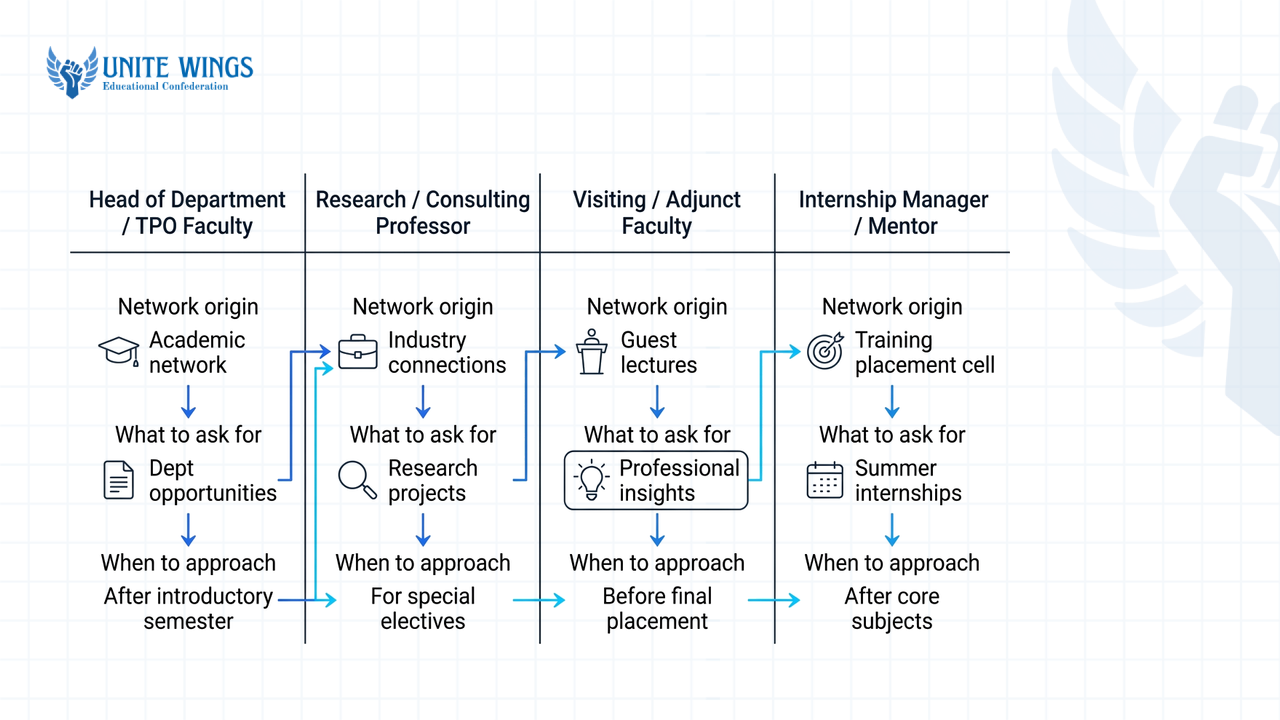
| Contact type on campus | Where their industry network comes from | What to ask them for | When to approach them |
|---|---|---|---|
| Head of Department (HOD) / TPO Faculty | Official college MoUs, past campus recruiters, senior alumni batches | Introductions to alumni working at your target company or startup | Mid-semester of pre-final or final year, before placement season peaks |
| Research / Consulting Professor | Corporate R&D grants, technical consulting clients, specialist labs | Direct reference to a technical lead or R&D manager at a partnering firm | After scoring in the top 10% of their subject or completing a capstone module |
| Visiting / Adjunct Faculty | Full-time corporate day job or active industry consulting bench | Employee referral for a live Req ID at their current company | Within 2 weeks of finishing their elective module |
| Internship Manager / Mentor (FTE) | Internal company hiring managers, sister-team leads, HR business partners | PPO conversion, internal team transfer, or formal ATS referral | Halfway mark of the internship for a PPO; post-internship once a Req ID is live |
If you study at a top-tier engineering institute, watch the calendar carefully. According to the IIT Delhi Office of Career Services 2026 timeline, a student blackout period typically begins in November ahead of December full-time recruitment phases, which restricts external placement interactions. Build your faculty goodwill by the midpoint of the semester through lab delivery and capstone work, well before exam and placement freezes start.
Here is the exact script to use in person or over email when asking a professor for an alumni introduction:
"Professor [Last Name], while building the [specific module, e.g., anomaly detection pipeline] for our 6th-semester minor project, I saw that two alumni from our department from the 2022 batch are working on the data engineering team at [Target Company]. Since you guided their final-year thesis, would you be comfortable introducing me to [Alumnus Name] over email or LinkedIn so I can ask 2 questions about their team's tech stack?"
What is the right way to connect with a guest lecturer who visited my college?
The right way to connect with a guest lecturer is to send a LinkedIn connection request within 24 to 48 hours of their campus session, including a personalized note that cites a specific concept or phrase from their talk. Networking guides from College Fast Forward and Medium confirm that anchoring your note to a specific takeaway separates you from the dozens of generic connection requests speakers receive after an event.
Specialized academic networks in India, such as Board Infinity's visiting faculty bench of over 3,000 industry practitioners in 2026, bring working managers into colleges for weekend workshops, capstone reviews, and electives. Most students crowd the podium for 3 minutes after the talk, click a group photo, and never follow up. Instead, treat a guest lecture as a 3-step outreach workflow over two weeks.
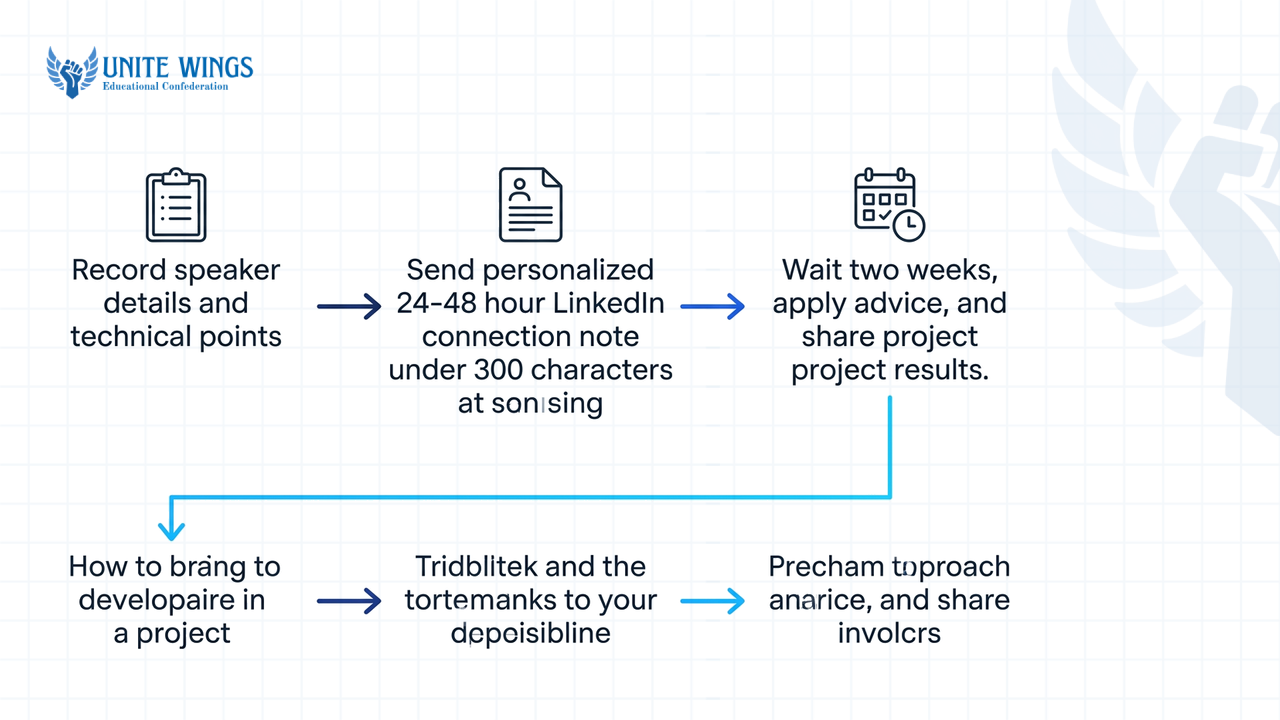
- Write down the speaker's exact job title, company name, and one concrete technical or business point they made during the session (for example, why their team migrated from REST to gRPC, or how they calculate customer acquisition cost).
- Within 24 to 48 hours (per College Connect Us 2026 guidelines), open LinkedIn on a desktop browser or click "More" on the mobile app to select "Add a note" before hitting Connect. Keep the note under 300 characters so it fits the free LinkedIn limit.
- Wait at least two weeks after they accept before asking for anything. During those two weeks, apply the advice they gave in class to a small project or dataset, and share the link in a follow-up message.
Copy and adapt this 24-hour LinkedIn connection note (268 characters):
"Hi [Speaker First Name], thank you for visiting [College Name] yesterday. Your point about why [Company Name] tests SQL query cost before deploying to production changed how I'm structuring my current DBMS project. Would love to stay connected here on LinkedIn."
Two weeks later, once you have actually implemented what they talked about, send this follow-up message:
"Hi [Speaker First Name], following up on your lecture at [College Name] two weeks ago, I applied the query optimization check you mentioned to my capstone dataset and cut execution time by 40%. Here is the 2-minute GitHub readme: [short link]. No need for a long reply, just wanted to show you that your session was put to work."
When a fresher role opens at their company 4 months later, you are no longer a random student begging for a favour; you are the student who listened and executed. If your profile is still half-empty when they click your name, fix your headline and featured section first using the steps in our LinkedIn Masterclass.
When should I ask my internship mentor about full-time openings or referrals?
You should first bring up full-time conversion (a Pre-Placement Offer, or PPO) with your internship mentor at the halfway mark of your internship, and ask for external or off-campus job referrals only when a specific job requisition ID goes live. Career transition guides from Atrium Staffing and Refonte Learning point to the midpoint review as the right window because it gives you enough time to act on feedback before final headcount decisions are locked.
Waiting until the last Friday of an 8-week summer internship to ask about a PPO is a classic fresher mistake; by week 8, the department's full-time budget is already allocated. During your week-4 or week-5 one-on-one meeting with your manager, use this exact wording:
"We are halfway through my 8-week internship, and I have really enjoyed working on [Project Name] with the team. My goal is to join [Company Name] full-time after I graduate in [Month, Year]. Based on my work over the first 4 weeks, what specific skills or deliverables do I need to demonstrate in the remaining 4 weeks to be a strong candidate for a PPO?"
If you reach the final two weeks of your internship and your manager tells you a full-time conversion offer is unavailable due to headcount freezes, Atrium Staffing's 2026 post-internship guide recommends doing three things immediately before your corporate email and Slack accounts are deactivated:
- Ask for specific performance feedback on your completed project so you can quantify your resume bullets.
- Secure a commitment for a LinkedIn recommendation and request that they keep you in mind when future headcount opens on sister teams.
- Collect personal contact information (their personal email address or mobile number) and connect on LinkedIn during your final two weeks, as advised by Vault.com (2026).
What most students get wrong about referrals
Two mechanical rules govern corporate Applicant Tracking Systems (ATS) like Workday, Greenhouse, and Taleo, yet almost no college placement cell teaches them:
- The Requisition ID Rule: Never tell a former mentor or professor, "Please let me know if anything opens up." According to StudentInternships.org (2026), corporate ATS tools require an active Job Requisition ID (Req ID) to bind an employee referral to a candidate. Vague requests before a job is posted cannot be logged in the system and get forgotten within 48 hours.
- The Intern Restriction: Do not ask a fellow intern who had their internship extended to refer you for a full-time role. As documented in Medium's tech hiring guides, standard corporate ATS platforms restrict referral permissions to permanent Full-Time Employees (FTEs). Always send your referral request to a full-time engineer, analyst, or manager on the team.
How do I stay in touch with my summer internship manager after the internship ends?
Stay in touch with your summer internship manager by reaching out once every 3 to 4 months (roughly 3 times a year) with a brief update on how you applied their mentorship, a new project milestone, or a relevant industry article. Both The Intern Group and Vault.com warn against empty "Hi sir, how are you?" check-ins, which feel like homework to reply to and slowly kill the relationship.
If your summer internship ends in July after your 6th semester, and full-time off-campus hiring for your batch heats up between January and May of the following year (where Naukri's JobSpeak data showed fresher hiring for 0 to 3 years of experience rising 7% to 17% year-on-year from February to May 2026, per a single-source report by 360 Digital Transformation), you need exactly three touchpoints to keep the relationship warm before you ask for a referral.
- October (3 months post-internship, The Academic Application Update): Send a 3-sentence LinkedIn message or email showing how a tool or workflow you learned during the internship helped you in your 7th-semester project.
"Hi [Manager Name], hope Q3 went well for the [Team Name] team. Just wanted to share a quick win, I used the automated unit-testing workflow you taught me over the summer on my final-year capstone project, and our faculty panel scored it top in the batch. Thank you again for drilling that habit into me."
- January (6 months post-internship, The Industry / Certification Milestone): Share a concrete certification, hackathon win, or live deployment related to their domain.
"Hi [Manager Name], wishing you a great start to 2026. Following your advice from my exit review to strengthen my cloud fundamentals, I cleared my AWS Cloud Practitioner exam last week and deployed a small RAG pipeline. Hope the new product release at [Company Name] is going smoothly."
- March/April (When a live Req ID drops, The Referral Ask): Once you spot an open entry-level role on the company's careers page, use the off-campus referral playbook confirmed by Medium: include the exact Job ID, a shortened resume link, and a 2-line value summary in your very first message so your former manager does not have to ask for details.
"Hi [Manager Name], I saw that [Company Name] just opened a fresher [Role Title] position on the [Department] team (Job Req ID: JR-2026-4491). Since I built the [specific feature/dashboard] on your stack during my summer internship and already know internal workflows like [Tool A] and [Tool B], I would love to apply. Would you be comfortable submitting a referral for me in the portal? My updated 1-page resume is here: [short link]. Do not apply on the careers page yet if their portal requires the employee to generate a referral link first, ask them which method their ATS uses.
To track live requisitions across 30+ target companies and automate your follow-up reminders without losing threads, you can learn the exact tracker setup in our Job Search and Outreach Masterclass.
How do I ask a professor or former manager for a LinkedIn recommendation?
Ask a professor or former manager for a LinkedIn recommendation by requesting permission in person or via a direct message first, giving them 2 to 3 weeks of notice, and sending 3 to 4 pre-written bullet points of your project outcomes so they do not face a blank page. Career advisors at College Fast Forward and the Yale Office of Career Strategy recommend freshers collect 3 to 5 strong LinkedIn recommendations to serve as third-party proof when they lack full-time work history.
According to College Fast Forward's 2026 guide, LinkedIn's search algorithm favours profiles with active connections and structured recommendations when recruiters filter candidates. Yet most professors and managers ignore LinkedIn's automated recommendation prompts because staring at an empty text box during a busy workday creates friction (what College Fast Forward calls "blank-page syndrome").
Follow this 4-step sequence to get a response within days:
- Ask verbally or over email before clicking the LinkedIn button: Both Coursera (2026) and Yale OCS advise asking verbally first if you are still on campus or in the office. Give managers at least 2 to 3 weeks of notice ahead of any application deadline, and give university professors 4 to 6 weeks if your request falls near semester exams or grading cycles.
- Send a "brag sheet" with 3 to 4 drafted bullets: In line with Indeed's 2026 internship recommendation guidelines and Yale OCS, attach your resume and 3 to 4 specific bullet points covering the exact skills and metrics you want highlighted (for example, Python data cleaning, reducing report generation time by 30%, or leading a 4-member lab team).
- Offer a reciprocal recommendation or course testimonial: As noted by Yale OCS (2024), offering to write a thoughtful recommendation about their mentorship or course in return is standard professional practice.
- Trigger the official LinkedIn prompt: Go to their LinkedIn profile, click More, select Request a recommendation, choose your exact relationship ("You were senior to me" or "You taught me"), and paste the drafted bullets right into the message box.
Copy this exact message into your email or the LinkedIn request box:
"Hi [Professor / Manager Name], as I prepare for off-campus [Data Analyst / SDE] placements this semester, I am building out my LinkedIn profile with feedback from mentors who have closely reviewed my work. Would you be open to writing a short 3-to-4-sentence recommendation on my LinkedIn profile about my work on [Project Name / Course Name]?
To save you time and avoid a blank page, I drafted three bullet points below covering what we worked on, please feel free to edit, shorten, or rewrite them however you prefer:
- Built an automated Python script during the 8-week summer internship that cleaned 50,000+ rows of sales data daily and reduced manual Excel reporting by 4 hours a week.
- Communicated blockers early during weekly agile standups and delivered the client dashboard 3 days ahead of the sprint deadline.
- Collaborated with both the backend engineering and finance teams to validate GST calculation logic.
I have no urgent deadline for the next 3 weeks, and I would also be glad to write a recommendation highlighting your mentorship on your profile. Thank you for your time and guidance."
Your 7-day action plan to activate your campus and internship network
Do not wait until your final semester exams end to start messaging people. Break the work into three short tasks over the next 7 days:
- Today (30 minutes): Open a spreadsheet and list 3 professors whose subjects or labs you scored well in, 2 guest lecturers or workshop speakers from the past year, and every full-time employee (not fellow interns) you worked with at your last internship.
- By Day 3 (45 minutes): Send one LinkedIn recommendation request using the 3-bullet "brag sheet" template above to either your project guide or your former internship mentor.
- By Day 7 (30 minutes): Send one no-ask "3-times-a-year" update message to a past internship manager or visiting faculty member showing a project link or skill you built based on their feedback.
Turn your LinkedIn profile into a referral magnet
When you message a guest lecturer, alumnus, or former manager, the first thing they do before replying is click your LinkedIn profile. Join the Unite Wings LinkedIn Masterclass to rewrite your headline, about section, and project highlights using AI so recruiters and senior mentors immediately see your proof of work, and walk away with a weekly outreach habit that keeps your network warm all year.
Frequently asked questions
Can current interns refer other candidates for full-time jobs at their company?
No, current interns almost never have permission to submit formal referrals for full-time positions in corporate Applicant Tracking Systems (ATS), according to Medium's tech hiring guides. Internal HR portals restrict referral rights to permanent Full-Time Employees (FTEs). Instead, ask your intern friend to introduce you directly to their full-time manager or team lead.
What should I do if my internship manager doesn't respond to my message post-internship?
Wait 10 to 14 business days and send one polite follow-up on a different channel, for example, moving from LinkedIn DM to the personal email address you collected during your final two weeks (Vault.com, 2026). If they still do not reply, message another Full-Time Employee (FTE) from the same project team who saw your daily work.
What is a realistic starting salary for a fresher in India in 2026?
Average fresher salaries in India for standard IT service roles sit between 3.5 and 4.5 LPA in 2026 (with TCS NQT tracks spanning 3.36 to 7 LPA, per JoinSaarthi), according to Hyring's 2026 report. However, specialized roles in AI, machine learning, cloud computing, and product firms or GCCs pay between 8 and 15+ LPA, according to Jobvumi (2026). Salary bands shift by city and company tier, so check live Glassdoor and AmbitionBox listings before negotiating.
How early should I ask a college professor for a letter of recommendation or reference?
Give your professor at least 2 to 3 weeks of notice before your application deadline, as advised by Coursera (2026). If your deadline falls during university semester exams, project viva weeks, or peak admission cycles between November and January, request the recommendation 4 to 6 weeks in advance and attach your resume and drafted project bullets.
How do I ask an alumnus for a job referral on LinkedIn without sounding transactional?
Never ask for a referral in a cold connection note unless a live job opening is about to close. If a role is already live, Medium's off-campus referral playbook recommends removing all friction for the alumnus: state your shared college department, give the exact Job Requisition ID, paste a shortened resume link, and write a 2-line summary matching your project metrics to the job description.
Newsletter
Stay updated with our latest news and insights.