
Does Turnitin Flag Perplexity AI? How to Use It Safely
Why copy-pasting Perplexity answers triggers Turnitin AI detectors and bad-source penalties, plus the 5-step workflow to research ethically and pass every check.
Yes, Turnitin flags text copied from Perplexity AI, even when every sentence ends with a numbered citation. If you are asking is using perplexity ai considered plagiarism in college, the rule is straightforward: using Perplexity as a search engine to discover research papers is ethical, whereas pasting its generated paragraphs into your assignment or B.Tech final-year report counts as academic misconduct under AICTE and university rules. You stay safe when Perplexity finds the PDFs and you write every sentence yourself from those primary documents.
In short
- Turnitin and DrillBit score prose patterns (low perplexity and uniform sentence length), so Perplexity's inline footnotes do not lower your AI detection score.
- Switch Perplexity from "All Web" to "Academic Focus" or add
-site:reddit.com -site:quora.comto stop it from pulling forums and SEO blogs. - Independent audits report citation and factual error rates between 20% and 47% on Perplexity, meaning you must open every DOI or PDF before citing it.
- Under APA 7th edition rules, cite the human-authored journal paper you found through Perplexity, never Perplexity itself.
- If your Indian university requires an AI declaration, list Perplexity AI as a literature discovery tool and state that all writing and analysis are yours.
Can Turnitin and college AI detectors spot text copied from Perplexity?
Yes, Turnitin and DrillBit Extreme consistently flag raw text copied from Perplexity AI. Because Perplexity uses large language models like GPT-3.5 and GPT-4 to summarize web search results, its prose exhibits low perplexity (predictable word sequences) and low burstiness (uniform sentence lengths), which are the exact statistical markers AI detectors measure.
Many students assume that Perplexity is safe because it acts like a search engine and attaches numbered footnote badges to every claim. That is the single biggest trap in college submissions right now. According to a 2026 analysis by Humanizer AI, Turnitin evaluates the statistical texture of the sentences independently of whether citations exist or whether the facts are accurate. Pasting a Perplexity summary and converting the bracketed numbers into APA references still leaves you with synthetic sentence structures.
As reported by Phrasly.ai, Turnitin updated its instructor interface in August 2026 to remove specific tool attribution labels, showing professors a unified percentage score and blue highlight bars rather than naming the app used. In Indian central universities and IITs governed by INFLIBNET's ShodhShuddhi program, your thesis or project report is screened through either Turnitin or DrillBit Extreme. Furthermore, Avloryn Labs notes that AICTE guidelines for technical and management colleges classify unacknowledged AI-generated text as plagiarism and mandate AI screening alongside traditional similarity checks.
What most students get wrong is trying to fix a flagged Perplexity paragraph by running it through a basic synonym-swapping paraphraser like QuillBot. Turnitin added dedicated AI-bypasser and humanized-text detection models in August 2025, as documented by ProofreaderPro.ai. Swapping three adjectives per sentence ("vital" to "important", "moreover" to "additionally") is called patchwriting by the International Center for Academic Integrity (ICAI), and modern detectors catch both the underlying AI skeleton and the spinner pattern.
There is also a documented risk for Indian students who write formal English from scratch. Peer-reviewed research by Liang et al. published in Patterns (cited by ProofreaderPro.ai) found that non-native English writers using strict, textbook grammar can face false-positive AI detection rates as high as 61%, despite commercial vendors claiming under 1% false positives overall. If your own writing is rigid and uniform, blending it with even 20% Perplexity copy-paste can push your entire chapter over your department's rejection cap.
Why do professors reject some citations that Perplexity includes in its answers?
Professors reject Perplexity citations because its default web search pulls from non-authoritative sources like Reddit threads, Quora answers, and commercial SEO blogs, and because the model frequently misrepresents what the linked article actually says. Independent audits of Perplexity AI show citation and factual error rates between 20% and 47%.
When you type a prompt into Perplexity's default search bar, the engine prioritizes fast, readable web pages over paywalled or dense academic PDFs. As documented by ReadWonders and AppliedAI Tools, Perplexity answers routinely incorporate user-generated forums and marketing articles. If you are submitting a literature review for a semester project or an M.Tech dissertation, an internal examiner who spots a Medium post, a LinkedIn pulse article, or a company blog in your reference list will immediately deduct marks or ask for a rewrite.
Even when Perplexity cites a real academic journal, you cannot trust the summary without opening the paper. Audits by the Tow Center and Salesforce (reported via DataStudios.org and Medium) found that Perplexity's citation accuracy—meaning whether the linked document genuinely supports the claim next to the footnote number—ranges between 40% and 80%. The AI often stitches together two unrelated sentences from a paper's introduction or hallucinates a statistic by merging two different web sources.
A third mistake is citing Perplexity AI itself in your bibliography (for example, writing "Perplexity AI, 2026, response to author prompt"). According to APA 7th edition standards outlined by ReadWonders, when an AI tool is used as an intermediary search engine, you must open, read, and cite the primary human-authored source. Citing Perplexity directly is reserved exclusively for papers where the AI model's conversational behavior or prompt output is the actual subject of your research. Additionally, because Perplexity scrapes live web data dynamically, a session link you save today can display different sources six months later when your external examiner clicks it.
How do I stop Perplexity from citing random blogs, Reddit threads, or SEO websites?
To stop Perplexity from citing blogs and forums, switch the search mode from "All Web" to "Academic Focus" before submitting your query, or append negative search operators like -site:reddit.com -site:quora.com directly to the end of your prompt. Both methods force the engine to retrieve peer-reviewed literature.
Perplexity does not currently offer a permanent account toggle or global blocklist to ban specific websites across all your chats, and recent interface updates removed the single-click "X" button that previously let users delete a bad source and regenerate on the fly, according to a 2026 guide on AppliedAI Tools. Instead, you have to control the sources at the prompt level using three specific settings:
- Turn on Academic Focus Mode: Inside the Perplexity search bar, click the Focus dropdown (often labeled "All" or represented by a globe icon) and select "Academic". As detailed in the Vertech Academy cheat sheet, this restricts Perplexity's retrieval index to scholarly repositories including Semantic Scholar, PubMed, and ArXiv, blocking Reddit, Wikipedia, and marketing blogs before the LLM writes a single word.
- Append
-site:search operators: When you need recent industry data or government reports that might not sit in PubMed, stay in standard web mode but add negative domain filters at the end of your prompt. Copy and paste this string at the end of your question:-site:reddit.com -site:quora.com -site:medium.com -site:linkedin.com -site:wikipedia.org. - Configure Perplexity Spaces for semester-long projects: A workflow shared via Reddit uses Perplexity Spaces to create a dedicated research room for a thesis topic. Inside the Space's custom instructions box, set a permanent system rule: "Only retrieve and cite peer-reviewed journal articles with a valid DOI, government portals (.gov.in), or institutional reports. Exclude blogs, forums, and commercial websites. For every claim, state the first author, publication year, and methodology."
If you want to set up a clean pipeline where Perplexity finds verified PDFs and NotebookLM organizes your reading notes without hallucinating citations, we build that exact setup live in the Research with AI: Perplexity and NotebookLM workshop.
What is the right way to read the primary source PDF and paraphrase in my own voice?
The reliable way to paraphrase without triggering Turnitin or committing patchwriting is the "cover-and-write" method: open the original PDF found via Perplexity, read the relevant section until you understand the mechanism or finding, close the PDF window completely, write the point from memory in your own voice, and then cross-check the numbers and add the citation.
According to academic integrity standards from the ICAI and a 2026 guide by EyeSift, true paraphrasing requires transforming both the vocabulary and the grammatical structure of the passage while crediting the original author. If you keep the Perplexity tab open on half of your laptop screen and MS Word on the other half, your brain will unconsciously copy the sentence rhythm of the AI output. That rhythm is what triggers the blue highlights on Turnitin.
Follow this 5-step source-first workflow for every paragraph of your assignment or literature review:
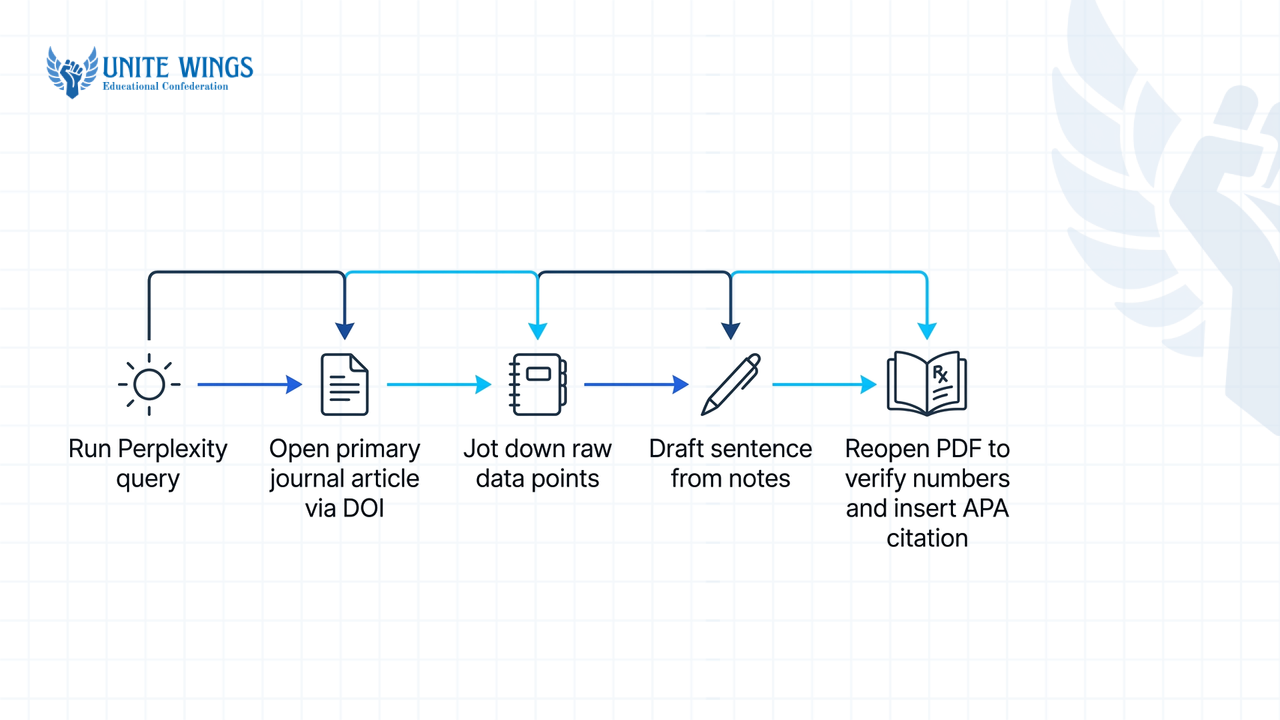
- Run your query in Perplexity with Academic Focus turned on. Ignore Perplexity's written paragraph completely; treat it only as a table of contents.
- Click the numbered citation badge to open the primary journal article via its DOI or PDF link. Check the abstract, the methodology table, and the specific results paragraph to verify that the paper actually proves what Perplexity claimed.
- Read that section of the PDF, jot down raw data points on a notepad (for example: "Sharma 2024, n=420 tier-2 engineering students, 38% drop in test anxiety, paired t-test"), and minimize both the browser and Perplexity.
- Draft your sentence from your shorthand notes, connecting it directly to your own project's argument. Vary your sentence lengths naturally—write a 28-word technical explanation followed by an 8-word blunt observation.
- Reopen the PDF to verify that you did not distort any numbers (preventing the "telephone effect" warned against in the National Law University Delhi policy), and insert the APA or IEEE citation to the human author.
| Comparison criteria | Raw Perplexity copy-paste (85% AI score) | Source-first cover-and-write (0% AI score) |
|---|---|---|
| Sample text | "Microplastics in freshwater ecosystems pose a significant threat to aquatic biodiversity [1]. Recent studies indicate that ingestion by benthic organisms leads to bioaccumulation across trophic levels, ultimately impacting human health through dietary consumption [2]. Furthermore, wastewater treatment plants in urban areas serve as primary point sources for polymeric fibers [3]." | "When we sampled effluent guidelines for our Pune river basin case study, we ran into the same pattern reported by Kumar and Verma (2024): municipal sewage plants filter out coarse debris, yet synthetic polyester fibers under 5mm pass straight through into benthic sediment. Bottom-feeding carp ingest those fibers. If local fisheries harvest from downstream stretches, those polymers enter the human diet directly (Patel et al., 2025)." |
| Why Turnitin flags or clears it | Uniform 15-to-22-word sentences, generic transition ("Furthermore"), passive transitions ("pose a significant threat", "serve as primary"), and zero course-specific context. | Mixed sentence lengths (39 words, 7 words, 18 words), active verbs ("filter", "pass", "ingest"), ties the literature to a specific student project ("Pune river basin case study"), and names authors inline. |
| Citation validity | Footnotes [1], [2], [3] often link to secondary science blogs or abstracts without page numbers. | Direct APA citations to verified primary papers after checking the exact particle size (5mm) in the PDF. |
Notice how the second version cannot be generated by a generic search summary because it anchors the external paper to the student's actual lab or case study location. Even if you are a non-native English speaker worried about the false-positive bias, anchoring sentences with concrete nouns, exact experimental metrics from the PDF, and short punchy follow-up lines breaks the uniform statistical pattern that detectors flag.
How do I disclose AI-assisted research if my Indian university asks for an AI declaration?
To disclose AI use at an Indian university, add an "AI Disclosure Statement" in your thesis methodology or declaration page stating the exact tool name (Perplexity AI), the timeframe used, and the specific auxiliary task (literature discovery and locating DOIs), while explicitly confirming that all reading, drafting, and data analysis were performed by you.
Students often panic about whether admitting to Perplexity will get their thesis rejected under national rules. Here is the exact regulatory reality in India right now: the governing national law is the UGC (Promotion of Academic Integrity and Prevention of Plagiarism in Higher Educational Institutions) Regulations, 2018. As confirmed by ResearchExperts.in and ProofAI.in, the 2018 UGC regulations enforce a four-tier text similarity framework for theses (Level 0: up to 10% similarity, Level 1: 10% to 40%, Level 2: 40% to 60%, and Level 3: above 60%), and Clause 2 explicitly excludes routine semester assignments and term papers from the central ShodhShuddhi thesis check.
However, as of 2026, the UGC has not codified a single national numeric percentage cap specifically for AI-generated text. Because there is no national number, individual central universities, IITs, and NAAC A+ colleges set their own internal rules, according to ResearchExperts.in. Some engineering departments enforce an informal 10% to 20% ceiling on Turnitin or DrillBit AI reports, while institutions like National Law University Delhi mandate a formal written declaration detailing the tool name, version, and scope of assistance. As Avloryn Labs points out, Indian universities treat undeclared AI text as academic misconduct, whereas transparent disclosure of search assistance is widely accepted.
Use this decision rule before submitting:
- If you are submitting a B.Tech/M.Tech thesis, PhD synopsis, or journal manuscript: Check your university ordinance or ask your guide if an AI declaration annexure exists. If yes, or if your college uses DrillBit/Turnitin screening, include the declaration below.
- If you are submitting a regular semester assignment: Even though UGC Clause 2 excludes coursework from ShodhShuddhi, college faculty still run Canvas or Moodle Turnitin checks. Keep a copy of the primary PDFs you downloaded and your Google Docs version history so you can prove your writing process if a false positive happens.
Copy-paste AI disclosure template for Indian university submissions:
Declaration on the Use of Generative AI Tools During the preparation of this [thesis / dissertation / project report], the author used Perplexity AI (Academic Focus mode, accessed between [Month Year] and [Month Year]) solely as an intermediary search discovery tool to locate relevant peer-reviewed journal articles and primary datasets. No text, paragraphs, tables, or analytical interpretations generated by Perplexity AI were copied or paraphrased into this manuscript. All primary sources retrieved were independently read, verified via their original DOIs/PDFs, synthesized, and written entirely by the author. The author takes full academic responsibility for the originality and factual accuracy of this work.
What to do before your next submission
Do not wait until the night before your final-year report binding or Turnitin portal deadline to clean up how you use AI. Take these three steps this week:
- Today (10 minutes): Open your current draft and highlight every citation you got from an AI chat. Click each link. If any citation points to a blog, Reddit, Wikipedia, or a dead link, open Perplexity, switch the search bar to Academic Focus, and replace that source with a verified journal paper that has a working DOI.
- This week (during your next writing session): Turn on version tracking in MS Word or use Google Docs so your keystroke history is saved automatically. Practice the cover-and-write method on three paragraphs: read the downloaded PDF, minimize the window, write from your bullet notes, and check your sentence length variety.
- Before final submission: Ask your project guide or department coordinator for the exact Turnitin/DrillBit AI threshold in your department, and paste the AI disclosure template into your front matter if your institution requires declarations.
Build a zero-plagiarism AI research workflow
If you want to cut your literature review time in half without risking a Turnitin flag, join the Research with AI: Perplexity and NotebookLM masterclass. You will walk away with a working two-tool pipeline: Perplexity configured to pull only verified academic PDFs, and Google NotebookLM set up to query your downloaded papers with exact inline page citations so you can write in your own voice.
Frequently asked questions
Does Turnitin flag text copied directly from Perplexity AI?
Yes, Turnitin flags raw text copied from Perplexity AI because the platform uses large language models like GPT-4 that produce uniform sentence lengths and predictable word choices. Even though Perplexity adds numbered citation links, Turnitin analyzes the statistical pattern of the prose itself rather than checking your bibliography.
Is using Perplexity AI considered plagiarism in Indian colleges?
Using Perplexity AI as a search engine to discover research papers is not plagiarism, provided you read and cite the original articles and write the text yourself. However, copying Perplexity's generated paragraphs without acknowledgment violates AICTE guidelines and Indian university academic integrity rules, which classify hidden AI writing as plagiarism.
Does rewriting Perplexity text with QuillBot bypass Turnitin in 2026?
No, running Perplexity output through basic synonym-swapping tools like QuillBot rarely bypasses Turnitin today. In August 2025, Turnitin deployed dedicated detection models trained specifically to spot AI-paraphrased and humanized text, meaning word-swapped AI paragraphs get flagged for both synthetic structure and patchwriting.
What is the correct way to cite a source found through Perplexity in APA format?
Under APA 7th edition guidelines, you should never cite Perplexity AI when you use it as a search tool. Instead, click the numbered reference link in Perplexity's answer, open and verify the original human-authored journal article or report, and cite that primary source directly in your reference list.
What is the UGC AI percentage limit for PhD theses in India?
As of 2026, the University Grants Commission (UGC) has not established a uniform national percentage limit specifically for AI-generated text. While the UGC 2018 regulations cap traditional text similarity at 10% for Level 0 compliance, individual Indian universities and IITs set their own internal AI detection thresholds and disclosure rules.
What should I do if Turnitin falsely flags my own original writing as AI?
Because non-native English writers using formal academic grammar face false-positive rates up to 61% on AI detectors, always draft your assignments in Google Docs or MS Word with Track Changes enabled. Show your professor your timestamped version history, your raw handwritten or typed reading notes, and the downloaded PDFs you cited.
Newsletter
Stay updated with our latest news and insights.