
Daily Routine for College Students Doing Freelancing Alongside Class
How to fit client outreach, delivery and revisions into 90 minutes a day so you earn ₹10,000–₹25,000 a month without dropping your CGPA.
A working daily routine for college students doing freelancing splits your day into three strict zones: zero client work during morning lectures, a lightweight communication batch during afternoon breaks, and a single 2.5-hour evening block for delivery. According to Padhaao.in, Indian college freelancers average 8 to 12 hours per week (roughly 1 to 3 hours daily) on client projects, which is enough for beginners to earn ₹5,000 to ₹20,000 a month (Hunarbox.in) without violating strict college attendance mandates or tanking their CGPA.
In short
- Cap your weekly hours at 8 to 12: Use a single 90-minute to 2.5-hour evening block for actual client delivery instead of working in 15-minute gaps between classes.
- Batch client replies at lunch: Answer all Slack, WhatsApp, and Upwork messages during afternoon hours, and restrict live voice calls to after 6:00 PM.
- Separate pitching from delivery: Never hunt for new gigs on heavy weekday lab days; move all cold outreach and Upwork proposals to a 2-hour Saturday or Sunday slot.
- Use the 3-Week Exam Blackout: Stop bidding on new projects two weeks before end-semester exams and finish active orders early so exam week is 100% client-free.
How many hours a day do college students need for freelancing?
College students in India need roughly 1 to 3 hours daily, totaling 8 to 12 hours a week, to run a profitable freelance side hustle (Padhaao.in). Research from StudEarning.tech and Beyond Discovery Coaching (2026) confirms that batching work into dedicated 2- to 2.5-hour blocks protects your GPA far better than scattering work across the day.
How you spend those hours determines your monthly payout. Data from Hunarbox.in and KS Verse shows that beginner students doing generalist content writing or basic data entry earn ₹5,000 to ₹20,000 per month, while student gig platform TimBuckDo reports an average student payout near ₹8,000 (ranging from ₹6,000 to ₹15,000, per JNU Jaipur). Students who use those same 10 weekly hours for technical fields like UI/UX design, full-stack web development, or AI integration scale between ₹20,000 and ₹80,000 per month (KS Verse). However, Legal Lancer India (2026) notes that localized Indian rate data has small sample sizes, so your exact hourly rate will swing based on whether you bill domestic clients in rupees or international clients on Upwork.
What most students get wrong is trying to code, edit, or write during 20-minute breaks between lectures. Switching your brain from a Data Structures lecture to a client's React bug and back to a DBMS lab ruins both your lab grade and the client's code. A 2025–2026 study by Akiflow and Kahoot found that 47% of college students already cite time management as a top-three challenge, while Gitnux (2026) reports that first-year students average 14.5 hours of study per week outside class (with 52% of undergrads studying under 10 hours). Because your academic load fluctuates between heavy engineering semesters and lighter arts or commerce timetables, use this weekday blueprint to keep boundaries tight:
| Time block | Activity | Rules and tools to use |
|---|---|---|
| 8:00 AM – 1:00 PM | Morning lectures and labs | Keep freelance notifications muted. Zero active coding or designing under the desk. |
| 2:00 PM – 5:00 PM | Afternoon admin batch | Spend time replying to client Slack/WhatsApp messages and checking Upwork notifications via your mobile device. |
| 2:00 PM – 5:00 PM | Afternoon classes or library study | Complete college assignments and lab records so your evening stays free. |
| 5:00 PM – 8:00 PM | Commute, gym, hostel dinner | Full mental reset. Do not open your laptop for client work here. |
| 8:00 PM – 10:30 PM | 2.5-hour evening delivery sprint | Close all social tabs, open your AI workflow, and finish one concrete client deliverable. |
How do I handle client calls when I am inside a college lecture?
Handle daytime client requests by setting an asynchronous communication rule before you accept the project, routing all daytime questions to text or Loom videos, and restricting live voice calls to after 6:00 PM (StudEarning.tech). If you try to step out of a lecture hall to take a 15-minute discovery call, you risk losing attendance in Indian colleges that strictly enforce attendance mandates.
During your afternoon breaks, check your messages and reply using this exact script from StudEarning.tech: "I am locked in university academic labs until 5:00 PM. Can we review specifications via chat or set up a quick sync at 6:30 PM?" Clients rarely care that you are in class; they only panic when you ghost them for eight hours without saying when you will reply.
To prevent daytime calls from ever landing on your calendar, set up three filters before a contract starts:
- Choose asynchronous gigs over live-support roles: When bidding on Fiverr (which takes a flat 20% commission) or Upwork (which charges 0% to 15% based on client billing volume, per CampusFeed.in), pick deliverables with clear written briefs like blog posts, landing pages, or YouTube edits. Reject social media manager or virtual assistant gigs that demand instant WhatsApp replies at 11:00 AM.
- Lock your booking calendar: According to Waco3.io and Lifestack (2026), automated scheduling tools like Calendly and Reclaim.ai stop back-and-forth email threads from bleeding into lecture hours. Connect Calendly to your Google Calendar and set your available meeting hours strictly between 6:00 PM and 9:00 PM IST.
- Send 3-minute Loom videos at lunch: When a client asks for a project update during class, wait until your afternoon administrative block to record a quick Loom screen-share showing progress and paste the link in Slack. A visual walkthrough answers their questions faster than a live call.
When should a student freelancer pitch new clients vs deliver work?
Student freelancers should deliver client work during weekday evening blocks (Monday to Friday, 8:00 PM to 10:30 PM) and push all new client pitching, portfolio updates, and proposal writing to a dedicated weekend block (StudEarning.tech). Mixing cold outreach with active delivery on a Tuesday night guarantees you will spend 90 minutes scrolling job boards and zero minutes finishing the deliverable you are actually getting paid for.
India's gig economy is growing fast: the India Skills Report 2026 (prepared by ETS, CII, AICTE, AIU, and Taggd) projects the gig workforce will reach 23.5 million by 2030 alongside a 56.35% youth employability rate, while Redseer Strategy Consultants estimates today's 6 million active gig workers will hit 17 to 21 million by 2030 (JNU Jaipur). With roughly 60% of Indian freelancers under age 30 and the market projected to grow from $7.3 billion to $50.4 billion by 2032 (I-Gauge), competition on entry-level gigs is stiff. Note that while Fiverr allows accounts at age 13+ with parental consent, Upwork and Indian portals like Internshala require you to be 18+ for payouts.
Keep your pipeline full without burning weekday study hours by following this weekly split:
- Monday to Friday (8:30 PM – 10:00 PM) is for paid execution: Log your hours using free trackers like Clockify or Toggl Track (recommended by Waco3.io and Lifestack, 2026) so you see exactly how long a ₹2,000 article or ₹5,000 landing page takes you. If you have no paid client work on a Wednesday night, spend that 90-minute block studying for college internals or building one portfolio sample.
- Saturday (10:00 AM – 12:00 PM) is for pitching: Send 5 to 10 targeted proposals. On Upwork, use their built-in AI assistant, Uma, to synthesize long job descriptions and draft your initial proposal structure (Upwork), then rewrite the first two lines manually to reference the client's specific company.
- Sunday (6:00 PM – 6:30 PM) is for taxes and invoicing: Track every rupee in a simple Google Sheet. Under Indian tax law, freelance earnings count as business or professional income (CampusFeed.in). While you do not need GST registration until your annual turnover crosses ₹20 lakh, if your total annual income crosses the basic taxable threshold, you must file using ITR-4 under Section 44ADA (CampusFeed.in). Section 44ADA is a lifesaver for students: it lets eligible professionals declare 50% of gross receipts as taxable net income, automatically writing off the other 50% as expenses without keeping paper receipts.
How do I pause freelance work during university semester exams?
Pause your freelance workload by following the "3-Week Exam Blackout" rule: stop bidding on or accepting any new projects two weeks before your semester exams begin, finish all active orders during that two-week buffer, and keep your actual exam week completely free of client deadlines (StudEarning.tech and The Student Entrepreneur). A ₹3,000 gig is never worth an academic backlog that impacts your campus placements.
Follow this four-step timeline every semester so you never have to choose between a client deadline and an engineering or degree exam:
- Week 1 of the semester (Calendar Blocking): Before you take on a single retainer client, take your university academic calendar and mark every internal assessment, lab viva, and end-semester exam window in red on Google Calendar (Jobbers.io, 2026).
- 21 days before exams (Retainer Notice): Message your recurring clients three weeks ahead (or at least one week before small mid-terms, per Beyond Discovery Coaching, 2026). Use this exact template: "Hi [Client Name], my university semester exams run from [Start Date] to [End Date]. To make sure your schedule isn't disrupted, I can deliver all of next month's [articles/designs/edits] early by [Date 1 week before exams], or we can pause billing for those 10 days and resume on [Date after exams]. Which works better for you?"
- 14 days before exams (The Pitch Freeze): Turn on the "Unavailable" badge on Upwork and activate Out of Office mode on Fiverr. Deliver the final drafts of all ongoing projects so you have zero open revision loops when your first exam paper starts.
- Exam week: Delete Slack and Upwork from your phone for seven days. Clients who respected your three-week notice will wait for you; clients who demand edits during your university finals are clients you should fire anyway.
How can AI tools cut my freelance delivery time in half on busy college days?
Using a targeted stack of free AI tools—Perplexity for source gathering, Claude for long-form drafting and code, ChatGPT for brainstorming, and Canva AI for layouts—cuts routine research and writing time by 40% to 50% (Jobbers.io, Enterprise DNA, and NextGenZ). That speed lets you compress a 3-hour deliverable into a single 90-minute evening sprint after a tiring day of labs.
Furthermore, the Upwork Future Workforce Index (2026) found that freelancers doing AI-related work earned 34% more per hour than those who did not. However, watch out for the subscription trap: buying four $20/month AI Pro plans costs ₹6,800 a month, which wipes out most of a beginner student's ₹8,000 monthly profit. Stick to the free tiers of these tools (Quora) and use them only where they actually save time—AI speeds up first drafts and boilerplate code by 40%, though deep technical debugging or custom creative edits still require manual work.
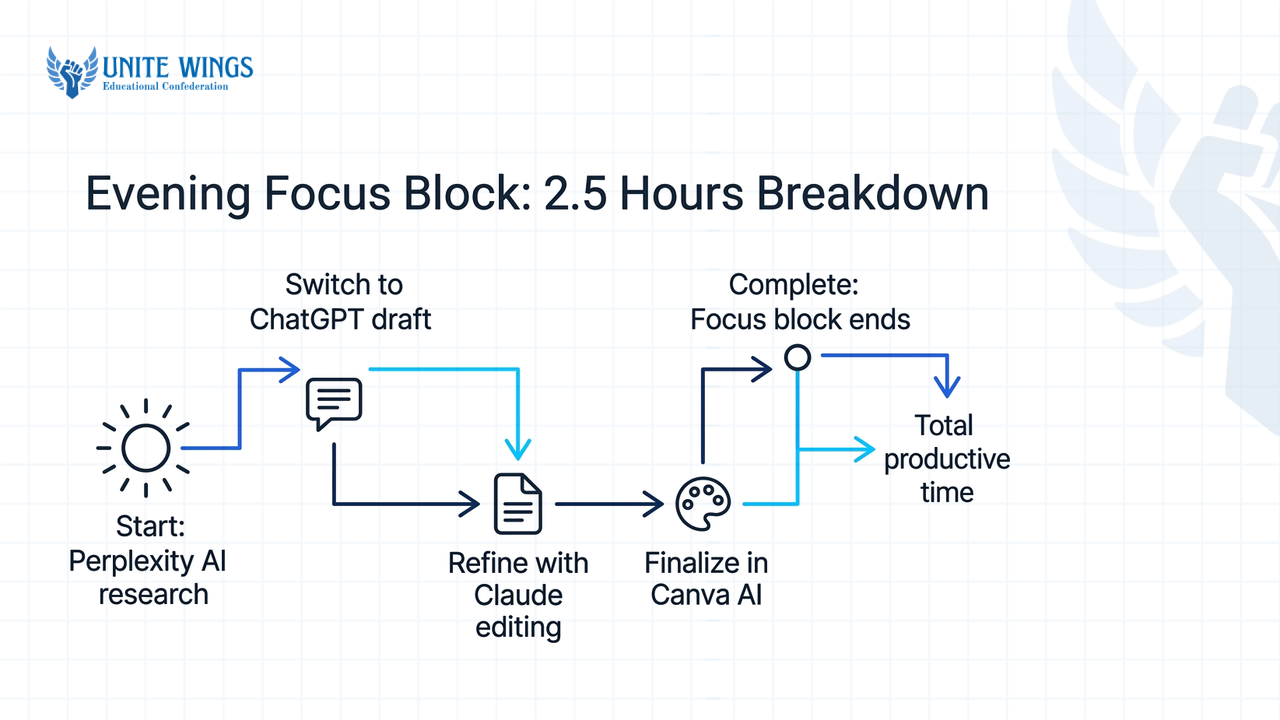
Here is how to run a 2.5-hour evening focus block (8:00 PM to 10:30 PM) using free AI assistants:
- 8:00 PM – 8:15 PM (Research without tab clutter): Open Perplexity AI instead of multiple Google tabs to pull cited facts, competitor links, or documentation for your client brief (Enterprise DNA). If you need to synthesize heavy PDFs alongside web sources for a technical client, our Research with AI: Perplexity and NotebookLM session walks through the exact two-tool workflow.
- 8:15 PM – 10:00 PM (First draft or code build): Use ChatGPT to brainstorm hooks or campaign angles, then switch to Claude for long-form writing or front-end code generation, where its reasoning handles complex briefs with less robotic phrasing (NextGenZ). If your gig involves social media carousels or presentation decks, use Canva AI (Magic Design) to generate the base layout in five minutes.
- 10:00 PM – 10:30 PM (Human polish and automation): Spend the final 30 minutes rewriting awkward sentences, testing code, and verifying every number so the client gets human-grade work. Use free tiers of Zapier or Make (Jobbers.io, 2026) to automatically log finished client form submissions into your tracking sheet.
How to set up your student freelance routine this week
Do not wait for a free semester to start. Set up your guardrails in the next seven days so your first client project fits neatly around your college timetable:
- Tonight (30 minutes): Open Google Calendar and block your morning lectures, your afternoon communication window, and a recurring 8:00 PM – 10:30 PM delivery sprint from Monday to Thursday. Mark your next internal and semester exam dates and count back 14 days to set your "Pitch Freeze" reminder.
- This Wednesday (45 minutes): Create a free Calendly account locked to 6:00 PM – 8:30 PM IST, install Clockify on your browser, and set up free accounts on Claude, Perplexity, and Canva.
- This Saturday (2 hours): Build one sample piece during your morning pitching block and send five tailored proposals on Upwork or Internshala using the asynchronous rules above.
Get your first paying client without burning out
If you want a step-by-step system to land a beginner project and deliver it in evening sprints, join the Freelance with AI masterclass. You will learn how to pick a low-overhead skill, find one small client, use AI assistants to cut your delivery time, and earn your first verified testimonial while keeping your college grades intact.
Frequently asked questions
How many hours a day should a college student spend on freelancing?
College students in India should spend roughly 1 to 3 hours daily on freelancing, adding up to 8 to 12 hours per week (Padhaao.in). Batching those hours into a single evening block between 8:00 PM and 10:30 PM lets you complete client deliverables without cutting into morning lectures or exam prep.
How do I handle client calls when I am trapped inside a college lecture?
Never answer live voice calls during lectures; instead, set an asynchronous communication rule upfront and reply during your afternoon break (StudEarning.tech). Send a message stating you are in university labs until 5:00 PM, offer to review details over chat or a Loom video, and schedule voice calls after 6:00 PM.
Do college students in India need to pay income tax or register for GST on freelance earnings?
Indian students do not need GST registration until annual freelance turnover crosses ₹20 lakh (CampusFeed.in). However, freelance earnings count as professional income, so if your total annual income exceeds the basic tax exemption limit, you must file ITR-4 under Section 44ADA, which lets you automatically write off 50% of gross receipts as expenses.
How much can a beginner college student earn from freelancing in India?
Beginner student freelancers in India typically earn ₹5,000 to ₹20,000 per month (Hunarbox.in), with student gig platforms like TimBuckDo reporting an average payout near ₹8,000 (JNU Jaipur). Students who move from basic writing into technical niches like UI/UX design, web development, or video editing scale to ₹20,000 to ₹80,000 per month.
How do I pause freelance work during university semester exams without losing clients?
Use the 3-Week Exam Blackout rule: stop bidding on new gigs two weeks before exams start and finish ongoing tasks early (StudEarning.tech). Message recurring clients three weeks before exams, offering either to deliver the next batch of work early or to pause billing until your final paper ends.
What are the best free AI tools to speed up freelance work for students?
Combine the free tiers of Perplexity AI for cited web research, Claude for long-form writing and coding, ChatGPT for brainstorming, and Canva AI for graphic layouts (Enterprise DNA). Using these tools together cuts routine research and drafting time by up to 40% to 50% without costing you monthly subscription fees.
Newsletter
Stay updated with our latest news and insights.