Cold Emailing for First Freelance Clients: A Guide for Indian Students
A step-by-step cold outreach playbook for Indian students to skip Upwork bidding wars and pitch D2C brands, agencies, and YouTubers for their first ₹10,000 gig.
Sending a cold email for freelance work for college students in India gets you paid faster than competing against dozens of other sellers on Upwork or Fiverr. Instead of waiting for an algorithm to show your zero-review profile to a buyer, you pick a D2C brand, creator, or agency and email them a "Permissionless Sample" consisting of one reworked Instagram Reel script, a redesigned landing page section, or a brief blog outline attached directly inside an email under 120 words. You keep 100% of your fee instead of losing 10% to 20% in marketplace commissions, and you build an independent portfolio that belongs to you before campus placements even start.
In short
- Skip Fiverr's flat 20% cut and Upwork's 0% to 15% fees by emailing founders and marketing managers directly from a secondary custom domain, keeping spam complaint rates under 0.30%.
- Bypass the zero-review trap with a Permissionless Sample: send 1 edited short video clip, 1 social media graphic mockup, or 1 hero-section rewrite in your first email rather than asking for a call.
- Quote fixed project packages instead of beginner hourly rates (which sit at ₹300 to ₹1,000 per hour domestically, or $15 to $30 per hour for overseas clients) so prospects judge the output, not your college year.
- Collect a 30% to 50% advance before starting work, and use RBI-authorized platforms like Skydo, Razorpay MoneySaver, or Wise Business with the right RBI purpose code (such as P0802 or P1006) to download your mandatory eFIRA.
Why is cold emailing better than Upwork or Fiverr for beginner student freelancers?
Cold emailing is better for beginner students because you keep 100% of your project fee, choose your exact buyers, and avoid competing against thousands of veteran profiles. According to jobbers.io, Fiverr deducts a flat 20% commission on your earnings and Upwork takes 0% to 15% plus paid "Connects" tokens just to submit a proposal. On cold email, a ₹10,000 project puts ₹10,000 in your bank account.
Marketplaces trap beginners in a catch-22: you need reviews to win gigs, and you need gigs to get reviews. Platform advocates argue that Upwork and Fiverr are still simpler for absolute beginners because buyers there have immediate intent to hire. That works once you have five-star ratings, but as a second-year student with an empty profile, you are forced to bid $4 an hour just to get noticed. As spacesales.agency notes, cold email lets you manufacture demand by picking specific companies that aren't actively shopping on marketplaces and showing them a fix for a visible flaw.
You also own the relationship. Client testimonials and work history built on Upwork stay locked inside Upwork's platform, as pointed out by smartremotegigs.com. When you close a D2C founder or a marketing agency over email, their LinkedIn recommendation, video testimonial, and case study sit on your personal portfolio site as proof you can also show to campus placement panellists.
| Feature | Upwork / Fiverr | Direct Cold Emailing |
|---|---|---|
| Platform Commission | 10% to 20% per project (plus Connects cost on Upwork) | 0% (you keep 100% of the contract value) |
| Competition per Gig | Dozens of bidders visible on the same job post | Only you in the founder's inbox at that moment |
| How Beginners Win | Slashing prices to ₹300/hr ($4/hr) to get a first review | Sending a custom Permissionless Sample upfront |
| Portfolio Ownership | Reviews stay locked inside the marketplace account | Testimonials go directly on your LinkedIn and website |
| Buyer Intent | High (actively looking, comparing multiple cheap bids) | Manufactured (triggered by spotting a broken asset) |
What most students get wrong is sending 100 copy-pasted emails from their personal @gmail.com college address on day one. Google's spam filters flag bulk outreach from free personal accounts, and if your primary email gets blacklisted, you stop receiving college exam circulars and placement alerts. Buy a cheap secondary domain (for example, if your name is Rohan Sharma, register rohancreates.in), set up SPF and DKIM authentication records in your DNS settings, and keep your spam complaint rate strictly below 0.30%, as recommended by spacesales.agency.
Which 5 freelance services are easiest for Indian students to pitch via cold email?
The five easiest services for Indian college students to pitch over cold email are short-form video editing, graphic design, content writing, social media management, and landing page web development, according to notesly.in and Gromo's 2026 beginner freelance reports. A fourth-skill alternative for non-technical students is virtual assistance. These services work best for cold outreach because a prospect can judge your skill in 10 seconds by looking at a visual sample.
Pick one of these five based on what you can produce in two hours between college lectures:
- Short-form video editing (Reels, YouTube Shorts, podcast clipping): Download a founder's raw 20-minute YouTube video, cut the sharpest 45-second insight, add dynamic captions and B-roll, and send them an unlisted Google Drive link. If you want to target US creators or Indian finance YouTubers, pick this.
- Graphic design (Canva and Figma social assets): Audit a D2C skincare or food brand's Instagram grid or Amazon product graphics. Redesign one cluttered promotional post or a 5-slide LinkedIn carousel in Figma or Canva. You can speed up the layout work using the workflows in our Canva AI Masterclass.
- Content writing (SEO blogs and email newsletters): Find a B2B SaaS startup whose blog hasn't been updated in three months, or whose newsletter signup yields no welcome email. Draft a 1-page outline for a missing competitor-comparison article or write their first welcome email sequence.
- Social media management (and Virtual Assistance): Pitch busy agency founders or solo coaches who post inconsistently. Offer to repurpose their existing long-form blogs into 12 scheduled X (Twitter) threads and LinkedIn posts per month, or manage their inbox and calendar scheduling as a virtual assistant.
- Web development (WordPress, Webflow, or landing page builds): Look for local businesses, coaching institutes, or funded seed startups with slow, non-responsive mobile pages. Rebuild just the above-the-fold hero section with a clearer call-to-action button and send a short screen-recording video comparing their current mobile view with your rebuild.
Decision rule: if you need money within 30 days and have zero technical background, start with video clipping or Canva carousel design because every creator and D2C brand needs daily volume. If you want higher single-ticket payouts and know basic layout logic, pitch landing page rebuilds.
How do I pitch a freelance client when I have zero past client testimonials?
You bypass the zero-testimonial problem by using the "Permissionless Sample" method to send a custom micro-demonstration directly in your first email, kept under 120 words. As a 2026 medium.com guide on beginner outreach explains, when you don't have client reviews, you climb a "Proof Ladder" built on four pieces: a specific observation about their business, a relevant sample, a micro-demonstration done for them without asking permission, and a low-risk next step.
According to alexberman.com, generic cold emails offering vague "growth services" get ignored, leaving average cold email reply rates between 1% and 5% (Upwrite, 2026). When you point out a visible business flaw and attach the fix, personalized campaigns can push positive reply rates between 15% and 30%.
Follow this 4-step workflow to send 5 hyper-targeted pitches a day:
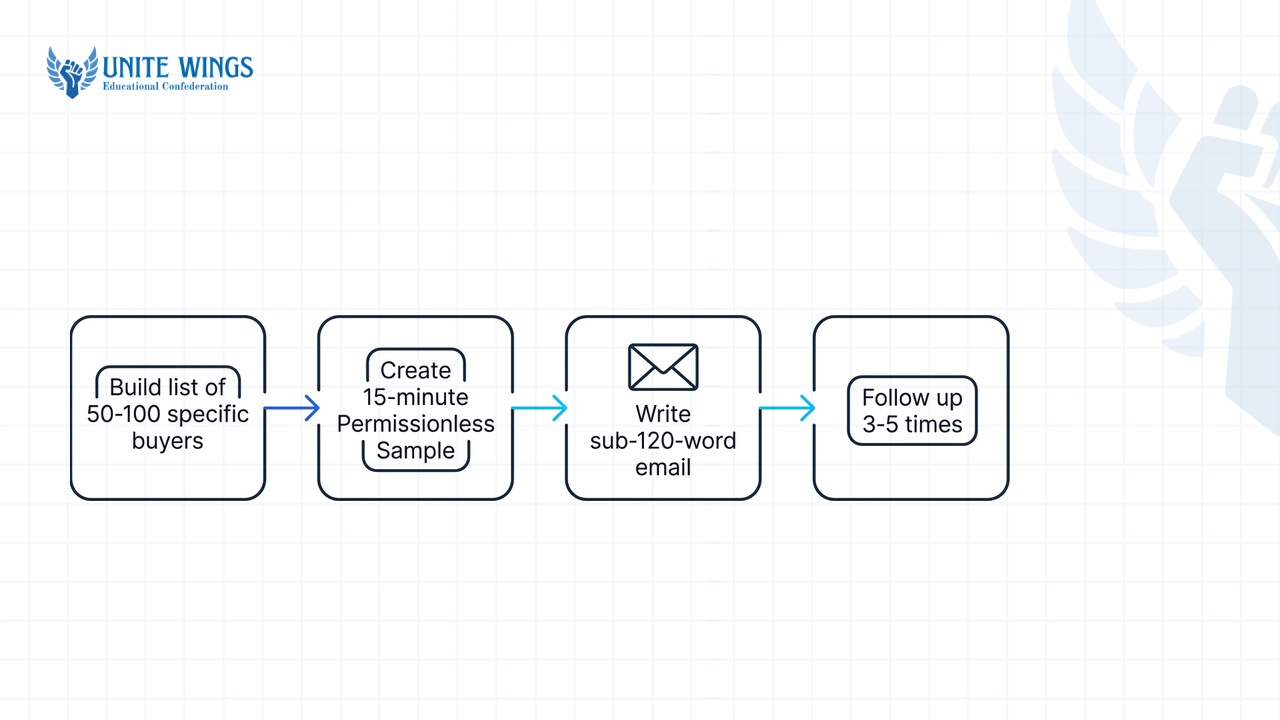
- Build a list of 50 to 100 specific buyers: Skip Fortune 500 companies. Look for local agencies, small SaaS startups, or content creators matching your chosen service niche. Find the founder or Head of Marketing's direct business email.
- Create a 15-minute Permissionless Sample: Do not build a full website or edit a 20-minute video for free. Spend 15 to 20 minutes creating a micro-proof: rewrite the headline and sub-headline of their landing page, edit a single 30-second vertical clip from their latest podcast, or mock up two slides of a LinkedIn carousel.
- Write a sub-120-word email: Leadomos's 2026 cold email research confirms that beginner emails perform best under 120 words. Cut your name, college name, branch, and year from the opening line. Open with the flaw you noticed, drop the sample link, and end with a low-friction question.
- Follow up 3 to 5 times: Most founders read your first email on their phone while commuting and forget to reply. Space 3 to 5 brief follow-ups three days apart; Leadomos data shows a large share of positive replies come from follow-ups rather than email one.
Copy and adapt these two templates:
Template 1: Pitching short-form video editing to a creator or coach
Subject: Quick edit from your latest podcast with [Guest Name]
Hi [First Name],
Loved the point you made at the 14:20 mark in Tuesday's YouTube episode about [specific topic] because it is a great hook that has not been clipped for Reels or Shorts yet.
I cut that 40-second segment into a vertical clip with captions and B-roll so you can see how it looks: [Unlisted Drive/Frame.io Link].
Feel free to post it today, no charge. I have 3 more timestamps from that same episode that would work well as Shorts. Want me to send those over too?
Best, [Your Name]
Template 2: Pitching content writing or landing page copy to a D2C/SaaS founder
Subject: Quick question about [Brand Name]'s welcome email / blog
Hi [First Name],
I signed up for [Brand Name]'s newsletter yesterday and noticed there's a 48-hour gap before the first email hits, and the blog hasn't covered [Specific Customer Pain Point] yet.
I drafted a 250-word welcome email and a 3-point outline for a comparison post that targets buyers searching for [Keyword]. Put both in a view-only Google Doc here: [Link].
Open to taking a 30-second look to see if the tone matches your brand?
Cheers, [Your Name]
What most students get wrong is crossing the line from a strategic Permissionless Sample into unpaid labour. If a founder replies, "This looks nice, can you edit 4 more videos for free so we can test your consistency before signing a contract?", say no. Your 30-second clip is the proof of concept. For any extra test work, reply: "Happy to do a single trial reel at a flat ₹1,000 test rate before we lock in a monthly pack."
How should a college student price their first freelance project in a cold email?
Never quote an hourly rate in your cold email; quote a flat project or monthly package price after the prospect replies positively to your sample. According to xflowpay.com, beginner freelance rates in India sit between ₹300 and ₹1,000 per hour ($4 to $12 USD) for entry-level domestic work, while Fueler's 2026 estimate puts beginner content writing at ₹0.50 to ₹1.50 per word. However, quoting hourly or per-word rates upfront invites clients to compare you against the cheapest bidders on Fiverr.
When you quote a fixed deliverable such as "₹8,000 for a pack of 8 edited Reels" or "$200 for 4 SEO blog posts", the client pays for the business outcome rather than counting how many hours you spent in your hostel room. If you pitch overseas startups or agencies in the US, UK, or Australia, thesoloentrepreneur.in notes that beginner rates of $15 to $30 per hour (converted into fixed package prices) yield 3x to 5x higher earnings than domestic Indian SME budgets because of currency conversion.
To make sure you don't undercharge on fixed packages, calculate your internal floor rate first using the formula from dealinsec.com and Xflow:
Base Hourly Floor Rate = (Monthly Personal Expenses + Target Savings) / Realistically Billable Hours per Month
Because you are a full-time college student with attendance rules, mid-sems, and lab practicals, you do not have 160 billable hours a month. Even freelancers working full-time often manage only 80 billable hours out of 160 after accounting for admin and outreach. As a student, estimate 40 billable hours per month (10 hours a week).
Here is a worked example for a third-year engineering or arts student:
- Monthly hostel/PG expenses + phone/Wi-Fi + target savings: ₹16,000
- Realistic billable hours per month during a regular semester: 40 hours
- Base hourly floor: ₹16,000 / 40 = ₹400 per hour
- Add a 25% buffer for software, taxes, and payment gateway fees: ₹500 per hour.
If a 4-blog package or a 10-Reel bundle will take you 12 hours of actual work across the month, your minimum project quote is 12 hours × ₹500 = ₹6,000 for an Indian client, or $180 to $250 for an international client. State this price only after they reply to your cold email asking, "How much do you charge for this?" In our Freelance with AI masterclass, we show you how to use AI tools to cut that 12-hour production time in half while keeping your flat package fee the same.
How do I take payments safely in India after a client replies yes?
To collect payments safely in India, lock in a written scope with a 30% to 50% upfront advance before starting work, and use an RBI-authorized cross-border gateway for foreign clients so you receive a digital Foreign Inward Remittance Advice (eFIRA). As caba.in and dealinsec.com confirm, taking 30% to 50% upfront is standard beginner practice and filters out bad-faith clients who vanish after receiving the final Google Drive folder.
Follow these 4 steps the moment a client agrees to your price:
- Send a 5-line scope confirmation email: You do not need a 10-page legal contract for a ₹10,000 gig. Reply with an email specifying: exact deliverables (e.g., "8 vertical videos under 60 seconds"), delivery timeline ("2 videos every Friday"), revision limit ("Up to 2 rounds of revisions per video; extra revisions at ₹500 each"), total fee, and payment split ("50% advance to start, 50% upon final watermarked preview").
- Collect domestic Indian payments: Use UPI, NEFT, or IMPS directly into your PAN-linked savings account, or generate a domestic payment link via Razorpay.
- Collect international payments via PA-CB platforms: When a US or UK client asks for your PayPal or bank wire details, know the hidden costs. According to xflowpay.com and skydo.com, PayPal and traditional Indian bank SWIFT transfers charge high foreign exchange markups on top of transaction fees. Instead, sign up for an RBI-regulated Payment Aggregator - Cross Border (PA-CB) platform such as Skydo, Razorpay MoneySaver, PayGlocal, or Wise Business using your PAN card and Indian bank account. They give you local US/UK receiving accounts or payment links with mid-market forex rates. (Gateway fee structures change periodically, so check the live pricing calculator on Skydo or Razorpay before invoicing).
- Select the right RBI Purpose Code and download your eFIRA: Under FEMA and RBI rules detailed by jiopay.in and wisemonk.io, every foreign inward payment must pass through an Authorised Dealer (AD) Category-I bank or PA-CB platform with a valid RBI purpose code, for example
P0802for software and IT implementation/web services, orP1006for business and management consultancy. Once the money settles in your Indian bank, download the electronic Foreign Inward Remittance Advice (eFIRA / e-FIRC) from your dashboard and save it in a folder for income tax filing.
Two recent regulatory updates make foreign freelancing much simpler for Indian students in 2026. First, an RBI amendment reported by wisemonk.io (effective November 14, 2025, single source) extended the timeline for realizing export proceeds from 9 months to 15 months from your invoice date. Second, under the Foreign Exchange Management (Export and Import of Goods and Services) Regulations, 2026 (effective October 1, 2026, reported by businesstoday.in), individual service-exporting freelancers are exempt from filing a separate Export Declaration Form (EDF) for foreign remittances. And regarding GST: GigOrbit's 2026 pricing guide confirms that GST registration for service providers in India is mandatory only when your annual turnover crosses ₹20 lakh, so you do not need a GST number to land your first few college clients.
What to do this week to land your first client
NITI Aayog's gig economy reports, cited by caba.in, project India's gig workforce to grow from 77 lakh in 2020–21 to 2.35 crore by 2029–30. To get your first paying client before next month's mid-semester exams, follow this 7-day schedule:
- Days 1–2 (Infrastructure and list): Pick one service from the top five (video clipping, Canva design, blog writing, social management, or landing pages). Set up a clean outreach email on a secondary domain with SPF/DKIM enabled, and build a Google Sheet of 50 D2C brands, SaaS startups, or creators with verified founder emails.
- Days 3–5 (Permissionless Samples): Spend 2 hours each evening making 5 micro-samples (15 minutes per sample) and sending 5 under-120-word cold emails. By Friday night, you will have 15 custom pitches out.
- Days 6–7 (Follow-ups and KYC): Send your first 2-line follow-up to the Day 3 batch, and complete your basic PAN and bank KYC on Skydo or Razorpay so your payment link is ready the moment someone replies "How much?"
Shortcut your first client win
If you want help picking your service, building your Permissionless Sample in half the time, and writing outreach emails that get replies, join our Freelance with AI masterclass. You will walk away with a ready-to-send client pitch, an AI-assisted delivery workflow to finish client work between college classes, and a step-by-step playbook to earn your first paid testimonial.
Frequently asked questions
Do I need a GST number or company registration to start freelancing as a student in India?
No, you do not need a GST number or company registration to start freelancing as a college student. In India, GST registration for service providers is mandatory only after your total annual turnover crosses ₹20 lakh. Until then, you can invoice clients as an individual using your personal PAN card and savings bank account.
How many cold emails should a college student send daily to get their first client?
Send 5 to 10 researched cold emails per day containing a custom Permissionless Sample, aiming for a list of 50 to 100 prospects over two weeks. While generic mass emails see a 1% to 5% reply rate, personalized pitches pointing out a specific business flaw can achieve 15% to 30% positive replies when paired with 3 to 5 follow-ups.
Is it possible to get freelance clients via cold email without a portfolio website?
Yes, you can land clients without a portfolio website by putting your proof directly inside the email. Attach a Google Drive link to a 30-second edited video clip, a view-only Google Doc with a blog draft, or a Figma link showing a redesigned social post. Clients care about what you made for their brand, not a multi-page website.
How can Indian students receive USD payments from foreign clients without losing money to high fees?
Use an RBI-authorized cross-border platform like Skydo, Razorpay MoneySaver, PayGlocal, or Wise Business instead of PayPal or traditional bank SWIFT wires. These platforms convert USD at mid-market rates with transparent fees, let you select the mandatory RBI purpose code (like P0802 or P1006), and automatically generate your eFIRA for tax compliance.
What should I do if a prospect asks for more free samples after seeing my cold email?
Politely decline extra unpaid work and offer a small paid trial instead. Your initial 30-second video clip or 1-section rewrite is the only free proof of concept you provide. If they want a full video or complete article to test you further, quote a flat single-piece trial rate and collect 50% upfront before starting.
Can I send cold emails from my regular personal Gmail or college email ID?
Do not use your college .edu or .ac.in address, and avoid sending bulk outreach from your primary personal @gmail.com account. Free personal inboxes trigger spam filters easily, and getting flagged can block your important academic and placement emails. Buy a cheap secondary custom domain, configure SPF and DKIM records, and keep spam complaints below 0.30%.
Newsletter
Stay updated with our latest news and insights.