
25 Opening and Closing Lines for Student Presentations in English
Drop 'Today my topic is' for good. 25 word-for-word English opening hooks, slide transition lines and Q&A handoffs for seminars, vivas and interviews.
If you want to know how to start and end a presentation in English for students without freezing up, stop opening with "Respected faculty and my dear friends, my name is..." and start with a one-sentence problem, question, or number instead. Delaying your personal introduction until after a 20-second hook grabs attention right away, according to Life Is a Speech. At the end, replace the abrupt "That's all, thank you" with a three-part close: a signpost phrase, a one-line takeaway, and a direct invitation for questions.
In short
- Keep your self-introduction to 10 to 20 seconds (roughly 5% of your total speaking slot) and place it after your opening hook.
- Never say "Next slide" to your laptop user; use bridge phrases like "This brings me directly to..." while clicking the remote yourself or nodding to your partner.
- In group project evaluations, each speaker should end their part by naming the next speaker and their topic, plus physically gesturing toward them.
- If you blank on an English word mid-slide, pause, take a breath, and use the two-clue method: give a short filler plus the broad category of the word.
- Close every talk with a clear summary signal followed by "Thank you for your attention, I'm happy to take any questions."
Why your college presentation habits affect your placement rounds
Fixing your classroom presentation habits matters right now because campus recruiters evaluate communication and presentation skills as top desired core competencies for freshers and early-career candidates. According to NASSCOM, India's Global Capability Centres (GCCs) leased a record 9 million square feet of office space in early 2026, creating heavy demand for freshers with cross-functional presentation and communication skills.
World Economic Forum and LinkedIn datasets cited by NASSCOM show that gaps in analytical and presentation skills directly hurt corporate placement readiness for Indian graduates, while an earlier 2022 Statista and NASSCOM survey found that over 57% of workplace respondents rank listening and speaking as the most critical soft skills in corporate setups.
What most Indian students get wrong is treating a semester seminar like a school elocution competition. You memorise heavy sentences or copy archaic greetings like "Good morning to the esteemed panel," and when you forget one adjective under pressure, your entire flow collapses. Up to 80% of speakers experience public speaking anxiety, according to Preply, so the fix is not trying to "be confident." The fix is memorising short, functional English sentence frames that hold your thoughts together even when your hands are shaking.
| Stage of talk | Weak Indian-classroom cliche | Natural, simple English upgrade |
|---|---|---|
| Greeting | "Respected faculty, HOD sir, and my dear friends, a very good morning to one and all present here." | "Good morning, everyone." |
| Opening line | "Today I am standing before you to give a presentation on the topic of..." | "What would the tech industry look like if 50% of jobs were done by AI? Today, I'll show you..." |
| Apologising | "Sorry, I'm a bit nervous today / Sorry, this slide has too much text." | (Say nothing. Pause, take a breath, and state the main point of the slide.) |
| Moving slides | "Next slide please... next slide." | "Now that we've looked at the problem, let's turn to the data." |
| Group handoff | "Now my friend Rahul will come and tell the rest." | "To walk you through the testing phase, I'll hand over to my colleague, Rahul." |
| Ending | "That's it from my side. Thank you." | "To sum up, our model cuts processing time by half. Thank you for listening, I'm happy to take any questions." |
How do you start a college presentation without saying 'My name is' first?
To start a college presentation without saying "My name is" first, open with a 15-to-20-second hook using a specific scenario, a bold question, or a problem your classmates already feel, and state your name only before giving your roadmap. Communication coaches at Life Is a Speech note that starting immediately with "Hi, my name is..." is one of the least engaging ways to begin a talk. Keep your actual self-introduction to 10 to 20 seconds, or roughly 5% of your total speaking slot, according to a 2026 guide from The Orator App.
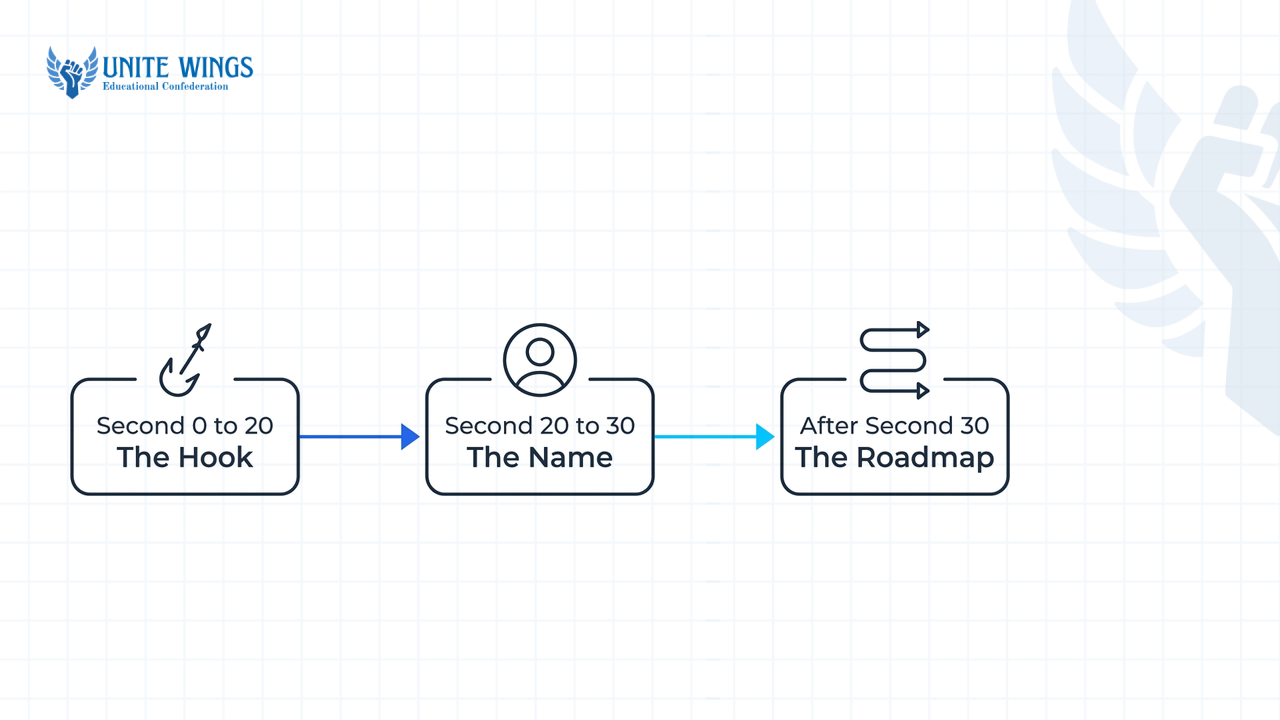
Here is the exact 3-step formula for your first 30 seconds:
- Second 0 to 20 (The Hook): Drop the audience into a small scene, ask a question, or state a problem.
- Second 20 to 30 (The Name): Give your name and your role or project group.
- After Second 30 (The Roadmap): Use sequencing words like "Firstly, Secondly, Finally," recommended by the British Council to help non-native English speakers guide listeners, to state what your talk covers.
Also, cut out opening apologies. Professional guidelines from Life Is a Speech warn against starting with lines like "I'm a bit nervous" or "Sorry, this is a bit rambly," because they immediately lower the evaluator's expectations of your work. If your college department strictly forces a traditional format where you must state your name and roll number on the title slide, say "Good morning, I'm Ananya, Roll Number 14," pause for two full seconds, and launch straight into Hook #1 below.
Copy and adapt any of these 10 opening lines for your next college seminar or placement presentation:
- The Question Hook (from Preply): "What would the tech industry look like if 50% of jobs were done by AI? I'm Rohan, and today we are looking at which tasks automation actually replaces."
- The Daily Problem Hook: "Have you ever tried booking a tatkal ticket at 10 AM and watched the payment page freeze? I'm Priya, and our final-year project solves database crashes during peak traffic."
- The Specific Scene Hook: "Imagine waking up during exam week to find your hostel Wi-Fi is down and your notes are locked in the cloud. I'm Aman, and today I'll show you how our offline sync app prevents this."
- The Surprising Number Hook: "Every day, our college canteen throws away 40 kilos of untouched food. My name is Sneha, and over the next five minutes, I will walk you through our hostel waste-tracking system."
- The Direct Contrast Hook: "Most students spend four hours writing a lab report and ten minutes checking the data. I'm Vikram, and today I'll explain why reversing that ratio improves accuracy."
- The Industry Shift Hook: "Three years ago, writing boilerplate code took half a sprint; today, it takes thirty seconds. I'm Kavya, and I've divided this talk into three parts to show how testing has become the real bottleneck."
- The "Raise Your Hand" Hook: "Quick show of hands, how many of you read the terms and conditions before installing a UPI app?" I'm Siddharth, and today I'm breaking down the hidden data permissions in Indian fintech apps."
- The Bold Claim Hook: "Electric vehicles in India are only as clean as the coal plants charging them. I'm Meera, and my presentation looks at solar micro-grids for campus charging stations."
- The Cost Hook: "A single server outage costs a mid-sized e-commerce company lakhs of rupees every minute. I'm Arjun, and today I'll show you how our load-balancing script cuts recovery time."
- The Three-Part Roadmap Opener: "Why do 70% of student startups shut down before graduation? I'm Neha, and I'll answer that today: firstly by looking at team splits, secondly at funding gaps, and finally at how to build a working prototype in one semester."
What are 5 simple English phrases to move from one slide to the next?
Five simple English phrases to move from one slide to the next are: "Now that we've looked at X, let's turn to Y," "This leads me directly to...", "This brings me to my next topic," "Let's move on to...", and "To walk you through the next part...". Communication trainers like Teacher Lisa on YouTube point out that signposting phrases act as verbal bridges between sections, stopping the amateur habit of saying "Next slide" like a command to a computer.
When you say "Next slide, please" to a classmate sitting at the teacher's desk, you break your own train of thought and remind the external examiner that you are reading from a deck. Instead, agree on a visual cue with your laptop operator before the presentation starts by nodding your head at the end of a sentence or using these exact signposting bridges as their trigger to press the spacebar.
Here are 5 plug-and-play slide transition lines drawn from Angielski.pl, GetFluently, and Talaera, along with when to use each one:
- Moving from problem to solution (Line #11): "Now that we've looked at [the current server delay], let's turn to [how our caching layer fixes it]."
- Connecting cause and effect (Line #12): "This leads me directly to [the cost breakdown on this chart]."
- Shifting to a completely new section (Line #13): "This brings me to my next topic: [how we tested this survey across 200 students]."
- Keeping a fast pace in short slots (Line #14): "Let's now move on to the next point, which is [our hardware limitations]."
- Zooming in on a diagram or table (Line #15): "To walk you through [this architecture diagram], let's start at the top left box."
If your slides are packed with full paragraphs of copied Wikipedia text, you will end up turning your back to the room and reading them aloud, which is one of the top classroom mistakes flagged by New Age World School. If you want to build clean visual decks with three bullets per slide so you don't have to read off the wall, check out our Canva AI Masterclass.
How do you introduce your group members smoothly in a team presentation?
To introduce your group members smoothly in a team presentation, briefly recap your own section in one sentence, state the next speaker's name and exact topic, and physically gesture toward them as you step back. According to VirtualSpeech, combining a verbal summary with a physical handoff keeps the audience focused while you switch microphones or spots at the podium.
Before going on stage, your team must pick one of two introduction methods outlined in coaching guides like Presentation Expressions:
- Option A (Upfront leader intro): Choose this if you want to establish team structure upfront. The first speaker introduces everyone at the start ("Over here is Aditi, who built the database, and next to her is Varun, who ran the user tests") so you don't waste 15 seconds on introductions during every handoff.
- Option B (Relay intro): Choose this to preserve conversational flow and keep transitions natural. Each person introduces their own name when their segment begins, because the external examiner will forget four names announced ten minutes earlier.
Whichever option you pick, the incoming speaker should always acknowledge the previous speaker with a quick "Thank you, [Name]" before starting their first slide. Here are 5 handoff lines (Lines #16 to #20) you can use with your project partners:
- Upfront group introduction by the first speaker (Line #16): "Before we begin, let me introduce the team: over here is [Riya], who handled the backend API, and next to her is [Karan], who designed the frontend interface."
- Standard relay handoff to the next speaker (Line #17): "We've just seen why the problem happens; to show you how we built the prototype, I'll now hand over to my colleague, [Aditi]."
- Incoming speaker acknowledgement (Line #18): "Thank you, [Rohan]. Now, let's turn to the three test cases we ran in the lab."
- Handing over for a technical demo or numbers slide (Line #19): "That covers our design choices. To clarify how the budget breaks down across components, [Varun] will take over from here."
- Handing back to the team leader for the conclusion (Line #20): "Those are our test results. I'll now pass the floor back to [Neha] to wrap up our final recommendations."
What should you say if you forget a word mid-slide?
If you forget an English word or lose your place mid-slide, stop speaking, take one slow breath, and either use a short rescue phrase like "The word escapes me, let me put it another way" or describe the word's broad category. Public speaking coach Dane McFarlane advises giving yourself permission to pause rather than rushing with panic fillers like "umm, sorry, wait."
Most students freeze because they memorise their script word-for-word like a poem. When you forget one technical English verb like "depreciation" or "authentication," your brain locks up searching for that exact word. Dane McFarlane recommends practising core themes and key messages instead of exact sentences so a single forgotten word doesn't derail your talk.
When a specific English word vanishes while you are on stage, use the Two-Clue Recovery Strategy outlined by FunFluen:
- Clue 1 (Hold your turn): Use a natural English rescue phrase from Native1.pl such as "It's on the tip of my tongue" or "The exact term escapes me right now."
- Clue 2 (Give the broad category or purpose): Explain what the thing does using basic words.
Here is how that looks in practice during a college viva or seminar:
- You forget the word "scalability": "The exact word escapes me right now, but I am talking about how well the system handles 10,000 users instead of 100 without crashing."
- You forget the word "procurement": "It is on the tip of my tongue, referring to the process of buying raw materials from outside vendors."
- You completely lose your train of thought: According to Dane McFarlane, a light, direct line like "I've lost my train of thought for a moment, let me check where we are on the slide" works well psychologically because everyone in the audience has experienced the same thing and relates to it.
How do you close a presentation and invite questions confidently?
To close a presentation and invite questions confidently, follow a three-step arc: use a signpost phrase, restate your single biggest takeaway in one sentence, and end with "Thank you for your attention, I'm happy to take any questions." Guides from The Royal Visions and English Lesson via Skype emphasize that signaling the end prepares the audience to listen to your final point and formulate their questions.
Never end a presentation by clicking to a blank slide that says "Thank You" in Comic Sans and mumbling "That's all from my side." And if you are presenting to classmates in an interactive tutorial, you don't even have to wait until the final slide; language platform GetFluently suggests using semi-formal check-ins mid-way or at the end, such as "Any questions so far?" to keep the room awake.
Memorise one of these 5 closing lines (Lines #21 to #25) so you always know how to land your final 20 seconds:
- The Standard Formal Close from English Lesson via Skype Line 21: "The main point is that [automating our attendance sheet saves 12 hours a week]." Thank you for your attention. I'd be happy to take any questions now."
- The Action-Oriented Close from The Royal Visions Line 22: "Let me leave you with this one takeaway: [small database indexes prevent big server crashes]." Thank you for listening, I'm happy to take any questions."
- The Semi-Formal Classroom Close from GetFluently Line 23: "That brings me to the end of my talk on [solar micro-grids]." Thank you for your time, do you have any questions so far?
- The Feedback-Inviting Close for Project Reviews from Talaera Line 24: "That covers our prototype results from phase one." So, now I'd be very interested to hear your comments and questions."
- The Team Presentation Final Close (Line #25): "To wrap up for our entire group, our three-step model cuts testing costs by 30%. Thank you for your attention because my team and I would be happy to answer any questions now.
If you want live practice speaking these structures out loud so you don't freeze during your next seminar or placement round, join the Group Discussion and Speaking Masterclass.
Your 48-hour action plan before your next presentation
Do not try to memorise all 25 lines tonight. Pick four lines consisting of one opener, two transitions, and one closer, and lock them into your muscle memory before you step up to the podium.
- Today (15 minutes): Open your slide deck and delete the "Thank You" text on your last slide; replace it with 3 bullet points showing your core summary numbers so the professor has something useful to look at during Q&A. Write your chosen opening hook from Lines #1–10 and your closing line from Lines #21–25 on an index card or the top of your phone notes.
- Tomorrow (20 minutes): Do one standing run-through with your project partners using a stopwatch. Time your self-introduction to make sure it stays under 20 seconds, and practise saying your exact group handoff line (Lines #16–20) while physically gesturing to your partner.
- On presentation day (5 minutes before your slot): Pick one backup rescue phrase ("The exact word escapes me, let me explain what it does...") so your brain knows you have a safety net if you blank out mid-slide.
Practise live before placements hit
Reading phrases silently is step one, but speaking them under pressure takes reps. In the Group Discussion and Speaking Masterclass, you walk away with repeatable speaking frameworks for presentations, GDs, and HR rounds, plus live practice sessions so you can organize your thoughts before nerves take over.
Frequently asked questions
How do I start a college presentation without sounding boring or robotic?
Skip "My name is..." in your first sentence and start with a 15-second hook instead, such as a question ("What would the tech industry look like if 50% of jobs were done by AI?") or a real campus problem. State your name and three-part outline only after you have the room's attention.
How long should an introduction take in a short college presentation?
Your personal self-introduction should take 10 to 20 seconds, or roughly 5% of your total speaking time, according to The Orator App. In a 5-minute student presentation, spend 20 seconds on your opening hook, 15 seconds stating your name and roadmap, and move straight to your first content slide.
Is it wrong to say "Respected teachers and my dear friends" in a college presentation?
While traditional Indian school competitions use that greeting, corporate trainers and campus recruiters prefer a direct, natural "Good morning, everyone." Overly formal greetings burn 10 seconds of your opening slot and sound scripted during placement presentations or internship reviews.
What are the best English transition words to use between PowerPoint slides?
Replace "Next slide, please" with signposting phrases like "Now that we've looked at X, let's turn to Y," "This leads me directly to...", or "Let's move on to the next point." Use sequencing words like "Firstly," "Secondly," and "Finally" to help your audience track where you are in the talk.
What should I do if I completely forget my lines or English words on stage?
Stop talking, take one slow breath, and never apologise for being nervous. If you forget a specific English word, use the two-clue strategy: hold your turn with a phrase like "The exact term escapes me right now," and then describe what the item does using simple everyday words.
How do I ask the audience for questions professionally at the end?
Signal that you are finishing by stating your core takeaway in one sentence, and close with "Thank you for your attention, I'd be happy to take any questions now." In smaller, semi-formal college tutorials, you can simply ask, "That brings me to the end of my talk, are there any questions so far?"
Newsletter
Stay updated with our latest news and insights.