
Why I Am Not Getting Replies for Online Part Time Jobs (6 Fixes)
This article helps frustrated students who have been applying to remote part-time roles on Internshala, LinkedIn, or freelance platforms without hearing back. Diagnose their application mistakes and show them how to send proof-backed pitches.
Why I Am Not Getting Replies for Online Part Time Jobs (6 Fixes)
If you are asking yourself why I am not getting replies for online part time jobs, the short answer is that your applications are either getting auto-rejected by software before a human sees them, or blending into a wall of 200 identical student pitches. According to LoopCV's 2026 report, the industry-wide average job application response rate is just 2% to 3%, and for entry-level applicants, that baseline drops to 1% to 2%. You are not getting ignored because you lack talent; you are getting filtered out because of how, when, and what you submit.
By the end of this guide, you will know how to audit your resume for hidden remote-work filters, replace generic cover letters with a 60-second work sample, and time your applications so recruiters actually open them.
Key takeaways
- Entry-level applicants face a 1% to 2% baseline response rate because the average posting receives over 200 applications, forcing recruiters to use strict automated filters.
- One 2026 guide found that nearly 90% of remote applications get rejected simply because the resume fails to list digital collaboration tools like Slack, Notion, Zoom, or Google Workspace.
- Opening your pitch with "I am a hardworking student" signals a generic mass-application and wastes the 6 seconds a hiring manager spends scanning your profile.
- Attaching a 1-minute sample video or task output bypasses text fatigue and satisfies the mandatory gating filters used on platforms like Upwork and PeoplePerHour.
- Applying within the first 24 hours of a job going live—especially on Tuesday mornings between 10 AM and 1 PM—multiplies your callback odds by 2x to 8x.
Why do employers ignore student applications for online part time jobs?
Employers ignore most student applications because sheer applicant volume forces them to rely on automated keyword and location filters, while up to 40% of listings are inactive "ghost jobs." Data from FlexJobs and Greenhouse in 2025 shows that the average job posting receives over 200 applications, and a 2026 IndiaTimes report notes that over 50% of job seekers face complete silence because AI-driven application volume overwhelms corporate recruiters.
When you apply on portals like Internshala—which dominates entry-level virtual internships and student part-time roles in India—or LinkedIn, you are fighting a severe supply-and-demand squeeze. A single-source 2026 report by DigitalMarketingSkill noted that remote positions accounted for just 9% of total LinkedIn postings while drawing 37% of all applications. In the broader global market, trackers even disagree on how many truly remote roles exist: Indeed's market index shows remote or hybrid terms hovering around 8% to 8.4% of postings, whereas Robert Half's 2026 data via Staywise App indicates fully remote postings have compressed down to 3% to 4% due to return-to-office mandates.
Even within India, where a NASSCOM survey cited by Inkstall found that roughly 76% of IT employers intend to maintain remote or hybrid flexibility, student seekers face three invisible walls:
- The Ghost Job Trap: A 2026 LoopCV analysis estimates that 20% to 40% of active online job postings are "ghost jobs" that are already filled or kept open only for pipeline building, giving you a 0% response rate no matter how good your resume is.
- Slow Hiring Pipelines: Silence does not always mean rejection right away; Workable data cited by FlexJobs shows the average time to hire spans 12.7 to 49 days depending on the industry.
- Industry Response Gaps: In addition, general administrative and tech part-time roles see dismal response rates of 0.5% to 2%, whereas specialized tutoring, writing, or healthcare support roles see 5% to 10% response rates.
What most students get wrong: The hidden PIN-code rejection
Many students in tier-2 and tier-3 engineering or degree colleges assume "Work From Home" means location does not matter. However, a 2026 Hindustan Times report revealed that minor-city PIN codes can trigger automated rejections within minutes on roles advertised broadly as remote. Companies often set hidden geographic filters in their Applicant Tracking Systems (ATS) for tax, payroll, or internet-reliability reasons.
Fix #1: Stop relying solely on portal "Easy Apply" buttons. When applying from a non-metro PIN code, or if your college runs a rigid 8 AM to 4 PM six-day schedule (which Quora and Reddit student discussions highlight as the main reason Indian students need asynchronous micro-tasks rather than fixed-shift roles), focus on specialized remote boards or direct client outreach. A 2026 WorkHireUSA guide notes that using specialized remote job boards cuts sorting time by up to 60% by removing hybrid clutter, and sending a polite LinkedIn message to the hiring manager within 24 hours of applying helps you bypass the portal queue entirely.
What is wrong with starting a cover letter with 'I am a hardworking student'?
Starting a cover letter with "I am a hardworking and dedicated student" gets you skipped because recruiters view unbacked self-praise as a cliché signal of a copy-pasted mass application. According to 2025 data from Vault via VT.edu, hiring managers spend an average of only six seconds looking at a cover letter or resume before deciding whether to read further or skip you entirely.
Career guides from CampusESP, ProfessionalResumes.in, and Tadween.me confirm that opening with generic traits without metrics or proof adds zero value. When a founder or HR executive on Internshala opens 150 applications for a social media or content internship, 130 of them start with "I am a 3rd-year B.Tech student, and I am very hardworking and quick to learn." You sound identical to everyone else.
As St. Andrews University and FoundIt Gulf advise, you must replace empty claims like "strong communication skills" with factual proof from academic projects, college fest work, or past freelance gigs.
Fix #2: Use the Problem-Proof-Sample pitch formula. Never talk about your personality traits in the first line. Instead, name the company's goal, state a metric from a project you have already done, and link directly to the proof.
| Pitch Element | Rejected Student Pitch (What 98% Send) | Hired Student Pitch (The 2% That Get Replies) |
|---|---|---|
| Opening Line | "Dear Sir/Madam, I am a hardworking 2nd-year BBA student applying for the part-time content role." | "Hi [Hiring Manager Name], saw you are scaling your Instagram reels for [Company Name] this month." |
| Skill Claim | "I have strong communication skills, know Canva, and am a fast learner who will not disappoint you." | "While managing my college E-Cell page, I designed 15 carousels in Canva and grew reach by 4,200 views in 3 weeks." |
| Call to Action | "Please find my resume attached and give me a chance to prove myself." | "I drafted 3 headline hooks and 1 sample slide for your latest product launch here: [Link]. Can deliver 5 posts/week via Notion." |
If you struggle to turn your college projects into sharp, metric-backed bullet points, the Resume Masterclass shows you how to rebuild your resume and application lines so a recruiter understands your value in ten seconds.
How does sending a 1-minute sample beat 200 other part time applicants?
Sending a 1-minute video, audio clip, or mini task sample beats 200 other applicants because it breaks text fatigue for overwhelmed recruiters and satisfies mandatory screening rules on freelance portals. On platforms like Upwork and PeoplePerHour, attaching a 1-minute sample video or task output is often an absolute gating filter, and applications lacking it are automatically rejected.
Even when a job description on Internshala or LinkedIn does not explicitly ask for a sample, including one is Fix #3 for instant replies. Think about the recruiter's workday: they have read 80 text-only applications in a row. When application #81 has a clickable Google Drive or Loom link saying, "60-second audit of your landing page" or "1-minute voice sample for your EdTech explainers," they click it out of pure relief.
Here is the 4-step 60-Second Work Sample Method you can execute today in under 15 minutes per job:
- Pick one micro-problem from the job post: If they want a part-time blog writer, pick their latest blog topic. If they want a video editor, take a 15-second clip from their YouTube channel. If they want data entry/research, find 5 leads that match their target customer.
- Create a miniature output: Write one 100-word intro paragraph, edit a 15-second caption reel, or record a 60-second Loom screen-share showing a clean Google Sheet with 5 researched leads.
- Set permissions to "Anyone with the link can view": Nothing kills a pitch faster than a Google Drive link that asks the recruiter to "Request Access."
- Paste the link in line two of your application note: Put it right at the top so the hiring manager sees it during their 6-second scan.
If you do not have any past internship work to show yet, you can build verifiable proof from scratch over a weekend in the AI Portfolio Sprint.
What is the best time of day to apply for remote part time listings?
The best time to apply for remote part-time listings is within the first 24 hours of the job going live, specifically on Monday or Tuesday mornings between 10 AM and 1 PM. According to LoopCV (2026), applying within 24 hours of a job posting yields a 2 to 4 times higher response rate, while 2026 analyses from ResumeFast and HiringOdds show that applying within the first 24 to 96 hours makes interview callbacks up to 8 times more likely.
For years, older 2017 career blogs told students to apply during a strict 6 AM to 10 AM "golden hour." Recent data proves that posting age matters far more than waking up at dawn, and that recruiter review blocks actually peak slightly later in the morning:
- Peak Days: A 2025 report from We Work Remotely shows Monday and Tuesday mornings are the peak times employers post new remote jobs. Supporting this, JobHire's 2026 analysis of 4.54 million postings found that Tuesday is the single highest day for new job listings (19.5% of weekly volume).
- Peak Hours: JobHire's data shows recruiters review applications heaviest between 10 AM and 1 PM.
- The Afternoon Drop-Off: Submissions made after 1 PM or late at night—when most Indian college students finally open Internshala or LinkedIn after classes or hostel dinner—miss the active review block and sit buried beneath newer morning applications.
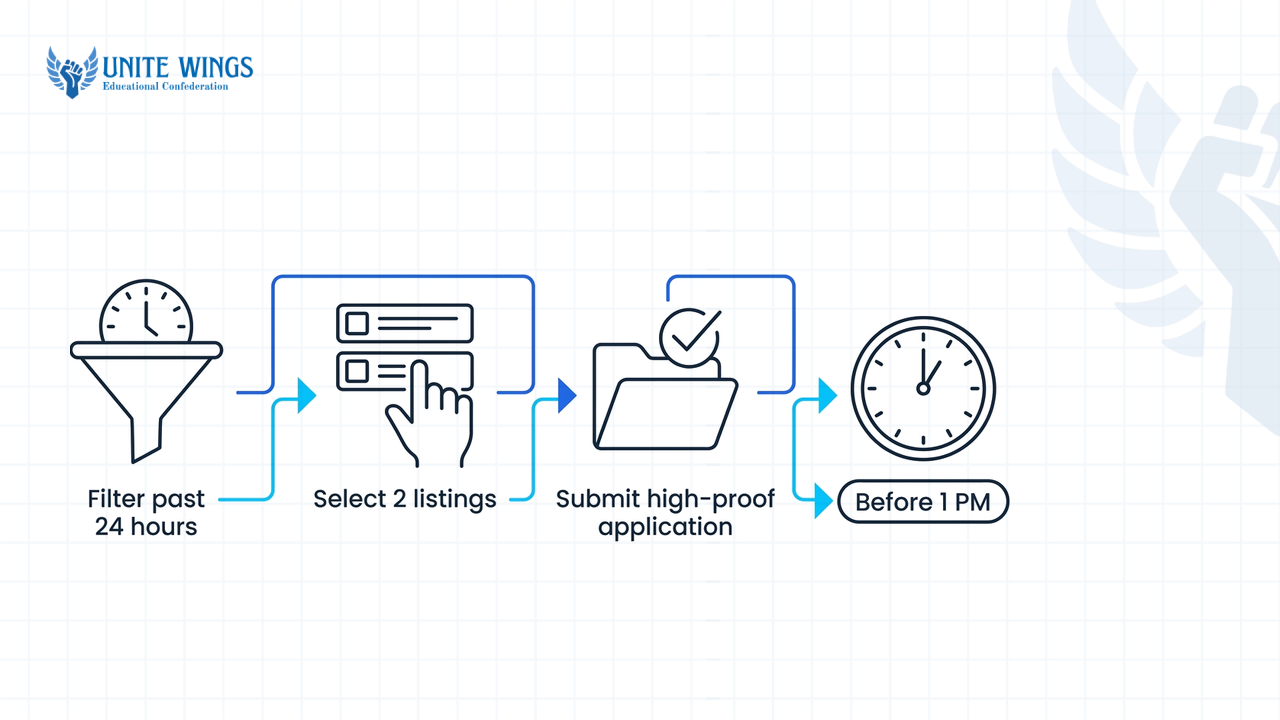
Fix #4: Shift your application habit to a 15-minute mid-morning sprint. Instead of mass-applying to 20 week-old listings at 11 PM from your hostel bed, set a filter on LinkedIn and Internshala for "Past 24 hours" during your 11 AM college break on Mondays, Tuesdays, and Wednesdays. Submit 2 or 3 high-proof applications before 1 PM so your name sits at the top of the recruiter's afternoon review queue.
How do I fix my profile so part time recruiters actually click on it?
To get part-time recruiters to click and approve your profile, you must add a dedicated "Remote Tools & Platforms" section listing software like Slack, Zoom, Notion, and Google Workspace near the top of your resume and LinkedIn profile. A 2026 single-source guide from WorkHireUSA reports that almost 90% of remote job applications get rejected because the candidate's resume or profile fails to mention any digital communication or asynchronous collaboration tools.
Why does this happen? Because hiring a student remotely is a management risk. If a startup founder has to spend three hours teaching you how to share a calendar invite, update a Trello board, or reply in a Slack thread, you are costing them time. Consequently, companies configure their ATS filters to scan specifically for remote infrastructure keywords alongside role skills.
According to 2025–2026 profile optimization guidelines from Deloitte (cited via Social Media for Learning) and WorkHireUSA, here is Fix #5—a 4-part overhaul you should apply to your resume and LinkedIn today:
- Add an explicit "Remote Collaboration Tools" skills row: Place this right above or below your technical skills. Copy and customize this exact line for your resume:
- Remote & Async Workflow: Slack, Notion, Google Workspace (Docs, Sheets, Drive), Zoom, Trello, Asana, Loom.
- Replace passive student headlines: Change your LinkedIn headline from "Student at XYZ College" to an active service headline: "Part-Time Content Writer & Canva Designer | Helping EdTech & D2C Brands Publish 5x Faster | Notion & Google Workspace Ready."
- Clean up your URL and headshot: Use a clear, well-lit headshot against a plain background and customize your LinkedIn URL (remove the random numbers at the end of your name) before pasting it onto your resume.
- Match your target role to realistic Indian part-time ecosystems: If you are applying for standard freelance gigs on Upwork or Fiverr—which Inkstall notes have seen a heavy surge in student traffic—highlight portfolio links. If you need immediate cash flow without waiting 30 days for HR interviews, look at verified fintech onboarding and sales gigs on platforms like GroMo or PickMyWork. According to 2026 guides from GroMo, PickMyWork, and CareerGrowKaro, online part-time jobs for Indian students realistically pay ₹3,000 to ₹25,000 per month for 1 to 3 flexible daily hours, though exact payouts vary by task volume and platform rates.
Fix #6: Watch out for part-time registration fee scams
When you are frustrated by zero replies on real job portals, you become an easy target for WhatsApp and Telegram scammers who reply in 30 seconds. To stay safe from scams, never pay upfront training fees, security deposits, ID card charges, or "typing kit" fees. Legitimate online part-time jobs in India are 100% free to apply for and join. If a "recruiter" asks for ₹499 to release your first project, block them immediately.
Your next 3 steps to get a reply this week
Stop sending out the same resume that has been ignored 50 times. Before you apply to another listing tonight, do these three things:
- Update your resume skills block right now: Add
Slack, Notion, Zoom, Google Workspace, Trellounder a dedicated Remote Tools & Platforms subheading so you stop failing basic remote ATS checks. - Record or build one 60-second sample: Pick the exact skill you want to get paid for (writing, Canva design, video editing, coding, or lead research) and create a 1-minute sample hosted on an open Google Drive or Loom link.
- Apply to 5 fresh listings on Tuesday between 10 AM and 12 PM: Filter Internshala or LinkedIn for jobs posted in the Past 24 Hours, ditch the "hardworking student" intro, put your sample link in sentence two, and message the hiring manager on LinkedIn the same day.
Skip the portal queue and land your first paying client
Tired of competing against 200 applicants for every listing on job portals? Join the Freelance with AI masterclass to learn how to find one small client directly, deliver fast, high-quality work with AI as your assistant, and walk away with your first real client pitch, workflow, and paid testimonial.
Frequently asked questions
Why am I getting zero replies for online part-time job applications?
You are likely getting filtered out by automated software or applying too late. Entry-level roles have a 1% to 2% response rate according to LoopCV (2026), while the average posting gets 200+ applications, and up to 20% to 40% of listings are inactive "ghost jobs" that never reply to anyone.
How much can a student in India realistically earn from an online part-time job?
Indian college students can realistically earn between ₹3,000 and ₹25,000 per month working 1 to 3 flexible hours a day, according to 2026 data from CareerGrowKaro and GroMo. Earnings depend on whether you do micro-tasks, content writing, tutoring, or commission-based fintech onboarding gigs.
What should I write instead of "I am a hardworking student" in my cover letter?
Open with a specific problem the company is trying to solve and back your skill claim with a number from an academic project or college society role. Since hiring managers scan cover letters for only six seconds (VT.edu, 2025), lead with a clickable link to a work sample.
When is the best day and time to apply for remote part-time jobs?
Apply on Monday or Tuesday mornings between 10 AM and 1 PM, and always within 24 hours of the job being posted. Data from JobHire and ResumeFast (2026) shows Tuesday has the highest volume of new listings (19.5%) and applying within 24 hours boosts callback odds up to 8x.
Can my city PIN code get me rejected from a remote job in India?
Yes, automated screening software sometimes rejects candidates from tier-2 or tier-3 PIN codes within minutes, even on jobs advertised as remote, as reported by Hindustan Times in 2026. To bypass this, reach out directly to hiring managers on LinkedIn or pitch clients on global freelance platforms.
How many days should I wait before following up on a remote job application?
Send a polite, two-sentence introductory message with your 1-minute work sample on LinkedIn within 24 hours of applying (WorkHireUSA, 2026). Because average hiring timelines stretch from 12.7 to 49 days (FlexJobs, 2025), wait 5 to 7 business days before sending one final follow-up note.
Newsletter
Stay updated with our latest news and insights.