Right vs Wrong: How to Prepare for Group Discussion
Are common mistakes costing you job offers? Compare the right and wrong ways of approaching GD rounds. Find out exactly how to prepare for group discussion effectively while refining your communication skills for group discussion to leave a lasting positive impression.

Written by
Swarn Shauryam SwarnkarThe landscape of campus placements and corporate hiring in India has fundamentally shifted in 2026. With artificial intelligence streamlining routine technical tasks, recruiters at top multinational companies and dynamic startups are no longer just looking for coding skills or high academic scores. They are looking for human adaptability. If you want to secure the best job offers, knowing how to prepare for group discussion is no longer optional—it is the deciding factor in modern recruitment.
What is a Group Discussion? A Group Discussion (GD) is a structured behavioral assessment where a panel evaluates a group of candidates on their ability to collaborate, communicate, and solve problems in real-time. Rather than a test of public speaking, it is a simulation of workplace dynamics designed to measure human-centric soft skills, emotional intelligence, and leadership potential.
To help Indian college students navigate this critical round, Unite Wings has compiled this definitive guide. We will compare the right and wrong ways to approach your GD, backed by the latest 2026 hiring data, to ensure you leave a lasting, positive impression on your assessors.

The 2026 Job Market: Why Group Discussions Matter More Than Ever
Why are Group Discussions important in 2026? Group Discussions are essential because employers now prioritize skills-based hiring over traditional academic metrics. As AI tools automate technical workflows, GDs allow recruiters to assess the irreplaceable human skills—like teamwork, adaptability, and complex communication—that dictate real-world job performance and leadership potential.
The era of mass elimination based solely on a resume is fading. According to the NACE Job Outlook 2026 Spring Update, 70% of employers now use skills-based hiring, up from 65% in 2025. Conversely, screening by GPA has plummeted to just 42%. Furthermore, a staggering 87% of employers apply skills-based evaluation directly at the interview or group discussion stage.
Why this sudden shift? The PwC 2025 Global AI Jobs Barometer reports that occupations most exposed to AI have seen a 55% faster change in required skills. The emphasis has pivoted heavily toward judgment, adaptability, and complex interpersonal communication. Employers need graduates who can navigate intellectual friction and lead human teams.
However, there is a dangerous blind spot for freshers. Cengage Group and NACE 2025/2026 data highlights a 30% gap between how graduates rate their own professionalism and leadership, and how employers actually evaluate them. Group Discussions are specifically engineered to expose this gap.
Based on foundational research by Schmidt and Hunter, structured behavioral assessments like criteria-based GD panels are roughly twice as predictive of on-the-job performance as unstructured interviews. When combined with cognitive tests, they yield a highly reliable 0.63 correlation coefficient.
Top Skills Evaluated in Group Discussions
According to NACE 2026 data, recruiters are using structured rubrics to actively score candidates on the following competencies:
| Competency Assessed | Employer Demand (%) | What It Looks Like in a GD |
|---|---|---|
| Teamwork | 85% | Building on others' ideas, managing conflict, and ensuring group inclusion. |
| Problem-Solving | 82% | Breaking down abstract topics or case studies logically. |
| Verbal Communication | 78% | Speaking clearly, concisely, and with persuasive tone control. |
| Written Communication | 72% | (Often tested via brief pre-GD or post-GD summary notes). |
Industry Consensus
"Group Discussions are more than just a test of speaking skills—they're a real-time evaluation of leadership, collaboration, emotional intelligence, and clarity of thought."
Right vs. Wrong: The Core Framework for GD Success
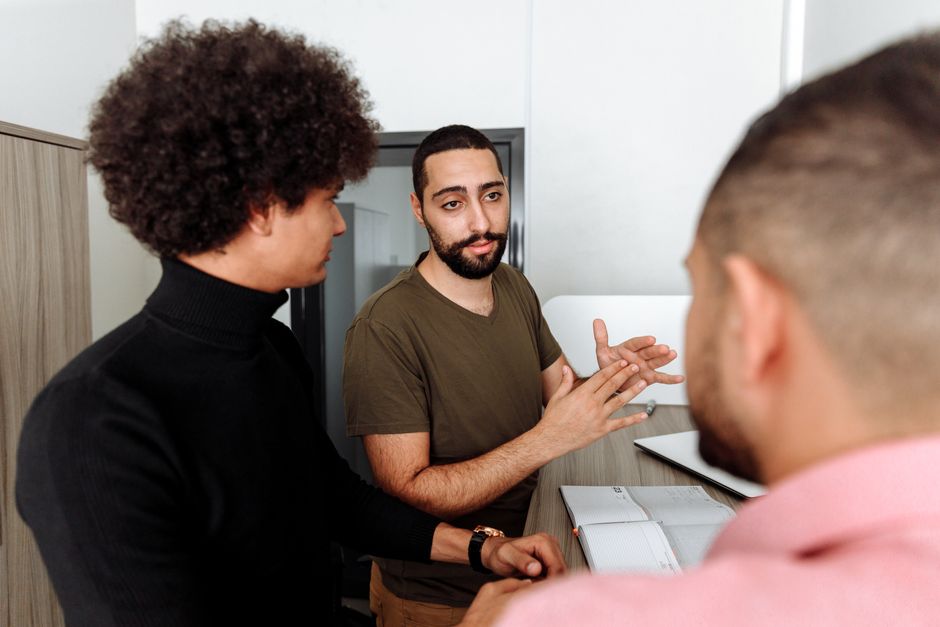
How should you act in a Group Discussion? To succeed in a Group Discussion, act as a facilitator rather than an aggressor. The right approach involves actively listening, structuring logical arguments, and building group consensus. The wrong approach involves interrupting others, speaking without knowledge, or dominating the conversation just to maximize airtime.
Many candidates approach the GD round as a battleground. This is a critical mistake. Understanding the difference between constructive participation and destructive dominance will save your candidacy. Here is the right versus wrong framework for every phase of the discussion.
A. Initiating the Discussion
Starting the GD can earn you massive leadership points, but only if done correctly.
- Right (The Facilitator Approach): Start by setting a clear context. Provide a brief, neutral overview of the topic, or ask an open-ended question to invite group collaboration.
- Example: "Good morning, everyone. Today’s topic focuses on the impact of AI on employment. While it certainly improves efficiency, it raises valid concerns about job displacement. How do we feel about the pressing need for corporate reskilling?"
- Wrong (The Aggressor Approach): Jumping in first purely for the sake of being first, especially when you lack knowledge on the topic. Speaking loudly, rambling without structure, or starting with extreme, polarizing statements creates a terrible first impression.
- The Expert Verdict: Initiating only earns leadership points if it successfully frames the discussion. If you do not understand the prompt, initiating is an automatic penalty.
B. Listening and Interacting
Your behavior when you are not speaking is judged just as heavily as when you are.
- Right (Active Building): Use active listening to build upon your peers' ideas. Assessors actively score your "Listening Skill." You should nod, take brief notes, and validate others’ points before introducing your own.
- Example: "Rohan made a highly valid point about the economic impact of this policy; I would like to add a social dimension to that perspective."
- Wrong (The Fish Market): Interrupting, talking over others, pointing fingers, or physically elbowing your neighbors. Ignoring the previous speaker just to selfishly pivot back to your memorized script shows a complete lack of teamwork.
- The Expert Verdict: According to SHRM Labs and assessment design principles, panels use structured rubrics to avoid bias. They are looking for comparable evidence of skills, not the loudest voice. "Overpowering the conversation" is the number one reason highly assertive candidates face rejection.
Important Note
Acting as a facilitator to prevent the discussion from stalling showcases premium problem-solving and team management skills. Do not fall into the trap of turning a discussion into a debate.

C. Managing Knowledge Gaps & Mistakes
You will inevitably face a topic you know nothing about. How you handle this unknown is a major test of emotional intelligence.
- Right (The Observer Strategy): If you are unfamiliar with an abstract topic or an obscure current event, remain calm. Let 3 to 4 people speak first. Actively analyze their points, find the logical gaps, and synthesize a new angle based on the data they have provided.
- Wrong (The Rambler): Making up fake statistics, rambling for several minutes to dominate airtime, or constantly fluctuating your opinion just to agree with the loudest person in the room.
- The Expert Verdict: Quality heavily outweighs quantity. Speaking just 3 to 4 times with strong, concise, and logically sound points is the optimal strategy for clearing the round.
D. Concluding the GD
The end of the discussion is about alignment, not winning an argument.
- Right (The Consensus Builder): Step in to summarize the key viewpoints objectively. Acknowledge both sides of the argument and offer a balanced, actionable conclusion or a forward-looking solution on behalf of the group.
- Wrong (The Last-Word Fallacy): Introducing entirely new arguments at the final minute, or aggressively shutting down a peer just to ensure you get the final word.
Essential Communication Skills for Group Discussion
What are the key communication skills for a group discussion? The key communication skills for a group discussion include high emotional intelligence, balanced assertiveness, logical structuring of arguments, and positive non-verbal body language. Candidates must communicate their ideas firmly but respectfully, maintaining composure even when faced with intellectual disagreements.
Mastering communication skills for group discussion requires more than just speaking fluent English. It requires strategic delivery. Recruiters evaluate your communication across these four highly assessed dimensions:
- Assertiveness vs. Aggressiveness: In the corporate world, you must stand up for your ideas, but you must do so respectfully. Assertiveness is speaking firmly and clearly without raising your voice or displaying negative emotion. Aggressiveness is attacking the person rather than the idea.
- Emotional Intelligence (EQ): Human resource insights from the World Economic Forum (WEF) state: "Emotional intelligence (EQ) is emerging as a decisive hiring factor at all levels. Employers consistently seek graduates who can communicate clearly, adapt to change, collaborate effectively, and navigate complex interpersonal dynamics." Recruiters will closely watch your EQ. They want to see how you maintain composure when someone directly contradicts you.
- Logical Structuring: Avoid disjointed, stream-of-consciousness rambling. Present your arguments using a clear "Claim + Evidence + Impact" structure. State your point, back it up with a fact or logical reasoning, and explain why it matters to the broader topic.
- Body Language & Non-Verbal Cues: Your physical presence speaks volumes. Maintain an open posture (do not cross your arms). Avoid excessive hand gesturing when you are not speaking, as it can be distracting. Most importantly, make eye contact with your group members, not just the evaluation panel.
The Golden Rule of GDs
According to Indeed Hiring guidelines: "Address that person calmly, assert that you would like to finish your thought and carry on speaking with the intent to convey calmness and maturity. This is a discussion, not a debate."

Step-by-Step Guide: How to Prepare for Group Discussion
How do I prepare for a Group Discussion? To prepare for a group discussion, you must identify common GD formats, practice the 2-minute speaking drill, build a robust daily information diet, and participate in mock GDs. Regular roleplay with peer evaluation using structured rubrics is the fastest way to improve your collaborative and communication skills.
Moving beyond generic advice like "be confident," Unite Wings recommends this concrete, actionable 4-step preparation framework for Indian college students facing 2026 placement drives.
1. Identify and Study the GD Formats
You cannot prepare effectively if you do not know the rules of the game. Modern GDs typically fall into one of three categories:
- Factual / Current Affairs Topics: Tests your awareness of the world. Example: "Is social media doing more harm than good in modern democracies?"
- Case Study Topics: Tests commercial awareness and problem-solving. Example: "A tech startup is losing market share to a cheaper competitor; what should the CEO do to survive?"
- Abstract Topics: Tests lateral thinking and creativity. Example: Discussing the color "Blue" or interpreting a philosophical quote.
2. The 2-Minute Drill
Fluency is built through repetition. Every day, pick a random topic and speak about it out loud for exactly 2 minutes without stopping. Record yourself using your smartphone. Watch the playback to analyze your use of filler words (like "um," "uh," "like"), evaluate your facial expressions, and check the logical flow of your thoughts.
3. Maintain an Active Information Diet
You cannot contribute high-quality content if your mind is empty. Spend 3 to 4 weeks prior to your recruitment season reading major publications to build a mental repository of facts. Subscribe to resources like The Economist, TechCrunch, and major Indian dailies. Memorize 5 to 10 versatile statistics related to the global economy, artificial intelligence, sustainability, and social issues. Having verifiable data at your fingertips instantly elevates your authority in any room.
4. Conduct Mock GDs with Roleplay
You cannot learn to swim by reading a book; you must practice in a group. Form practice groups of 5 to 8 peers. Run 15-minute mock GDs, but strictly rotate the role of the "evaluator." The evaluator should not participate, but rather grade the others using a standard 5-point corporate rubric:
- Content Quality: Did the candidate bring unique, factual insights?
- Communication Clarity: Was the candidate articulate and easy to understand?
- Listening & Teamwork: Did the candidate support others and build on ideas?
- Leadership: Did the candidate help guide the group toward a consensus?
- Composure: Did the candidate maintain emotional control under pressure?

Frequently Asked Questions (FAQ)
What happens if I don't know the topic in a group discussion? If you are unaware of the topic, do not panic and do not initiate the discussion. Use the "Observer Strategy." Allow 3 to 4 participants to speak first. Listen actively to their points, identify the core theme, and enter the discussion by summarizing their points or adding a logical extension to what has already been said.
What is the difference between a Group Discussion and a debate? A debate is competitive; the goal is to prove the opposing side wrong. A Group Discussion is collaborative; the goal is to explore a topic from multiple angles and arrive at a shared understanding or consensus. Aggressively shutting down peers will win a debate but will get you disqualified in a GD.
How many times should I speak during a 15-minute GD? Quality is more important than quantity. Aim to speak 3 to 4 times, for about 45 to 60 seconds each time. This allows you to make substantial points (Initiating, Building, and Concluding) without dominating the airtime, showing recruiters you respect team dynamics.
How can I effectively interrupt someone who won't stop talking? Do not raise your voice. Wait for them to take a breath, use a polite but firm transitional phrase, and validate their point before pivoting. For example: "I agree with your point on X, Amit, and to add to that perspective..." This demonstrates high emotional intelligence and leadership.
Are statistics really necessary in a Group Discussion? While not strictly mandatory for abstract topics, using data (like citing NACE or WEF statistics) in factual or case study GDs significantly boosts your credibility. It shifts your contribution from a mere "opinion" to an authoritative, evidence-based argument.
Newsletter
Stay updated with our latest news and insights.