
How to Use Claude for Coding and DSA Without Ruining Logic
Prompt settings that stop Claude from spoiling the full LeetCode solution and force it to give progressive hints, ASCII dry-run tables, and time-complexity breakdowns instead.
To learn how to use Claude for coding and DSA for beginners without ruining your problem-solving muscle, set up a custom system instruction or a local CLAUDE.md file that bans full code blocks and forces a three-tier Socratic hint ladder. Instead of pasting a LeetCode question and reading the solution, wrap your broken code in <code_draft> XML tags and ask exclusively for edge cases, complexity bottlenecks, or markdown dry-run tables. This forces you to write the syntax yourself, which is the difference between freezing during a campus placement test and clearing high-tier coding rounds, where 2026 fresher salaries jump from ₹3.36 LPA in TCS Ninja to ₹7–11.5 LPA in TCS Digital and Prime, or ₹7–21 LPA in Infosys Specialist Programmer tracks, according to Hello Engineers' 2026 salary report.
In short
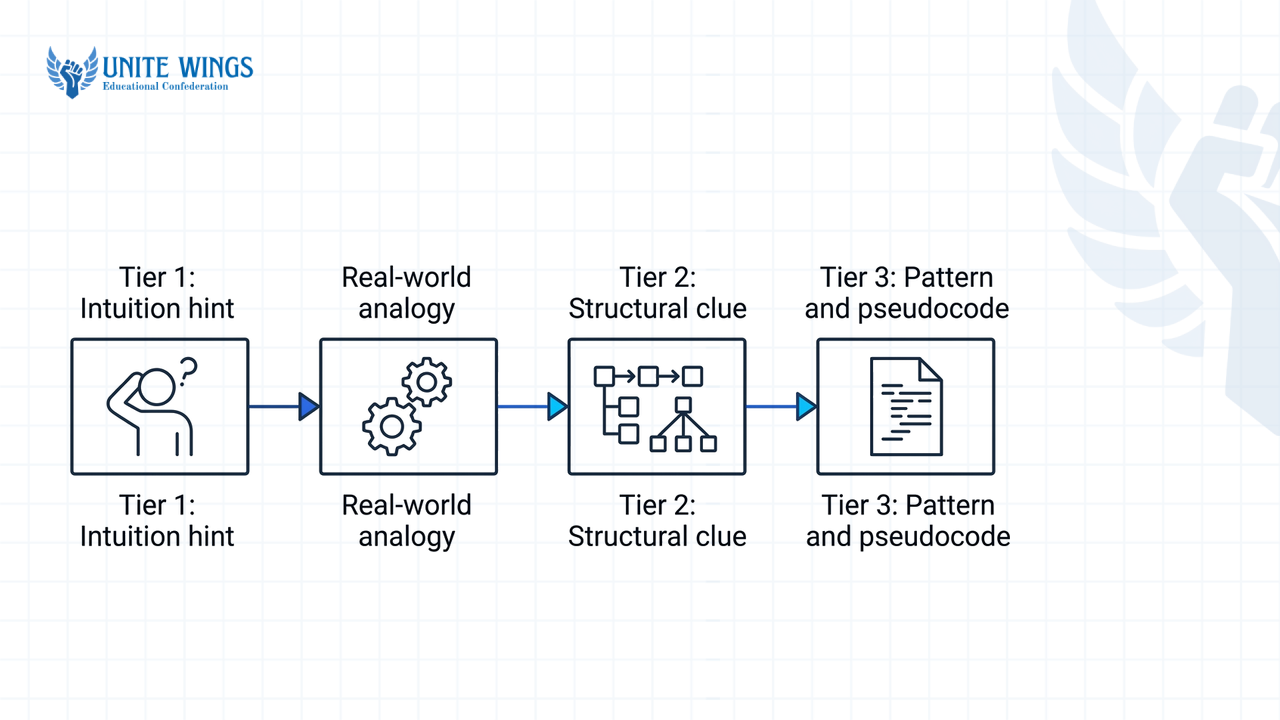
- Lock Claude into a 3-tier hint system (Tier 1: Intuition, Tier 2: Data structure clue, Tier 3: Pattern name) using a local
CLAUDE.mdconstitution file or a Claude.ai Project. - Put your long problem statements and draft code in XML tags at the top of your prompt, above your instructions, to raise context accuracy by up to 30% (Medium, 2026).
- Force dry-run tables for recursion and Dynamic Programming by pre-starting your prompt with the exact markdown column headers you want Claude to fill.
- Debug GeeksforGeeks
Wrong AnswerorTLEverdicts by passing the exact input constraints (likeN = 10^5) and asking solely for the failing boundary test case. - Clear your chat history (
/clearin Claude Code) after every single problem so old constraints do not degrade the model's context window.
How do I stop Claude from giving me the full code when I just want a logic hint?
You stop Claude from dumping the full solution by replacing polite one-line requests with a persistent system constitution placed inside a Claude.ai Project instruction box or a local CLAUDE.md file in VS Code that enforces a three-tier hint ladder and bans code blocks unless you type a specific override phrase.
What most students get wrong is typing "please don't give me the code, just give me a hint" at the bottom of a standard chat tab. Models in the 2026 lineup like Claude Sonnet 5 and Opus 4.8 have strong helpfulness biases; if you ask a soft question about a bug, they will print the corrected C++ or Java function anyway unless constrained by strict architectural wrappers. Once your eyes scan that working loop, your brain records fake familiarity. Two weeks later, when you sit for a proctored GeeksforGeeks Job-A-Thon (which tests you on 3 DSA problems and core CS MCQs, where plagiarism software flags copied patterns and drops scores to zero), you blank out because you never built the logic from scratch.
To fix this permanently, you need strict system boundaries, which Anthropic's 2025 Prompt Engineering Guide confirms work better than vague modifiers like "be helpful." You can set this up in two ways depending on where you practice.
| Feature | Claude.ai Web Project | Claude Code CLI / VS Code (CLAUDE.md) |
|---|---|---|
| Best for | Browser-based LeetCode & GFG practice | Local IDE coding, Git tracking, & mock tests |
| Rule enforcement | Project Custom Instructions box | Root CLAUDE.md constitution file |
| Risk of rule drift | Medium (drifts in long chats; needs manual reset) | Low (reads CLAUDE.md on every local query) |
| Extra workflow tools | Artifacts for side-by-side tables | Plan Mode (--permission-mode plan) & /clear |
Follow these steps to lock in the No-Spoiler Socratic Tutor setup today:
- If you use the browser (
claude.ai): Click Projects in the left sidebar, create a project namedDSA Socratic Coach, and open the Project Instructions panel. If you want a guided walk-through on configuring Projects and Artifacts from scratch, our Claude Masterclass covers the exact workspace setup. - If you code locally in VS Code: Install the official Anthropic VS Code extension or the native CLI installer (which launched in general availability in May 2025, per Suprmind.ai's 2026 feature review). Create a folder called
dsa-practice, open it in your terminal, and create a plain text file namedCLAUDE.mdin the root directory. - Paste this exact Socratic Tutor constitution into your Project Instructions or
CLAUDE.mdfile:
<system_rules>
Role: You are a strict MAANG DSA interviewer and Socratic tutor for an Indian engineering student.
Hard Constraint 1: NEVER output full code solutions, complete functions, or corrected code blocks in C++, Java, or Python unless the user types the exact phrase "OVERRIDE: SHOW FULL CODE".
Hard Constraint 2: NEVER name the algorithm or pattern (do not say "Sliding Window", "Kadane's", "Dijkstra", or "Monotonic Stack") on the first response.
Hint Ladder Protocol: When the user shares a problem or stuck logic, respond ONLY with Tier 1. Wait for the user to reply before moving to Tier 2.
- Tier 1 (Intuition): Ask one guiding question and give a 1-sentence real-world analogy pointing to the bottleneck.
- Tier 2 (Structural Clue): Name the auxiliary data structure needed (e.g., "Think about tracking frequencies with a hash-based structure" or "Consider what happens if you maintain indices in a LIFO order") and state the target time/space complexity.
- Tier 3 (Pattern & Pseudocode): Name the exact algorithmic pattern and provide a 4-line plain-English step list. Zero code syntax.
</system_rules>
When you use Claude Code in the terminal, you can also create repeatable slash commands inside a .claude/commands folder, a workflow documented by Builder.io in 2025. For example, save a file at .claude/commands/hint.md containing Read my current file, identify the logical blocker, and give me a Tier 1 hint only. Then, whenever you get stuck in VS Code, you can trigger your custom slash command from the terminal.
What prompt makes Claude generate a step-by-step dry run table for recursion or DP?
To make Claude generate a clean dry-run table without spoiling the answer, wrap your draft logic in XML tags at the top of the prompt and specify the exact markdown table columns, such as recursion call depth, parameter values, memoization array state, and return value, for a small custom input like N = 3 or a 4-element array.
Recursion and Dynamic Programming (DP) break beginners because you cannot visualize the call stack unwinding in your head. If you ask a generic question like "why is my DP failing?", Claude will rewrite your state transition equation. Instead, use Claude as a human compiler that traces your exact broken code on a tiny test case so you can spot the wrong base case yourself.
Two prompt engineering rules make this work every time:
- Put data above instructions: A 2026 Medium benchmark on Claude prompt blocks found that placing long context blocks (your problem description and code) at the top of the prompt, before your instructions, improves context retrieval accuracy by up to 30%.
- Use response prefilling or strict markdown headers: Anthropic's 2025 Prompt Engineering Interactive Course highlights that pre-starting the assistant output with a markdown table header (or forcing the exact first line of output) stops conversational preambles and prevents smaller models like Claude Haiku 4.5 from accidentally leaking code before the table.
Copy and paste this template the next time your recursive tree or 2D DP grid gives the wrong output:
<problem_statement>
[Paste the LeetCode/GFG problem text here]
</problem_statement>
<my_draft_code>
[Paste your current C++ / Java / Python recursive or DP function here]
</my_draft_code>
<instructions>
Trace MY exact code above, keeping bugs included without fixing them, on the small input: nums = [1, 2, 3], target = 4.
Do not write any introductory text and do not write corrected code.
Start your response immediately with the markdown table header below, tracking up to 10 steps of the execution stack:
| Step | Function Call / Loop Index | Active Call Stack | dp[] Table State | Condition Checked | Return Value |
</instructions>
When Claude outputs this table for a problem like 0/1 Knapsack or Coin Change, look at the Condition Checked and Return Value columns around your base cases (index == 0 or target < 0). You will immediately see things like your code returning 0 instead of INT_MAX on an invalid branch, or overwriting a memoized cell before both recursive left and right branches finish executing. You fix the one line in your IDE yourself, and the logic stays yours.
How can I ask Claude to find the exact edge case failing my GeeksforGeeks submission?
To find a hidden failing test case without getting your code rewritten, pass your code along with the exact GeeksforGeeks constraint bounds (such as 1 <= N <= 10^5 and -10^9 <= arr[i] <= 10^9) and instruct Claude to return only three specific boundary inputs where your logic hits a runtime error, integer overflow, or wrong answer.
GeeksforGeeks practice portals and OA platforms like HackerRank often lock the exact test case after test case #1102 fails, showing you only Wrong Answer or Segmentation Fault. If you paste your code into AI without the mathematical constraints from the bottom of the problem page, Claude guesses blindly and usually rewrites your whole function. As noted by Claude-World's 2026 guide on competitive programming test case generation, feeding exact constraint parameters is what directs the model toward boundary failure and overflow analysis.
Use this XML-structured prompt whenever your submission passes sample tests but fails hidden platform tests:
<constraints>
Time Limit: 1.0 sec
1 <= N <= 10^5
-10^9 <= A[i] <= 10^9
Expected Time Complexity: O(N log N)
Expected Auxiliary Space: O(1)
</constraints>
<failing_submission>
[Paste your C++ or Java submission here]
</failing_submission>
<instructions>
My submission passed the initial sample cases on GeeksforGeeks but failed on test case 1045 with a "Wrong Answer" (or "Runtime Error / TLE").
Do NOT rewrite my code and do NOT show me the corrected line.
Analyze the <constraints> against my <failing_submission> and output exactly 3 items:
1. The Failure Category: Choose from [32-bit Integer Overflow | Off-by-One Boundary | Empty/Single-Element Input | Negative Number Handling | Uninitialized Memory | Time Limit Bottleneck].
2. A Minimal Failing Test Case: Give me the smallest possible input array (max 5 elements) or extreme value that breaks my current code.
3. Actual vs. Expected Output: State what my code outputs on that test case versus what the problem requires.
</instructions>
What most students get wrong during long debugging sessions
Do not keep debugging five different GeeksforGeeks problems in the same continuous chat window. Builder.io's 2025 analysis on Claude context management confirms that long sessions suffer from context degradation: old variable names and constraints bleed into new answers, and the model starts ignoring your "no code" rule. The moment you pass a problem, type /clear in Claude Code or open a fresh chat inside your Claude.ai Project.
How do I use Claude to convert my brute-force O(n²) code into an optimal O(n) solution?
Convert a brute-force $O(n^2)$ solution into an optimal $O(n)$ approach by asking Claude to isolate the redundant inner loop lookup in your code and ask you a guiding question about which data structure or pointer movement eliminates that repeated work.
During campus interviews for high-paying roles, where Recrew.ai and Hello Engineers report 2026 fresher product packages between ₹15 LPA and ₹50 LPA in Bengaluru, Hyderabad, and Pune compared to the ₹3.36–4.5 LPA band at mass IT services firms, interviewers rarely fail you for starting with an $O(n^2)$ brute-force answer. They fail you when you cannot optimize that brute-force code after they ask, "Can we do better than quadratic time?"
If you ask an AI to "optimize my code to $O(n)$," it deletes your nested loop and replaces it with a finished Hash Map or Two-Pointer block. Instead, use prompt chaining, a technique confirmed by TechPress (2026) and the 2026 Claude AI Mastery Bootcamp to preserve a student's underlying logic by isolating nested loops without rewriting the whole function.
Run this three-step chain whenever you get a Time Limit Exceeded (TLE) on an $O(n^2)$ draft:
- Step 1 (Isolate the redundant work): Paste your working $O(n^2)$ code and prompt:
Look at my inner loop in <code_draft>. In plain English, what exact question is the inner loop asking over and over again at every iteration of i? Do not suggest a fix yet. - Step 2 (Choose the invariant or data structure): Once Claude replies (for example: "Your inner loop scans from
i+1tonevery time just to find iftarget - arr[i]exists" or "It recalculates the sum of the subarray from scratch"), reply with your own idea:If I want to answer that inner-loop question in O(1) time instead of O(n) time, I am thinking of storing seen elements in an unordered_map (or moving a left pointer when the sum exceeds K). Critique my idea: does this handle duplicate elements and negative numbers in this problem? Do not write code. - Step 3 (Verify the state transition): Write the single
whileloop or hash map check yourself, paste it back, and ask:Check my pointer update conditions inside this while loop. Is there any input where left overtakes right or causes an infinite loop?
If you are using Claude Code in your terminal, you can also run it in Plan Mode (claude --permission-mode plan), a feature detailed in GeeksforGeeks' 2026 CLI documentation. In Plan Mode, Claude can read your local file and debate the time and space complexity trade-offs with you in the terminal without having permission to edit or overwrite your .cpp or .java file.
Can Claude explain complex C++ STL or Java Collections syntax using simple diagrams?
Yes, Claude can generate ASCII memory layout diagrams, Red-Black Tree visualizations, and markdown comparison tables that show how C++ STL containers or Java Collections allocate memory, resize arrays, and invalidate iterators under the hood.
Many 1st and 2nd-year BCA, MCA, and B.Tech students memorize syntax like mp[key]++ in C++ or HashMap.put() in Java without knowing the time complexity cost behind that single line. In technical interviews, if you use std::map inside a loop of size $10^5$ assuming it is $O(1)$, the interviewer will immediately ask you how std::map is implemented internally and why your code actually runs in $O(N \log N)$.
As covered in GeeksforGeeks' 2026 Claude tutorial, you can ask Claude to draw ASCII flowcharts and memory layouts directly in your chat or Artifact window so you see the pointers and buckets visually.
Copy this prompt when you want to master a C++ STL container or Java Collection before using it in a problem:
<instructions>
Explain the internal working of C++ std::unordered_map vs std::map (or Java HashMap vs TreeMap) for a technical interview.
Do not give me generic textbook definitions. Format your response strictly into these 3 parts:
1. ASCII Memory Diagram: Draw an ASCII diagram showing how keys and values are stored in memory (show the bucket array, hash function, linked-list chaining on collision for unordered_map, and the Red-Black Tree node pointers for map).
2. The Hidden Bug Trap: Show a 3-line code snippet of a beginner mistake that causes silent bugs or TLE (for example: how checking mp[key] == 0 in C++ accidentally inserts the key and inflates map size, or how rehashing invalidates iterators).
3. Complexity & Interview Table: Create a markdown table comparing Average Time, Worst-Case Time (and what triggers it, such as hash collision attacks), Memory Overhead, and Key Ordering.
</instructions>
You can use this exact visual prompt for any container that trips you up in DSA rounds:
- Dynamic Arrays (
std::vector/ArrayList): Ask for an ASCII diagram of capacity doubling from size 4 to 8, showing whypush_back()is amortized $O(1)$ and why holding a pointer tov[0]causes a dangling pointer bug after reallocation. - Priority Queues (
std::priority_queue/PriorityQueue): Ask for an ASCII binary heap tree mapped alongside its underlying 0-indexed array representation (2*i + 1and2*i + 2), plus the exact comparator syntax for a Min-Heap of pairs. - Deque and Monotonic Queues (
std::deque/ArrayDeque): Ask for the chunked memory map of a deque compared to a contiguous vector.
Once you start solving DSA problems cleanly and understanding data structures under the hood, you also need deployed projects on your resume so recruiters shortlist you for those coding tests in the first place. Our Build a Website with AI session shows you how to turn your logic into a working, published web project without getting stuck on boilerplate setup.
What to do next
With the Naukri JobSpeak index showing fresher hiring up 8% year-on-year in mid-2026 (per Hello Engineers), companies are actively filtering for students who can think through unfamiliar edge cases live on screen rather than those who just memorized standard solutions. Set up your AI guardrails before you solve your next problem:
- Today (15 minutes): Create a dedicated
DSA Socratic CoachProject onclaude.aior put theCLAUDE.mdfile from the first section into your local VS Code practice folder so Claude can never auto-print full code again. - This week (3 problems): Pick three medium-level recursion or array problems on GeeksforGeeks or LeetCode. Force yourself to use only Tier 1 and Tier 2 hints, and run the XML dry-run table prompt whenever your output disagrees with the sample test case.
- Every Sunday (30 minutes): Build a Spaced Repetition System (SRS) markdown file in your project folder. As highlighted in GitConnected's 2026 DSA Prep System guide, logging each solved problem as a pattern card storing only the problem link, the trigger clue you missed, and the failing edge case rather than the full code, and reviewing cards at 1, 7, 30, and 90-day intervals stops you from forgetting patterns before placement season.
Turn your logic into a live project this weekend
DSA clears the online coding test, but a working project on your resume gets you the interview shortlist and gives you real architecture to discuss in technical rounds. In the Build a Website with AI workshop, you will take an idea, build a functional website using AI without drowning in syntax errors, learn how to debug and fix it yourself, and publish a live URL you can put on your resume and GitHub the same day.
Frequently asked questions
How do I prevent Claude from drifting and breaking my "no code" rule in long chats?
Clear your context window after every single problem by typing /clear in Claude Code or opening a fresh chat thread inside your Claude.ai Project. When a chat exceeds several debugging turns, earlier system prompts lose weight against recent code snippets, causing the model to slip back into printing full functions.
Which Claude model is best for DSA preparation in 2026?
Use Claude Sonnet 5 for daily hint generation, dry-run tables, and C++ STL explanations, and switch to Opus 4.8 with extended thinking enabled when analyzing tricky Dynamic Programming state transitions or constraint proofs. Avoid lightweight models like Haiku 4.5 for Socratic coaching unless you use strict output prefilling, as faster models skip negative constraints more often.
Can I configure Claude to act like a timed MAANG mock interviewer?
Yes, you can structure custom slash commands in a .claude/commands directory or use Project prompts to set up repeatable prompt workflows for algorithmic mock tests and code reviews.
Will GeeksforGeeks or LeetCode ban my account if I use Claude for hints?
No, using Claude in a separate tab or local IDE to ask for conceptual hints, ASCII diagrams, or edge-case analysis during daily practice will not flag your account. However, during live hiring contests like the GeeksforGeeks Job-A-Thon, plagiarism detectors automatically flag AI-generated or shared code structures and reduce your contest score to zero.
Why should I put my code inside XML tags like <my_code> when prompting Claude?
Anthropic trains Claude models specifically to recognize XML tags (<constraints>, <code_draft>, <instructions>) as structural boundaries between raw data and commands. Wrapping your code and problem statement in XML tags at the top of the prompt prevents Claude from confusing problem constraints with your instructions and increases retrieval accuracy by up to 30%.
Newsletter
Stay updated with our latest news and insights.