
A 4-Hour Weekend Routine for College Students to Build a Portfolio
Turn two hours on Saturday and two hours on Sunday into one published portfolio project every month, even when weekdays are packed with classes.
You do not need free evenings from Monday to Friday to build a tech portfolio that gets you shortlisted. By locking in a strict 4-hour weekend routine, using 2 hours on Saturday and 2 hours on Sunday, you can scope, build, test, and publish one complete project every four weeks (ksverse.in). Over a single four-month semester, that gives you the 3 to 4 live, clickable projects recruiters in India use as their primary filter during a 6-second resume scan (resumeraja.in).
In short
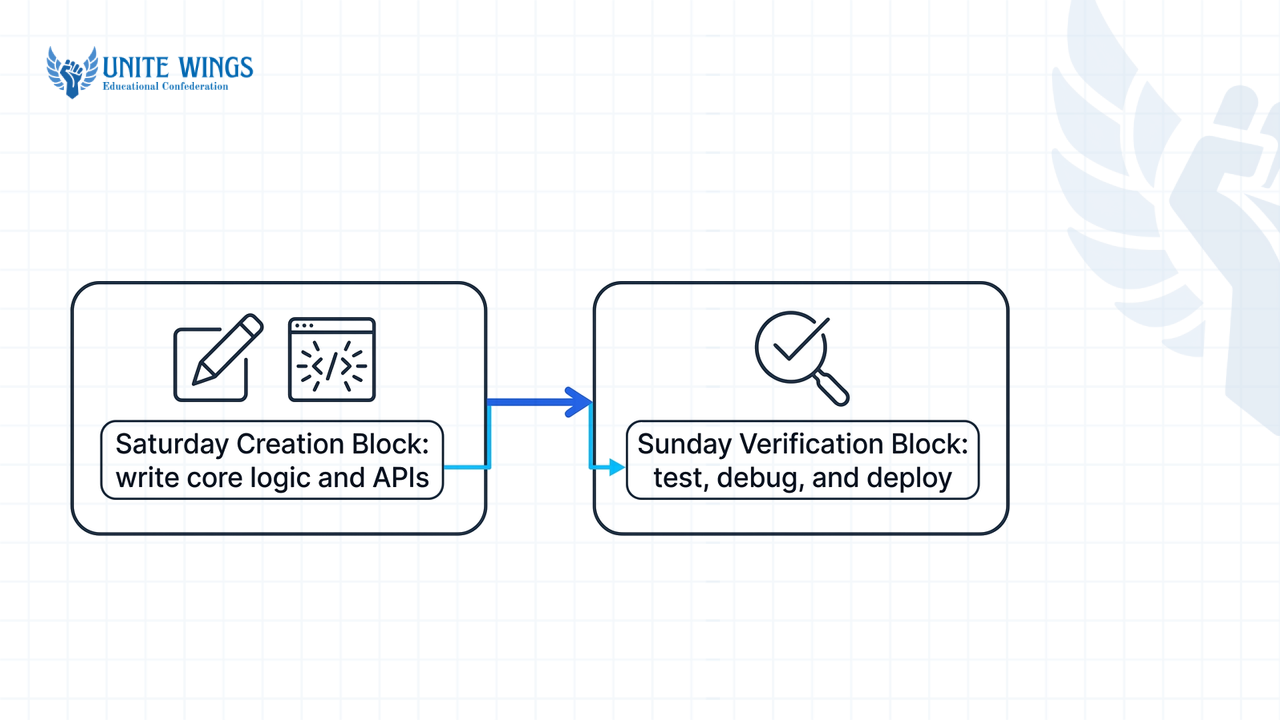
- The 2+2 Split: Block 2 hours on Saturday for architecture and core logic, and 2 hours on Sunday for testing, debugging, and documentation (showproof.io).
- The 4-Weekend Calendar: Ship one project a month by splitting it into Weekend 1 (Scoping), Weekend 2 (Building with AI), Weekend 3 (Testing and deployment), and Weekend 4 (Publishing on LinkedIn and your resume).
- Why it pays off: Entry-level mass IT services firms (TCS, Infosys, Wipro, Cognizant) pay ₹3.36 LPA to ₹6 LPA, whereas AI and Machine Learning roles pay ₹8 LPA to ₹20 LPA and Infosys Specialist Programmer bands offer ₹7 LPA to ₹21 LPA (helloengineers.in, acciojob.com).
- Skip the custom website: Do not waste four weekends writing CSS for a personal site; host your portfolio on a 1-page Notion template or an enhanced GitHub README and deploy individual apps on Vercel or Netlify (showproof.io, tiiny.host).
How can I build a portfolio if my college takes up my whole weekday?
Stop trying to code at 10 PM after eight hours of lectures, lab records, and a two-hour bus commute. Build a weekend routine for college students to build portfolio proof by isolating 2 hours on Saturday and 2 hours on Sunday, leaving your weekdays entirely for college attendance, internal exams, and sleep (gradstarglobal.com, showproof.io).
Most placement advice fails Indian engineering and degree students because it assumes you have two free hours every Tuesday night. Between 75% attendance mandates, sessional exams, and hostel or metro travel, weekday coding leads straight to burnout by week two.
The 2+2 weekend routine works because it removes weekday guilt and sets a hard boundary on your time:
- Saturday (2-Hour Creation Block): Phone in another room. You only write core logic, connect APIs, or ingest data. Do not fix colours, fonts, or documentation during this block.
- Sunday (2-Hour Verification Block): You test the code you wrote on Saturday, handle errors, deploy the link, or write the documentation (gradstarglobal.com).
Stick to this routine for one semester (16 weeks) and you will finish 4 verified projects. A 2025 tiiny.host guide notes that a student portfolio needs 3 to 6 curated projects to show skill versatility, while a 2026 resumeraja.in analysis found that 3 to 4 solid projects with clickable links act as the main filter for freshers facing heavy off-campus competition.
If you are from a tier-2 or tier-3 college, this matters even more right now. A 2026 report on the India Skills Report findings notes that 64% of employers treat candidates with practical skills and active projects as premium talent regardless of college tier, while only 31% prioritize elite institution tags (lukmaanias.com). Furthermore, the CII India Skills Report 2026 confirms that tier-2 and tier-3 cities are driving emerging talent pipelines, with Uttar Pradesh, Maharashtra, and Karnataka ranking as the top employable states (ciiskills.in).
What can I realistically build in 4 hours over a weekend?
In a single 4-hour weekend window, you can build a working micro-project like an API-driven weather tracker, an automated expense calculator, or a single-feature data script. For a full resume-worthy project, combine four consecutive 4-hour weekends (16 hours total) to ship a complete Minimum Viable Product (MVP) (resumeraja.in, ksverse.in).
What most students get wrong: They try to build an "AI-powered full-stack hospital management system" in one weekend, get stuck on authentication on Saturday afternoon, and abandon the GitHub folder forever. Career advisors and technical screeners agree that a shipped, simple application with a live URL beats an unbuilt theoretical architecture every time (resumeraja.in).
Use this decision rule to pick your project scope based on your target salary band and role:
| Target Track & Salary Band | What NOT to Build (Stalls Out) | What to Build in 16 Hours (4 Weekends) | Core Proof Required |
|---|---|---|---|
| IT Services (TCS, Infosys, Wipro, Cognizant) ₹3.36 LPA – ₹6 LPA (helloengineers.in) | Full e-commerce clone with payment gateway | Live expense tracker or local weather dashboard using a public REST API (resumeraja.in) | Hosted live on Vercel or GitHub Pages with clean UI |
| Infosys Specialist Programmer / AI Tracks ₹7 LPA – ₹21 LPA (helloengineers.in, acciojob.com) | Custom LLM trained from scratch | Automated data ingestion script with LLM summary and baseline accuracy evaluation (medium.com) | GitHub repo with messy-data error handling and benchmark metrics |
| Product Companies / Tech Giants (Amazon, Google, Microsoft) ₹15 LPA – ₹50 LPA (helloengineers.in) | Generic CRUD to-do list app | Micro-service solving one campus problem (e.g., mess menu waste predictor or timetable clash checker) | Live link, system architecture diagram in README, and latency numbers |
Notice the salary jump in the table above. While general career sites quote an average fresher salary, the Indian market is split into two distinct tracks. Mass-hire IT services pay ₹3.36 LPA to ₹6 LPA, while AI/ML roles pay ₹8 LPA to ₹20 LPA and global product companies pay ₹15 LPA to ₹50 LPA (helloengineers.in, acciojob.com). Even internships reflect this focus on practical output: a 2026 hiredoor.in report found the average tech internship stipend in India reached ₹31,400 per month, with 31% of internships converting into Pre-Placement Offers (PPOs). Note that salary ranges and hiring bands change across placement seasons, so always check current company career portals or recent campus placement notices before applying.
How do I divide a project across four weekends without losing track?
Divide a 16-hour monthly build into four strict milestones: Weekend 1 is problem scoping and GitHub setup, Weekend 2 is building the core MVP using AI, Weekend 3 is edge-case testing and live deployment, and Weekend 4 is documentation, recording a 90-second video demo, and updating LinkedIn (ksverse.in, medium.com).
When you leave a project on Sunday at 6:00 PM and do not touch it until next Saturday at 10:00 AM, you lose 30 minutes just remembering what you were doing. To prevent that, end every Sunday session by writing a three-line NEXT_SATURDAY.md file inside your code repository stating the exact file and function you need to open next.
Follow this exact 4-weekend sprint calendar for your next project:
Weekend 1: Scoping, architecture, and repository setup (Hours 1 to 4)
- Saturday (2 Hours, Scope and Wireframe): Write a one-sentence problem statement and pick at most three features. Draw a basic box architecture on paper or Excalidraw showing where data comes in, how it gets processed, and what the user sees.
- Sunday (2 Hours, Skeleton Setup): Create the public GitHub repository, initialize your project folder, install required packages, and push your first commit with a skeleton
README.md(ksverse.in). If you are using a public dataset or API, test one sample API call in Postman or a test script to prove the data actually loads.
Weekend 2: Building the core MVP with AI (Hours 5 to 8)
Over 90% of working technology professionals in India already use generative AI tools routinely for daily workplace productivity, and over 30 lakh students across 5,868 engineering and diploma colleges have access to advanced AI tools and project-based learning through AICTE frameworks (shankariasparliament.com, wheebox.com). Use AI to write boilerplate code so you can spend your 4 hours on logic.
- Saturday (2 Hours, Backend and Core Logic): Build the main engine, specifically the data ingestion script, the calculation logic, or the API connection (medium.com). Use this exact prompt structure in Claude or ChatGPT so you understand the code instead of blindly pasting it:
I am building a [project name] in [Python/React]. Write only the function that fetches data from [API endpoint] and filters out null values. Add inline comments explaining the error handling so I can explain it in a technical interview. - Sunday (2 Hours, Basic UI and Output): Connect your logic to a basic interface, using Streamlit for Python or AI projects, or a clean single-page React or HTML view. If you want a guided structure for turning a rough idea into a working app using AI tools, the AI Portfolio Sprint walks you through picking, building, and publishing a project step by step.
Weekend 3: Testing, edge cases, and live deployment (Hours 9 to 12)
Most beginner projects only work when the user enters perfect inputs. Technical interviewers immediately test what happens when your app gets messy data (medium.com).
- Saturday (2 Hours, Break Your Code): Test three failure states: what happens when the API rate-limits you, when a user submits an empty form, or when a CSV has missing columns? Add error logging and validation checks. If it is a data or AI project, measure it against a baseline (for example, how many seconds your script takes compared to manual sorting, or accuracy percentage on a test split).
- Sunday (2 Hours, Live Deployment): Deploy the application on Vercel, Netlify, or GitHub Pages so a recruiter can verify it in one click (tiiny.host). Test the live URL on your mobile phone over mobile data to confirm it loads outside
localhost.
Weekend 4: README, video demo, and publishing (Hours 13 to 16)
What most students get wrong: They finish coding a project and immediately spend six weeks trying to code a custom React portfolio website from scratch to host it. A 2026 showproof.io guide calls this portfolio procrastination, which is wasting weeks on CSS styling instead of shipping software. Skip the custom domain and use an enhanced GitHub README or a 1-page Notion template (showproof.io).
- Saturday (2 Hours, Exhaustive README and Demo): Write a GitHub README with four headings: Problem Statement, Tech Stack, Architecture or Metrics, and Live Link. Record a 90-second screen-share video showing the working app and upload it to the README or Loom (ksverse.in).
- Sunday (2 Hours, Resume and LinkedIn Integration): Add the formatted bullet point to your resume and update your LinkedIn Projects and Featured sections (resumeworded.com, skillsitacademy.com).
Should I spend my weekend doing online courses or building projects?
Spend 80% of your weekend hours building projects and at most 20% watching specific course modules when you get stuck. A 2026 requirehire.com report states that 91% of freshers who rely solely on theoretical online course certificates without visible project proof face prolonged unemployment or automated resume rejections.
Online certifications from platforms like NPTEL, Coursera, or edtech providers only add weight to your CV when paired with demonstrable project code (emeritus.org, prayug.com). Think about how hiring is shifting in India: according to the Wheebox and CII India Skills Report 2026, national youth employability rose to 56.35% in 2026 (up from 54.81% in 2025), and project-based hiring has grown by 38% to nearly 40% year-on-year (wheebox.com, shankariasparliament.com). Companies are hiring for what you can execute on day one, which is also why India's gig and freelance workforce is projected to surpass 23.5 million by 2030 (ciiskills.in).
Apply this rule whenever you are tempted to buy or start a 40-hour weekend video course:
- If you have zero projects on your GitHub: Do not start a full course. Pick a 4-weekend project first, and only watch the 15-minute tutorial video that solves the exact bug sitting on your screen on Saturday morning.
- If you are doing a required college NPTEL or Coursera credit: Turn the course assignment into a standalone public repository during Weekend 2 and Weekend 3, swap the default dataset (like the Titanic or Iris dataset) for an Indian dataset (like UPI transaction volumes or Bengaluru traffic data), and deploy it live.
How do I publish my weekend project on LinkedIn and my resume?
Put your project outcomes, metrics, and core tech stack in the very first sentence of both your resume bullet and your LinkedIn entry (medium.com). On LinkedIn, descriptions in the Projects section are truncated behind a "see more" button after the first two lines, even though the field allows up to 2,000 characters (resumeworded.com).
A single-source 2026 resumeraja.in study notes that a recruiter spends roughly 6 seconds on the initial scan of a fresher's resume. If your first line says "This project was created to help users understand weather patterns using modern web technologies," you have wasted your two visible lines on fluff.
Step-by-step: Adding your project to LinkedIn
- Open your LinkedIn profile, click Add profile section, select Recommended, and click Add projects (skillsitacademy.com, alphr.com).
- Project Name: Include the title and the core stack right in the name field so it is scannable:
Automated Campus Attendance Tracker | Python, OpenCV, FastAPI. - First Two Lines of Description (Before "See More"): State the metric, the tech stack, and the live verification link immediately (resumeworded.com, medium.com).
Copyable template:
Built and deployed a live [app type] using [Tech Stack] that [specific outcome/metric, e.g., processes 500+ rows of messy CSV data in 4 seconds]. Live demo & GitHub repo linked below. - Pin to Featured: Go back to Add profile section -> Recommended -> Add featured, and pin either your deployed Vercel link, your 90-second demo post, or your 1-page Notion portfolio so recruiters see it before scrolling down to your college degree (ksverse.in).
Copyable resume project line items (Individual vs. Group)
Use this exact one-line structure on your resume (resumeraja.in):
- For an individual weekend MVP:
Fleet Telemetry Dashboard | Tech Stack: Python, SQL, REST API, Vercel. Built a responsive dashboard reducing manual data entry tracking by 30%; handled null-value edge cases across 10,000+ rows and deployed live via Vercel. - For a college group project:
If you include a final-year academic group project alongside your weekend builds, you must explicitly define your individual role (such as backend logic vs. UI design) so the interviewer knows what code you actually wrote (medium.com).
Copyable template:
Smart Mess Inventory System (Team of 4, Role: Backend and Database Owner) | Tech Stack: Node.js, PostgreSQL, Render. Designed the 6-table relational schema and wrote REST endpoints that cut query latency by 40%; integrated with frontend team's React dashboard.
If you want to overhaul the rest of your CV so every section passes that 6-second scan, the Resume Masterclass shows you how to format and edit your resume with AI while keeping your own voice.
Your action plan for this month
Do not wait for semester exams to finish or for a long vacation to start your portfolio. With fresher hiring on Naukri's JobSpeak index up 9% year-on-year in the April–June 2026 quarter and major hubs like Bengaluru (34% of openings), Hyderabad (19%), Pune (13%), and Gurgaon (11%) actively recruiting, having live proof ready before campus and off-campus drives open gives you an immediate edge (helloengineers.in, hiredoor.in).
- This Friday night (15 minutes): Put two recurring calendar blocks on your phone for the next four weeks, specifically Saturday 10:00 AM to 12:00 PM and Sunday 4:00 PM to 6:00 PM.
- This Saturday (2 hours): Pick one small problem (an expense calculator, a messy-data cleaner, or a public API tracker), write a one-sentence scope, and create the empty GitHub repository (resumeraja.in, ksverse.in).
- Four Sundays from today: Deploy your working MVP on Vercel or Netlify, put the metric in the first two lines of your LinkedIn Projects section, and add the live URL to your resume (tiiny.host, resumeworded.com).
Ship your first project with guided support
If you get stuck choosing what to build or don't know how to prompt AI tools to debug and deploy your work, join the AI Portfolio Sprint. You will walk away with one completed, real-world project built with AI assistance and published online so you can link it directly on your resume and LinkedIn.
Frequently asked questions
How many projects should a college student include in a portfolio?
Include 3 to 6 curated projects in your portfolio, and highlight the top 3 to 4 projects with clickable live links on your one-page resume (tiiny.host, resumeraja.in). Four small, deployed applications that solve distinct problems carry far more weight with Indian technical recruiters than ten unfinished folders sitting in your GitHub repositories.
Do I need to code a personal portfolio website from scratch to get hired?
No, you do not need a custom-coded portfolio website unless you are specifically applying for frontend UI design roles. Coding a personal site from scratch often causes multi-month procrastination on CSS styling; instead, use a clean 1-page Notion template or an enhanced GitHub profile README to organize your links (showproof.io).
Do NPTEL and Coursera certificates help freshers get jobs without projects?
No, online course certificates alone rarely get you past the initial screening round. A 2026 hiring analysis notes that 91% of freshers who rely solely on theoretical certificates without visible project proof face automated resume rejections (requirehire.com). Always pair a certification with a working GitHub repository and a live deployment link (emeritus.org).
How do I list a final-year college group project on my resume?
State your exact individual role, such as Backend Developer, Database Administrator, or UI Designer, right next to the project title (medium.com). Describe only the modules, APIs, or schemas you personally built and tested so you can defend every line of code during technical interviews.
Where should I host my student projects for free in 2026?
Deploy frontend and full-stack web apps on Vercel, Netlify, or GitHub Pages, which give you a free, instant public URL (tiiny.host). Recruiter screening takes around 6 seconds per resume, so a live link that opens in one click in a browser verifies your skills much faster than raw source code (resumeraja.in).
Can a student from a tier-3 college get a high-paying tech job using weekend projects?
Yes, 64% of employers in 2026 treat candidates with practical skills and active projects as premium talent regardless of their college tier, while only 31% prioritize elite institution tags (lukmaanias.com). Shipping deployed AI, data, or software projects helps you compete for ₹8 LPA to ₹20 LPA roles beyond standard mass-recruitment drives (acciojob.com).
Newsletter
Stay updated with our latest news and insights.