
7 Portfolio Examples for BTech Freshers Beyond Clone Apps
Why Netflix clones get ignored in 2026, plus 7 BTech fresher portfolio breakdowns showing how to document architecture, bugs fixed, and live deployment links.
Strong portfolio examples for BTech freshers consist of 2 to 3 deployed, production-grade projects that document architectural trade-offs, database schemas, and caching logic rather than UI tutorials. Devhives and Frontlines Media (2026) report that recruiters spend about 6 seconds screening an entry-level resume and portfolio, immediately rejecting standard Netflix clones, weather dashboards, and to-do apps. While baseline mass IT roles at TCS, Infosys, and Wipro pay ₹3.36 to ₹4.5 LPA, HelloEngineers (2026) notes that specialized AI-aligned digital tracks at these same firms pay ₹7 to ₹21 LPA, and product companies or Global Capability Centers (GCCs) offer ₹15 to ₹50 LPA to freshers who prove they can engineer systems beyond basic CRUD.
In short
- Cap your portfolio at 2 to 3 deployed projects; Devsunite (2026) confirms that deep architecture and load-testing metrics beat a grid of 10 shallow tutorial clones.
- Skip building a personal website if you target backend, data, or cloud roles; PlainEnglish (2025) found 51% of hiring managers do not penalize candidates without a site if their GitHub profile is strong.
- Visualise backend repositories using Mermaid.js flowcharts, interactive Swagger UI (
/docs) links, and GitHub Actions CI/CD badges so screeners can verify your work in 6 seconds. - Include a "Decisions and Trade-offs" section in your GitHub README to prove an AI coding assistant did not blindly generate your repository.
- Optimize your resume text first: GitConnected (2025) reports that roughly 75% of resumes are rejected by Applicant Tracking Systems (ATS) before a human ever clicks your portfolio link.
Why do tech recruiters reject portfolios with tutorial clone projects?
Tech recruiters reject tutorial clone projects like Netflix UI replicas, weather apps, and basic e-commerce templates because AI code generation tools have made basic CRUD applications trivial to generate in minutes. According to Devhives and Refactor Talent (2026), clones show zero differentiation across thousands of campus applicants, break on edge cases, and prove only that you followed a video without exercising engineering judgment.
When a placement cell opens applications for a ₹7 to ₹21 LPA digital track or a Bengaluru startup role, the hiring manager sees the exact same MERN stack Amazon clone on 400 straight resumes. In 2026, DevSunite reports that engineering evaluations have shifted entirely away from whether your app renders on a screen toward architectural choices, error handling, caching layers, and security hardening. If a recruiter clicks your live link and enters an invalid email or disconnects their Wi-Fi, a tutorial clone crashes with an unhandled runtime error because the YouTube instructor never coded the failure state.
What most students get wrong is thinking a bigger clone (like a full Spotify replica instead of a calculator) fixes the problem. It does not. The fix is taking one module of an application and engineering it for scale, then documenting the numbers. Instead of a full e-commerce clone with fake items, build just the flash-sale inventory reservation service that prevents two users from buying the last phone when 500 concurrent requests hit the database.
7 portfolio examples for BTech freshers that pass technical screening
Industry guidelines from ProjectNest and Devsunite (2026) recommend limiting your student portfolio to 2 or 3 production-quality projects: ideally one backend service, one AI or data integration, and one real-world utility app. One merged pull request into an active open-source repository also carries higher signal value than any course clone, according to GitConnected (2025), because it proves you can read external codebases and pass peer review.
If you do not have open-source commits yet, pick two projects from the seven blueprints below based on your target role.
| # | Project Concept | Target Role | Core Proof of Work (What Recruiters Check) | Free Hosting Stack |
|---|---|---|---|---|
| 1 | Rate-Limited URL Shortener with Redis | Backend / SDE | Throughput metrics under load, Redis cache hit/miss ratio, custom token-bucket middleware | Render |
| 2 | Collaborative Markdown Whiteboard | Frontend / Full-Stack | WebSocket state synchronization, conflict resolution on concurrent edits, latency benchmarks | Vercel + Supabase |
| 3 | Automated SQL Schema Normalizer & Indexer | Database / Backend | Primary/foreign key modeling (3NF), EXPLAIN ANALYZE query times before and after indexing | GitHub Pages + Supabase |
| 4 | Multi-Tenant Hostel Mess Billing & Webhook API | FinTech / Digital Track | Idempotency keys for duplicate payments, JWT role-based access, payment gateway webhook retries | Render + MongoDB Atlas |
| 5 | AI-Parseable Documentation Search Agent | AI Engineer / Full-Stack | Chunking strategy for markdown files, vector retrieval latency, fallback handling on LLM timeouts | Vercel + Supabase |
| 6 | Campus Placement Eligibility & ATS Parser | Product / Utility | Regex and PDF text extraction edge cases, dynamic rule engine for CGPA/backlog cutoffs | Netlify + Render |
| 7 | Log Ingestion Pipeline with Dead-Letter Queue | DevOps / Cloud | GitHub Actions CI/CD pipeline, Docker containerization, retry logic for failed log payloads | GitHub Actions + Render |
1. Rate-limited URL shortener with Redis caching and load metrics
A standard URL shortener is a clone; a URL shortener that survives 1,000 requests per second with custom rate-limiting middleware is an engineering project. Devsunite (2026) notes that backend portfolios demonstrating job-readiness feature Redis caching layers, rate-limiting logic, and load-testing throughput metrics.
- What to build: A REST API in Go, Node.js, or Java Spring Boot that hashes long URLs, checks a Redis cache before querying PostgreSQL, and blocks IP addresses exceeding 20 requests per minute using a sliding-window algorithm.
- Resume bullet to copy: "Engineered a URL redirection service with Redis caching and sliding-window rate limiting, reducing PostgreSQL read load by 78% and maintaining sub-45ms p95 latency across 1,000 concurrent requests in k6 load tests."
2. Real-time collaborative whiteboard via WebSockets
YouTube Web Dev Trends and Devhives (2026) identify real-time collaborative tools via WebSockets and customized markdown applications as standout non-clone frontend concepts.
- What to build: A browser canvas or markdown editor where two users on different devices can draw shapes or type notes simultaneously, showing live cursor positions and handling reconnection when a user drops offline for 10 seconds.
- Architecture proof: Document in your README why you chose WebSockets over HTTP long polling, and how your frontend resolves state conflicts if User A deletes a box while User B is moving it.
3. Relational database normalizer and query benchmark suite
Filemakr (2026) confirms that normalized relational database designs, indexing strategies, and explicit primary/foreign key modeling serve as primary evaluation metrics for backend and final-year student projects.
- What to build: Take a messy, unnormalized CSV dataset (such as 100,000 rows of Indian railway timetable records or hospital appointments) and write migration scripts to split it into Third Normal Form (3NF) PostgreSQL tables with strict foreign key constraints.
- Architecture proof: Put a screenshot of the
EXPLAIN ANALYZEterminal output in your README showing a complexJOINquery taking 420ms on an unindexed table versus 4ms after you added a composite B-tree index.
4. Multi-tenant hostel mess billing API with payment webhooks
Instead of an e-commerce cart, solve a campus problem with production financial safeguards.
- What to build: A backend service where hostel admins generate monthly mess bills, students pay via a test-mode payment gateway webhook, and the system guarantees a student is never double-charged even if they tap the "Pay" button three times on slow hostel Wi-Fi.
- Architecture proof: Highlight your use of idempotency keys in the database and how your webhook endpoint verifies cryptographic signatures before marking an invoice as paid.
5. AI-parseable repository documentation search tool
Dokly (2026, single source) points out that well-structured README files now serve a dual purpose as human-readable manuals and machine-parseable documentation maps optimized for developer search and code-retrieval AI agents.
- What to build: A tool that ingests any GitHub repository URL, parses its markdown files by heading hierarchy rather than arbitrary character counts, and lets developers query setup instructions or environment variables with exact line citations.
- Architecture proof: Show how your code handles rate limits from the GitHub API and what fallback response the user sees if the external LLM API times out.
If you want structured guidance to scope, build, and publish a project like this over a weekend, the AI Portfolio Sprint walks you through selecting a non-clone problem, building it with AI assistance, and deploying the proof.
6. Campus placement eligibility and ATS keyword checker
GitConnected (2025) reports that automated Applicant Tracking Systems filter out roughly 75% of resumes prior to human review. Build a utility that solves this exact bottleneck for your batchmates.
- What to build: A web utility where a student uploads their PDF resume and selects a target company profile (e.g., "Mass IT Digital Track - 7.5 CGPA cutoff, zero active backlogs, requires Java + SQL"), and the app parses the PDF metadata to flag missing keywords or formatting errors like multi-column tables that break ATS parsers.
- Architecture proof: Document the edge cases your PDF parser handles, such as broken Unicode fonts from Canva exports or missing hyperlink metadata.
7. Asynchronous log ingestion service with CI/CD badges
For cloud, DevOps, and infrastructure roles, UnfortunatelyHired and Vercel/ProfileCrest (2026) state that recruiters look for CI/CD status badges from GitHub Actions and system architecture over visual landing pages.
- What to build: A microservice that receives error logs from client apps, queues them in memory or RabbitMQ, writes them in batches to disk, and routes malformed JSON payloads to a Dead-Letter Queue (DLQ) for manual inspection.
- Architecture proof: Configure a GitHub Actions workflow
.ymlfile that runs your unit tests and linter on every push tomain, and display the green passing badge at the top of your repository.
Should a BTech fresher make a separate portfolio website or just use GitHub?
If you are applying for frontend, UI/UX, or mobile development roles, build a hosted portfolio website; if you target backend, data, cloud, or general SDE roles, a well-structured GitHub profile with pinned repositories is enough. PlainEnglish and Vertex (2025) report that while 65% of hiring managers check portfolio websites from entry-level applicants, 51% state a candidate's chances are not lowered without one if their GitHub profile signals are strong.
PlainEnglish (2025) also confirms that GitHub profiles outperform simple static websites during technical evaluations because they expose transparent commit histories, pull request workflows, and concrete code organization. A recruiter hiring for a ₹15 LPA backend role at a Bengaluru or Hyderabad GCC (cities that Recrew.ai [2026] notes pay a 15% to 20% salary premium over national averages) does not care about CSS scroll animations on your personal landing page. They want to see if you commit code incrementally with clear messages or if you uploaded an entire ZIP file in a single commit labelled "final commit" the night before placements.
Use this decision rule to save time during placement season:
- Frontend / Full-Stack / Mobile freshers: Deploy a single-page site on Vercel, Netlify, GitHub Pages, or a student portal like SitesPlaced (all offer free tiers, as noted by SitesPlaced and Frontlines Media, 2026). Your site itself is your first frontend proof of work.
- Backend / Data / AI / Core Java or C++ freshers: Skip the personal website. Create a profile-level
README.mdon GitHub (by naming a repository identical to your GitHub username) and pin your top 3 repositories. - Resume link integration: ProjectNest and Frontlines Media (2026) advise placing one centralized portfolio or GitHub profile link in your resume header alongside direct links to 2 or 3 curated repositories under your project bullets to prevent document crowding and ATS parsing errors.
To make sure your resume passes the initial 75% ATS cut so recruiters actually reach those links, the Resume Masterclass covers how to structure your project bullets and metadata for ten-second human and machine scans.
How do I present a backend or API project visually in a portfolio?
Present a backend or API project visually by embedding an ASCII or Mermaid.js system architecture diagram at the top of your GitHub README, linking directly to an interactive Swagger/OpenAPI (/docs) or Postman collection, and displaying terminal execution logs or CI/CD status badges. FreeCodeCamp (2025) and Vercel/ProfileCrest (2026) confirm that these visual signals replace UI screenshots for non-visual repositories.
When an HR screener or engineering lead opens your backend repository during their 6-second scan, seeing a raw list of folders (src/, controllers/, models/) with a one-line README causes an instant rejection. Nobody will clone your repo, install Node or Python packages, configure a local database, and hit endpoints via cURL just to find out what your project does.
Follow these 4 steps to make any backend repository pass the visual test in under 10 seconds:
- Add status badges under the title: Include a GitHub Actions CI/CD passing badge, your primary language version, and deployment status so the reviewer knows the code compiles.
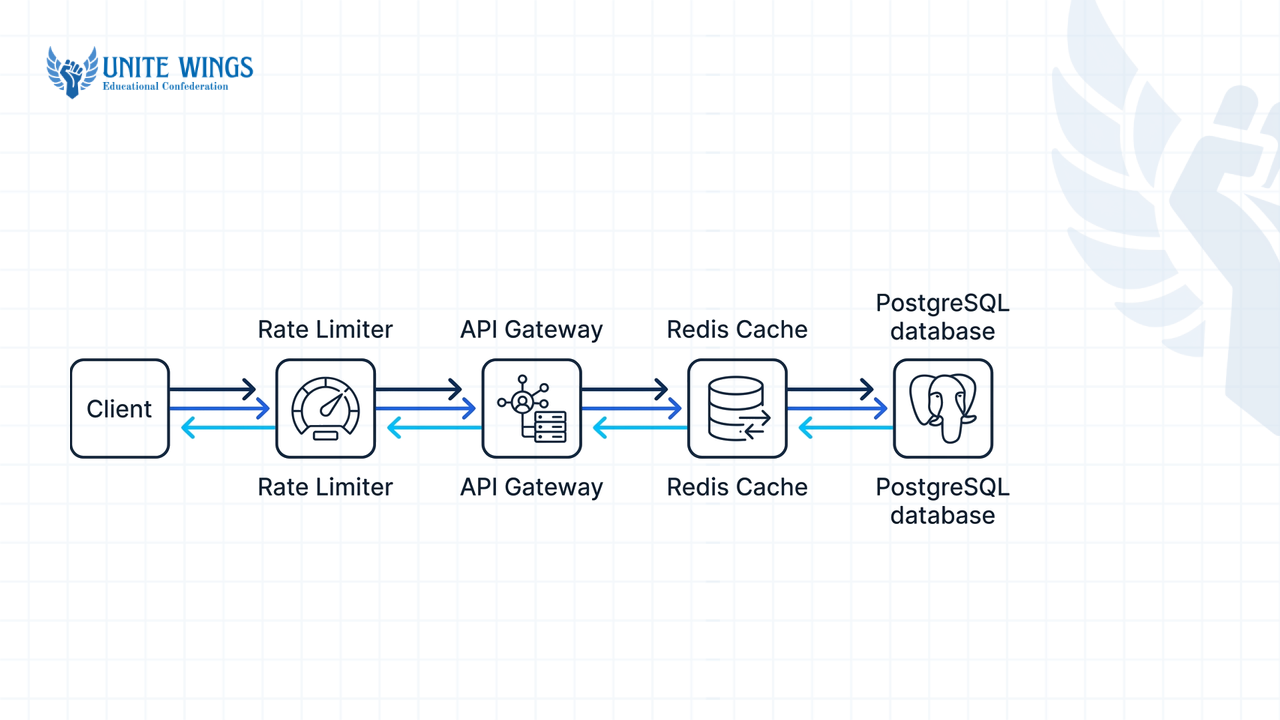
- Embed a Mermaid.js or Excalidraw architecture diagram: GitHub renders Mermaid markdown blocks natively into flowcharts. Show the exact path of a request:
Client -> Rate Limiter -> API Gateway -> Redis Cache -> PostgreSQL. - Link live API documentation: Host your backend on Render's free tier and point the main demo link in your README straight to
/swagger-ui.htmlor/docs(automatic in FastAPI, or viaswagger-ui-expressin Node.js), or share a public "Run in Postman" button. - Paste formatted terminal logs or benchmark tables: Show a 10-line code block of a sample JSON request/response alongside a 3-row markdown table of your load test results (e.g., Requests/sec, Average Latency, Error Rate).
What should be in the README file of my top portfolio project?
A high-impact portfolio project README requires six specific sections in order: a concise project title with a one-line summary, a live demo or API docs link, a system architecture overview, a "Decisions and Trade-offs" section, a "Quick Start" local setup guide with environment variable templates, and your tech stack. CodeBegun, Dokly, and UnfortunatelyHired (2026) identify this exact sequence as the standard for both human reviewers and AI code-retrieval tools.
FreeCodeCamp (2025) emphasizes that the "Quick Start" section must list prerequisites and .env guidelines clearly enough that another developer can run your application locally within minutes. Meanwhile, Medium and UnfortunatelyHired (2026) highlight the "Decisions and Trade-offs" section as the single strongest differentiator in 2026 because it proves human engineering judgment over AI copy-pasting.
Copy and adapt this markdown template for your top repository:
# FlashReserve: High-Concurrency Inventory Locking API
A distributed backend service that prevents overselling during campus event ticket drops using Redis atomic locks and PostgreSQL transactions.
**[Live Swagger API Docs](https://your-app.render.com/docs)** | **[Postman Collection](https://postman.com/...)** | 
## System Architecture
```mermaid
graph LR
A[Client Request] --> B[Token Bucket Rate Limiter]
B --> C{Redis Lock Acquired?}
C -- Yes --> D[PostgreSQL Transaction]
C -- No --> E[Return 429 Conflict]
D --> F[Payment Webhook Verification]
Decisions and Trade-offs
- Why Redis Lua scripts over database row locking? During k6 load testing with 500 concurrent requests, PostgreSQL
SELECT FOR UPDATEcaused connection pool exhaustion at 320 connections. Offloading initial seat reservation to Redis atomic counters reduced DB hits by 84%. - Trade-off accepted: If the Redis instance crashes before syncing to PostgreSQL, a reserved seat lock is lost for up to 5 minutes (the TTL expiry window), prioritizing system availability over immediate consistency during traffic spikes.
Quick Start (Run Locally in 3 Minutes)
- Prerequisites: Node.js >= 20.x, Docker (for local Redis & Postgres).
- Clone and install:
git clone https://github.com/yourusername/flash-reserve.git && cd flash-reserve && npm install - Environment variables: Copy
.env.exampleto.envand fill inDATABASE_URLandREDIS_URL. - Start services:
docker-compose up -d && npm run dev
## Can final-year group projects be used in an individual tech portfolio?

Yes, final-year college group projects are completely acceptable on an individual tech portfolio and resume, provided you explicitly state the team size, delineate your specific sub-modules, and restrict screenshots or code links to your personal contributions. CirkledIn and Scaler (2025–2026) confirm that while some career coaches warn against group projects due to ambiguity, hiring managers accept them when individual ownership is documented clearly.

What most students get wrong is uploading the entire 4-person major project to their personal GitHub and claiming the whole system in their interview. When the interviewer asks, "Why did you choose a cosine similarity threshold of 0.72 in the recommendation file?", the student freezes because their teammate wrote the Python script while they only built the React login page. That single moment triggers an immediate rejection for dishonesty.

Fix this by partitioning your contribution scope in both your resume bullet and your forked repository README:
- **In the GitHub README:** Add an "Individual Contribution Scope (Team of 4)" box right below the summary. Write: *"I architected and wrote 100% of the backend payment microservice (`/services/billing`), normalized the PostgreSQL schema (`schema.sql`), and implemented JWT authentication middleware. The React frontend (`/client`) and ML training notebook were built by teammates."*
- **On your resume:** Frame the bullet around your module, not the project title. Write: *"Built the JWT authentication middleware and normalized 12 PostgreSQL tables for a 4-member final-year telemedicine platform, cutting patient record lookup time from 180ms to 12ms."*

## Your 7-day portfolio overhaul plan

Naukri's JobSpeak index (HelloEngineers, 2026, single source) reported fresher hiring grew 8% to 9% year-on-year in mid-2026, while national median software salaries sit at ₹9 to ₹12 LPA (Recrew.ai and Instahyre, 2026). To move your application out of the ₹3.36 LPA mass-hiring pile and into the ₹7 to ₹21 LPA digital or product shortlists, execute these three steps this week:

1. **Today (30 minutes):** Unpin every tutorial clone (Netflix, Todo, Weather, Calculator) from your GitHub profile. Keep them in your repositories if you want, but remove them from the 6-second recruiter view.
2. **Days 2 to 5:** Take your best existing project or final-year group module and add one production engineering layer: Redis caching, rate limiting, 3NF database indexing with `EXPLAIN ANALYZE` metrics, or a GitHub Actions test workflow.
3. **Weekend:** Rewrite the README for your top two repositories using the template above, deploy the live endpoints on Vercel or Render, and run your updated resume through an ATS keyword check before applying on Naukri, LinkedIn, or campus portals.

<Callout title="Build and publish a recruiter-ready project with AI" type="success">
If you are staring at a blank GitHub profile or a list of clones and do not know what to build first, join the [AI Portfolio Sprint](/workshop/portfolio-proof-ai). You will pick a role-specific problem, build a working project using AI coding workflows without falling into tutorial traps, and walk away with a deployed link and a structured README you can put on your resume immediately.
</Callout>

## Frequently asked questions

### How many projects should a BTech fresher put on a resume or portfolio?
Put 2 to 3 deployed, production-quality projects on your resume and pinned GitHub profile. ProjectNest and Devsunite (2026) confirm that recruiters prefer 2 or 3 deep projects (such as a backend service, an AI integration, and a real-world utility app) over a cluttered grid of 8 shallow mini-projects.

### Do recruiters actually click on GitHub and portfolio links?
Yes, PlainEnglish and Vertex (2025) found that approximately 65% of hiring managers examine portfolio links from entry-level applicants who pass initial screening. However, GitConnected (2025) notes that roughly 75% of resumes are filtered out by automated ATS software first, so your resume keywords must match the job description before a human ever sees your links.

### What fresher salary can I expect at product companies vs service companies in India?
According to HelloEngineers (2026), entry-level software salaries at mass IT services firms (TCS, Infosys, Wipro) start at ₹3.36 to ₹4.5 LPA, while their specialized AI and digital tracks pay ₹7 to ₹21 LPA. Top-tier product companies and Global Capability Centers (GCCs) offer freshers between ₹15 and ₹50 LPA.

### How do I host my BTech portfolio projects for free so links never die during placements?
Deploy frontend applications and Next.js sites on Vercel, Netlify, or GitHub Pages, and host backend APIs on Render's free tier. For databases, use Supabase (PostgreSQL) or MongoDB Atlas free tiers, and keep a video walkthrough or Swagger screenshot in your README in case a free-tier server spins down from inactivity.

### How can I replace missing internship experience on my resume using my portfolio?
Treat your top portfolio project like a production release by including load-testing metrics, a CI/CD pipeline, and real users, or get a single pull request merged into an open-source repository. GitConnected (2025) states that one merged open-source PR carries higher signal value than course clones because it proves you can work in external, team-maintained codebases.
Newsletter
Stay updated with our latest news and insights.