12 Weekend Portfolio Projects for Freshers by Job Role (2026)
Twelve role-specific project briefs you can finish in one weekend—covering marketing, finance, HR, operations, product, and tech—using public Indian company data.
Indian recruiters screening off-campus applications on Naukri and LinkedIn reject resumes that list generic US Superstore dashboards or Netflix clones. While mass IT services companies pay ₹3.5 LPA to ₹6 LPA in 2026 (where your monthly in-hand is 70% to 85% of CTC divided by 12), product and AI roles paying ₹15 LPA to ₹21 LPA+ require portfolio projects for freshers with no experience built around Indian business problems. Pick two or three projects from the 10 weekend briefs below, build them with public Indian datasets or synthetic logs, and link the live work at the top of your resume.
In short
- Build 2 to 3 role-specific projects using Indian context (such as Blinkit dark stores, public OGD datasets, or RBI datasets) instead of Western tutorial datasets.
- Prioritise Power BI over Tableau for Indian data roles; a 2026 GrowAI analysis found over 22,000 active Indian job postings for Power BI compared to roughly 8,000 for Tableau.
- Non-technical freshers in HR and Finance must submit operational workbooks (like bank reconciliation exception sheets or attrition models) with invented data, never confidential employer templates.
- Prove you did not copy-paste from ChatGPT by maintaining an incremental Git commit history, documenting an exception log of dirty data, and recording a 60-second Loom walkthrough.
Which portfolio project fits your target fresher role?
Match your target job role on Naukri or LinkedIn to the exact artifact hiring managers open during technical rounds. If you are a non-CS student targeting business or operations roles, pick Notion, Excel, or Power BI deliverables; if you are targeting software or analytics roles, host your work on GitHub and Vercel.
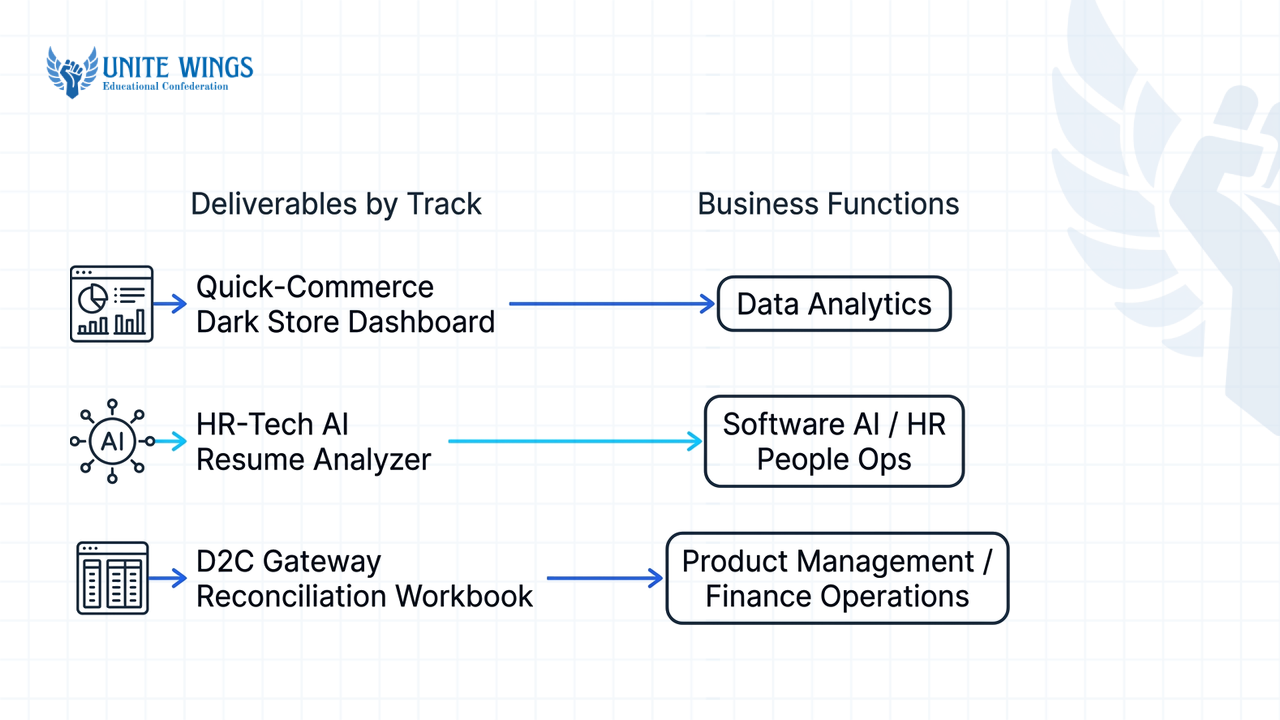
| Track | Project 1 (Weekend 1) | Project 2 (Weekend 2) | Primary Hosting Tool |
|---|---|---|---|
| Data Analytics | Quick-Commerce Dark Store Dashboard | RBI UPI Failure Rate SQL Audit | Power BI Service / GitHub |
| Software / AI | HR-Tech AI Resume Analyzer | Loan-Processing Control App | Vercel / Render / GitHub |
| Product Management | Checkout Drop-off Tear-Down | Blinkist Onboarding UX Critique | Notion / PDF Deck |
| Finance Operations | D2C Gateway Reconciliation Workbook | Mutual Fund NAV & Corporate Action Tracker | Google Sheets / Excel |
| HR & People Ops | IT Services Attrition Driver Model | Campus-to-Corporate Onboarding Tracker | Power BI / Notion |
10 weekend portfolio projects across 5 fresher tracks
You can build any of these 10 projects in 12 to 20 hours over a weekend by scoping down to a single business problem. Hiring managers at Indian startups and Global Capability Centers (GCCs)—which Aon's 2026 survey projects will lead India Inc. salary hikes at 10.4%—follow the HireXL 2026 portfolio standard: state the business problem, list your tools, show step-by-step methodology, log exceptions, and link the live output.
Track 1: Data analytics
1. Blinkit vs. Swiggy Instamart dark store expansion and AOV dashboard NextLeap's 2026 data shows Blinkit (a subsidiary of Eternal, formerly Zomato, which acquired it for ₹4,447 crores in mid-2022) leads Indian quick-commerce with 3.4 to 3.6 million daily orders, 2,150+ dark stores (up from 1,300 in 2025), and a projected Average Order Value (AOV) of ₹709 versus Swiggy Instamart's ₹619.
- Steps to build: Combine public quarterly shareholder letters from Eternal and Swiggy with pincode boundary files from
data.gov.in. Model store density against order volume and separate quantity vs. price assumptions to explain the ₹90 AOV gap. - Deliverable: A published Power BI Service dashboard (GrowAI's 2026 data shows Power BI has 22,000+ active Indian jobs vs. Tableau's ~8,000) with a dynamic city filter and a 1-page PDF executive summary.
2. RBI UPI transaction failure and reversal audit
- Steps to build: Download bank-wise UPI transaction volume and technical decline tables from the Reserve Bank of India (RBI) portal. Write SQL queries in PostgreSQL to rank remitter and beneficiary banks by technical decline percentages, isolating festival surge months.
- Deliverable: A GitHub repository containing your
.sqlquery scripts, a cleaned CSV export, and aREADME.mdtable recommending routing rules for a payment aggregator.
Track 2: Software engineering and AI
3. HR-Tech AI resume parser and JD matcher for Indian campus placements According to Naresh IT (2026), a popular fresher portfolio project for HR-tech integration is an AI Resume Analyzer built with Python, Flask, and the OpenAI API.
- Steps to build: Build a Python and Flask backend that extracts text from uploaded PDF resumes, compares skills against a pasted Naukri job description using an LLM API, and calculates a missing-keyword match score. Configure the tool to compare skills to job descriptions and suggest keyword enhancements.
- Deliverable: A live web app deployed on Render or Vercel, a GitHub repo with environment variables properly hidden, and a sample test folder containing anonymised fresher resumes.
4. Synthetic Loan-Processing Control System
- Steps to build: Build an application backend that automates loan-processing controls, validating synthetic applicant data against risk criteria. Write unit tests to handle edge cases and manually validate error handling.
- Deliverable: A deployed web app on Render or Vercel with a clean GitHub repository displaying an active, working live URL in the README. If you have no coding background, you can use the Build a Website with AI workflow to ship and debug your first live tool.
Track 3: Product management and UI/UX
5. Blinkit stockout and item substitution checkout teardown
- Steps to build: Survey real users on how they react when a quick-commerce app auto-substitutes an out-of-stock grocery item. Map the current user path in Figma, calculate the drop-off rate at the cart review screen, and design a wireframe for a "Pre-approve replacement brand" toggle.
- Deliverable: A Notion case study or PDF deck clearly labelled "Unsolicited Practice Brief" on the cover page, complete with Figma prototype links and success metrics (e.g., reducing cart abandonment by X%).
6. Blinkist onboarding UX critique
- Steps to build: Record screen captures of the user onboarding flow on Blinkist. Document user friction points, layout clarity, and drop-off risks, then write a Product Requirements Document (PRD) prioritizing fixes using the RICE (Reach, Impact, Confidence, Effort) scoring table.
- Deliverable: A public Notion PRD containing user stories, acceptance criteria, and edge-case tables (such as handling partial registration drop-offs).
Track 4: Finance operations and business analysis
7. Indian D2C Gateway-to-bank reconciliation and exception workbook Centaur Careers (2026) and Skarion (2026) state that finance operations portfolios must use synthetic data to demonstrate reconciliation, consistent units, and exception controls.
- Steps to build: Generate 500 rows of fictional orders for an Indian D2C skincare brand in Python or Excel, mixing prepaid UPI orders with transaction fees and Cash on Delivery (COD) orders with estimated Return to Origin (RTO) rates. Reconcile the order log against a simulated bank statement and isolate mismatched settlements.
- Deliverable: A multi-tab Excel or Google Sheets workbook featuring a summary pivot table, separated price and quantity variance tabs, and an "Exception Ledger" flagging 12 deliberate settlement discrepancies for the finance team to resolve.
8. Mutual fund NAV calculation and corporate action tracker
- Steps to build: Pull 30 days of historical closing prices for 10 Nifty 50 stocks from the National Stock Exchange (NSE) website to simulate a simplified equity fund. Build a daily Net Asset Value (NAV) calculator in Excel that adjusts share quantities and cash balances for simulated bonus issues, dividend payouts, and expense ratios.
- Deliverable: A locked-formula spreadsheet workbook with a documented audit trail tab explaining how each corporate action altered the per-unit NAV.
Track 5: HR analytics and people operations
9. Indian IT services fresher attrition and overtime risk model Jobaaj Learnings (2026) identifies analyzing employee attrition drivers, overtime impact, salary bands, tenure, and promotion delays as the primary way to prove HR analytics competency.
- Steps to build: Use a synthetic dataset representing an Indian IT services company (where HyrEzy's September 2026 snapshot shows a median CTC of ₹5 LPA for 0–2 years of experience, with the middle half earning ₹3.7–8.4 LPA). Run a logistic regression or pivot analysis correlating bench time, night-shift overtime hours, and commute distance against resignation rates.
- Deliverable: A Power BI dashboard and a 2-page HR policy memo proposing targeted retention interventions for high-risk salary bands.
10. Campus-to-corporate 90-day onboarding and BGV tracker
- Steps to build: Map the operational workflow for onboarding freshers from Letter of Intent (LOI) to confirmation. Build an automated Google Sheets tracker with conditional formatting that flags missing documentation, pending verification checks, and overdue onboarding tasks.
- Deliverable: A shareable Google Sheets template and a Notion Standard Operating Procedure (SOP) doc detailing escalation emails when a candidate fails to submit required onboarding documents.
What counts as a portfolio project for non-creative roles like HR or Finance?
For non-creative roles like HR and Finance, a portfolio project is an operational workbook, an exception ledger, or a policy workflow built with 100% synthetic data. According to Centaur Careers (2026) and Hirefly (2026), hiring managers look for bank reconciliation sheets, KYC/AML review logs, 3-statement financial models, and employee onboarding checklists rather than visual design decks.
What most students get wrong is submitting college theory essays or uploading actual spreadsheets from a past internship. Centaur Careers (2026) warns that using confidential employer files, real customer account numbers, or proprietary corporate templates will get you disqualified for breaching data privacy. Fix this by inventing every name, date, and transaction ID, and adding an "Exception Log" tab. Top results on Google tell you to show a clean final dashboard, but Indian interviewers in finance and operations look for your exception log: the sheet where you documented duplicate invoices, negative inventory numbers, or unmapped employee IDs and wrote the business rule to fix them.
Can I do an unsolicited audit of an Indian brand like Zomato or Blinkit?
Yes, unsolicited product audits, UX critiques, and business teardowns of Indian consumer apps like Zomato and Blinkit are widely accepted portfolio artifacts in 2026, provided you label them as practice briefs. NextLeap and Medium analyses from 2023–2026 confirm that hiring managers value these breakdowns when they evaluate public metrics like drop-off rates or store expansion.
To stay within legal and ethical boundaries, never put the company's logo on your cover slide in a way that implies they hired you, and never scrape private user data. Base your numbers on public disclosures: for example, cite Eternal's quarterly reports showing Blinkit's expansion from 1,300 to 2,150+ dark stores or its ₹709 projected AOV. Back up your UX critique by running a 20-person Google Forms survey of real users in your college hostel and linking the raw anonymised responses in your Notion doc.
Where can I find real Indian datasets to build a fresher project?
You can download free, verified Indian datasets from the Open Government Data (OGD) Platform India (data.gov.in), AI Kosh (aikosh.indiaai.gov.in), the Reserve Bank of India (RBI), the National Stock Exchange (NSE), the Census of India (censusindia.gov.in), and MoSPI NSSO/PLFS reports (mospi.gov.in). These sources replace overused Western Kaggle datasets with Indian demographic and financial metrics.
According to Roorkee College of Smart Computing (2026), data.gov.in is maintained by the National Informatics Centre (NIC) under the National Data Sharing and Accessibility Policy (NDSAP) explicitly for educational, research, and non-commercial use. You can register for a free API key on data.gov.in, download pre-packaged machine learning datasets with structured data cards from AI Kosh under the India AI Mission, or pull record-level JSON dumps from the OGD mirror on Hugging Face (2026). For socioeconomic projects, use the India Data Project (indiandataproject.org).
How long should a fresher portfolio project take from start to finish?
A single application-tier portfolio project takes 1 to 4 weeks, or roughly 12 to 20 structured hours spread across 2 to 3 weekend days. While TaskVeda and Vertex AI (2026) recommend a 30-day build plan to ship three weekend projects, JobsByCulture (2026) notes that a deep foundation project can take 4 to 8 weeks.
Follow the JobsByCulture (2026) 3-project portfolio structure: 1 foundation project (deep system or data architecture), 1 application project (real-world tool or SaaS), and 1 community contribution. If you are balancing final-year exams, use the weekly batching rhythm recommended by Lauren M. on Medium (2026): split 3 to 5 hours a week into a 45-minute Friday planning session, a 3-hour Saturday build block, and a 1-hour Sunday documentation session.
How do I prove I didn't just copy-paste my project from ChatGPT?
Prove your project is original by maintaining an incremental Git commit history, recording a 60-second Loom video walkthrough of your logic, and stripping out unedited LLM hallmarks. According to GitConnected (2026) and ClarityHire (2026), technical evaluators now use code-coherence tools that inspect type-test-refactor timelines and paste logs to catch raw AI-generated submissions.
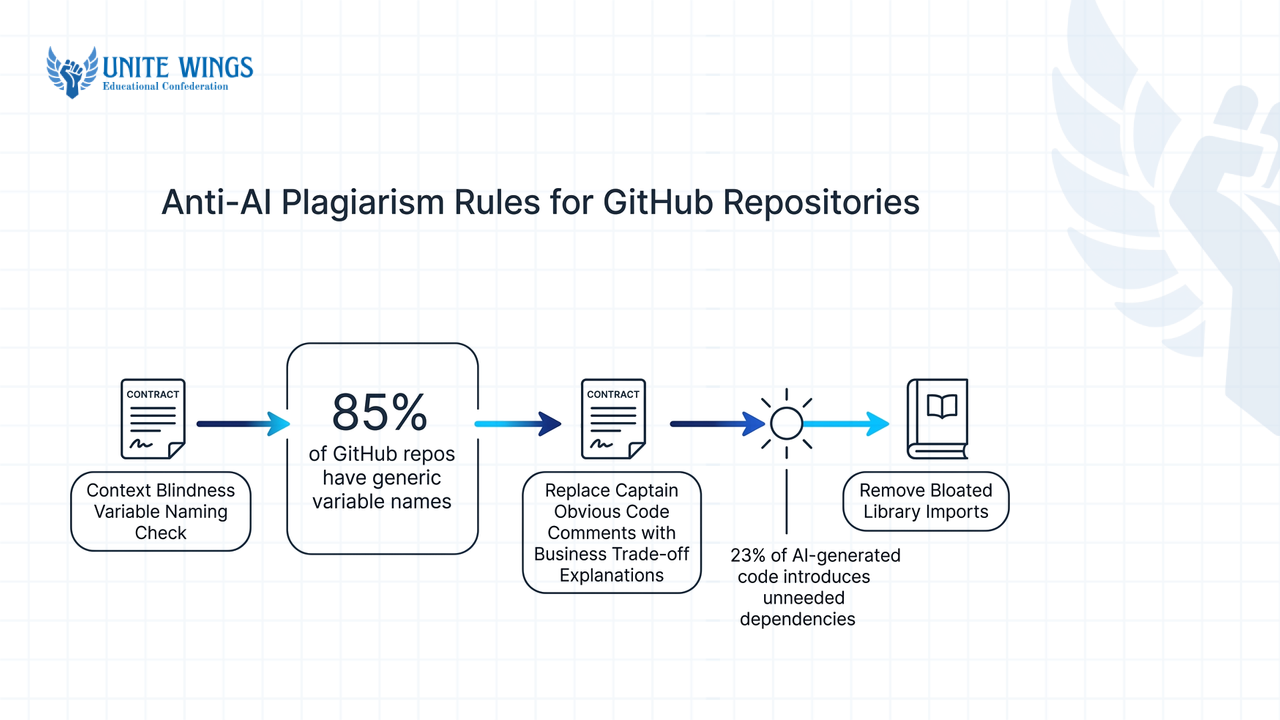
Dice's 2025 ethical engineering guidelines advise treating AI as a draft partner while modifying logic and validating edge cases manually. Before you push to GitHub, check your repository against the three AI giveaways identified by GitConnected (2026):
- Context blindness: Standardise your variable names so you do not mix
snake_casefrom a pasted ChatGPT snippet inside acamelCaserepository. - "Captain Obvious" comments: Delete AI comments that explain what a line does (
# loop through array) and replace them with comments explaining why you made a business trade-off (# cap COD orders at ₹5,000 to match D2C fraud rules). - Bloated imports: Remove heavy library imports when a native Python or JavaScript function solves the problem.
Embed a 60-second Loom link at the top of your README.md or Notion page where you show your screen, change one filter or input live, and explain how your code or sheet handles an unexpected error.
Your 30-day portfolio action plan
Naukri's JobSpeak index recorded fresher hiring (0–3 years experience) rising between 7% and 17% year-on-year from February to May 2026. To convert that hiring volume into interviews before your next semester ends, execute this schedule:
- This weekend: Pick 1 project from the table above that matches your target job title, download the dataset from
data.gov.inor generate your synthetic CSV, and write your 1-paragraph business problem statement. - Week 2: Build the core artifact (Power BI dashboard, deployed Vercel app, or Excel reconciliation workbook) and log the data exceptions you cleaned.
- Week 3: Format the case study using the Problem-Process-Impact structure, record your 60-second Loom walkthrough, and place the live URL on your resume and LinkedIn Featured section.
Build and publish with the AI Portfolio Sprint
If you want structured guidance to ship your first project without getting stuck on setup, join the AI Portfolio Sprint. You will pick a role-specific brief, build and verify the project using AI ethically as your assistant, and walk away with a published case study link ready for recruiters.
Frequently asked questions
What counts as a portfolio project for non-creative roles like HR or Finance?
Operational workbooks built with synthetic data count as portfolio proof for HR and Finance freshers. Centaur Careers (2026) and Hirefly (2026) recommend building bank reconciliation exception sheets, 3-statement financial models, simplified fund NAV trackers, employee attrition models, or 90-day onboarding trackers using invented names and numbers to protect data privacy.
Can I do an unsolicited audit of an Indian brand like Zomato or Blinkit?
Yes, unsolicited UX critiques, product breakdowns, and business audits of Indian brands like Zomato and Blinkit are widely accepted for product, design, and business roles. You must clearly label the project as an "Unsolicited Practice Brief," use only public data (like quarterly reports or user surveys), and never claim an official client relationship.
Where can I find real Indian datasets to build a fresher project?
You can access free, verified Indian datasets on the Open Government Data Platform (data.gov.in), AI Kosh (aikosh.indiaai.gov.in), the Reserve Bank of India (RBI), the National Stock Exchange (NSE), Census of India (censusindia.gov.in), MoSPI (mospi.gov.in), and the India Data Project (indiandataproject.org). Always cite the portal and document your data-cleaning steps.
How long should a fresher portfolio project take from start to finish?
A single weekend or application-tier portfolio project takes 12 to 20 structured hours spread over 2 to 3 days, or 1 to 4 weeks if working part-time alongside college classes. A complete fresher portfolio of 3 deployed projects can be shipped within a 30-day build plan by batching 3 to 5 hours every weekend.
How do I prove I didn't just copy-paste my project from ChatGPT?
Prove originality by pushing incremental Git commits over several days instead of one massive upload, recording a 60-second Loom video explaining your architecture live, and removing AI giveaways like mismatched snake_case and camelCase variables. Documenting specific data errors you fixed manually also proves human ownership during technical interviews.
How many projects should a fresher include in a job portfolio?
Include 2 to 3 deeply documented, role-specific projects with live working links rather than 10 superficial tutorial clones. Following the JobsByCulture (2026) framework, combine 1 foundation project (deep system or data architecture), 1 application project (real-world tool or SaaS), and 1 community contribution.
Newsletter
Stay updated with our latest news and insights.